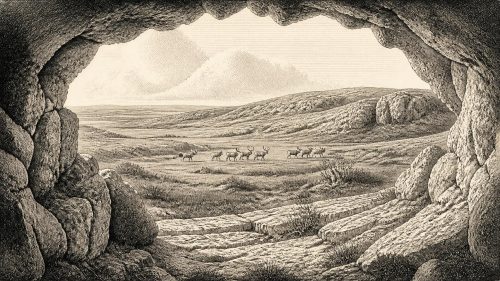
Castlepook Reindeer Toolmarks31964 BCE
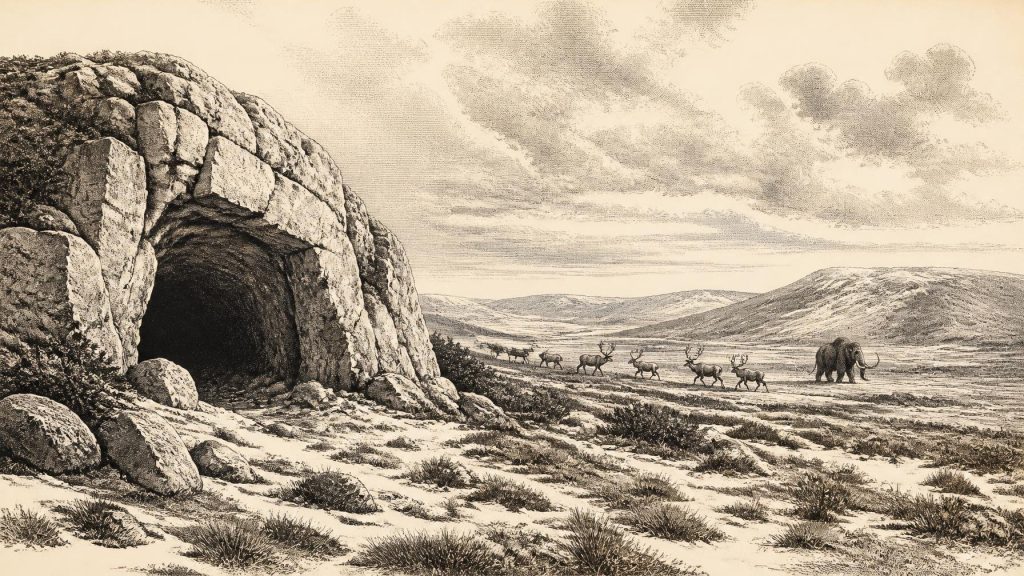
Around 31,964 BCE, Ireland lay on Europe’s north-western fringe during Marine Isotope Stage 3, before the Last Glacial Maximum. Castlepook Cave in County Cork preserved remains of mammoth, reindeer, giant deer, bear and hyaena, demonstrating intermittent Late Pleistocene ecological connections despite uncertain routes across changing seas and ice. A reindeer femur reportedly dated about 31,000 BCE bears marks potentially made by stone tools, suggesting human carcass processing. However, mixed cave deposits and absent associated artefacts prevent confirmation. Open steppe-tundra supported diverse fauna, but advancing ice later erased evidence. The human presence remains unproven, while climate and shifting coastlines governed survival.
Dateline
“31,964 BCE” is a useful modern label, not a date that people living in prehistoric Ireland could have recognised. It corresponds only approximately to 33,900 years before the conventional radiocarbon baseline of 1950. At such depth in time, archaeology cannot identify a particular year, season, event or individual. The responsible frame is a broad one: Ireland in the later part of Marine Isotope Stage 3, before the fullest extent of the last ice sheet. Evidence consists chiefly of cave animal remains, their scientific dates, sedimentary records and the changing shape of the surrounding seas and ice. It offers a vivid but fragmentary glimpse of an Ice Age island, not an annual chronicle.
An Island at the Edge of Europe
At around this point in the deep past, Ireland lay at the north-western edge of the European world inhabited by Upper Palaeolithic hunter-gatherers. It was not yet the fully ice-covered landscape associated with the peak of the Last Glacial Maximum, conventionally dated in global terms to about 26,500–19,000 years ago. The last Irish ice sheet expanded and reorganised over a long period, and its extent differed from region to region. Later glacier movement also eroded, buried and dispersed earlier deposits. This is one reason why the Irish record for the period is so much thinner than that of France, Iberia, southern Britain or central Europe.
Lower global sea levels altered coastlines and shallow seas, but they do not licence a simple picture of a permanent dry land bridge from Ireland to Britain or continental Europe. The position of the shoreline, local land uplift and depression beneath ice, marine channels, sea ice and glacier margins changed repeatedly. Mammals did reach Ireland during parts of the Late Pleistocene, demonstrating some form of ecological connectivity with Britain and the wider European landmass. How any individual animal or person crossed, and whether particular passages were open at any given moment, remains uncertain. Ireland was accessible at intervals, but it was also a marginal and challenging destination.
What Castlepook Can Tell Us
The most relevant place is Castlepook Cave near Doneraile in north County Cork, historically known as Mammoth Cave because of its rich fossil assemblage. Material from the cave has produced evidence for an Ice Age fauna that included woolly mammoth, reindeer, giant deer, brown bear and spotted hyaena. Older excavations, however, recovered many bones without the standards of modern stratigraphic recording. Cave deposits can also be mixed by water, sediment movement, carnivore activity and later digging. A bone from the cave can establish that an animal lived or died within a broad period; it does not necessarily preserve the exact place where the animal was killed, eaten or carried underground.
Radiocarbon programmes and improved pretreatment have shown that some southern Irish cave fauna belongs to the pre-Last Glacial Maximum part of the Late Pleistocene. Earlier conventional radiocarbon determinations from Castlepook were revised as methods improved, a reminder that deep-time chronologies require continuing scrutiny. Scholarship therefore uses calibrated ranges, rather than treating an uncalibrated laboratory age as a calendar date. For Ireland around 34,000 calibrated years before present, the secure conclusion is that sizeable mammals had occupied the island during this broad climatic phase; their local populations may have appeared, retreated or vanished as habitats and access routes changed.
A reindeer femur from Castlepook has particular public importance. It has been reported as dating to about 31,000 BCE and as bearing deep marks interpreted by Ruth Carden as consistent with cutting or chopping by a stone tool. If that interpretation is confirmed, it would be evidence that people processed a reindeer in Ireland far earlier than the formerly accepted late-glacial evidence for human activity. It is an arresting possibility, and it makes Castlepook directly relevant to this date. Yet the claim must be stated at its proper scale. The bone is not a securely excavated occupation surface, and no associated stone-tool assemblage, hearth, dwelling, burial or human remains of comparable antiquity has been recovered there.
A Faunal Landscape, Not a Settled Country
The animal record allows a cautious reconstruction of the kind of environment available in parts of Ireland. Reindeer, mammoth and giant deer point towards open, cold-climate habitats rather than the dense broadleaf woodland familiar from later prehistoric Ireland. A mosaic of grassland, herb-rich steppe-tundra, sparse scrub and sheltered valleys is more plausible than a single uniform landscape. Seasonal conditions, soils, altitude and proximity to ice would have produced strong regional variation. The cave fauna also indicates a food web with predators and scavengers: spotted hyaenas could transport and gnaw bones into their dens, while wolves and brown bears belonged to the wider Pleistocene ecological setting.
These fossils do not prove that every species lived together at Castlepook in 31,964 BCE, nor do they measure herd sizes. They reveal a long-lived and changing record accumulated over millennia. It would be equally misleading to imagine modern Irish pasture, bog and hedgerow transplanted into this time. The island’s later green, wooded appearance was the product of post-glacial warming, soil development and, much later, farming. Here the dominant historical force was climate: repeated cold phases, expanding ice and shifting coastlines set the limits within which plants, animals and any visiting people could survive.
People: A Fleeting Possibility
If the Castlepook marks were made by humans soon after the reindeer died, the likely actors were a very small, mobile Upper Palaeolithic foraging party, not a settled population. Reindeer offered meat, marrow, fat, hide, sinew, antler and bone, making a carcass a valuable resource. A single butchered limb bone could represent one episode of carcass processing after a hunt, scavenging event or journey across a difficult landscape. It cannot show whether the people camped nearby, how long they stayed, which route they used or whether they returned.
Nothing presently justifies naming an Irish tribe, language, leader or cultural group for this date. The people potentially represented at Castlepook should not be called “Irish” in the later ethnic, linguistic or national sense. Nor can Irish evidence tell us their clothing, family structures, gender roles or social hierarchy. Upper Palaeolithic communities elsewhere in Europe made sophisticated stone tools, ornaments, images and ritual deposits, but those discoveries cannot simply be imported into Ireland. They provide a continental context for what humans were capable of; they are not proof of equivalent practices on this island.
No Politics, No Diplomacy, No Written Memory
Political history cannot responsibly be written for Ireland in this period. There is no evidence for kingship, territorial states, named communities, law, diplomacy, organised warfare or alliances. Nor are there grounds to infer trade networks. A group moving through the Irish landscape might have carried portable stone tools or raw materials, but no Irish assemblage of this age demonstrates exchange, ownership systems or regular long-distance commerce. Economy, in the limited sense available here, means subsistence: the possible use of animal carcasses and the practical challenge of obtaining food, warmth and shelter in a volatile climate.
Religion, learning and culture are similarly beyond direct recovery. No Irish monument, grave, painted cave, engraved object, musical instrument or formal ritual site can be assigned to around 31,964 BCE. Caves later became important places in many Irish prehistoric traditions, but Castlepook must not be given a ceremonial role merely because it is a cave. Its demonstrated importance at this age is palaeontological. The absence of material evidence is not proof that people had no beliefs, stories or knowledge of the landscape; it means that archaeology cannot describe them here.
Approaching the Glacial Maximum
The longer-term development matters more than any imagined event in this nominal year. In the millennia after this period, worsening cold and the growth of the British-Irish Ice Sheet transformed much of Ireland. At its later maximum, ice extended across broad areas of the island and onto adjacent continental shelves. Some uplands may have supported cold-based ice or stood above erosive ice as nunataks, while fast-flowing outlets carried ice towards the Irish Sea and Atlantic margins. Glacial erosion removed or disturbed many earlier terrestrial surfaces, helping to explain why evidence for people before the final deglaciation is exceptionally rare.
Thus Ireland around 31,964 BCE should be understood as a place of ecological opportunity but profound instability. Mammals had reached it, and a reported reindeer bone raises the possibility that humans did too. The strongest evidence concerns Ice Age fauna and environmental change; the human story remains a question rather than a settled narrative. Far from being an empty prelude to later history, this was a formative landscape in which ice, sea, animals and intermittent connections to Europe determined what could happen next.
Primary Sources
- Prehistoric Details
- Heritage Artefacts of County Cork
- The Irish Quaternary Fauna Project
- A Reconsideration of the Radiocarbon Dating of the Marine Isotope Stage 3 Fauna from Southern Ireland
- Phylogeographic, Ancient DNA, Fossil and Morphometric Analyses Reveal Ancient and Modern Introductions of a Large Mammal: The Complex Case of Red Deer (Cervus elaphus) in Ireland
- Could Brown Bears (Ursus arctos) Have Survived in Ireland During the Last Glacial Maximum?
- Dimensions and Chronology of the Last Ice Sheet in Western Ireland
- Trimlines, Blockfields and the Vertical Extent of the Last Ice Sheet in Southern Ireland
- Late Pleistocene Chronostratigraphy and Ice Sheet Limits, Southern Ireland
- Early Deglaciation of the British-Irish Ice Sheet on the Atlantic Shelf Northwest of Ireland Driven by Glacioisostatic Depression and High Relative Sea Level
- Maximum Extent and Dynamic Behaviour of the Last British-Irish Ice Sheet West of Ireland
- Oscillating Retreat of the Last British-Irish Ice Sheet on the Continental Shelf Offshore Galway Bay, Western Ireland
- The Deglaciation of the Western Sector of the Irish Ice Sheet from the Inner Continental Shelf to its Terrestrial Margin
- Stratigraphic and Palaeo-Geomorphological Evidence for the Glacial-Deglacial History of the Last British-Irish Ice Sheet in the North-Western Irish Sea
- The Last Glacial Maximum
- The IntCal20 Northern Hemisphere Radiocarbon Age Calibration Curve (0–55 cal kBP)
- A Stratigraphic Framework for Abrupt Climatic Changes During the Last Glacial Period Based on Three Synchronized Greenland Ice-Core Records: Refining and Extending the INTIMATE Event Stratigraphy
- New Insights on the Fauna of Ireland's Younger Dryas and Early Holocene from Alice & Gwendoline Cave
- 2022:564 – Castlepook Cave, Castlepook South, Cork
- Sedimentary Ancient DNA Reveals Late Pleistocene Faunal Connectivity Between Ireland and Eurasia