Derryvree Interstadial Deposits31963 BCE
Approximately 34,000 calendar years ago, Ireland lay in the unstable later Marine Isotope Stage 3, before the Last Glacial Maximum. Derryvree and Greenagho deposits show intervals without overriding ice in north-central Ireland, although conditions varied regionally. Periglacial terrain, local or expanding glaciers, lower sea levels and episodic milder phases shaped the landscape. Cave faunas document mammoth, giant deer, reindeer, horse, predators and other animals, indicating open, shifting habitats and links with north-west Europe. No secure evidence demonstrates people in Ireland then; the earliest accepted sign of human activity is much later, from butchered bear bone dated about 12,700 cal BP.
Dateline
“31,963 BCE” is a modern way of labelling a point so remote that it cannot be treated as a dated year in the historical sense. It corresponds only approximately to 33,900 calibrated years before AD 1950 (cal BP). Neither an Irish written record nor an archaeological sequence can identify an event, a person, a season, or even a securely bounded generation at this point. The responsible subject is therefore not an imagined community in a named year, but Ireland in the later part of Marine Isotope Stage 3: a cold, unstable phase of the Late Pleistocene, before the Last Glacial Maximum reached its full intensity.
Dating an Uncertain Moment
At this depth of time, dates are expressed as ranges because radiocarbon measurements need calibration and because deposits are not clocks with annual resolution. The International Calibration Curve defines “BP” as before AD 1950 and shows why conventional radiocarbon ages must be converted into calendar-age ranges rather than simply translated into BCE dates. The date 31,963 BCE should consequently be read as “around 34,000 calendar years ago”, not as 1 January of a prehistoric year.
That distinction matters especially in Ireland. Organic deposits beneath later glacial sediments at Derryvree and Greenagho, County Fermanagh, provide evidence for intervals without overriding ice in north-central Ireland. Their calibrated ranges include c. 36.9–31.7 thousand and c. 37.2–35.7 thousand years ago respectively. They do not describe the entire island at one instant, but they show that the last major Irish ice sheet did not simply cover Ireland continuously throughout this earlier period.
A Changing Ice-Age Landscape
Ireland lay within the North Atlantic climatic system, where abrupt shifts in temperature, precipitation, sea ice and glacier growth repeatedly changed the character of the land. The island was not yet in the fully developed Last Glacial Maximum familiar from popular images of an ice-smothered Ireland. Recent ice-sheet synthesis reconstructs the growth and retreat of the British–Irish Ice Sheet from 31,000 to 15,000 years ago, while other evidence indicates that much of the Irish ice mass expanded from comparatively limited cover after about 34,000 years ago and reached the southern coast only much later.
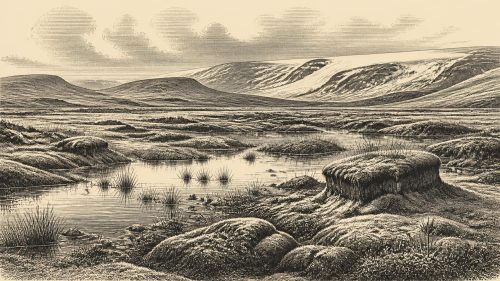
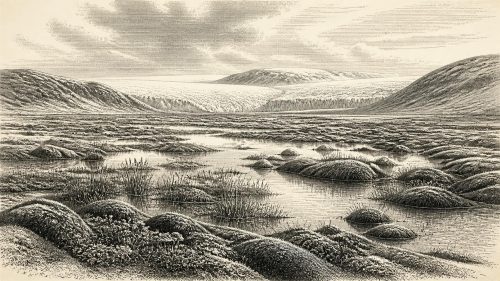
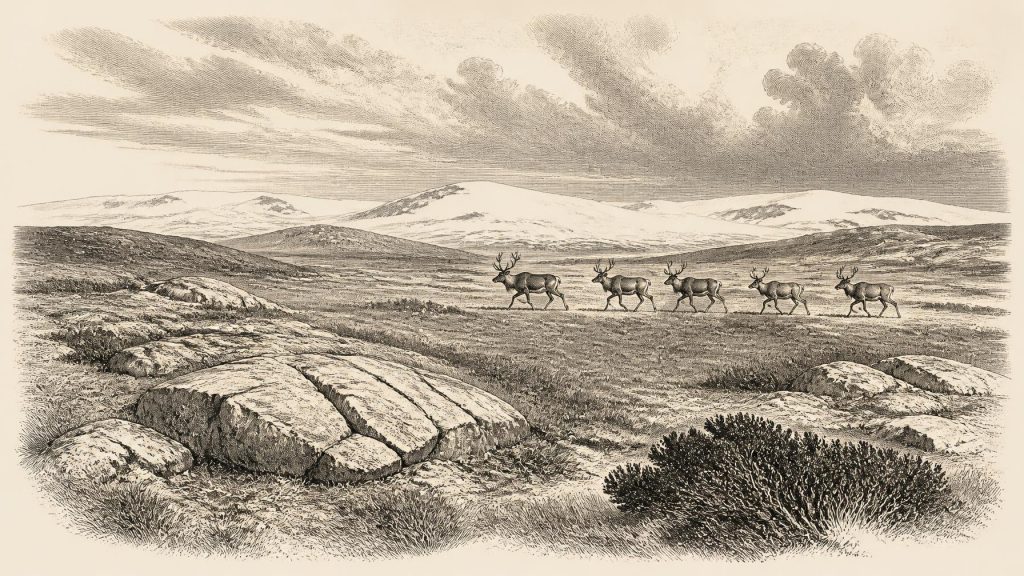
For around 31,963 BCE, therefore, the most defensible picture is not a single neat ice margin. Parts of Ireland may have supported periglacial landscapes: seasonally frozen ground, sparse vegetation, exposed rock and sediment, and strong cold-weather processes. Other areas may have been affected by local or expanding ice. In south-west Ireland, uranium-series dating of stalagmites in Crag Cave records episodic cave formation during milder Greenland Interstadials, indicating that conditions could become sufficiently temperate and unfrozen for water to percolate through limestone. Such evidence captures regional environmental change over millennia, rather than proving the weather in a particular year.
Sea level was far lower than it is today because immense volumes of water were locked in global ice sheets. Yet lower seas do not permit a simple claim that Ireland was definitely joined to Britain or the European mainland at this exact point. Coastlines, river courses, ice lobes and shallow seas altered repeatedly. The routes available to animals—and potentially to people—must be inferred from changing palaeogeography, not assumed from a modern map.
Animals, Caves and Fossil Evidence
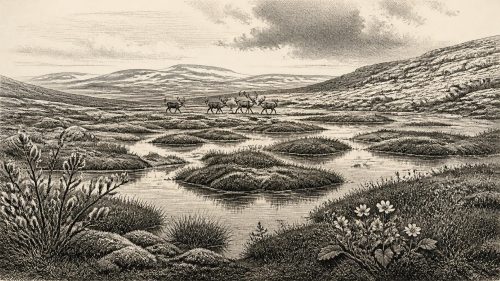
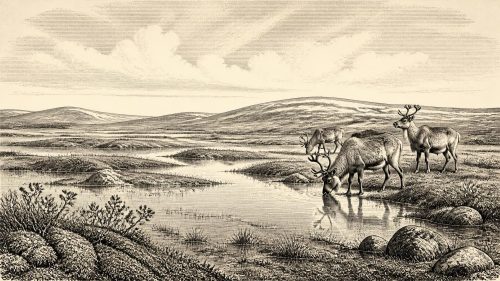
The strongest direct evidence for Ireland at this timescale is palaeontological. Cave collections, particularly in the south and west, show that a varied Pleistocene mammal fauna entered Ireland during the long interval from at least about 45,000 to 20,000 years ago. The documented pre-Last Glacial Maximum fauna includes woolly mammoth, giant deer, reindeer, horse, brown bear, wolf, Arctic fox, mountain hare, lemmings and spotted hyaena. These species should not be imagined as a fixed list occupying every county simultaneously: their ranges shifted with climate, vegetation and access routes.
Castlepook Cave near Doneraile, County Cork, is particularly important because it preserves pre- and post-Last Glacial Maximum faunal material. Improved pretreatment and redating have revised some older results substantially, suggesting that giant deer and spotted hyaena there may have disappeared locally before the Last Glacial Maximum, around 40,000 cal BP. This is a useful warning against turning a fossil assemblage into a snapshot of 31,963 BCE. It does, however, establish a wider ecological world in which large herbivores, predators and scavengers could inhabit parts of Ice-Age Ireland during favourable intervals.
Such fauna implies open or broken habitats rather than the dense temperate woodland that would cover much of Ireland in later millennia. Grazing animals and their predators depended on mosaics of grassland, herb-rich ground, scrub and sheltered terrain. The exact balance of plants is difficult to recover, and fossil finds are concentrated in caves rather than evenly distributed across the landscape. Nevertheless, the evidence decisively corrects any assumption that prehistoric Ireland was always an ecological backwater: it was periodically part of a broader north-west European zone of animal movement.
People: No Demonstrated Community
There is no securely demonstrated settlement, hearth, tool-making floor, burial, dwelling or human bone from Ireland around 31,963 BCE. It is therefore not responsible to describe an Irish tribe, language, leader, family system, hunting camp or migration in this year. Nor can archaeologists identify political affairs, diplomacy, organised conflict, trade networks or religion in Ireland at this date. Those are not merely unknown details; the evidence needed to establish that people were present at all has not been recovered.
The currently published direct indication of Upper Palaeolithic human activity in Ireland is vastly later. A brown-bear kneecap from Alice and Gwendoline Cave, County Clare, bears cut marks interpreted as stone-tool butchery and has been independently dated to c. 12,810–12,590 cal BP, equivalent to roughly 10,860–10,640 BCE. That evidence is important, but it cannot be projected backwards more than twenty millennia to populate Ireland in 31,963 BCE.
Older claims and suggestive finds demand particular caution. The National Museum of Ireland notes that the Mell flint flake in County Louth was made elsewhere and later transported by ice, rather than showing an early Irish occupation. Cave deposits also pose formidable problems: nineteenth- and early twentieth-century excavations often disturbed layers, and burrowing animals, erosion and later human use can mix material of widely different ages. Re-examination, direct dating of individual bones, microscopy of surface marks and careful reconstruction of old excavation records are therefore central to the modern study of Ireland’s deep past.
What Regional Comparison Can—and Cannot—Add
Across continental Europe, Homo sapiens communities of the Upper Palaeolithic produced sophisticated stone and organic tools, ornaments, images and long-distance social connections. In Britain, archaeological evidence confirms human presence in periods that demonstrate northern environments could be occupied when climate and resources allowed. But regional comparison is context, not proof. There are no Irish artefacts of Gravettian age, no Irish cave art securely dated to around 34,000 years ago, and no basis for attaching a continental archaeological culture to Ireland itself.
If people ever made short visits to Ireland during this phase, they left no accepted material trace from which their economy or beliefs can be reconstructed. If none came, the animal record still matters: the island’s ecology was being shaped by the same climatic fluctuations, lowered sea levels and changing passages that conditioned human movement elsewhere. Either possibility underscores a central feature of the period—Ireland’s future human history was being prepared environmentally long before durable settlement can be demonstrated.
The Long View
The later Last Glacial Maximum would transform the island more drastically. At its greatest extent, the British–Irish Ice Sheet covered most of Ireland and adjacent shelves, eroding, burying and rearranging older landscapes. This geological destruction helps explain why evidence for earlier people is so scarce, but absence of evidence is not positive proof that no individual ever arrived. It does mean that sustained occupation at 31,963 BCE remains unproven.
For Ireland around this nominal year, the history is thus one of climate, ice, land and animals rather than kingdoms or named ancestors. The best-supported conclusion is modest but compelling: parts of the island lay in a severe, rapidly changing Ice-Age environment, still capable at intervals of supporting distinctive Pleistocene fauna, while the evidence does not yet justify placing a known human community there.
Primary Sources
- Trimlines, blockfields and the vertical extent of the last ice sheet in southern Ireland
- Growth and retreat of the last British–Irish Ice Sheet, 31,000 to 15,000 years ago: the BRITICE-CHRONO reconstruction
- Pattern and timing of retreat of the last British-Irish Ice Sheet
- The last Eurasian ice sheets – a chronological database and time-slice reconstruction, DATED-1
- Episodic speleothem deposition tracks the terrestrial impact of millennial-scale last glacial climate variability in SW Ireland
- Spatio-temporal dynamics of speleothem growth and glaciation in the British Isles
- A reconsideration of the radiocarbon dating of the Marine Isotope Stage 3 fauna from southern Ireland
- The Irish Quaternary Fauna Project
- First evidence of a Late Upper Palaeolithic human presence in Ireland
- New insights on the fauna of Ireland's Younger Dryas and Early Holocene from Alice & Gwendoline Cave
- The colonization of Ireland: A human ecology perspective
- Revisiting Alice and Gwendoline Cave, Co. Clare: new light on the 1902 excavations
- Prehistoric Details
- The Mesolithic in Ireland: when was it?
- Ireland through geological time
- The IntCal20 Northern Hemisphere Radiocarbon Age Calibration Curve (0–55 cal kBP)
- The early prehistory in the west of Ireland: Investigations into the social archaeology of the Mesolithic, west of the Shannon, Ireland
- The early prehistory in the west of Ireland: Investigations into the social archaeology of the Mesolithic, west of the Shannon, Ireland
- Anthropogenic changes to the Holocene nitrogen cycle in Ireland
- Could brown bears (Ursus arctos) have survived in Ireland during the Last Glacial Maximum?
- Dual ancestries and ecologies of the Late Glacial Palaeolithic in Britain
- Ice Age Ireland