Doneraile’s Reindeer Threshold31870 BCE
The label 31,870 BCE denotes an approximate Late Pleistocene, Marine Isotope Stage 3 horizon, not a datable Irish year. Ireland experienced cold, periglacial conditions and growing ice, with open tundra-like landscapes and changing routes to Britain and Europe. Castlepook Cave near Doneraile preserves fauna including reindeer, mammoth, giant deer, hyaena, wolves and bears, accumulated over separate episodes. A reindeer femur, possibly cut by a stone tool about 33,000 years ago, may indicate brief Upper Palaeolithic human activity. However, disturbed cave deposits and limited evidence preclude claims of settlement, society or continuous occupation. Climate, ice and faunal movement dominate the record.

Dateline
31,870 BCE is not a date that can be matched to an Irish event, ruler, season or generation. It is a modern retrospective calendar label, roughly equivalent to 33,800 years before AD 1950, the conventional reference point behind archaeological “BP” dating. At this depth of time, radiocarbon results require calibration and carry statistical ranges; they cannot responsibly identify a single calendar year in Ireland. The most useful frame is therefore the later part of Marine Isotope Stage 3 (MIS 3), within the Late Pleistocene, and a broad period around 34,000 calibrated years ago.
For Ireland, this is an especially important but elusive horizon. It falls long before writing, farming, monuments, named peoples or any evidence for political institutions. What can be investigated is a changing Ice Age landscape, the animals that occupied it, cave deposits which preserved their bones, and one much-discussed indication that people may have reached the island far earlier than was once thought. The evidence is significant precisely because it is so slight: it offers a possible threshold of human activity, not a settled prehistoric society.
A Date Range, Not a Recorded Year
Radiocarbon ages are not calendar ages. They measure the remaining carbon-14 in organic material and must be calibrated against records of changing atmospheric carbon. For dates this old, calibration commonly produces wide ranges rather than a neat conversion. The designation 31,870 BCE should consequently be read as an approximate point within a larger climatic and archaeological interval, not as an anniversary. It is safer to say that Ireland around this time lay in MIS 3, during the long and uneven approach towards the Last Glacial Maximum.
This distinction matters because Irish evidence is discontinuous. A bone can date the death of an animal, but not automatically the moment it entered a cave, the time at which another animal gnawed it, or the date when a person might have cut it. Caves are valuable archives, yet their contents can be moved by carnivores, water, sediment collapse and earlier excavators. Modern redating has also shown that some older determinations from Irish cave collections required revision. The proper history of this period is therefore one of probabilities, tested interpretations and carefully bounded claims.
Cold Ground and Growing Ice
Ireland was not yet simply a featureless island buried under the full Last Glacial Maximum ice sheet. The precise extent of ice varied greatly by region and through time. Recent reconstructions treat roughly 32,000 to 23,000 years ago as a prolonged build-up phase of the British–Irish Ice Sheet, rather than a single moment when ice suddenly covered every landscape. Around 34,000 calibrated years ago, conditions could fluctuate between glacier-free terrain, local ice in uplands and expanding ice masses. Later advances would obliterate or conceal much of the evidence from this earlier world.
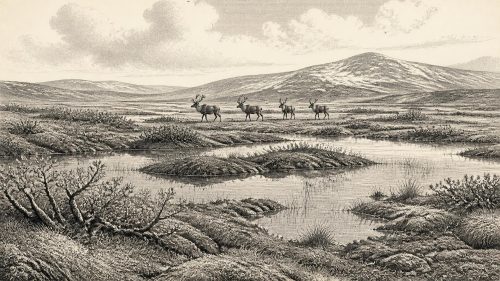
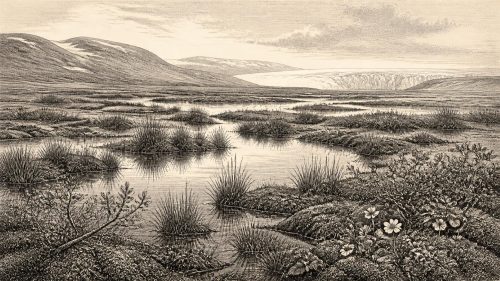
In the north, deposits beneath a drumlin at Derryvree, near Maguiresbridge in County Fermanagh, provide a valuable environmental comparison. Organic silts and fine sands there produced a radiocarbon determination of 30,500 years BP, with an uncertainty of more than a thousand years, and yielded plant and animal evidence interpreted as open tundra under a periglacial climate. That sequence is not an annual record for 31,870 BCE, nor is it necessarily precisely contemporary with Castlepook in Cork. It does, however, show the kind of cold, treeless and wet ground that could occur in Ireland during this broad Middle Midlandian phase.
Such country was shaped by frost as much as by flowing ice. Seasonal freezing and thawing disturbed soils; snow lay long in sheltered ground; streams carried sediment across bare or sparsely vegetated slopes. Low shrubs, sedges, grasses, mosses and hardy herbs could support grazing animals without producing woodland. The familiar modern Irish patchwork of fields, hedges and peatlands did not exist. Nor can today’s coastlines be projected backwards without care: lower global sea levels exposed large areas of continental shelf, but ice, sea, rivers and land bridges changed repeatedly. Routes into and out of Ireland remain one of the central questions of this period.
The Fauna of Southern Caves
Castlepook Cave, near Doneraile in north County Cork, is the key Irish locality for the discussion. Antiquarian excavations there recovered a large and complicated assemblage of animal remains. Subsequent work, including the Irish Quaternary Fauna Project and later radiocarbon reassessment, has identified a pre-Last Glacial Maximum fauna containing animals associated with cold open habitats: reindeer, mammoth, giant deer, spotted hyaena, wolf, fox, brown bear, mountain hare and lemmings. Some species are represented more securely than others, and material from different deposits cannot simply be treated as one simultaneous community.
The assemblage nevertheless establishes that Ireland could sustain a richer Pleistocene animal world than its later isolated fauna might suggest. Reindeer were especially well adapted to cold, exposed environments, while mammoth and giant deer point to extensive feeding grounds beyond the cave entrance. Spotted hyaenas, wolves and foxes were not passive background creatures: they could kill, scavenge, transport bones and use caves as dens or shelters. A cave bone collection is thus evidence both of a wider landscape and of the particular agents that brought remains underground.
There is no basis for imagining these animals as a permanent menagerie gathered at Doneraile on one day. Their presence represents episodes spread across time. The revised dates for southern Irish cave fauna suggest that certain mammals, including giant deer and spotted hyaena, may have disappeared locally before about 40,000 calibrated years BP, while other remains document later phases. The lesson is not that all Ice Age species lived together continuously, but that Ireland’s animal populations shifted as climate, ice cover and access routes changed.
A Reindeer Bone and a Human Question
The exceptional claim concerns a reindeer femur from the Castlepook collection. It has been described as bearing a mark consistent with cutting or chopping by a sharp stone tool while the bone was fresh, and public heritage accounts have associated it with an age of about 33,000 years ago. If that interpretation is confirmed, it would indicate that Upper Palaeolithic people handled and processed a reindeer carcass in Ireland at a date far earlier than the long-accepted post-glacial settlement record.
That would be a major development, but its scale must not be exaggerated. The bone is not a securely excavated campsite with a hearth, a stone-tool assemblage, dwelling remains, human burials or an occupation surface. No named group, language or ancestry can be assigned to whoever may have made the mark. The most that can presently be inferred is a possible brief human visit or carcass-processing episode in a landscape where reindeer were available. Hunters could have crossed a changing maritime and glacial frontier, exploited a large animal, and left little durable evidence beyond a modified bone.
Nor does the find prove that the animal was killed at the cave. The carcass may have been processed elsewhere and a portion later carried into the cave by scavengers. That possibility does not erase the human interpretation of a cut mark, but it narrows what the mark can demonstrate. New excavations at Castlepook seek the evidence needed to resolve these questions: undisturbed Pleistocene layers, stone artefacts, charcoal, more modified bone and reliable associations between finds. Until such evidence is recovered and fully assessed, the cautious wording is “possible early human activity”, not permanent settlement.
Society Without States
Political affairs, diplomacy and organised warfare cannot be reconstructed for Ireland around this date. There were no Irish kingdoms, tribal names, laws, churches, farms, ports or trade institutions. Even a human presence is not securely demonstrated as a resident population. It would be anachronistic to describe any visitors as “Irish” in an ethnic or national sense. The available evidence does not identify their social organisation, family structure, beliefs or routes of movement.
European context can suggest possibilities but cannot fill the Irish silence. Homo sapiens elsewhere in Upper Palaeolithic Europe made sophisticated stone and organic tools, practised seasonal mobility, hunted and scavenged, exchanged materials over distance, and sometimes created art and formal burials. None of this authorises claims for Irish cave art, ritual, clothing, shelters, language or long-distance trade at Castlepook. Comparative evidence may make the use of sharp lithic tools plausible; it is not proof that every feature of continental Upper Palaeolithic life existed on the island.
Everyday life, if people were present, would have been governed first by survival in a severe and variable environment: access to game, fuel, shelter, fresh water and routes across exposed terrain or water. A reindeer carcass could supply meat, fat, hide, sinew and bone, but one mark does not reveal how these resources were divided, stored or exchanged. There is no Irish evidence at this date for cultivation, animal husbandry, pottery, metalworking or built settlement. Economy, in the limited sense supported by the record, was the ecology of mobile animals and perhaps the opportunistic exploitation of their remains.
What the Landscape Preserved
The strongest historical actors in this period were climate and ice. They enabled some animals to enter Ireland, made other areas uninhabitable, altered potential crossings, and later destroyed or buried much of the terrain on which people might have travelled. The glacially reshaped landforms mapped across Ireland are a later visible legacy of these processes. Yet the bones protected in limestone caves and the sediments sealed beneath tills preserve brief windows onto worlds that the ice did not wholly erase.
For 31,870 BCE, Doneraile’s reindeer is therefore more useful as a question than as a finished origin story. It directs attention to a Late Pleistocene Ireland that was environmentally dynamic, connected at intervals to wider north-west European faunal worlds, and potentially visited by people. But it also requires restraint. There is no year-specific event to narrate, only a calibrated archaeological horizon in which one modified bone, a cave fauna and scattered environmental records make the deep past of Ireland faintly visible.
Primary Sources
- A reconsideration of the radiocarbon dating of the Marine Isotope Stage 3 fauna from southern Ireland
- Middle Midlandian Freshwater Series at Derryvree, Maguiresbridge, County Fermanagh, Northern Ireland
- The Irish Quaternary Fauna Project
- The IntCal20 Northern Hemisphere Radiocarbon Age Calibration Curve (0–55 cal kBP)
- Growth and retreat of the last British–Irish Ice Sheet, 31,000 to 15,000 years ago: the BRITICE-CHRONO reconstruction
- Behavioural tendencies of the last British–Irish Ice Sheet revealed by data–model comparison
- Pattern, style and timing of British–Irish Ice Sheet advance and retreat over the last 45,000 years: evidence from NW Scotland and the adjacent continental shelf
- Maximum extent and dynamic behaviour of the last British–Irish Ice Sheet west of Ireland
- The colonization of Ireland: A human ecology perspective
- New insights on the fauna of Ireland's Younger Dryas and Early Holocene from Alice & Gwendoline Cave
- Castlepook Cave: County Geological Site Report
- Heritage Artefacts of County Cork
- Archaeology Research Excavation Grant 2022: Final Report
- Castlepook Cave, County Cork, 2022 Excavation Report
- Quaternary Geomorphology
- Prehistoric Details: Stone Age
- Occurrence of mammalia relicts at site Castlepook Cave
- Pleistocene Vertebrates in the British Isles
- Irish Quaternary Vertebrates
- The Mesolithic in Ireland: when was it?
- Radiocarbon Date List VII
- Quaternary Geomorphology 1:50,000 Ireland (ROI) ITM