Faunal Change31866 BCE
Approximately 33,800 years ago, Ireland lay within the climatically volatile Late Pleistocene, but neither its conditions nor ice extent can be fixed. Competing reconstructions suggest advancing ice alongside patches of open, treeless habitat supporting cold-adapted fauna. Organic deposits and cave assemblages document wetlands, grassland and mammals including deer, giant deer and spotted hyaena. Castlepook Cave provides MIS 3 evidence, revising animal chronologies and suggesting local disappearances before the Last Glacial Maximum. A marked reindeer bone may indicate an early human visit, but no secure settlement evidence exists. Uncertain sea routes, glacial erosion and records define this changing, intermittently habitable island.
Dateline
The label 31,866 BCE gives a misleading impression of precision. No Irish event can be assigned to that calendar year, and no contemporary Irish calendar, settlement sequence or written record exists. In archaeological terms it is best treated as a nominal point roughly 33.8 thousand years before present, within the Late Pleistocene and Marine Isotope Stage 3 (MIS 3). Even that conversion needs care: “before present” conventionally means before AD 1950, while radiocarbon measurements must be calibrated into calendar ranges rather than read as calendar years. For this depth of time, the responsible subject is therefore not a year’s happenings, but what a sparse set of animal bones, cave deposits, buried sediments, ice-sheet reconstructions and wider North Atlantic climate records can, and cannot, say about Ireland.
At this remove, Ireland was not a country in any political or cultural sense recognisable today. There is no evidence for rulers, tribes, diplomacy, warfare, farms, villages, trade networks, formal religion or language on the island at this date. Nor is there a securely excavated Irish occupation site that can be placed in this particular interval. The historical value of the period lies elsewhere: it preserves a difficult but important chapter in the making of Ireland’s landscape, and in the question of whether people ever reached the island before the great expansion of ice that followed.
Dating a Moving Climate
Modern calendar-year precision is unavailable. A point corresponding approximately to 33.8 ka ago falls close to the transition between Greenland climatic events conventionally called Greenland Stadial 6 and Greenland Interstadial 6 on the extended GICC05 ice-core timescale. The onset of GI-6 is placed at about 33,740 years before AD 2000, but correlations between Greenland ice, Irish sediments and cave finds are neither exact nor automatic. An interstadial in a Greenland isotope record identifies a major North Atlantic climatic shift; it does not prove that the same temperature, vegetation or ice limit occurred simultaneously in every Irish valley.
That distinction matters because climate was volatile. During MIS 3, abrupt warmings and coolings reorganised the North Atlantic world repeatedly, sometimes on scales much shorter than archaeological periods. A cave bone may be directly dated, yet its date range commonly spans centuries or more; a layer of silt may record an episode of deposition rather than a single season. Calibration adds another necessary layer. IntCal20, the principal Northern Hemisphere calibration curve, extends to 55,000 calibrated years before present, but it explicitly incorporates uncertainty in the older part of the curve. It permits improved ranges, not a pinpointed Irish Tuesday in 31,866 BCE.
Ice in an Uncertain Island
Ireland stood on the approach to the Last Glacial Maximum, not yet at its best-established maximum extent. The British–Irish Ice Sheet reached its maximum extent much later, broadly around 27–21 ka in older syntheses and around 25–23 ka in well-dated Irish Sea work. By then ice occupied much of Ireland and extended across adjoining continental shelves. That later maximum should not simply be projected backwards onto the earlier date considered here.
The ice history around 34 ka is genuinely debated. The BRITICE-CHRONO reconstruction begins at 31 ka because earlier geographical constraints are few; its model depicts initial nourishment of ice on high ground, including a centre in Northern Ireland, rather than a confidently mapped blanket over the whole island. Other recent work argues that the British–Irish Ice Sheet may have developed substantially earlier during MIS 3, partly on the basis of raised-shore and offshore evidence. These are competing reconstructions of a changing ice mass, not grounds for declaring all of Ireland either uniformly ice-free or uniformly glaciated in this nominal year.
The safest picture is regional and provisional. Some uplands and northern districts may have supported accumulating or advancing ice, while other areas could at times have remained available to cold-adapted plants and animals. Glacial erosion, subsequent ice advances and rising seas have destroyed or buried much of the relevant evidence. The patchiness of the record is itself historical evidence: this was a landscape repeatedly remodelled by ice, meltwater, frost and later marine change.
Open Ground and Fossil Archives
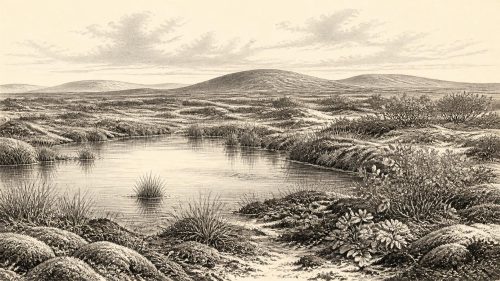
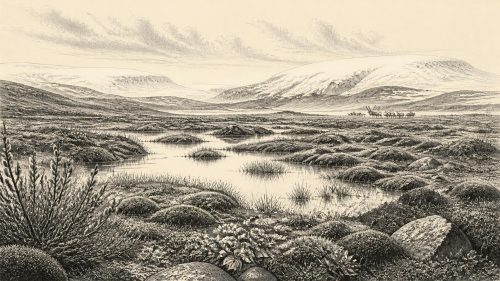
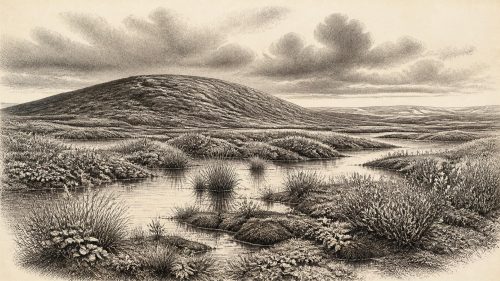
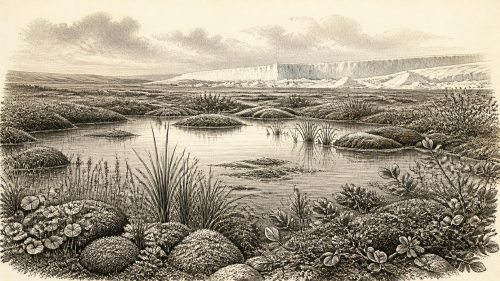
Where plant and insect remains survive beneath or between glacial deposits, they point to environments very unlike modern Ireland. The classic Irish Quaternary sequences at Derryvree in County Fermanagh, Greenagho and Aghnadarragh preserve organic sediments associated with cold phases. Pollen, beetles and plant remains have been interpreted as evidence for open, treeless ground, wet mossy or sedge-rich hollows, and strongly seasonal conditions. The Derryvree organic silts, for example, have long been described as recording a treeless muskeg environment between tills. Such deposits illuminate types of Irish cold-stage habitat, but their correlation with any one numbered BCE year remains uncertain.
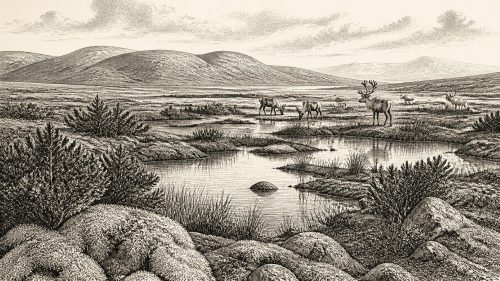
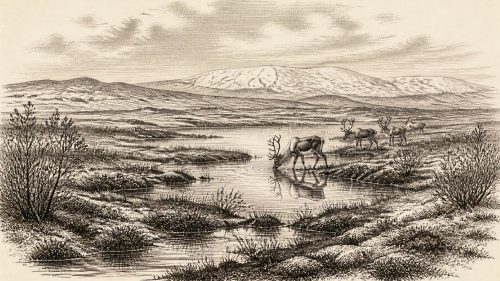
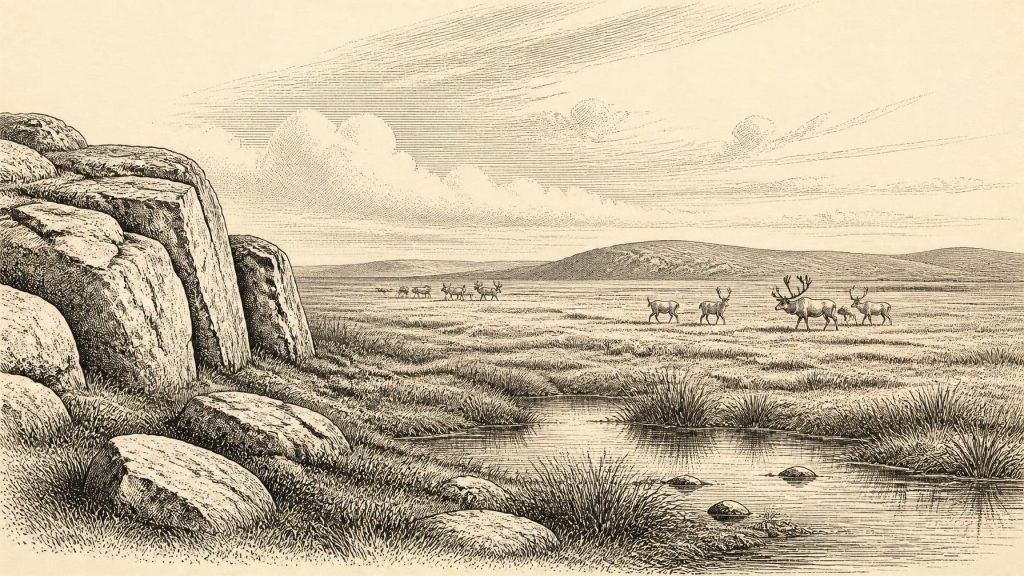
“Tundra” is a useful shorthand only if used cautiously. It should not conjure an unbroken white wilderness. In exposed settings there may have been herb-rich grassland, sedges, dwarf shrubs, bare mineral ground and seasonal wetlands; sheltered places would have offered different resources. The animals whose bones occur in southern Irish caves show that, during portions of MIS 3, such landscapes could sustain sizeable herbivores and their predators. Yet fossils demonstrate presence, not abundance, and an animal reaching a cave does not establish a stable local population.
Castlepook and Its Animals
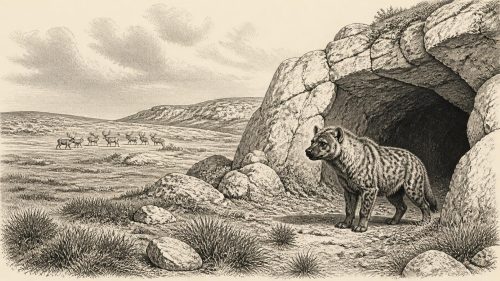
Castlepook Cave near Doneraile, in north County Cork, is central to the discussion because it has produced one of Ireland’s most significant pre-Last Glacial Maximum faunal assemblages. Reassessment using improved pretreatment and radiocarbon methods has shown that several Castlepook specimens are substantially older than earlier determinations suggested. The resulting evidence places particular mammals in Ireland during MIS 3 and indicates that some, notably giant deer and spotted hyaena, may have disappeared locally before the Last Glacial Maximum.
Red deer are also securely represented in the wider southern Irish cave record before the maximum cold. Two directly dated County Waterford cave specimens fall within calibrated ranges of 32,930–31,280 cal BP and 30,297–29,594 cal BP. Those ranges are important evidence that deer could live in southern Ireland during the broader pre-LGM interval, but neither is a direct observation of conditions in 31,866 BCE. Reindeer, giant deer, brown bear, wolf, hare and spotted hyaena belong to the wider Pleistocene faunal conversation around Irish caves, although each species has its own chronology and evidential quality.
The economic implications are ecological rather than social. Herd animals imply grazing opportunities; carnivores imply prey and scavenging chains; caves served at different times as traps, dens, shelters or repositories into which bones were carried. Nothing in this evidence demonstrates hunting quotas, seasonal camps, meat-sharing rules or a human-managed economy. It does, however, overturn the older assumption that pre-LGM Ireland was necessarily devoid of substantial land mammals.
The Human Question
A reindeer femur fragment from the Castlepook collections has been reported as carrying marks consistent with stone-tool butchery and as dating to roughly 33,000 years ago. If both the date and anthropogenic interpretation are upheld through full contextual analysis, it would indicate a strikingly early human visit to Ireland in the Upper Palaeolithic. It would not, by itself, demonstrate permanent settlement, a named culture, or a community living at the nominal date of this article. A marked bone is not a settlement plan.
That restraint is essential. No securely dated Irish lithic assemblage, hearth, dwelling floor, burial, art panel or human skeletal remain belongs to around 33.8 ka. The later terminal-Pleistocene evidence from Alice and Gwendoline Cave in County Clare is much firmer evidence for people in Ireland, but it is separated from this period by many millennia. Current heritage guidance accordingly treats the early human story as highly fragmentary and stresses Ireland’s insular setting and limited faunal opportunities as major constraints on colonisation.
Sea Crossings, Society and Silence
Lower global sea levels changed coastlines and exposed areas now underwater, but they did not guarantee a walkable route from Britain or continental Europe. Whether any Late Quaternary land bridge linked Ireland and Britain has long been disputed; sea level, crustal rebound, ice margins and local bathymetry all mattered, and any connection could have been short-lived or discontinuous. The evidence does not permit a confident reconstruction of a land route available in 31,866 BCE. A human arrival, if one occurred, might have involved a difficult sea or ice-margin crossing rather than a simple migration over dry ground.
Consequently, political affairs, conflict and diplomacy cannot responsibly be supplied for this date. There are no Irish polities to describe, no proven encounters between groups, and no evidence for exchange beyond the movement of animals and perhaps people through a wider north-west European world. Similarly, religion, culture and learning leave no identifiable Irish material trace. It is reasonable to say that contemporary Upper Palaeolithic people elsewhere possessed sophisticated knowledge, social traditions and skilled technologies; it is not reasonable to assign those practices to an undocumented camp in Ireland.
The most important development around this point, then, was environmental rather than institutional: Ireland occupied a shifting boundary between habitable cold-stage landscapes and expanding glaciation. Castlepook’s fauna, the buried organic deposits of Fermanagh and the offshore record preserve scattered glimpses of that boundary. They show an island in flux, intermittently capable of supporting large mammals and possibly fleeting human visitors, but heading towards a glacial transformation that would erase much of the evidence. The silence is not empty. Properly read, it is the defining historical fact of Ireland at this remote date.
Source References
Hover over a number to see the source. Select it to open the source.

- [1] Phylogeographic, ancient DNA, fossil and morphometric analyses reveal ancient and modern introductions of a large mammal: the complex case of red deer (Cervus elaphus) in Ireland
- [2] A reconsideration of the radiocarbon dating of the Marine Isotope Stage 3 fauna from southern Ireland
- [3] Growth and retreat of the last British–Irish Ice Sheet, 31,000 to 15,000 years ago: the BRITICE-CHRONO reconstruction
- [4] The timing and magnitude of the British–Irish Ice Sheet between Marine Isotope Stages 5d and 2: implications for glacio-isostatic adjustment, high relative sea levels and ‘giant erratic’ emplacement
- [5] Extent and timing of the Last Glacial Maximum (LGM) in Britain and Ireland: a review
- [6] Stratigraphic and palaeo-geomorphological evidence for the glacial-deglacial history of the last British-Irish Ice Sheet in the north-western Irish Sea
- [7] Oscillating retreat of the last British-Irish Ice Sheet on the continental shelf offshore Galway Bay, western Ireland
- [8] A stratigraphic framework for abrupt climatic changes during the Last Glacial period based on three synchronized Greenland ice-core records: refining and extending the INTIMATE event stratigraphy
- [9] Greenland Ice-Core Chronology 2005 (GICC05) for various Greenland ice cores
- [10] The IntCal20 Northern Hemisphere radiocarbon age calibration curve (0–55 cal kBP)
- [11] Irish Pleistocene biostratigraphy
- [12] Figure 6.— The subdivision of the Quaternary Period in Ireland
- [13] The Irish Quaternary Fauna Project
- [14] The Mesolithic in Ireland: when was it?
- [15] The Island of Ireland: Drowning the Myth of an Irish Land-Bridge?
- [16] Deglaciation, Earth crustal behaviour and sea-level changes in the determination of insularity: A perspective from Ireland
- [17] The problem of a late quaternary landbridge between Britain and Ireland
- [18] Ireland: Submerged Prehistoric Sites and Landscapes
- [19] New insights on the fauna of Ireland’s Younger Dryas and Early Holocene from Alice & Gwendoline Cave
- [20] Archaeological Heritage of County Cork: A Guide
Primary Sources
- Phylogeographic, ancient DNA, fossil and morphometric analyses reveal ancient and modern introductions of a large mammal: the complex case of red deer (Cervus elaphus) in Ireland
- A reconsideration of the radiocarbon dating of the Marine Isotope Stage 3 fauna from southern Ireland
- Growth and retreat of the last British–Irish Ice Sheet, 31,000 to 15,000 years ago: the BRITICE-CHRONO reconstruction
- The timing and magnitude of the British–Irish Ice Sheet between Marine Isotope Stages 5d and 2: implications for glacio-isostatic adjustment, high relative sea levels and ‘giant erratic’ emplacement
- Extent and timing of the Last Glacial Maximum (LGM) in Britain and Ireland: a review
- Stratigraphic and palaeo-geomorphological evidence for the glacial-deglacial history of the last British-Irish Ice Sheet in the north-western Irish Sea
- Oscillating retreat of the last British-Irish Ice Sheet on the continental shelf offshore Galway Bay, western Ireland
- A stratigraphic framework for abrupt climatic changes during the Last Glacial period based on three synchronized Greenland ice-core records: refining and extending the INTIMATE event stratigraphy
- Greenland Ice-Core Chronology 2005 (GICC05) for various Greenland ice cores
- The IntCal20 Northern Hemisphere radiocarbon age calibration curve (0–55 cal kBP)
- Irish Pleistocene biostratigraphy
- Figure 6.— The subdivision of the Quaternary Period in Ireland
- The Irish Quaternary Fauna Project
- The Mesolithic in Ireland: when was it?
- The Island of Ireland: Drowning the Myth of an Irish Land-Bridge?
- Deglaciation, Earth crustal behaviour and sea-level changes in the determination of insularity: A perspective from Ireland
- The problem of a late quaternary landbridge between Britain and Ireland
- Ireland: Submerged Prehistoric Sites and Landscapes
- New insights on the fauna of Ireland’s Younger Dryas and Early Holocene from Alice & Gwendoline Cave
- Archaeological Heritage of County Cork: A Guide