Dublin, Downing Street and Haughey1991 CE
Dateline
In 1991 Ireland stood between the difficult recovery of the late 1980s and the faster economic and social change that would define the later decade. Charles Haughey remained Taoiseach, but his government was increasingly strained by internal rivalry. Unemployment was again rising, many households still felt insecure, and the Troubles continued to shape politics on both islands. Yet Dublin’s year as European City of Culture gave the capital an unusually outward-looking profile, while social partnership remained central to economic policy.
The year therefore combined cultural confidence with political instability. It was not yet the prosperous Ireland of the Celtic Tiger, but neither was it simply an extension of the crisis years. Public finances were stronger than in the mid-1980s, inflation had been brought down, and the State was trying to convert greater economic stability into employment. At the same time, divisions inside Fianna Fáil and violence connected with Northern Ireland ensured that 1991 remained unsettled.
Dublin as European City of Culture
Dublin was officially inaugurated as European City of Culture in March 1991, succeeding Glasgow. The designation brought a year-long programme of performances, exhibitions, commissions and community projects. Ceremonies at the Mansion House, St Stephen’s Green and the National Concert Hall marked the opening, with Taoiseach Charles Haughey among those attending. The programme sought to present Dublin not merely as an historic capital but as a contemporary European city with a lively artistic life.
The cultural year was ambitious but not free from criticism. Supporters argued that it encouraged exhibitions and community initiatives that might otherwise have struggled for funding. Critics complained that the programme lacked a strong public identity and did not reach enough of the city’s population. One important legacy was the attention given to Temple Bar, where European funding and redevelopment plans helped strengthen the case for retaining and renewing the district as a cultural quarter rather than allowing wholesale demolition. The debate itself reflected a city beginning to ask how culture, tourism and urban regeneration might fit together.
Pressure Inside Government
The Fianna Fáil–Progressive Democrats coalition that had taken office in 1989 remained in power, but relations within Fianna Fáil deteriorated sharply. Albert Reynolds, who had served as Minister for Finance, emerged as the strongest internal challenger to Haughey. In November Haughey dismissed Reynolds from the finance portfolio. Bertie Ahern, previously Minister for Labour, became Minister for Finance on 14 November. The confrontation did not immediately remove Haughey, but it made clear that his leadership was entering its final phase.
The dispute mattered because economic management had become central to the government’s claim to competence. Since 1987, fiscal restraint and negotiated wage agreements had helped reduce borrowing and inflation. The Programme for Economic and Social Progress continued the partnership model involving government, employers, trade unions and farming interests. Supporters saw this as a means of securing wage moderation, investment and social stability. Critics pointed to persistent unemployment and the uneven distribution of recovery.
Economy and Everyday Life
Central Statistics Office figures show that unemployment rose again in 1991 after improving at the end of the 1980s. Employment remained under pressure and the annual unemployment rate was about 14.7 per cent. The demographic picture was changing, however. The severe net emigration of the late 1980s eased markedly, suggesting that the long pattern of outward movement was beginning to weaken even before the later employment boom.
For many families the improvement was still difficult to see. Mortgage costs, unemployment, insecure work and the recent memory of emigration remained powerful features of everyday life. The 1991 Census captured a country in transition: still relatively young, still strongly shaped by family and parish networks, but increasingly urban and connected to European labour, media and consumer markets. Economic recovery was real, but its benefits were not yet broad enough to transform public mood.
Conflict and Downing Street
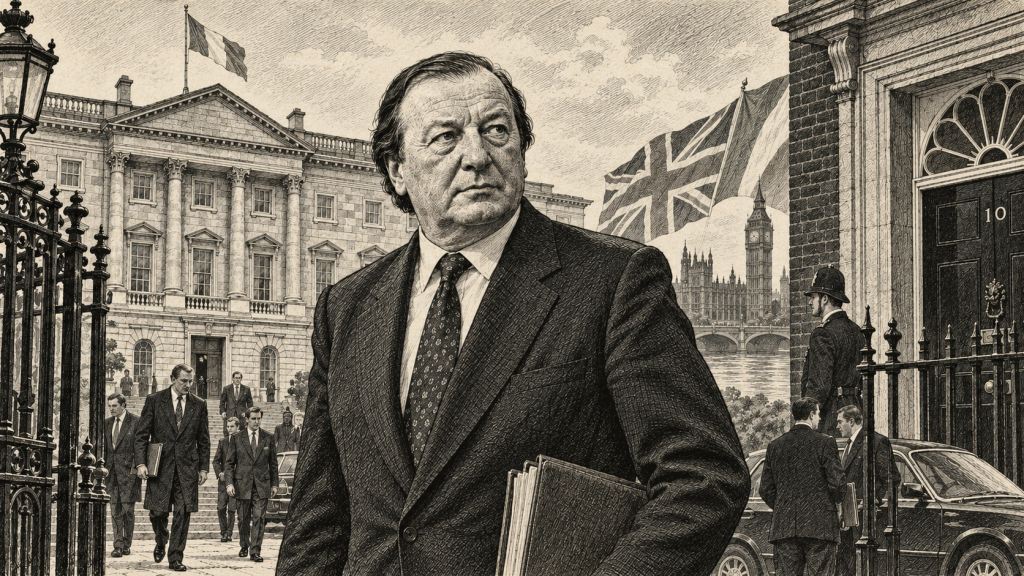
The Troubles remained an unavoidable part of the political landscape. On 7 February the IRA launched three improvised mortar bombs from a van in Whitehall towards 10 Downing Street while the British Cabinet was meeting. One mortar exploded in the garden behind the building. No one was killed, but the attack demonstrated the organisation’s ability to strike at the symbolic centre of British government and caused a major security shock.
Violence continued in Northern Ireland throughout the year, alongside attempts to develop political talks. The British and Irish governments, constitutional nationalist parties and unionist parties were still far from the settlement eventually reached in 1998, but channels of negotiation were widening. The contrast between political dialogue and continuing paramilitary violence defined the period: neither side could yet claim that the conflict was moving decisively towards peace.
The Year in Perspective
By the end of 1991, Haughey was still Taoiseach but his authority had been badly weakened. Reynolds had been removed from the Department of Finance but had not disappeared as a political rival. Dublin’s cultural year had projected a more European and creative image of the capital, while economic policy continued to depend on partnership and fiscal discipline. The Troubles, meanwhile, remained capable of reaching beyond Northern Ireland itself.
Seen from later decades, 1991 looks like a hinge year. Many of the institutions and policy habits associated with the coming transformation were already visible, but the confidence of the later 1990s had not yet arrived. Ireland was still dealing with unemployment, political turbulence and violence, even as cultural and economic developments pointed towards a different national mood.
Primary Sources
- RTÉ Archives: Dublin is European City of Culture 1991
- RTÉ Archives: Culture Year Criticism 1991
- CAIN: Chronology of the Conflict 1991
- Department of the Taoiseach: Twenty-Sixth Dáil
- Department of Finance: Former Finance Ministers
- Dáil Éireann: Confidence in Government debate, 18 October 1991
- Central Statistics Office: Historical unemployment rates
- Central Statistics Office: Census 1991 economic status