The Cork Reindeer Mark31710 BCE
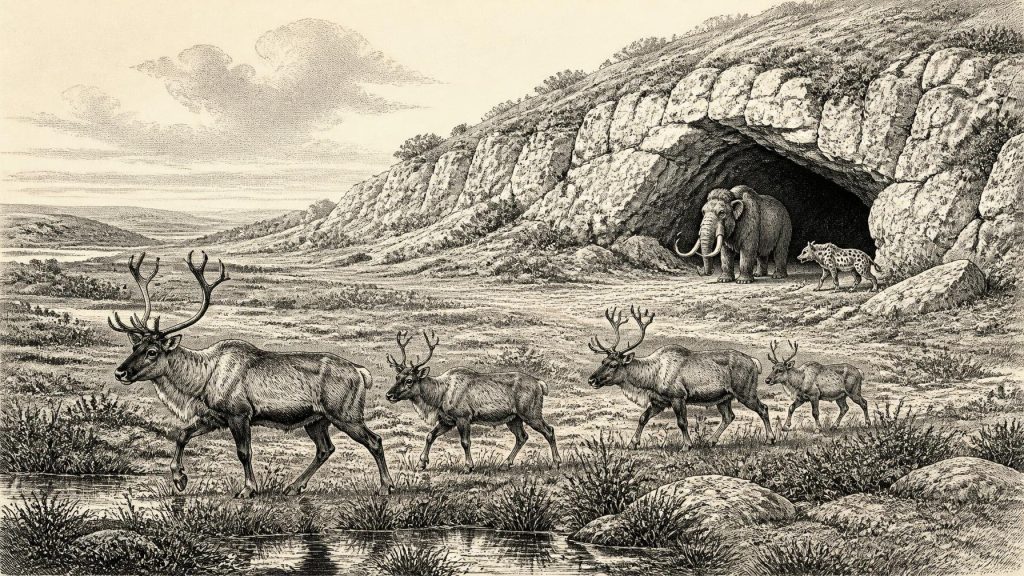
Around 31,710 BCE, a notional date within Marine Isotope Stage 3, Ireland experienced unstable cold conditions before the Last Glacial Maximum. Fossils and sediments show that intermittently accessible, open landscapes supported reindeer, mammoth, giant deer, predators and northern species. Castlepook Cave in County Cork preserves Ireland’s pre-glacial fauna collection, although its mixed, recorded deposits cannot establish contemporaneous communities. A reindeer femur, dated broadly to about 33,000 years ago, bears a possible stone-tool cut mark, suggesting but not proving brief human butchery. Without associated artefacts or habitation evidence, it cannot demonstrate settlement. The find nevertheless suggests a deeper Irish Palaeolithic past.
Dateline
The label 31,710 BCE is a modern chronological convenience, not a year that can be recovered from Irish evidence. No written record, political sequence, named person or calendar date exists for this remote part of the Late Pleistocene. Even radiocarbon measurements do not produce single-year precision here: they must be calibrated against changing atmospheric carbon levels and are expressed as probability ranges. The most responsible setting for this notional year is therefore the middle of Marine Isotope Stage 3 (MIS 3), roughly 34,000 calendar years before present, during the last cold stage but before the Last Glacial Maximum that would later overwhelm much of Ireland with ice.
For Ireland, this is a period known principally through bones, cave sediments, pollen and glacial geology. The evidence is sparse, unevenly preserved and often recovered long ago. Yet it shows that parts of the island could, at intervals, sustain an unexpectedly varied cold-climate fauna. The most evocative Irish clue for a possible human presence is a marked reindeer femur from Castlepook Cave near Doneraile, County Cork. It is important precisely because it may illuminate a fleeting encounter between people and an Ice Age animal; it is also important because it cannot responsibly be made to prove more than the evidence allows.
Between Cold Phases
At this point in the last glacial cycle, Ireland was not the familiar green island of later millennia. Climate fluctuated sharply during MIS 3, with relatively milder interstadial episodes punctuating severe cold. The terminology can be confusing: ‘milder’ did not mean modern conditions, and a landscape that supported mammals was still often open, windy and treeless or only thinly vegetated. Temperatures, ice extent, sea level and the availability of routes into Ireland changed over long spans, not according to an annual timetable.
Glacial research increasingly stresses that the British–Irish Ice Sheet had a complex history before its better-dated peak. There is evidence for major ice growth in and around Ireland during earlier phases of the last cold stage, alongside evidence that some areas were ice-free at other times. Around the date represented by 31,710 BCE, it is safer to speak of a changing mosaic than of an island uniformly buried beneath ice or uniformly open for habitation. The full Last Glacial Maximum lay ahead: ice expanded dramatically around 27,000–24,000 calendar years ago and would reshape much of the land surface.
Lower global sea levels altered coastlines, but they do not licence a simple picture of Ireland as permanently joined to Britain or continental Europe. Local sea level was also affected by the weight of nearby ice and by the sinking and later rebound of the Earth’s crust. The precise passages available to animals, and potentially to people, remain debated. What the fossil record establishes is more modest but significant: mammals reached Ireland during parts of MIS 3. Their movement was possible, although the exact route, season and frequency cannot be reconstructed from bones alone.
Castlepook’s Mixed Bone Archive
Castlepook Cave, historically called Mammoth Cave, sits in limestone country near the Awbeg valley in north County Cork. Excavations undertaken in the early twentieth century by the Royal Irish Academy’s cave-exploration committee produced a large collection later deposited in the National Museum of Ireland. It is Ireland’s key pre-Last Glacial Maximum cave-fauna archive. The collection includes remains attributed to woolly mammoth, reindeer, giant deer, brown bear, wolf, foxes, Arctic fox, mountain hare, lemmings and spotted hyena.
This list should not be mistaken for a census of animals alive together on one day in County Cork. Caves are complicated archives. Carnivores can drag prey into them; animals can die in or near entrances; water can move bones; later digging can disturb deposits; and nineteenth- and early twentieth-century excavation methods rarely recorded layers as precisely as modern excavators would require. Castlepook’s remains also came from several galleries and deposits. Individual specimens may represent different episodes separated by centuries or millennia.
Recent reassessment and redating have nevertheless strengthened the case that much of the older Castlepook fauna belongs within MIS 3. The revised chronology indicates that some animals previously thought much younger were thousands of radiocarbon years older. It also suggests that species such as giant deer and spotted hyena may have disappeared locally before the Last Glacial Maximum, around 40,000 calendar years before present. That conclusion is a reminder that the fauna of 31,710 BCE cannot be treated as static. Reindeer were among the animals able to exploit the open northern landscapes of this wider era, but the exact local combination of species at any one moment remains uncertain.
A Single Deep Mark
A fragment of reindeer femur from Castlepook has become central to Ireland’s deep prehistory because zooarchaeologist Ruth Carden identified a deep incision on it as a mark made by a sharp stone tool. The bone has been radiocarbon dated to approximately 33,000 years ago in broad public description, conventionally rendered as about 31,000 BCE. This makes it directly relevant to the chronological neighbourhood of the present entry. If the incision was made while the carcass was processed, it would be potentially the earliest evidence that people handled animal food in Ireland.
That is a consequential interpretation, but it is not equivalent to evidence for a settled population. The dated result primarily concerns the death of the reindeer, while the proposed cut-mark identification concerns the later history of its bone. The specimen was recovered from an old cave collection rather than a securely excavated occupation floor. There is no associated hearth, stone-tool assemblage, dwelling, burial, art or repeated domestic refuse of comparable age from Castlepook. Nor is there proof that an animal was killed at the cave: a carcass portion could have been processed elsewhere and subsequently carried or scavenged into the cavern.
The phrase ‘possible human butchery’ therefore captures the present state of the evidence better than declarations that Ireland was settled in 31,710 BCE. A tool mark would suggest a visit by people able to reach and exploit this landscape, perhaps as highly mobile hunters. It does not reveal their number, language, kinship, season of residence or ancestry. It would be unsound to assign them a tribe, nation, religion or political identity. In European terms, people of this date would normally be discussed within the Upper Palaeolithic, but Ireland has not yielded the securely contextualised material needed to describe a local Upper Palaeolithic culture.
Predators, Prey and Open Ground
The animal evidence gives a stronger picture of ecology than of human society. Reindeer point towards open, cold-adapted terrain, feeding across broad ranges and moving in response to vegetation and weather. Woolly mammoth and giant deer add to the impression of substantial herbivores using at least some Irish landscapes, while Arctic fox and lemmings indicate severe conditions and a northern character. Spotted hyena, represented at Castlepook by skulls, jaws and other remains, was not merely an exotic visitor: its bone-collecting habits may explain why the cave became such a rich but difficult archive.
Hyenas, wolves and bears also demonstrate why a cave should not automatically be imagined as a human shelter. A cave mouth could be a carnivore den, a trap, a place where bones accumulated through scavenging, or a temporary refuge at different times. Teeth marks and damaged bones record competition and consumption within the food web, not human conflict. The Irish evidence does not permit a narrative of battles, territorial chiefs or diplomacy. Its nearest equivalent to ‘regional affairs’ is the changing access of animal populations across the wider north-west European world as climate and ice margins shifted.
Plant evidence from Irish deposits of broadly comparable cold phases supports a landscape in which low shrubs, grasses, sedges, mosses and herbs mattered more than woodland. Local wet hollows and freshwater basins could sustain richer vegetation than exposed ground. In Fermanagh, buried inter-till organic deposits preserve pollen, seeds, mosses and insects which show that ice-age environments were not lifeless white deserts. Such records cannot be transplanted uncritically to north Cork, but they demonstrate the kinds of periglacial wetlands and open habitats available on parts of the island during colder Pleistocene intervals.
Life Without a Visible Society
If people did enter Ireland in this period, their economy would have depended on immediate knowledge of seasonal animals, stone, shelter, fuel and safe movement through a hazardous landscape. Reindeer would have offered meat, marrow, fat, hide, sinew and bone, but Castlepook does not demonstrate a complete hunting economy. There is no evidence for farming, herding, pottery, metalworking, exchange networks or permanent villages. There are likewise no objects from which to infer ritual practice, artistic traditions or formal learning. Silence in these categories is not evidence that humans had no culture; it is evidence that Ireland has not yet produced the archaeological traces required to describe it.
For the same reason, there were no identifiable Irish political affairs or diplomacy to report. ‘Ireland’ itself is an anachronistic geographical shorthand for a landscape whose coastlines, ecological connections and ice cover differed radically from today’s. The appropriate historical story is environmental and evidential: a changing north-western edge of Europe, occasionally accessible to cold-adapted mammals; a limestone cave that accumulated their remains; and one reindeer bone that may preserve a human action.
What This Date Can Mean
Thus 31,710 BCE should not be presented as the date of Ireland’s first settlement, nor as the year of a particular hunt at Castlepook. Modern calendar-year precision is unavailable. The reindeer femur belongs to a calibrated chronological range and to a wider MIS 3 context, rather than to a known day, season or generation. Its mark is compelling evidence under continued scrutiny, not a licence to fill the cave with invented hunters.
Even so, the find changes the questions worth asking. For generations, Ireland’s earliest human story began after the retreat of the last ice. Castlepook raises the possibility of a much deeper and more intermittent human past, one later ice advances may have erased almost completely. Continued work at the cave, including modern excavation and re-examination of museum collections, may clarify whether the marked bone represents a lone episode or the edge of a lost Palaeolithic record. For now, its value lies in its restraint: a single damaged reindeer femur opens a window onto an Ice Age Ireland that was populated by animals, shaped by climatic instability, and perhaps briefly visited by people.
Primary Sources
- A reconsideration of the radiocarbon dating of the Marine Isotope Stage 3 fauna from southern Ireland
- The Irish Quaternary Fauna Project
- Spotted Hyena Skull
- Heritage Artefacts of County Cork
- 2022:564 – Castlepook Cave, Castlepook South, Cork
- The IntCal20 Northern Hemisphere Radiocarbon Age Calibration Curve (0–55 cal kBP)
- Pattern and Timing of Retreat of the Last British-Irish Ice Sheet
- The Timing and Magnitude of the British–Irish Ice Sheet Between Marine Isotope Stages 5d and 2: Implications for Glacio-Isostatic Adjustment, High Relative Sea Levels and ‘Giant Erratic’ Emplacement
- Stratigraphic and Palaeo-Geomorphological Evidence for the Glacial-Deglacial History of the Last British-Irish Ice Sheet in the North-Western Irish Sea
- Sedimentology and Chronology of the Advance and Retreat of the Last British-Irish Ice Sheet on the Continental Shelf West of Ireland
- Pattern, Style and Timing of British–Irish Ice Sheet Advance and Retreat Over the Last 45,000 Years: Evidence From NW Scotland and the Adjacent Continental Shelf
- New Data for the Last Glacial Maximum in Great Britain and Ireland
- Maximum Extent and Dynamic Behaviour of the Last British–Irish Ice Sheet West of Ireland
- The Problem of a Late Quaternary Landbridge Between Britain and Ireland
- On the Postglacial Isostatic Adjustment of the British Isles and the Shallow Viscoelastic Structure of the Earth
- The Island of Ireland: Drowning the Myth of an Irish Land-Bridge?
- Figure 6—The Subdivision of the Quaternary Period in Ireland
- Quaternary Site Descriptions
- Pleistocene Vertebrates in the British Isles
- New Insights on the Fauna of Ireland’s Younger Dryas and Early Holocene from Alice & Gwendoline Cave
- Could Brown Bears (Ursus arctos) Have Survived in Ireland During the Last Glacial Maximum?
- Geology of Ireland