Crag Cave’s Interrupted Calcite31708 BCE
Around 31,708 BCE, Ireland was part of a climatically unstable Late Pleistocene landscape, not a place with a recoverable annual history. Derryvree sediments in Fermanagh indicate cold, open, waterlogged tundra-like habitats with mosses, sedges and northern insects during a broad period encompassing this date. Ice margins, sea levels and vegetation shifted repeatedly before the Last Glacial Maximum. Crag Cave stalagmites record intermittent milder phases, while southern caves preserve varied cold-stage mammals. Castlepook’s marked reindeer bone may indicate human processing, but lacks secure archaeological context. Evidence supports transient animal habitats and possible brief human visits, not settlement, society or political events.
Dateline
Modern calendar-year precision is not available for Ireland in 31,708 BCE. The label is a retrospective filing device, not a date that anyone then recorded or recognised. It falls approximately 33,700 years before AD 1950, within the Late Pleistocene and broadly within Marine Isotope Stage 3 (MIS 3), a volatile interval of the last Ice Age. Archaeology cannot identify an Irish event, ruler, community or season in this particular numbered year. The responsible account is instead built from calibrated date ranges, cave bones, buried wetland deposits, pollen, insects, plant remains and evidence for changing ice margins.
The closest securely useful Irish chronologies are measured in centuries or millennia. At Derryvree near Maguiresbridge, County Fermanagh, organic sediments lying between two tills produced a radiocarbon determination of 30,500 +1,170/−1,030 BP; a published calibration places the deposit broadly about 36,900–31,700 calibrated years BP. That range embraces the modern label 31,708 BCE, but does not turn it into a precisely dated environmental snapshot. The date refers to sampled organic material, while the sediments accumulated over time and preserve conditions at one locality, not a complete map of Ireland.
A Climate in Motion
Ireland was in the long approach to the Last Glacial Maximum, rather than at its peak. Recent syntheses place major British–Irish Ice Sheet growth after roughly 35–32 thousand years ago, with maximum overall extent later, conventionally around 27–21 thousand years ago. Yet an advancing ice sheet was not a simple, steady white front. Ice margins could expand, thin, retreat and reorganise; sea level, drainage and the availability of vegetation altered with them. On western Irish evidence, substantial ice loading and high relative sea level occurred at intervals between about 40 and 19 calibrated thousand years ago, while a rapid ice-margin fluctuation is recorded around 28 calibrated thousand years ago. The exact distribution of ice and ice-free ground at any moment around 33.7 thousand years ago remains debated.
That uncertainty matters. It prevents a confident claim that all of Ireland was either ice-covered or open at the same time. The island’s modern coastline also offers no straightforward guide. Globally lower sea level exposed more continental shelf, but the shape of land, sea and ice around Ireland changed repeatedly and locally. The evidence supports Ireland as part of a shifting north-west European cold-zone landscape, not a stable island with a known route for animals or people. Its later glacial landforms—drumlins, streamlined rock, moraines and meltwater channels—are the durable outcome of these changes, but they do not by themselves date a single advance to a single year.
Derryvree’s Cold Wetland
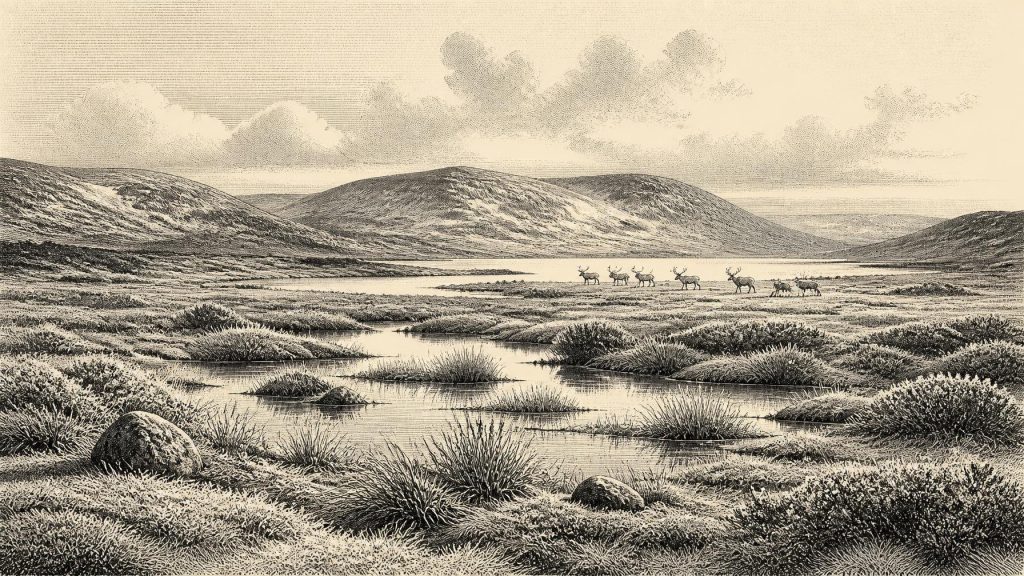
Derryvree supplies the clearest environmental window close to this broad date. Beneath a later till, investigators found organic-rich layers containing freshwater mosses and sedges, alongside an insect fauna of cold northern aspect. These remains indicate a cold, open and wet setting: shallow freshwater, sedge and moss communities, and ground exposed to severe frost. They do not demonstrate a forest, cultivated land or settled countryside. Rather, they support an interpretation of tundra-like or muskeg conditions—waterlogged hollows and pools amid sparse, largely treeless vegetation.
This was nevertheless a living environment, not an empty wasteland. Mosses, sedges and aquatic plants capture the existence of freshwater habitats; beetle and other insect evidence can register the character of local temperatures and ground cover. Comparable middle-Midlandian deposits at Hollymount and Greenagho, also in Fermanagh, show that cold non-glacial environments existed in parts of the region between episodes of ice advance. Greenagho’s radiocarbon result, about 32,460 BP, is treated cautiously as a minimum age, a useful reminder that apparent numerical exactness may conceal difficult stratigraphy and limits in the dating method.
Crag Cave, County Kerry, provides a different kind of climatic evidence. Uranium-series dating of stalagmites shows that calcite growth occurred episodically through MIS 3, in phases linked to relatively milder Greenland interstadials. Calcite needs water moving through soil and rock under conditions unlike those of a deeply frozen, dry cave system. It therefore confirms climatic oscillation in south-west Ireland, although it cannot tell us that a particular Derryvree plant community existed in Kerry, or specify weather in 31,708 BCE. The cave record and the wetland record illuminate a regional pattern of instability through separate local archives.
Caves and the Animal Record
South-western and southern caves reveal a striking, but unevenly dated, Pleistocene fauna. Castlepook Cave near Doneraile, County Cork—also called Mammoth Cave—has yielded more than 2,000 bones and is Ireland’s richest known vertebrate archive for the period leading towards the Last Glacial Maximum. Its broad assemblage includes woolly mammoth, giant deer, reindeer, brown bear and spotted hyaena; later deposits include lemmings, Arctic fox and wolf. A cave, however, is not a census point. It may receive bones through predators, scavengers, water movement, collapse, natural deaths and excavation disturbance. Individual species need not have occupied the surrounding land simultaneously.
Spotted hyaena is especially significant because it indicates an ecosystem far removed from later Irish experience. Hyaenas could accumulate and gnaw carcasses in dens, complicating any attempt to identify hunting or butchery from damaged bone. Revised radiocarbon work has pushed some Castlepook animal dates substantially older than results obtained in the 1990s and suggests that giant deer and spotted hyaena may have disappeared locally before about 40,000 calibrated years BP. This revision means that the old cave collection must not be treated as one contemporaneous ‘Ice Age fauna’. Its value lies in demonstrating repeated animal presence during a long, changing interval.
Shandon Cave near Dungarvan, County Waterford, adds separately dated remains of brown bear, reindeer, horse, wolf and mammoth from a middle-Midlandian sequence. The range of dates reinforces the broader conclusion that Ireland supported, or at least received, cold-stage mammals during MIS 3. It does not prove that every species was present in every county, nor that any particular herd passed through Ireland in this year. Animal bones give robust evidence of species and broad environmental opportunity; they rarely supply a continuous narrative of population size, migration route or seasonality.
The Unsettled Human Question
One Castlepook reindeer femur has made this period unusually important for Irish prehistory. Ruth Carden identified a deep mark on the bone as consistent with cutting or chopping fresh bone using a sharp stone implement, and County Cork heritage publications report that the animal died around 30,000 BCE. If this interpretation is confirmed, it would be evidence that a person processed a reindeer in Ireland during the Upper Palaeolithic, vastly earlier than the long-established post-glacial record of human activity.
The distinction between evidence and interpretation must remain firm. The bone was recovered from an historic cave collection rather than a modern excavation of a sealed occupation surface. Its radiocarbon result dates the animal’s death, not automatically the mark, the place of death, or the length of any human visit. Identifying a cut mark requires ruling out carnivore damage, trampling, sediment abrasion, excavation damage and later handling. Nor are there securely associated hearths, dwelling floors, stone-tool assemblages, human burials, artworks or food-processing areas in Ireland that can be assigned to this broad period. The femur is a serious and potentially transformative clue, not proof of a permanent settlement or continuous population.
Accordingly, political affairs, warfare, diplomacy, named peoples, language, religion and formal learning cannot responsibly be reconstructed. Nor can an economy of trade or farming be inferred. If people did visit, animal carcasses could have offered meat, hide, sinew, fat, bone and antler; that is a general possibility, not evidence for an Irish subsistence system. Terms such as kingdom, tribe, chief or Irish community would project much later social categories onto a record too slight to bear them.
What Can Be Said
The most important development around this modern date was environmental rather than political: Ireland lay within a rapidly changing cold-world system in which wetlands, open vegetation, mammals and ice margins shifted over long timescales. Derryvree demonstrates that cold freshwater habitats existed in Fermanagh during a broad interval that includes this date. Southern cave records demonstrate an Ice Age animal world of unusual diversity. Castlepook’s marked reindeer femur raises the possibility of a brief human encounter, but not yet a demonstrable settlement history.
Later ice expansion would erode, bury and rearrange many earlier deposits, helping to explain why the evidence is sparse and discontinuous. The appropriate history of 31,708 BCE is therefore not a fabricated annual chronicle. It is a disciplined account of what deposits and bones can show: a cold, variable Ireland; local open wetlands; intermittently available animal habitats; and one unresolved object that may yet alter the story of the island’s earliest human visitors.
Primary Sources
- Cork – County Geological Site Report: Castlepook Cave
- A Reconsideration of the Radiocarbon Dating of the Marine Isotope Stage 3 Fauna from Southern Ireland
- The Irish Quaternary Fauna Project
- Early Midlandian–Middle Midlandian, Pleistocene, Northern Ireland
- Episodic Speleothem Deposition Tracks the Terrestrial Impact of Millennial-Scale Last Glacial Climate Variability in SW Ireland
- Radiocarbon Constraints on the History of the Western Irish Ice Sheet Prior to the Last Glacial Maximum
- Extent and Timing of the Last Glacial Maximum in Britain and Ireland: A Review
- Growth and Retreat of the Last British–Irish Ice Sheet, 31,000 to 15,000 Years Ago: the BRITICE-CHRONO Reconstruction
- Late Pleistocene Chronostratigraphy and Ice Sheet Limits, Southern Ireland
- Pattern and Timing of Retreat of the Last British-Irish Ice Sheet
- A Stratigraphic Framework for Abrupt Climatic Changes During the Last Glacial Period Based on Three Synchronized Greenland Ice-Core Records
- The IntCal20 Northern Hemisphere Radiocarbon Age Calibration Curve (0–55 cal kBP)
- Radiocarbon Dating and Chronological Modelling
- The Mesolithic in Ireland: When Was It?
- Heritage Artefacts of County Cork
- Archaeology Research Excavation Grant Report: Castlepook Cave Project
- The Horse in the Late Pleistocene
- Middle Midlandian Interstadial Deposits at Greenagho, Near Belcoo, County Fermanagh, Northern Ireland
- Freshwater Organic Deposits and Stratified Sediments Between Early and Late Midlandian (Devensian) Till Sheets, at Aghnadarragh, County Antrim, Northern Ireland
- Radiocarbon Constraints on the History of the Western Irish Ice Sheet Prior to the Last Glacial Maximum
- Late Pleistocene Chronostratigraphy and Ice Sheet Limits, Southern Ireland
- Pattern and Timing of Retreat of the Last British-Irish Ice Sheet
- Growth and Retreat of the Last British–Irish Ice Sheet, 31,000 to 15,000 Years Ago
- Soils of County Waterford