
Castlepook’s Unfinished Question31705 BCE
Around 31,705 BCE, Ireland lay within the unstable MIS 3 Ice Age, with lower seas, uncertain animal routes and changing periglacial environments. Derryvree sediments in Fermanagh indicate open tundra wetlands supporting cold-adapted plants and small animals, rather than forest or agriculture. Castlepook Cave in Cork preserves diverse fauna, including mammoth, reindeer, giant deer, bears, wolves, foxes, lemmings and hyenas, though its mixed deposits cannot reconstruct one community. A cut-marked reindeer bone may indicate an early human visit, but lacks secure archaeological context. No settlement, institutions or trade are evidenced. Dating and stratified excavation are needed to assess Ireland’s Palaeolithic presence.
Dateline
31,705 BCE is not a date that can be recovered from the Irish archaeological record with calendar-year precision. It is a modern retrospective label, approximately 33,654 years before the conventional radiocarbon reference year of AD 1950. At this depth of time, evidence is dated in calibrated probability ranges, radiocarbon ages and broad climatic phases rather than by individual years. The most responsible way to approach Ireland around this point is therefore through the Late Pleistocene, within the long and unstable interval known as Marine Isotope Stage 3 (MIS 3), and through a small number of unusually informative deposits: cave bones in north Cork, organic sediments beneath Fermanagh drumlins, and records of advancing ice and changing seas around the island.
A Changing Ice-Age Island
In modern geographical terms Ireland was already an island, though its coastlines, neighbouring seas and possible routes of animal movement differed profoundly from those of today. Global sea level was lower during the Ice Age, exposing substantial areas of the continental shelf, but that does not establish a simple dry-land crossing between Ireland and Britain. Geological reconstructions have long treated an enduring Irish Sea land bridge with caution; routes, if available at all, depended upon local ice, water depth, shifting shorelines and short-lived environmental conditions. Animals evidently reached Ireland in some phases of the Pleistocene, but their presence cannot by itself demonstrate the route taken or prove that humans followed them.
Nor should “Ice Age” suggest a single, uniform frozen wilderness. MIS 3, conventionally spanning roughly 59,500 to 24,000 years ago, included abrupt swings between colder stadials and comparatively milder interstadials across the North Atlantic world. Ireland’s local evidence indicates that open, treeless or sparsely vegetated environments could alternate with wetter and somewhat more productive phases. The major Late Midlandian expansion of the British–Irish Ice Sheet was still developing around the broad date represented by 31,705 BCE; its maximum western advance is dated substantially later, after about 24,720 calibrated years BP. Consequently, neither a wholly ice-covered Ireland nor a benign, stable landscape is an adequate picture for this moment.
What the Fermanagh Sediments Show
One of the clearest Irish environmental archives comes from Derryvree near Maguiresbridge, County Fermanagh. Road works exposed freshwater silts and fine sands later buried beneath glacial deposits. Their plant remains, mosses, pollen and small-animal evidence describe an open tundra landscape under periglacial conditions. A radiocarbon measurement from the organic material produced an age of 30,500 radiocarbon years BP, with a large uncertainty; calibration places such measurements in broad calendar ranges rather than a single calendrical point. Derryvree cannot tell us what happened in the particular notional year 31,705 BCE, nor can it be assumed to represent all Ireland at once. It does, however, demonstrate that cold, open wetlands existed in the island’s north during the wider middle part of the last glaciation.
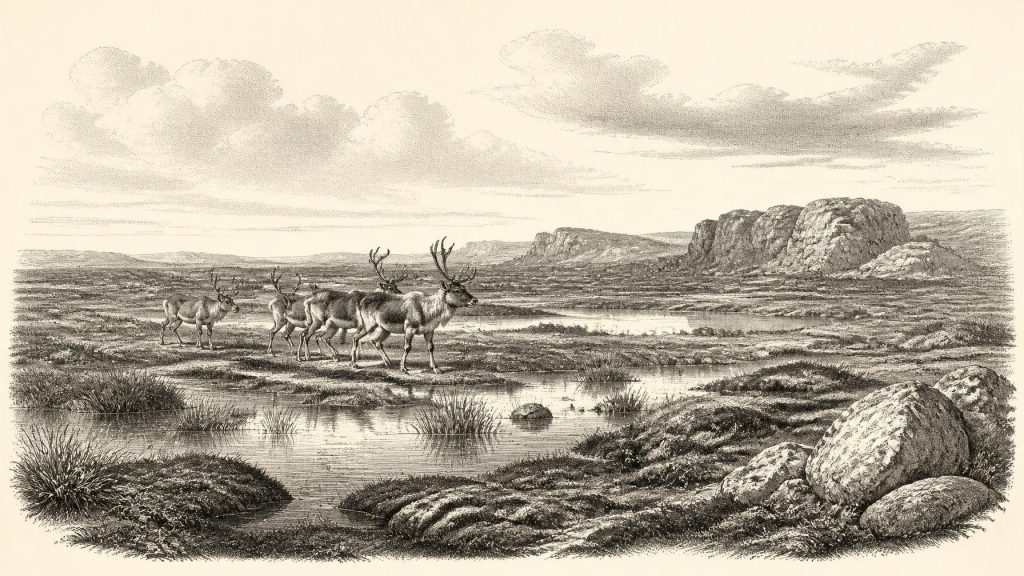
The plants matter because they correct an image of complete lifelessness. Mosses, sedges, bogbean and other cold-adapted or wet-ground vegetation could sustain small freshwater habitats amid exposed ground. Such settings would have changed with season, drainage and temperature. Inferences about dense forest, settled farmland or widespread human clearance are therefore impossible: trees were not shaping the Irish landscape as they would after the Ice Age, and no pollen record supports agriculture or deliberate woodland management at this date. The surviving record instead suggests a patchwork of wet hollows, mineral ground, open vegetation and areas affected by frost, wind and ice.
Castlepook’s Bone Archive
The strongest evidence for late-Pleistocene animal life around this broad period lies far to the south, at Castlepook Cave near Doneraile in north County Cork. Also known as Mammoth Cave, its passages produced a large fossil collection during excavations directed by Richard Ussher and the Royal Irish Academy’s cave-exploration committee in the early twentieth century. Although only part of the original collection survives, Castlepook remains Ireland’s richest archive of vertebrate remains from the long interval leading towards the Last Glacial Maximum. Individual bones have returned dates spanning approximately 45,700 to 19,950 radiocarbon years BP, a reminder that the assemblage is not one sealed episode or one contemporaneous animal community.
The recorded fauna is striking: woolly mammoth, reindeer, giant deer, brown bear, wolf, fox, Arctic fox, lemmings and spotted hyena are among the animals represented. Their bones show that Ireland could, during favourable phases, support a cold-climate fauna far richer and more unfamiliar than its later historic wildlife. Yet a cave assemblage is not a landscape census. Carnivores may have carried prey into chambers; water, collapse and later excavation may have moved material; and bones of different ages can be mixed in one collection. Spotted hyena is particularly important because gnawing and carcass transport can help explain bone accumulations without invoking human activity.
The Human Question
Castlepook also raises the most consequential, and most unresolved, question for Ireland at this date. A reindeer femur from the cave, recovered from an old collection and later examined by zooarchaeologist Ruth Carden, has been reported as approximately 33,000 years old and bears a deep incision interpreted as damage made by a sharp stone tool while the bone was fresh. If that interpretation is confirmed, it would indicate a human encounter with a reindeer in Ireland many millennia before the securely documented Late Glacial and Mesolithic occupation of the island. It would not, however, establish a village, a permanent population, a named people or continuous settlement.
The distinction is crucial. The bone’s date concerns the death of the animal; the identification of its mark as a human tool cut is a separate judgement; and the old excavation context does not provide an intact occupation floor. Castlepook has not yet yielded a securely associated suite of stone tools, hearths, constructed shelter, repeated food-processing deposits or human remains of this age. Recent work has aimed to identify undisturbed, stratified Pleistocene deposits in chambers including Hyaena Land and Elephant Hall, precisely because such contexts might test older interpretations with modern methods. Until that work produces decisive associations, a possible brief visit by mobile hunters remains an interpretation, not an established chapter of settlement history.
No Polities, No Proven Trade
There is no evidence from Ireland around 31,705 BCE for political institutions, chiefs, territories, diplomacy, warfare, law, formal religion, writing, monuments or organised trade. It would be misleading to fill those silences with analogies from much later Celtic, medieval or even Neolithic Ireland. No language can be identified, no ethnic name attached, and no ancestry traced securely from this possible Palaeolithic episode to later Irish communities. Even the word “society” must be used cautiously: the evidence may record animal movements and, at most, an isolated human action rather than a resident human group.
If people did reach Ireland, comparison with contemporaneous Upper Palaeolithic groups elsewhere in north-west Europe suggests that they would have needed flexible, mobile strategies: knowledge of seasonal animal behaviour, stone-working skills, clothing and shelter suited to severe weather, and routes through a dangerous coastal and glacial margin. These are reasonable archaeological inferences, not facts demonstrated in Ireland itself. There is no Irish evidence at this date for exchange networks, ritual practice, art, teaching traditions or domestic life. The safest conclusion is that the material record is presently too slight to describe any of them.
Animals, Weather and Survival
What can be said with greater confidence is that animal life and climate were the governing forces in this landscape. Reindeer were adapted to open, cold-country feeding; lemmings and Arctic fox point towards tundra-like conditions; mammoths and giant deer evoke the large-herbivore component of the wider Pleistocene world. Wolves and spotted hyenas were competitors and scavengers as well as predators. Their presence makes any imagined human journey more demanding: a carcass could attract dangerous carnivores, while caves offered not only shelter but also den sites, traps for sediment and repositories of bones.
Castlepook’s evidence also exposes the fragility of the archive. Late nineteenth- and early twentieth-century excavators recovered remarkable quantities of material, but their methods did not meet present expectations for fine-grained stratigraphic recording, sieving, spatial plotting or contamination control. Later radiocarbon re-dating has shown that some earlier determinations required revision, in certain cases by thousands of radiocarbon years. This is not a reason to dismiss the collection; rather, it explains why direct dating, microscopic study of modifications and excavation of undisturbed sediments are essential before confident historical claims are made.
An Ireland Before History
The Ireland illuminated by 31,705 BCE is therefore neither a blank page nor a recoverable national story. It is an Ice-Age environment glimpsed through deposits that have survived later glaciation, erosion and excavation. Fermanagh preserves evidence for open periglacial wetlands; Castlepook preserves the remains of a remarkable cold-climate fauna; one marked reindeer bone raises the possibility of a human presence that research has not yet securely demonstrated. The most important development is not a king’s accession, a battle or a migration recorded in words. It is the recognition that the island’s deep past may contain fleeting Palaeolithic human traces, and that testing this possibility requires patience, calibrated chronologies and an honest acceptance of uncertainty.
Primary Sources
- A reconsideration of the radiocarbon dating of the Marine Isotope Stage 3 fauna from southern Ireland
- The Irish Quaternary Fauna Project
- Castlepook Cave: County Geological Site Report
- Spotted Hyena Skull
- Archaeology Research Excavation Grant Report: Castlepook Cave Project
- Palaeoecology: Irish Quaternary Association Field Guide
- Growth and retreat of the last British–Irish Ice Sheet, 31,000 to 15,000 years ago: the BRITICE-CHRONO reconstruction
- Maximum extent and dynamic behaviour of the last British–Irish Ice Sheet west of Ireland
- Trimlines, blockfields and the vertical extent of the last ice sheet in southern Ireland
- The colonization of Ireland: A human ecology perspective
- The problem of a late quaternary landbridge between Britain and Ireland
- Deglaciation, Earth crustal behaviour and sea-level changes in the determination of insularity: A perspective from Ireland
- The Island of Ireland: Drowning the Myth of an Irish Land-Bridge?
- The IntCal20 Northern Hemisphere Radiocarbon Age Calibration Curve (0–55 cal kBP)
- Fast and slow components of interstadial warming in the North Atlantic during the last glacial
- The nature of MIS 3 stadial–interstadial transitions in Europe: New insights from model–data comparisons
- New insights on the fauna of Ireland's Younger Dryas and Early Holocene from Alice & Gwendoline Cave
- Archaeological Heritage of County Cork, Volume 1
- Ireland’s Palaeolithic Archaeology – Fleeting Footprints in a Frozen Land
- The Mesolithic in Ireland: When Was It?