Doneraile’s Ice-Age Hinterland31701 BCE
At the approximate horizon labelled 31,701 BCE, Ireland lay within the cold, unstable later Marine Isotope Stage 3, with open, largely treeless habitats and changing coastlines. Castlepook Cave near Doneraile preserves Ireland’s foremost cold-stage mammal archive, including mammoth, reindeer, giant deer, hyaena, Arctic fox and lemmings, although disturbed, time-depth deposits prevent their coexistence being assumed. A marked reindeer femur may indicate Upper Palaeolithic butchery, yet provides no secure proof of settlement. As ice expanded towards the Last Glacial Maximum, erosion and reworking obscured earlier evidence. This period is understood chiefly through environmental remains, not political, cultural or social history alone.
Dateline
“31,701 BCE” is a modern retrospective label, not a year that can be recovered from the Irish archaeological record. At this depth of time, calendar-year precision is unavailable: radiocarbon measurements require calibration, their ranges are often broad, and cave deposits can contain material accumulated over many millennia. The useful frame is therefore later Marine Isotope Stage 3 (MIS 3), the unstable middle portion of the last Ice Age, conventionally dated c. 57,000–29,000 calibrated years before present. The numbered year falls approximately 33,650 years before the 1950 reference point used in radiocarbon chronology, but it cannot responsibly be tied to a particular season, event or individual.
For Ireland, the strongest evidence relevant to this distant horizon comes not from settlements, monuments or written tradition, but from animal bones, cave sediments, pollen and the physical legacy of ice. These sources reveal an island—or a changing north-west European landmass whose coastlines and routes differed greatly from today—on the edge of profound environmental change. They do not permit a conventional political or social history. There were no known states, rulers, borders, diplomatic missions or named peoples in Ireland at this time; nor is there evidence from which religion, language, formal learning or artistic tradition in Ireland can be reconstructed.
A Cold-Stage Landscape
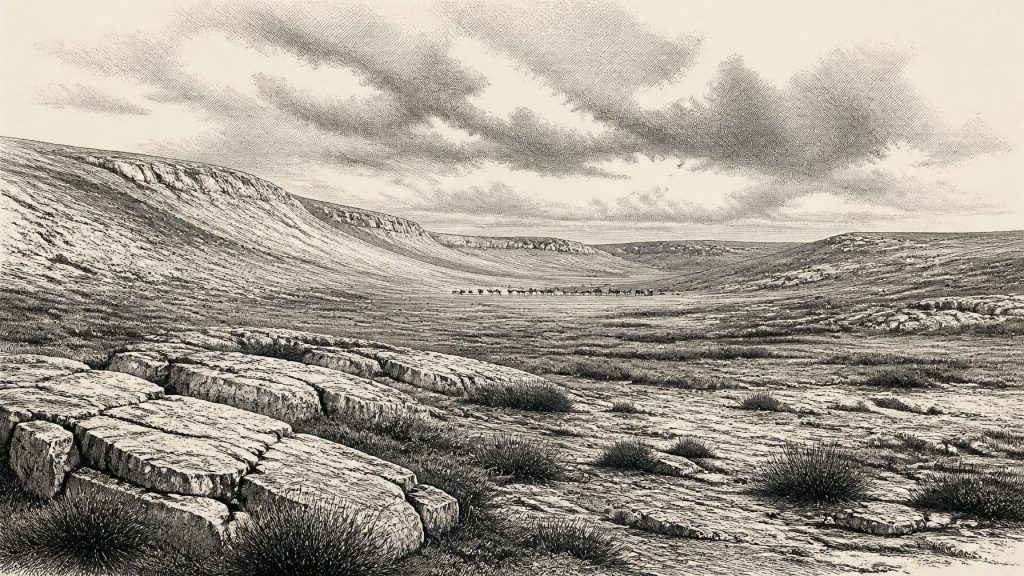
Later MIS 3 was not a single, unchanging freeze. Greenland ice-core records show repeated abrupt shifts between colder stadial conditions and relatively milder interstadials across the North Atlantic world. Ireland’s local evidence is too sparse to assign a precise Irish weather pattern to 31,701 BCE, but it is reasonable to see the country within a cold, highly variable climatic regime rather than as either permanently ice-covered or permanently temperate. Open ground, sparse vegetation, exposed soils and seasonally severe conditions formed the broad environmental setting in the periods represented by southern Irish fossil assemblages.
The familiar wooded Ireland of later prehistory did not exist. Trees were limited or absent across much of the cold-stage landscape, while grasses, sedges, herbs, dwarf shrubs and hardy tundra plants could occupy suitable ground. In northern deposits, plant remains and insect evidence have been used to identify episodes of treeless, cold-adapted vegetation, including arctic-alpine species. Such records do not provide a photograph of every region at one moment, but they establish the kinds of environments that could develop in Ireland before the Last Glacial Maximum.
Water and coastlines were also unlike those of the modern island. Large volumes of water were locked in continental ice sheets, lowering global sea level, but local relative sea level was complicated by the weight and movement of ice and by the shape of the Irish Sea basin. It is unsafe simply to imagine a continuous, dry land bridge from Ireland to Britain. Geological studies have challenged that old assumption, especially for routes across the Irish Sea. Nevertheless, animals demonstrably reached Ireland during the Pleistocene. Their movements may have involved changing coastal plains, short crossings, ice margins, temporary connections or combinations of these. The exact route remains an archaeological and geomorphological question, not a settled fact.
Castlepook’s Fossil Archive
The principal Irish place for this period is Castlepook Cave near Doneraile in north County Cork, above the Awbeg Valley. Excavated principally in the early twentieth century and once popularly called Mammoth Cave, its passages yielded a remarkable collection of Pleistocene animal remains. The National Museum of Ireland identifies it as the country’s most important cave site for mammal remains from the last cold stage. Among bones recovered from Castlepook are remains attributed to woolly mammoth, reindeer, giant deer, brown bear, wolf, Arctic fox, mountain hare, lemmings and spotted hyaena.
That list must be read carefully. It does not mean that every species grazed or hunted beside the Awbeg on one day in 31,701 BCE. The cave was excavated before modern standards of stratigraphic recording, and later research has shown that its deposits were complex, disturbed and sometimes re-sorted. A cave may be a carnivore den, a natural trap, a place into which bones fall through fissures, and a sedimentary archive at different times. Individual specimens have been directly dated, but the assemblage as a whole is a time-depth record rather than a neatly sealed living surface.
Even so, it changes the scale on which Ireland’s Ice-Age ecology must be imagined. Reindeer indicate cold, open country and mobile grazing herds. Lemmings and Arctic fox point towards severe environments, while mammoth and giant deer evoke a large-herbivore community wholly absent from later historic Ireland. Spotted hyaena is especially striking. Castlepook is the only Irish locality currently known to have produced its remains, and its presence demonstrates that the island’s Pleistocene carnivore world was more varied than the later Irish fauna. Predators, scavengers and herbivores together imply connected food webs, though not necessarily a single simultaneous community.
Scientific re-examination has sharpened, but also complicated, the chronology. The Irish Quaternary Fauna Project showed that a broad range of mammals reached Ireland between at least about 45,000 and 20,000 radiocarbon years ago. Improved pretreatment and redating of bones from Castlepook, Foley Cave and Shandon Cave later produced dates thousands of radiocarbon years older than some earlier determinations. The revised work suggests that giant deer and spotted hyaena may have disappeared locally before about 40,000 calibrated years ago. Thus those species are highly relevant to the wider MIS 3 environment, but cannot automatically be placed at the specific calendar label used here.
The Marked Reindeer Femur
One Castlepook object gives this era a special, if cautious, human dimension: a reindeer femur bearing a deep mark interpreted by zooarchaeologist Ruth Carden as a cut or chop made with a sharp stone implement while the bone was fresh. County Cork heritage material presents the specimen as dating to about 31,000 BC and as possible evidence that Palaeolithic hunters processed reindeer in the Doneraile area. If the mark is confirmed as humanly made and contemporary with the death of the animal, it would be dramatically earlier than Ireland’s long-established record of post-glacial occupation.
Yet this is evidence for a possible action, not a proven settlement. The bone was recovered from an antiquarian cave collection, rather than from a modern excavation exposing an intact hearth, floor or campsite. No securely associated stone-tool assemblage, dwelling, burial, fire-place, butchered bone concentration or repeated occupation layer of comparable age has been demonstrated at Castlepook. The radiocarbon date measures the age of the animal’s death, not automatically the date of the incision, the place where the animal was killed, or the length of any human visit.
The most responsible conclusion is therefore modest. Around the broad period to which 31,701 BCE belongs, people may have entered Ireland or its southern landscape briefly as part of wider Upper Palaeolithic movements through north-west Europe. They may have followed or encountered reindeer herds and used sharp stone edges to process carcasses. But Ireland cannot yet be described as permanently inhabited, nor can a particular group’s identity, route, technology or social organisation be recovered from the femur alone. The National Museum of Ireland continues to state that clear evidence of Palaeolithic human presence has not yet emerged, a useful reminder that the Castlepook claim remains exceptionally important but not fully settled.
Daily Life Beyond the Evidence
If people were present, their economy would have been based on hunting, scavenging, gathering and the careful use of animal materials, not farming. There were no crops, livestock, pottery villages, metal tools or managed fields in Ireland. A reindeer carcass could have supplied meat, fat, hide, sinew, bone and antler; the marked femur is at least compatible with such practical processing. But compatibility is not proof. It cannot tell us whether a party was large or small, whether it camped nearby, whether the hunt was successful, or whether the bone was later moved into the cave by carnivores.
For the same reason, trade and diplomacy cannot be inferred. Long-distance connections are plausible in the broad biological sense: the Castlepook fauna proves that Irish environments were not sealed off from wider north-west European ecological processes. Human movement, if the cut mark is anthropogenic, would likewise imply some route into the region. But no imported object, exchange network, alliance or territorial boundary is identifiable. Nor can archaeologists responsibly assign beliefs, ceremonies, cave art or a language to this sparse trace. Absence of evidence is not proof that people lacked culture; it is recognition that the surviving Irish record has not preserved it.
Approaching the Ice Maximum
The era’s greatest historical force was environmental rather than political. The British–Irish Ice Sheet did not reach its greatest reconstructed volume until about 23,000 years ago, while major growth across Ireland and Britain occurred from roughly 31,000 to 26,000 years ago. From the standpoint of 31,701 BCE, the fullest expansion lay in the future, but the climatic trajectory was towards greater cold and enlarged ice. Subsequent ice advance, erosion and reworking would remove, bury or disrupt much of the evidence for earlier landscapes and any fleeting human presence.
This destructive history helps explain why the archive is so thin. Ireland’s archaeological story at this date is not one of kings, battles or institutions, but of a difficult threshold: open cold-stage habitats capable of supporting substantial mammals; changing routes through a reshaped seascape; perhaps a passing human encounter with reindeer; and, later, the expansion of ice that transformed the land and obscured its oldest traces. Castlepook’s bones therefore matter not because they furnish a complete narrative, but because they show how much life—and how much uncertainty—lies beneath Ireland’s later prehistoric past.
Primary Sources
- The Irish Quaternary Fauna Project
- A reconsideration of the radiocarbon dating of the Marine Isotope Stage 3 fauna from southern Ireland
- The Exploration of Castlepook Cave, Co. Cork
- Spotted Hyena Skull
- Prehistoric Details
- Heritage Artefacts of County Cork 2021
- The Archaeological Heritage of County Cork
- Growth and Retreat of the Last British–Irish Ice Sheet, 31,000 to 15,000 Years Ago: the BRITICE-CHRONO Reconstruction
- Pattern and Timing of Retreat of the Last British-Irish Ice Sheet
- Stratigraphic and Palaeo-Geomorphological Evidence for the Glacial-Deglacial History of the Last British-Irish Ice Sheet in the North-Western Irish Sea
- Character of Advance and Retreat of the Southwest Sector of the British-Irish Ice Sheet During the Last Glaciation
- New Data for the Last Glacial Maximum in Great Britain and Ireland
- The Problem of a Late Quaternary Landbridge Between Britain and Ireland
- The Island of Ireland: Drowning the Myth of an Irish Land-Bridge?
- Ireland: Submerged Prehistoric Sites and Landscapes
- First Evidence of a Late Upper Palaeolithic Human Presence in Ireland
- New Insights on the Fauna of Ireland’s Younger Dryas and Early Holocene from Alice & Gwendoline Cave
- The IntCal20 Northern Hemisphere Radiocarbon Age Calibration Curve (0–55 cal kBP)
- A Stratigraphic Framework for Abrupt Climatic Changes During the Last Glacial Period Based on Three Synchronized Greenland Ice-Core Records
- Palaeolithic Ireland: New Evidence Emerges from the Emerald Isle