North Cork Reindeer Limb31695 BCE
Around 31,695 BCE, during later Marine Isotope Stage 3, Ireland was cold, open and partly affected by advancing glaciation. Buried freshwater deposits at Derryvree and Greenagho in Fermanagh demonstrate ice-free terrestrial environments before renewed ice advances. Castlepook Cave, County Cork, preserves remains of reindeer, mammoth, giant deer, bear, wolf and hyaena, indicating a Late Pleistocene grazing and predator landscape. A reindeer femur bearing a possible stone-tool cutmark may represent Ireland’s earliest human trace, but its uncertain cave context precludes proof of settlement. No tools, hearths, burials or social institutions are known. Environmental evidence, rather than human history, defines this period.
Dateline
31,695 BCE is not a date at which Irish prehistory can be narrated year by year. It is a modern calendar label, equivalent to roughly 33,645 years before the conventional radiocarbon reference year of AD 1950, and neither people nor events in Ireland at this depth of time can be fixed to a particular calendar year. The responsible frame is therefore a calibrated range and an archaeological period: later Marine Isotope Stage 3 (MIS 3), before the Last Glacial Maximum. For the island, the evidence is exceptionally fragmentary, but it is not entirely silent. Organic deposits beneath later glacial sediments and animal remains from limestone caves illuminate a cold, changing landscape in which a fleeting human visit is possible, rather than a documented settled population.
A Landscape Before Full Glaciation
At this point in the last Ice Age, Ireland was moving towards, but had not yet reached, the maximum expansion of the British-Irish Ice Sheet. The Last Glacial Maximum is generally placed at about 26,500–19,000 calibrated years BP, much later than the date considered here. Evidence for the earlier build-up of ice is complex and remains debated from region to region. Yet dated deposits beneath till show that substantial areas of Ireland had remained ice-free during parts of MIS 3. The important point is not that every valley was open at the same time, but that the familiar picture of an island wholly buried beneath ice does not fit this earlier interval.
In County Fermanagh, organic-rich silts at Derryvree, near Maguiresbridge, lay between two tills: sediments left by separate advances of glacier ice. A radiocarbon determination from the organic material has been calibrated broadly to about 36,900–31,700 years BP. That span includes the broad chronological neighbourhood of 31,695 BCE. Another sub-till freshwater deposit at Greenagho has produced a calibrated range of roughly 37,200–35,700 BP. These are not occupation sites, and they do not provide a weather report for a single year. They do, however, securely show that freshwater and terrestrial environments existed in parts of northern Ireland before renewed ice covered the deposits.
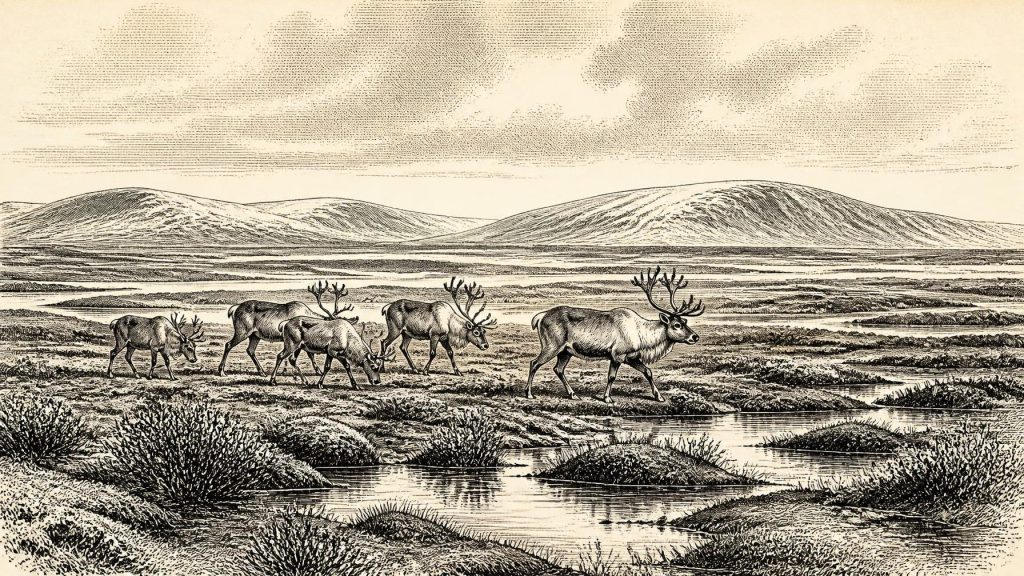
The plants and insects recovered from such buried sediments suggest an exposed periglacial country. At Derryvree, the evidence has been interpreted as a treeless muskeg or wetland landscape, with sedges, mosses and plants able to endure short growing seasons, frozen ground and difficult drainage. This was not a uniform white wilderness. Pools, wet hollows, mineral ground, stream margins and drier patches would have created different habitats within a generally cold setting. Wind, seasonal snow, frost action and low vegetation cover shaped the ground. The woodlands, enclosed fields and peat bogs of later Ireland belonged to a very distant future.
The Cave Record of North Cork
Southern Ireland offers another, very different archive. Castlepook Cave near Doneraile, County Cork, was excavated in the early twentieth century, when methods of recording cave deposits were far less exacting than they are today. Its old collections, held by the National Museum of Ireland, nevertheless preserve bones of animals that lived in Ireland before the Last Glacial Maximum. Reindeer, giant deer, mammoth, brown bear, wolf and spotted hyaena are among the species represented in the wider Castlepook assemblage. Together they indicate a landscape capable of sustaining large grazing animals and their predators during colder phases of the Late Pleistocene.
The assemblage must be handled carefully. Caves are not straightforward snapshots of an outdoor animal community. Carnivores can drag carcass parts into them; water and sediment can move bones; bones from separate periods may become mixed; and antiquarian excavations rarely retained the precise stratigraphic information now expected. Recent redating has also shown that some older Irish cave radiocarbon measurements required revision, in certain cases producing markedly older ages. Castlepook is thus valuable precisely because it preserves a long and complicated record, but it cannot establish that every species lived together, or was present in the same valley, at one moment around 31,695 BCE.
Reindeer are particularly important for understanding the broad environment. Their presence is consistent with open, cold habitats and seasonal movement across a wider north-west European zone. Mammoth and giant deer reinforce the picture of a fauna unlike that of modern Ireland, while hyaena and wolf reveal functioning predator–scavenger relationships. These animals were not symbols of an imagined “Celtic” past, nor evidence of later Irish traditions. They belonged to a Pleistocene ecological world that would be profoundly disrupted by advancing ice, changing sea levels and the repeated reorganisation of habitats.
The Marked Femur
One object from Castlepook has attracted particular attention: a reindeer femur bearing a deep incision interpreted by zooarchaeologist Ruth Carden as a cut made by a sharp stone edge during carcass processing. County Cork heritage material has presented the bone as dating to around 31,000 BCE. If the mark is correctly identified as a stone-tool cut, it is potentially the earliest evidence for human activity in Ireland by a very large margin. It would suggest that at least one person handled a reindeer carcass in the broader period represented by the bone. It does not, by itself, identify the people, their language, their numbers, their sex, their route of arrival or the duration of their stay.
The distinction between the observation and its interpretation matters. The observed facts are a reindeer limb bone, its radiocarbon age as reported for the specimen, and an incision on its surface. The interpretation is that the incision is a deliberate cutmark, rather than damage made by a carnivore, excavation tool, sediment movement or another process. Specialists assess such questions through the mark’s form, position and microscopic characteristics, but the old excavation context limits what can be concluded. There are no securely associated stone tools, hearths, dwelling floors, human remains, ornaments, burials or art from Ireland of this age. The bone therefore supports, at most, a possible brief Upper Palaeolithic human incursion, not a demonstrated settlement.
Nor can the femur tell us whether a hunter killed the reindeer, scavenged a dead animal, stripped hide, removed meat, separated a joint or sought sinew or marrow. The bone may have reached the cave only after carnivores moved discarded remains from an outdoor processing place. That possibility is not a weakness to be hidden; it is part of the historical value of the find. It makes visible the chain of decisions and natural processes that must be reconstructed before a cave bone becomes evidence for human action. Renewed investigation at Castlepook has sought surviving undisturbed deposits that may eventually test the older collection against a modern excavation record.
People Without a Recorded Society
If humans were present, their social world remains beyond direct recovery. There is no evidence for chiefs, territories, political institutions, alliances, warfare, diplomacy or inherited authority in Ireland at this date. There is likewise no basis for reconstructing religion, named beliefs, teaching, language, artistic convention or ceremonial practice. Such absences are not trivial gaps in a familiar national story: they are the central condition of the evidence. The earliest potential human trace is a single modified animal bone, not a settlement archive. To attach later cultural identities to it would be anachronistic.
Some inferences are reasonable at a very general level. A person capable of making the Castlepook incision, if the interpretation is accepted, possessed a sharp lithic tool and knowledge of animal anatomy sufficient to process a carcass. In the wider European Upper Palaeolithic, small mobile groups used stone technologies, moved across large seasonal landscapes and drew food, hide, bone and sinew from animals. That continental context helps explain what a cutmark might mean, but it must not be mistaken for proof that the same practices occurred in Ireland. Irish evidence has not yielded the implements or camp deposits needed to demonstrate them locally.
Economy and trade are similarly unresolvable. There is no evidence for farming, livestock keeping, cereal cultivation, pottery production, metalworking or exchange networks in Ireland around this time. Any food-getting by visiting people would have depended on wild resources: most visibly large herbivores, but potentially smaller animals, birds, fish and gathered plants where season and locality allowed. “Trade” is too strong a word for the available record. Movement, however, is inherent in the problem. Ireland’s coasts and surrounding shelf were configured differently under lower global sea levels, but the precise routes, crossings and degrees of connection with Britain and continental Europe are uncertain. A lower sea level does not automatically prove a walkable land bridge.
What This Date Can Mean
The strongest historical development around 31,695 BCE is environmental rather than political. Ireland contained, or lay close to, cold but biologically active landscapes during MIS 3. Fermanagh’s buried freshwater deposits preserve plants and insects from one such setting; Cork caves preserve the bones of animals adapted to an open Pleistocene world; and Castlepook’s marked reindeer femur raises the possibility that people entered that world as well. These lines of evidence do not form a continuous story. They are geographically separated, differ in date and preservation, and each has its own uncertainties.
Within several millennia, ice expansion would transform the island, erase many exposed traces and help explain why the Irish Palaeolithic record is so sparse. Glacial erosion, later marine change and the loss of lowland landscapes have all reduced the chance that short-lived camps survived. The appropriate image for 31,695 BCE is consequently not a populated prehistoric Ireland with known customs, but a cold, open and dynamic land: wetland basins in the north, large mammals in the south, approaching ice, and one reindeer bone that may preserve the faintest sign of a human hand.
Primary Sources
- First evidence of a Late Upper Palaeolithic human presence in Ireland
- A reconsideration of the radiocarbon dating of the Marine Isotope Stage 3 fauna from southern Ireland
- Phylogeographic, ancient DNA, fossil and morphometric analyses reveal ancient and modern introductions of a large mammal: The complex case of red deer (Cervus elaphus) in Ireland
- Trimlines, blockfields and the vertical extent of the last ice sheet in southern Ireland
- The IntCal20 Northern Hemisphere Radiocarbon Age Calibration Curve (0–55 cal kBP)
- The IntCal20 approach to radiocarbon calibration curve construction: a new methodology using Bayesian splines and errors-in-variables
- Maximum extent and readvance dynamics of the Irish Sea Ice Stream and Irish Sea Glacier since the Last Glacial Maximum
- The timing and magnitude of the British–Irish Ice Sheet between Marine Isotope Stages 5d and 2: implications for glacio-isostatic adjustment, high relative sea levels and ‘giant erratic’ emplacement
- Ireland: Submerged Prehistoric Sites and Landscapes
- Advances in Irish Quaternary Studies
- Figure 6.— The subdivision of the Quaternary Period in Ireland
- The Irish Quaternary Fauna Project
- 2022:564 – Castlepook Cave, Castlepook South, Cork
- Archaeology Research Excavation Grant 2022: Final Report
- Heritage Artefacts of County Cork
- New insights on the fauna of Ireland's Younger Dryas and Early Holocene from Alice & Gwendoline Cave
- Climate change and hunter gatherers in Ireland: problems, potentials and pressing research questions
- Lateglacial vegetation and environment in Ireland: First results from four western sites
- Early deglaciation of the British-Irish Ice Sheet on the Atlantic margin of Ireland
- A critical review and re-investigation of the Pleistocene deposits between Cranfield Point and Kilkeel, Northern Ireland: Implications for regional sea-level models and glacial reconstructions of the northern Irish Sea basin