Derryvree’s Permafrost Garden31660 BCE
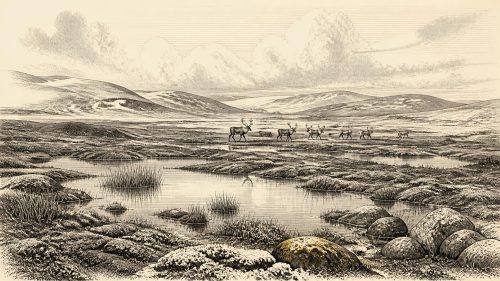
Around 31,660 BCE, Ireland lay in the later Marine Isotope Stage 3, as conditions worsened before the Last Glacial Maximum. Derryvree, County Fermanagh, preserves silts recording an ice-free, periglacial wetland of tundra, sedges, mosses, insects and shallow pools. Castlepook Cave, County Cork, demonstrates the presence of cold-stage fauna, including mammoth, reindeer, giant deer, predators and smaller mammals, though not necessarily simultaneously. A marked reindeer femur may indicate brief human butchery, but cannot prove settlement. No polities or cultural communities are evidenced. Expanding ice, changing sea levels and uncertain routes made Ireland severe, intermittently accessible and ecologically still linked to Europe.
Dateline
“31,660 BCE” is a modern way of placing a point in deep time, not a date that people in prehistoric Ireland could have recognised or recorded. It corresponds roughly to 33,610 years before AD 1950, the conventional reference point for radiocarbon chronology. No evidence can resolve events in Ireland to that individual year. The responsible frame is therefore a broad one: the later part of Marine Isotope Stage 3, before the Last Glacial Maximum, when Ireland’s landscapes, sea routes and ice cover were changing on millennial rather than annual timescales.
The closest well-dated Irish environmental sequence is at Derryvree, near Maguiresbridge in County Fermanagh. There, road works exposed organic silts and fine sands trapped beneath a drumlin. The deposit yielded a conventional radiocarbon age of 30,500 ± c.1,100 radiocarbon years BP; calibration places it broadly between about 36,900 and 31,700 calendar years BP. Thus 31,660 BCE lies at, or just beyond, the young end of this wide range, not at a securely identifiable horizon. The deposit is nevertheless unusually valuable: it preserves a glimpse of an Irish landscape shortly before the last great expansion of the Irish Ice Sheet.
An Open, Bitter Landscape
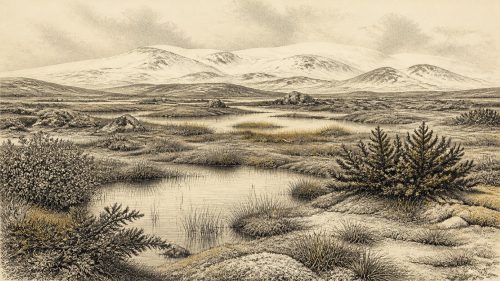
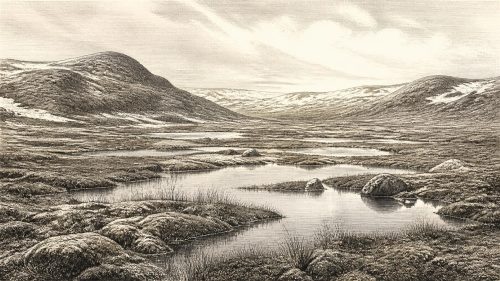
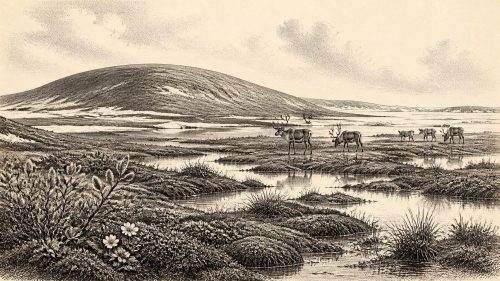
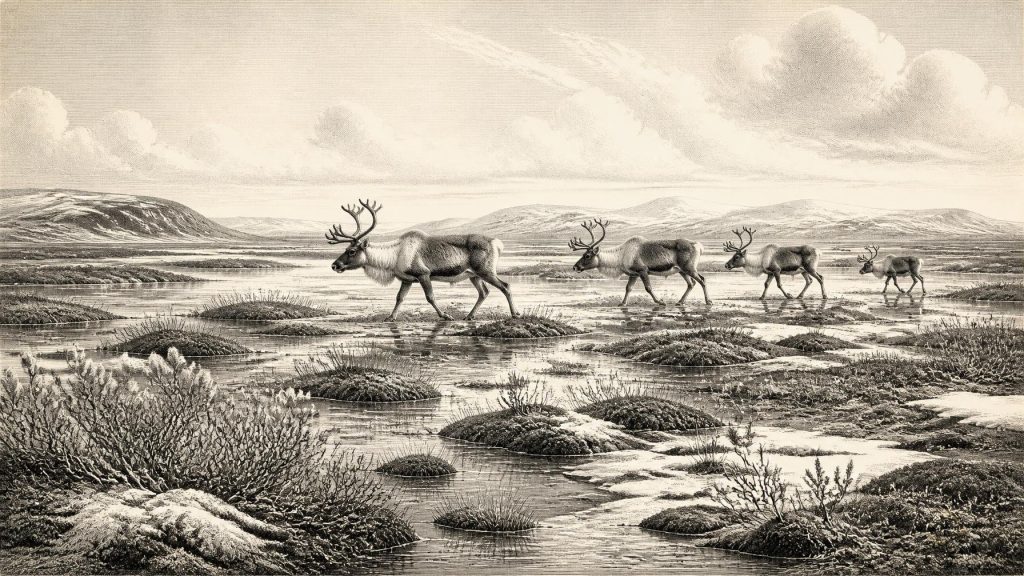
Derryvree was not a wooded version of modern Fermanagh. Pollen, plant macrofossils, mosses and insects indicate open tundra or muskeg: a cold, wet, largely treeless terrain with sedges, grasses, herbs, dwarf shrubs and patches of moss around shallow pools. The term muskeg denotes waterlogged, peat-forming ground with a complex mixture of open water and vegetation. It should not be imagined as a uniform frozen desert. In sheltered hollows there were freshwater habitats and decaying plant matter; across exposed ground, however, vegetation was probably sparse and the growing season short.
Periglacial conditions shaped this country. That means a climate associated with intense freezing and thawing near an ice-sheet margin, whether or not a particular location lay beneath glacier ice at a particular moment. Frozen ground, seasonal meltwater, unstable slopes and wind-blown sediment affected drainage and soils. The drumlin that later sealed the Derryvree sediments is itself part of the much younger-looking but immensely consequential glacial legacy that dominates Ireland’s physical geography. Around this date, the evidence indicates that north-central Ireland had still been ice-free within the broad Derryvree interval, but conditions were deteriorating as regional ice expanded.
Ireland Before Complete Ice Cover
The precise advance history of the last Irish Ice Sheet remains an active research problem, and it is important not to turn a general reconstruction into a fixed map for one notional year. Recent syntheses broadly place the build-up of the last British–Irish Ice Sheet between about 34,000 and 27,000 calendar years BP, with its maximum extent later, approximately 27,000–23,000 calendar years BP. At that maximum, ice covered Ireland and extended across much of its surrounding shelf. The Derryvree and Greenagho deposits show that, before this culmination, at least parts of Ireland retained exposed land, freshwater settings and tundra vegetation.
At roughly 33,610 calendar years BP, therefore, Ireland was neither reliably the familiar modern island nor demonstrably a single unbroken white ice cap. Lower global sea level exposed more continental shelf than today, but exposed shelf is not automatically a walkable land bridge. Glaciers, ice shelves, channels, shifting shorelines and local crustal movements complicate every reconstruction. Geological work has especially challenged easy claims of a southern Irish Sea land connection. For this period, the safest conclusion is that the geography between Ireland, Britain and continental Europe was dynamic and that animal movement was possible during favourable phases, while the exact routes remain uncertain.
The Castlepook Faunal World
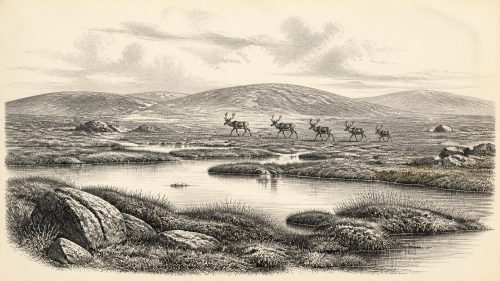
County Cork offers the other major Irish line of evidence. Castlepook Cave, also known as Mammoth Cave, near Doneraile, contains one of Ireland’s most important Pleistocene bone assemblages. Its deposits and historic collections include remains attributed to woolly mammoth, reindeer, giant deer, brown bear, wolf, fox, hare, lemmings and spotted hyaena. The assemblage does not prove that every species lived together at the same instant, nor that the cave was a settled animal community. Cave deposits accumulate over long spans and are altered by scavenging, water movement, excavation and collecting. Even so, they establish that a substantial cold-stage fauna reached southern Ireland during Marine Isotope Stage 3.
Modern re-dating has transformed this picture. Improved collagen preparation and accelerator mass spectrometry showed that several older cave-bone dates had understated the age of the Castlepook fauna by thousands of radiocarbon years. The revised results place important animals well before the Last Glacial Maximum; some evidence suggests that giant deer and spotted hyaena disappeared locally before about 40,000 calendar years BP. For the broad period around 31,660 BCE, reindeer and mammoth are more appropriate symbols of Ireland’s recorded Ice Age fauna than later familiar animals such as cattle, sheep or red deer. Yet even this phrasing needs care: fossil evidence documents presence in a broad interval, not an annual census of the island.
A Reindeer Bone and Human Possibility
One Castlepook object has particular importance for human history: a reindeer femur bearing a deep linear mark interpreted as damage made during butchery with a sharp stone implement. It has been publicly reported as dating to about 33,000 years ago, close to the broad chronological setting of this article. If the modification is confirmed as human-made and contemporary with the animal’s death, it would be Ireland’s earliest known evidence of human activity by a very large margin. It would suggest a short visit by Upper Palaeolithic hunters who obtained and processed a reindeer, rather than a people for whom Ireland was necessarily a permanent homeland.
The distinction matters. The bone derives from an old cave collection rather than a newly excavated, securely stratified camp floor with hearths, tools, food waste and repeated occupation surfaces. There is no known house, burial, stone-tool assemblage or cultural layer in Ireland that can responsibly be assigned to 31,660 BCE. Nor can the femur identify a named people, language or political group. It is best treated as potentially momentous but limited evidence: a trace consistent with human handling of an animal, not proof of a village, a colonising population or uninterrupted settlement.
No Polities, but Real Ecologies
For this reason, conventional headings such as political affairs, diplomacy, warfare, religion and learning have no direct content at this date. There were no Irish states, chiefs, treaties, written traditions or monuments evidenced in the record. Conflict may have occurred among predators, or between any visiting hunters and dangerous animals, but archaeology cannot recover it as a historical narrative. Likewise, no ritual practice can be inferred from Derryvree’s mosses or Castlepook’s bones. Silence here is not a claim that Ice Age people lacked social worlds, beliefs, knowledge or culture; it is a recognition that the Irish evidence does not reveal their particulars.
Society and economy can only be approached at the scale of subsistence possibilities. Reindeer, if hunted, would have offered meat, fat, hide, sinew, antler and bone; a single carcass could be a valuable resource for a small mobile party. Mammoth remains demonstrate the presence of far larger animals, although there is no sound evidence that people in Ireland hunted them. Hyaenas may have carried bones into caves or scavenged carcasses, while caves provided traps and preservation conditions for material that seldom survives in open terrain. These processes mean that Castlepook is an archive of ecological interactions rather than a straightforward hunting site.
What This Date Can Mean
The strongest history of Ireland around 31,660 BCE is consequently environmental and evidential. The island included open, cold, wet ground in Fermanagh; Ice Age mammals had reached areas such as north Cork; and the last major glaciation was gathering force, soon to erase or bury much of the earlier terrestrial record. The apparent scarcity of evidence is partly historical reality and partly preservation: advancing ice scoured landscapes, later sea-level change drowned former coastal zones, and many surviving bones were recovered before modern excavation standards.
This was a threshold rather than a year of known events. Derryvree preserves plants and insects from a periglacial wetland; Castlepook preserves animals from a changing faunal world; one marked reindeer bone raises the possibility that people briefly entered that world. Together they replace the old image of an empty prehistory with a more demanding one: Ireland was a severe but living northern landscape, intermittently accessible, ecologically connected to wider Europe, and poised before the ice reached its greatest extent.
Primary Sources
- Palaeoecology
- Trimlines, Blockfields and the Vertical Extent of the Last Ice Sheet in Southern Ireland
- A Reconsideration of the Radiocarbon Dating of the Marine Isotope Stage 3 Fauna from Southern Ireland
- Spotted Hyena Skull
- The Irish Quaternary Fauna Project
- Growth and Retreat of the Last British–Irish Ice Sheet, 31,000 to 15,000 Years Ago: the BRITICE-CHRONO Reconstruction
- BRITICE-CHRONO Maps and GIS Data of the Last British-Irish Ice Sheet 31 to 15 ka
- Late Pleistocene Chronostratigraphy and Ice Sheet Limits, Southern Ireland
- Maximum Extent and Dynamic Behaviour of the Last British–Irish Ice Sheet West of Ireland
- Oscillating Retreat of the Last British-Irish Ice Sheet on the Continental Shelf Offshore Galway Bay, Western Ireland
- Stratigraphic and Palaeo-Geomorphological Evidence for the Glacial-Deglacial History of the Last British-Irish Ice Sheet in the North-Western Irish Sea
- Ireland: Submerged Prehistoric Sites and Landscapes
- The Colonization of Ireland: A Human Ecology Perspective
- The Problem of a Late Quaternary Landbridge Between Britain and Ireland
- Deglaciation, Earth Crustal Behaviour and Sea-Level Changes in the Determination of Insularity: A Perspective from Ireland
- New Insights on the Fauna of Ireland's Younger Dryas and Early Holocene from Alice & Gwendoline Cave
- Occurrence of Mammalia Relicts at Site Castlepook Cave
- On the Discovery of Hyaena, Mammoth and Other Extinct Mammals in a Carboniferous Cavern in County Cork
- Late Pleistocene Mountain Glacier Response to North Atlantic Climate Change in South West Ireland
- A 10Be-Dated Record of Glacial Retreat in Connemara, Ireland, Following the Last Glacial Maximum and Implications for Regional Climate
- Reindeer Bone Found in Cork Cave Shows Human Activity in Ireland 33,000 Years Ago
- Heritage Artefacts of County Cork 2021