
Maguiresbridge and Castlepook31624 BCE
Approximately 31,624 BCE, Ireland lay within the unstable Marine Isotope Stage 3 cold period, not a precisely identifiable historical year. Inter-till deposits at Derryvree, Greenagho and Hollymount in Fermanagh show episodes of ice-free freshwater tundra later overridden by glaciers. Plant and insect remains indicate open, treeless, periglacial environments, while fluctuating sea levels and ice complicated access to the island. Castlepook Cave in County Cork preserves bones of mammoth, reindeer, giant deer, bears, wolves and hyaenas, reflecting intermittent cold-adapted fauna. A possibly cut-marked reindeer bone suggests, but does not prove, Upper Palaeolithic human activity. No institutions or political history are known.
Dateline
The label 31,624 BCE cannot identify a year of Irish history in the usual sense. No calendar, written testimony, named people or datable event survives from Ireland at this depth of time. Converted only as a modern chronological convenience, it falls roughly 33,573 years before AD 1950, the conventional ‘present’ of radiocarbon chronology. That arithmetic conversion must not be mistaken for archaeological precision. For the Late Pleistocene, evidence is normally dated in calibrated ranges, often spanning centuries or millennia, and the relationship between radiocarbon and calendar years is not a simple subtraction.
This point lies within Marine Isotope Stage 3, a prolonged and highly unstable portion of the last Ice Age. In Ireland it belongs to the Midlandian cold stage, but not straightforwardly to the island-wide Last Glacial Maximum, whose fullest expansion came later, broadly between about 27,000 and 23,000 calibrated years BP in many reconstructions. Around 31,624 BCE, Ireland was a changing borderland of ice, exposed ground, freshwater basins and low sea levels. Its exact appearance differed by region and altered repeatedly over lifetimes and generations.
A Record of Intervals, Not Annals
The most illuminating evidence comes from deposits buried beneath later glaciers. At Derryvree, near Maguiresbridge in County Fermanagh, road works cut through a drumlin and revealed organic silts and fine sands between two distinct sheets of till. This was not a settlement layer. It was the residue of a freshwater environment later overridden and sealed by ice. The deposit produced a radiocarbon determination of 30,500 years BP, with a large laboratory uncertainty of +1,170 and −1,030 years. Published calibrations express its possible calendar age as a broad interval, approximately 36,900–31,700 cal BP. That range encompasses the modern date-label 31,624 BCE, but it cannot tell us what happened in one particular year.
Derryvree is nevertheless exceptionally important. Its sediments demonstrate that, during part of this cold phase, north-central Ireland had ice-free terrain capable of sustaining ponds, marshy margins and tundra vegetation. The upper till proves that this landscape was subsequently transformed by glacial advance. Rather than offering a continuous narrative, the site gives a before-and-after sequence: freshwater life, burial beneath ice, and eventual exposure by erosion and excavation many thousands of years later.
Other Fermanagh localities broaden the picture without providing an annual timetable. Organic deposits at Greenagho near Belcoo lay beneath till and have been associated with a middle Midlandian interstadial; a conventional radiocarbon result of about 32,460 BP has been treated cautiously and has calibrated broadly to c. 37,200–35,700 cal BP. Hollymount, also near Maguiresbridge, preserves another inter-till freshwater deposit. Together, these sites show that Ireland’s late Ice-Age history consisted of repeated climatic and glacial shifts, not one unbroken freeze. They do not justify mapping a single uniform landscape across the entire island in 31,624 BCE.
Tundra Water and Open Ground
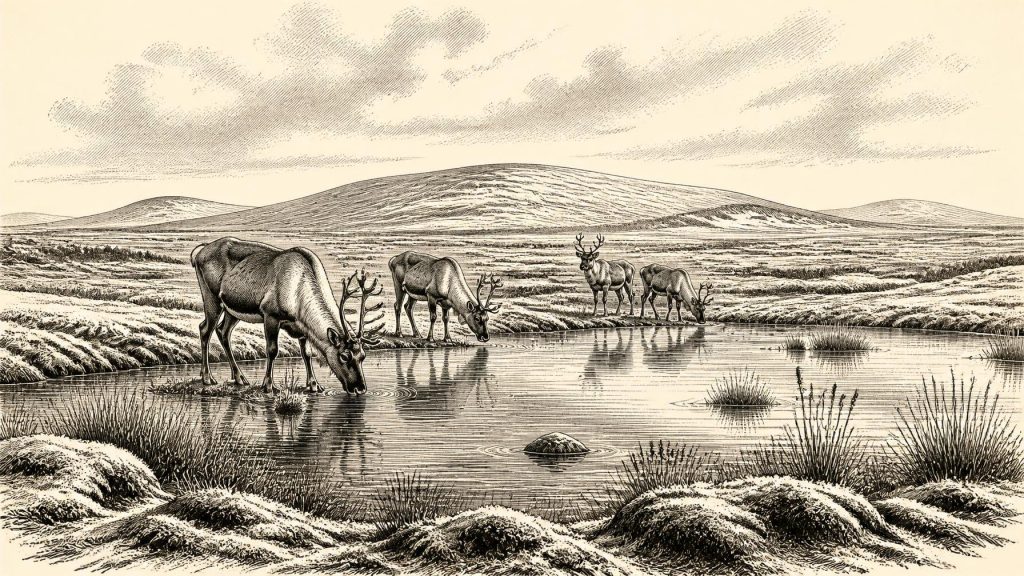
The Derryvree plant and insect evidence is the closest direct guide to conditions around this chronological horizon. Its assemblage indicates an open, treeless tundra or tundra-steppe landscape under a periglacial regime: ground subject to prolonged cold, frost action and seasonal thaw rather than dense woodland. Mosses and sedges grew around freshwater; finds including bogbean and mountain avens point to wet, cold-adapted habitats. Such plants do not imply a luxuriant marshland. They suggest shallow water, saturated margins and patches of vegetation within an exposed environment where wind, freezing and short growing seasons shaped what could survive.
‘Tundra’ should not conjure a flat, identical plain from Donegal to Cork. Ireland’s relief, geology and proximity to Atlantic waters would have created local differences. Valleys could hold water and sediment; limestone country offered caves and fissures; uplands were more exposed; and ice margins changed drainage routes. Seasonal snow cover, frozen ground and sparse vegetation were probable features in many places, but the precise temperature, snowfall and ice extent at the target point remain matters of reconstruction rather than observation.
Low global sea level exposed much of the continental shelf around north-west Europe. The modern coastline therefore did not define the land available to animals or people. Yet it would be misleading to picture an uncomplicated grassy bridge from Ireland to Britain or continental Europe. Glaciers, marine basins, shifting shorelines and local relative sea level all complicated the geography. Accessibility varied through time, and the routes that may have existed for large mammals were not necessarily dry, safe or continuously open routes for human groups.
Castlepook’s Animal World
Southern Ireland’s principal window onto this phase is Castlepook Cave, also known as Mammoth Cave, near Doneraile in north County Cork. Excavations begun in the early twentieth century recovered a remarkable Pleistocene bone assemblage. Later study and re-dating have shown both the value and difficulty of the collection: the cave contains evidence of animals from more than one episode, while early excavation methods did not provide the fine-grained stratigraphic control expected today.
Even with that caution, Castlepook establishes that Ireland supported, or was visited by, an Ice-Age fauna. Its records include woolly mammoth, reindeer, giant deer, brown bear, wolf and spotted hyaena. These are not a list of animals all demonstrably standing together in the Awbeg valley on the same day. Some remains may differ in age and some accumulated through carnivore activity. But the assemblage establishes the ecological possibilities of southern Ireland during the later part of MIS 3: large herbivores moving through open country, predators and scavengers following them, and caves acting at different times as shelters, dens, traps or repositories for bones brought in from outside.
Reindeer particularly suit the image of an open, cold-adapted landscape, while mammoth signals the wider north-west European mammoth-steppe world. Their presence does not mean that every part of Ireland was equally favourable. Nor does it make the island an ecological copy of the European mainland. Island geography, fluctuating access and changing ice cover could have made animal populations intermittent, small or locally absent. The surviving bones document occurrences, not stable population totals.
The Human Question
Castlepook has also changed the terms of debate about Ireland’s earliest people. A reindeer femur from the old cave collection was reported in 2021 as bearing deep marks consistent with cutting by a stone tool, and its date was publicised as about 33,000 years ago. If the marks are securely anthropogenic, the specimen would be powerful evidence that people reached Ireland during the Upper Palaeolithic, long before the previously accepted late-glacial evidence.
That conclusion remains appropriately cautious. The date belongs to the bone, not necessarily to the instant when a mark was made; one modified bone cannot prove a permanent settlement, identify a cultural group or show that a hunt occurred at the cave. Natural abrasion, carnivore damage, excavation damage and other processes can complicate assessments of marks on old bone. The National Museum of Ireland still notes that no clear evidence has yet established human presence in Palaeolithic Ireland. The responsible position for 31,624 BCE is therefore neither to declare the island certainly empty nor to populate it with an imagined hunting community. Castlepook raises a serious possibility of human activity within the wider period, but the evidence needs continued contextual, taphonomic and dating work.
No Polities, No Proven Settlements
There can be no political history for Ireland at this date in the conventional sense. No kings, chiefs, territories, diplomatic alliances, warfare, laws, languages or religious institutions can be recovered from the evidence. There are no known houses, hearths, campsites, tools in secure context, graves, monuments, cultivated fields or trade goods attributable to Ireland in this particular horizon. Consequently, claims about social rank, kinship systems, ritual practice, learning or exchange would be speculation.
Were people present, the wider European comparison would suggest small, mobile foraging groups whose lives depended on detailed knowledge of animals, weather, fuel, stone and seasonal routes. Such a comparison can help explain why a cut-marked reindeer bone would matter: reindeer offered meat, fat, hide, sinew and bone. It cannot be converted into evidence for an Irish band, a fixed camp at Castlepook, or an inherited local population. Comparison supplies a model, not a fact about this island.
The strongest story for 31,624 BCE is thus environmental and evidential. Fermanagh preserves a freshwater tundra interval enclosed between glacial deposits; north Cork preserves bones from a cold-world fauna and a debated sign of human modification. These fragmentary archives reveal an Ireland that was neither historically silent merely because nothing occurred nor historically knowable in the manner of a later society. It was a landscape repeatedly remade by climate and ice, occupied certainly by animals, and possibly—though not yet beyond dispute—visited by people.
Primary Sources
- A Middle Midlandian Freshwater Series at Derryvree, Maguiresbridge, County Fermanagh, Northern Ireland
- Early Midlandian–Middle Midlandian, Pleistocene, Northern Ireland
- Middle Midlandian Interstadial Deposits at Greenagho, Near Belcoo, County Fermanagh, Northern Ireland
- Irish Pleistocene Biostratigraphy
- The Irish Quaternary Fauna Project
- A Reconsideration of the Radiocarbon Dating of the Marine Isotope Stage 3 Fauna from Southern Ireland
- New Insights on the Fauna of Ireland’s Younger Dryas
- On the Cave of Castlepook, Near Doneraile, Co. Cork
- Heritage Artefacts of County Cork
- Prehistoric Details
- The Colonization of Ireland: A Human Ecology Perspective
- Palaeolithic Ireland: Fleeting Footprints in a Frozen Land
- The IntCal20 Northern Hemisphere Radiocarbon Age Calibration Curve (0–55 cal kBP)
- IntCal
- Quaternary Geological Map of Ireland
- Figure 6: The Subdivision of the Quaternary Period in Ireland
- Growth and Retreat of the Last British–Irish Ice Sheet, 31,000 to 15,000 Years Ago: The BRITICE-CHRONO Reconstruction
- Early Deglaciation of the British-Irish Ice Sheet on the Atlantic Shelf Northwest of Ireland Driven by Glacioisostatic Depression and High Relative Sea Level
- Last Glacial Maximum Cirque Glaciation in Ireland and Implications for Reconstructions of the Irish Ice Sheet
- Trimlines, Blockfields and the Vertical Extent of the Last Ice Sheet in Southern Ireland
- Glacial Geomorphology in the Wicklow Mountains, Ireland
- Deglaciation Chronology of the Donegal Ice Centre, North-west Ireland
- The Island of Ireland: Drowning the Myth of an Irish Land-Bridge?