
Maguirebridge’s Fossil Wetland31582 BCE
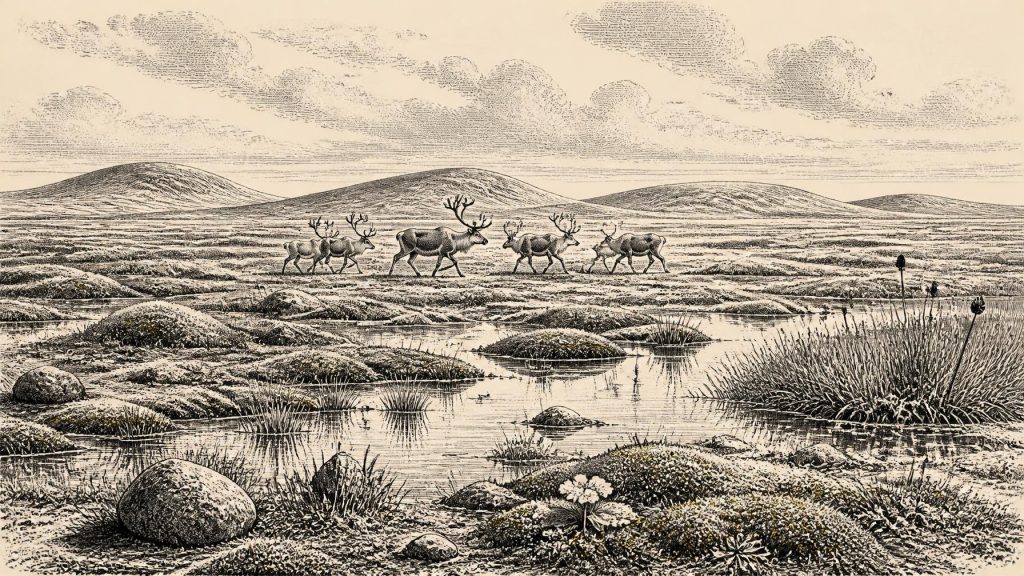
31,582 BCE is a modern label within an MIS 3 chronological range, not a datable Irish event. At Derryvree, County Fermanagh, freshwater sediments beneath glacial tills record an ice-free, periglacial tundra of wetlands, mosses, grasses and herbs, later overridden by advancing ice. Castlepook Cave, County Cork, preserves a mixed, long-accumulated fauna including mammoth, reindeer, giant deer, predators and cold-adapted small mammals, demonstrating Ice Age habitats. A marked reindeer femur may indicate stone-tool processing by people, but cannot prove settlement or sustained occupation. No evidence establishes later-style institutions. These sites reveal a dynamic, cold landscape before extensive Last Glacial Maximum ice.
Dateline
The label 31,582 BCE is a modern chronological convenience, not a year that could have been named, recorded or remembered in prehistoric Ireland. Nothing in the surviving evidence permits an event to be assigned to that single year, still less a ruler, battle or political decision. In archaeological terms it falls approximately 33,531 years before AD 1950, within Marine Isotope Stage 3 (MIS 3), an unstable interval of the Late Pleistocene. The responsible history of Ireland at this depth of time is therefore a history of sediments, fossil plants, animal bones and changing ice, presented in broad calibrated ranges rather than calendar-year precision.
The most revealing Irish evidence relevant to this horizon comes from two very different places: Derryvree, near Maguiresbridge in County Fermanagh, and Castlepook Cave near Doneraile in north County Cork. Derryvree supplies a rare environmental archive from beneath later glacial deposits. Castlepook preserves a remarkable but complicated collection of Ice Age animal remains, including one reindeer bone that may record human action. Neither site is a time capsule for 31,582 BCE. Together, however, they illuminate an Ireland that was cold, open, ecologically varied and vulnerable to a renewed advance of ice.
A Date Within a Range
At Derryvree, roadworks in 1969 cut through a drumlin and exposed freshwater silts and fine sands sealed between two thick layers of till: the unsorted debris deposited by glacier ice. That sequence establishes a relative history. Ice had covered the locality; an ice-free interval followed, allowing water, sediment and organic matter to accumulate; then a later glacier overrode and sealed the deposit. Organic material from the freshwater bed produced a conventional radiocarbon determination of 30,500 radiocarbon years before present, with a substantial uncertainty of +1,170 and −1,030 years.
Radiocarbon years are not identical to calendar years because atmospheric carbon levels have varied through time. Calibration consequently turns an apparently single laboratory figure into a broad and sometimes irregular calendar range. The Derryvree age has been expressed at roughly 36,900–31,700 calibrated years before present, or about 34,950–29,750 BCE. The nominal date of 31,582 BCE lies within that span, but it does not mark the beginning, end or peak of the deposit’s formation. It is better understood as one point within a millennia-long window onto Ireland’s Middle Midlandian, or MIS 3, environment.
This distinction is more than technical. Later ice sheets eroded and rearranged many ancient surfaces, while old cave excavations often removed deposits before modern recording standards existed. A date may establish when a plant grew or an animal died; it cannot automatically determine when a bone was moved, marked, buried or excavated. The very scarcity of securely stratified evidence means that each surviving fragment has unusual value, but also demands restraint.
Water Beneath the Drumlin
Derryvree demonstrates that at least part of Ireland was not continuously buried beneath ice during the broader period relevant to this date. Its freshwater sediments contained pollen, plant macrofossils, mosses and insect remains characteristic of a severe, largely treeless landscape. The published interpretation is open tundra with a periglacial climate: ground shaped by intense seasonal cold and frost, rather than a familiar temperate countryside of oak woods, hedges and pasture.
The setting should not be imagined as a uniform desert of snow. The evidence includes wetland plants and mosses, indicating biologically active freshwater margins, shallow pools and waterlogged ground. Sedges, grasses and herbs could take advantage of the short growing season. Fossil remains of bogbean, mountain avens and water-milfoil are particularly valuable because they give the Derryvree locality ecological texture: wet hollows and open water beside exposed, cold ground. The older term muskeg, used by researchers for this landscape, conveys a mosaic of moss-rich, peaty wetland rather than continuous woodland or an unbroken ice sheet.
Some pollen grains attributed to trees occur in the record, but they cannot responsibly be turned into a picture of local forest. Pollen can travel over considerable distances, and the wider assemblage points to sparse, predominantly herbaceous vegetation. The evidence supports open ground, strong seasonality and limited shelter; it does not tell us the precise temperature, snowfall or vegetation cover in every Irish valley during 31,582 BCE. Conditions in Fermanagh also cannot simply be projected onto the Atlantic coast, mountains or southern lowlands. Ireland’s changing ice margins, elevation and exposure to the ocean created regional variation.
Castlepook’s Animal World
In north Cork, Castlepook Cave offers the richest Irish archive for many pre-Last Glacial Maximum mammals. Excavated principally between 1904 and 1912 under the direction of the naturalist Richard J. Ussher, the cave was long known as Mammoth Cave because of its striking fossil assemblage. Subsequent re-examination and improved radiocarbon methods have shown that parts of the collection are much older than earlier dating programmes suggested. This matters because the cave records repeated phases of animal life and cave use, not one neatly contemporaneous herd or hunting episode.
The fauna associated broadly with MIS 3 includes woolly mammoth, reindeer, giant deer, brown bear, wolf, Arctic fox, mountain hare, Norwegian lemming, collared lemming and spotted hyaena. These animals establish an important point: Ireland could support, or be reached by, a far richer cold-stage fauna than its modern landscape suggests. Reindeer imply open grazing country; mammoths and giant deer likewise required extensive plant resources; lemmings and Arctic fox indicate cold-adapted habitats. Hyaenas and wolves reveal a food web in which large carcasses attracted predators and scavengers as well as herbivores.
Yet a cave bone assemblage is not a census of animals living outside the entrance at one time. Hyaenas could carry prey remains into their dens; water, gravity and later disturbance could move material; and the original excavators worked before stratigraphic methods were fully developed. Castlepook should therefore be read as a long-accumulated archive of ecological connections, carnivore activity and depositional processes. It confirms that Ice Age animals inhabited or visited Ireland during suitable phases, but it cannot reconstruct a particular season’s migration route or the size of any local herd.
The Reindeer Femur Question
One object gives this period unusual importance for Irish human history: a reindeer femur from Castlepook bearing a deep linear mark. Zooarchaeologist Ruth Carden has interpreted the modification as consistent with cutting or chopping on fresh bone with a sharp stone tool. County Cork heritage material dates the specimen broadly to about 31,000 BCE and presents it as potential evidence of Palaeolithic hunters processing reindeer in the Doneraile area. If that interpretation is sustained, it would place human activity in Ireland vastly earlier than the long-established terminal Pleistocene evidence.
Its potential is real, but its limitations are equally important. The bone derives from an old cave collection, not from a modern excavation of an undisturbed occupation surface. No securely associated hearth, stone-tool assemblage, shelter floor, human burial, food-preparation area or repeated camp sequence of comparable age has yet been recovered at Castlepook. A radiocarbon result dates the animal bone, not necessarily the exact moment of marking, the location where the animal was killed or the identity of whoever made the incision. Identifying a cut mark also requires careful distinction from carnivore damage, trampling, weathering, sediment movement and breakage.
The most defensible conclusion is therefore deliberately narrow. A reindeer lived in this wider Ice Age world, and its bone may preserve evidence that a person used a sharp stone implement during carcass processing. That is not evidence for a permanent settlement, a continuously occupied Ireland or a named population. Nor does it establish whether people hunted the animal, scavenged it after another predator’s kill, stayed for days, or merely crossed the landscape briefly. Renewed work at Castlepook may eventually test these possibilities through securely excavated deposits, but the present evidence does not licence certainty beyond the bone itself.
Society Beyond the Evidence
Political affairs, diplomacy and warfare cannot be recovered for Ireland at this date. There is no evidence for kingdoms, tribes, territorial borders, leaders, treaties or organised conflict. Likewise, no Irish object securely belonging to this period demonstrates a language, a religion, a burial custom, formal learning, artwork or exchange network. These absences should not be mistaken for proof that people in the wider Upper Palaeolithic world lacked complex social lives. They show only that Ireland has not yielded evidence through which such subjects can be described responsibly for this particular horizon.
Everyday life and economy can be discussed only as conditional inference. If people did reach Ireland, they would have needed knowledge of animal behaviour, fuel, weather, shelter and safe movement through a severe seasonal environment. Reindeer could offer meat, marrow, hides, sinew and bone; small, mobile groups elsewhere in Upper Palaeolithic Europe possessed the practical skills to exploit such resources. But no dwelling, toolkit or butchered assemblage establishes such a way of life in Ireland around 31,582 BCE. There is no evidence for local trade, boats, cultivated food, livestock, permanent villages or monuments.
The more certain economy was ecological. Short-season vegetation fed herbivores; herbivores sustained predators and scavengers; caves trapped and accumulated fragments of that relationship; wetlands preserved traces of the plants and insects on which the whole system depended. Derryvree and Castlepook show an Ireland that was neither the settled island of later history nor a wholly lifeless waste. It was a marginal North Atlantic landscape in flux.
Before the Greater Ice
The longer environmental trajectory gives this broad period its significance. The Last Glacial Maximum lay later, when the British–Irish Ice Sheet expanded extensively across Ireland and surrounding shelves. That advancing ice reshaped the landscape, deposited the tills that enclose Derryvree’s freshwater sediments and probably destroyed much evidence of earlier animal and possible human activity. It also helps explain why the archaeological record is so discontinuous.
For this remote point in time, then, the major development is not a year-specific human event but the coexistence of cold wetlands, open ground, mobile fauna and looming glacial transformation. The Derryvree deposits securely demonstrate a periglacial freshwater environment during a broad MIS 3 interval. Castlepook securely demonstrates an Ice Age fauna in southern Ireland and raises the serious, still unproven possibility of an early human visit. Holding evidence and interpretation apart is not a failure to tell Ireland’s earliest story. It is the only way to tell it honestly.
Primary Sources
- A Middle Midlandian Freshwater Series at Derryvree, Maguiresbridge, County Fermanagh, Northern Ireland
- A Reconsideration of the Radiocarbon Dating of the Marine Isotope Stage 3 Fauna from Southern Ireland
- Dublin Radiocarbon Dates II
- The Exploration of Castlepook Cave, County Cork
- The Irish Quaternary Fauna Project
- New Insights on the Fauna of Ireland’s Younger Dryas: Multi-Proxy Investigations at Alice and Gwendoline Cave, Co. Clare
- Growth and Retreat of the Last British–Irish Ice Sheet, 31,000 to 15,000 Years Ago: the BRITICE-CHRONO Reconstruction
- Palaeoecology
- Figure 6.— The Subdivision of the Quaternary Period in Ireland
- Quaternary Site Descriptions
- Continuity of Brown Bear Maternal Lineages in Northern England Through the Last-Glacial Period
- The Mesolithic in Ireland: When Was It?
- Heritage Artefacts of County Cork
- Castlepook Cave Project
- Castlepook Cave, Co. Cork: National Library of Ireland Catalogue Record
- Menyanthes trifoliata L.
- Dryas octopetala L.
- Myriophyllum alterniflorum DC.
- Quaternary
- Aghnadarragh
- UCD School of Archaeology Research Day 2022
- The Standard Stratigraphic Nomenclature of Ireland