
Cave Hyenas of Doneraile31563 BCE
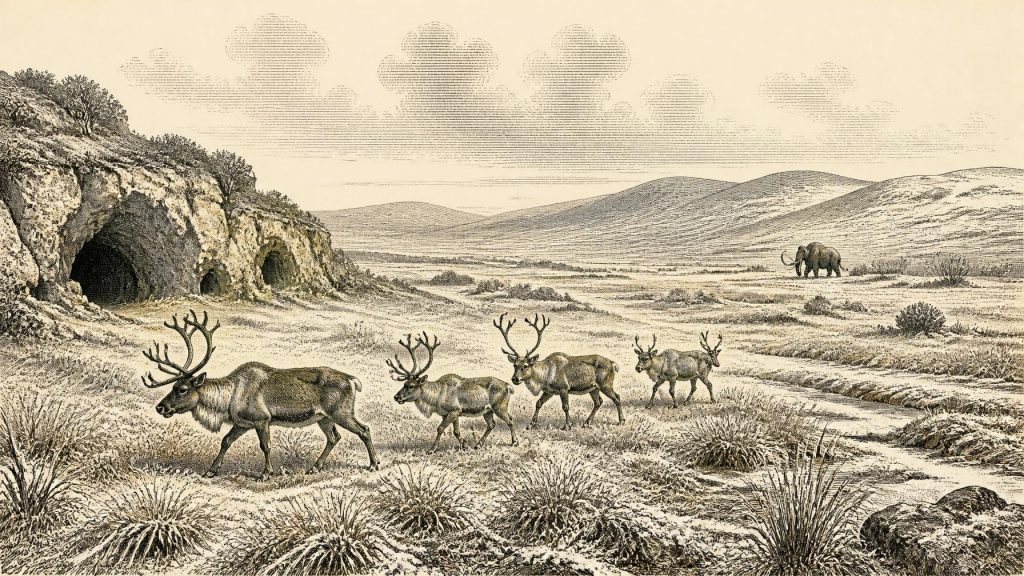
Around 33,500 calibrated years before present, later Marine Isotope Stage 3 Ireland was a cold, changing, largely treeless landscape, not an unbroken glacier. Castlepook Cave near Doneraile, County Cork, preserves important but mixed animal deposits, including mammoth, giant deer, reindeer, brown bear and spotted hyena. These animals indicate productive open steppe-tundra and complex predator-scavenger activity. Revised radiocarbon dates place some fauna well before the Last Glacial Maximum. A marked reindeer femur may record stone-tool butchery about 31,000 BC, suggesting fleeting Upper Palaeolithic visitors. However, no associated settlement, hearth, tools or other proof establishes permanent human occupation, institutions or continuous habitation.
Dateline
The label 31,563 BCE is useful only as a modern point of reference. No written record, annual calendar or archaeological layer allows Ireland to be described at that degree of precision. In radiocarbon terms it corresponds approximately to 33,500 calibrated years before present (cal BP, where “present” is conventionally 1950), but even that conversion must be treated as a broad chronological setting rather than a date in the manner of a later historical year. The responsible subject is therefore Ireland during the later part of Marine Isotope Stage 3: a changing Ice Age world before the Last Glacial Maximum.
The strongest evidence relevant to this horizon comes not from settlements, graves or tools in their original positions, but from animal bones and cave deposits. Above all, Castlepook Cave—also known as Mammoth Cave—near Doneraile in north County Cork preserves an unusually rich record of the large mammals and carnivores that reached southern Ireland during milder or more open phases of the last glacial cycle. It is evidence for a landscape and its animals. It offers, at most, a tantalising and still limited indication that people may also have entered it.
A Date Beyond Annals
Radiocarbon years are not calendar years. Their conversion depends on calibration curves, which account for past variation in atmospheric carbon-14 and yield ranges of probability rather than a single indisputable calendar day. At this age, the ranges may be wide and the reliability of a result depends greatly on the preservation and pretreatment of bone collagen. Re-dating of Irish cave fauna with improved methods has demonstrated that several older measurements were substantially too young. That finding matters profoundly: it has moved part of Castlepook’s fauna back into Marine Isotope Stage 3, well before the island-wide ice expansion conventionally associated with the Last Glacial Maximum.
Accordingly, 31,563 BCE should not be imagined as the date of a particular hunt, a cave occupation or an animal’s death. It belongs instead to a span of centuries and millennia when climate shifted sharply across the North Atlantic. Greenland ice cores reveal repeated swings between colder stadials and comparatively milder interstadials; Ireland’s local record is too fragmentary to match every swing securely to a particular site or season. What can be said is that the country had not yet entered the fullest extent of the later glaciation. The Last Glacial Maximum ice advance in southern Ireland is generally placed considerably later, with evidence for extensive ice after about 24,000 cal BP.
The Doneraile Fauna
Castlepook lay in the limestone country near the Awbeg and Blackwater drainage system. Its cave chambers accumulated bones through more than one episode, and the old excavations disturbed or mixed some deposits. That makes the cave an archive requiring caution, not a neatly sealed snapshot. Yet its importance is beyond doubt. The National Museum of Ireland describes it as the country’s most important site for mammal remains from the last cold stage, and its collections include woolly mammoth, giant deer, reindeer, brown bear and spotted hyena, alongside smaller cold-adapted animals in deposits of differing ages.
The animal list corrects a familiar but misleading image of an entirely frozen Ireland. A woolly mammoth did not live upon a featureless glacier, nor did a herd of reindeer. Their presence points to areas of open ground able to sustain grazing and browsing animals. Giant deer, reindeer and mammoth would have needed productive vegetation; wolves and hyenas occupied the same food web as predators, scavengers or both. Brown bears added another large omnivore to the scene. The landscape was cold, exposed and treeless or very sparsely wooded over broad areas, but it was biologically active.
Spotted hyena is especially revealing. Castlepook is the sole Irish locality securely associated with this animal, and many bones in cave assemblages bear the effects expected where carnivores carried in, consumed or gnawed carcass remains. A cave bone therefore cannot automatically be called food refuse from people. It may instead be the residue of a hyena den, a scavenging episode, water movement, collapse or later excavation disturbance. The distinction is central to every claim about human activity in Palaeolithic Ireland.
Open Country, Not Empty Country
At approximately 33,500 cal BP, Ireland was part of the wider north-west European glacial-zone environment, though the precise outline of coasts, ice margins and routes between Ireland, Britain and the continental shelf cannot be reconstructed for one notional year. Global sea level was lower than today, while local land levels and ice loads were changing. Animal populations plainly reached Ireland at various times before the Last Glacial Maximum, but the exact pathways remain debated. A low sea level did not automatically create a permanent, dry and easily crossed land bridge; channels, marshes, ice, seasonal sea ice and moving glacier fronts all mattered.
The best environmental interpretation is a mosaic rather than a single habitat. Exposed grassland, herb-rich steppe-tundra, patches of dwarf shrub, wet hollows and river corridors could have existed side by side, changing as temperature, snowfall and moisture altered. Such country could feed large herbivores in favourable periods, but it offered little shelter. Winds, freeze-thaw, short growing seasons and seasonal scarcity would have shaped every animal’s movements. The flora preserved at sites in Fermanagh, including Derryvree near Maguiresbridge, demonstrates the value of buried organic sediments, pollen, plant macrofossils and mosses for reconstructing Irish cold-stage environments. Those deposits are not necessarily contemporary with the precise year under discussion, but they show the kinds of evidence through which a treeless northern landscape can be responsibly recovered.
Regional variation matters. North Cork’s limestone caves favour the survival of bones, whereas much of Ireland’s open-air evidence was exposed to erosion, later glaciation and rising seas. The silence of the archaeological record in other regions cannot prove that no animals—or no people—ever passed through them. Conversely, the richness of Castlepook reflects the preserving role of a cave and the collecting habits of ancient carnivores as much as it reflects the abundance of life outside.
The Reindeer Femur Question
A fragment of reindeer femur from Castlepook gives this period exceptional historical interest. It has been presented as dating to around 33,000 years ago and bears a deep mark interpreted by zooarchaeologist Ruth Carden as having been produced by a sharp stone tool during the processing of a fresh carcass. County Cork’s heritage publication accordingly identifies it as a Palaeolithic reindeer bone of about 31,000 BC, while stressing that the bone may have been taken into the cave after butchery by carnivores rather than butchered inside it.
If that interpretation is sustained, it would be evidence for a very brief Upper Palaeolithic human presence in Ireland long before the better-known terminal Pleistocene evidence. It would suggest a person or small party equipped with a sharp stone edge, sufficiently familiar with carcass processing to remove meat, hide, sinew or marrow-bearing portions from a reindeer. Such people need not have been residents of the cave, or even permanent inhabitants of Ireland. They may have hunted the animal, encountered a carcass, or processed part of it before carnivores redistributed the remains.
But the evidence does not establish a settled community. No securely associated hearth, lithic workshop, shelter floor, dwelling, burial, ornaments or art is known from this horizon in Ireland. Nor can one infer a tribal name, political authority, language, kinship system or population size. The bone has an animal date; the identification of its surface modification as human-made is a separate taphonomic judgement. Its importance lies precisely in being a small, testable piece of evidence rather than licence for a fully populated prehistoric narrative.
Life Without States
For this reason, conventional headings such as politics, diplomacy and conflict have almost no direct application. There were no Irish kingdoms, borders, treaties, towns or institutions that can be identified at 31,563 BCE. If people did reach the island, their social world would have been organised through small, mobile hunter-gatherer relationships rather than state power. Cooperation in tracking animals, sharing food, making stone tools and navigating dangerous terrain is a reasonable inference from Upper Palaeolithic lifeways elsewhere in Europe; it is not direct evidence for a particular Irish camp.
Nor is there evidence for formal religion, ceremonial monuments or learned traditions in Ireland at this date. People elsewhere in Upper Palaeolithic Europe made sophisticated tools, images and personal objects, but none can be assigned to Ireland around this horizon. The responsible conclusion is not that such capacities were absent from any visitors, but that Irish evidence has not preserved or identified them. At Castlepook, the great cultural lesson is methodological: bones, tooth marks, cut marks, sediments and laboratory dates must be separated before historical claims are made.
A Precarious Threshold
The economic reality of the landscape, insofar as it can be reconstructed, was animal movement and ecological opportunity. Reindeer offered meat, fat, hides, sinews, bone and antler; mammoths and giant deer represented immense resources but also formidable risks. Hyenas, wolves and bears competed for carcasses and shelter. There is no evidence of trade in the later sense, although any people entering Ireland were part of wider networks of movement across north-west Europe and would have relied on portable knowledge: where herds travelled, which stones fractured well, and when a crossing was possible.
Castlepook was not a human town at the edge of history. It was a cave within a cold, shifting animal landscape. The later growth of ice would erase or bury much of that world, while subsequent sea-level change would alter its connections to neighbouring lands. Yet the Doneraile fauna proves that Ireland was not simply a sterile white blank before the Mesolithic. Around the broad period represented by 31,563 BCE, open country supported a remarkable Pleistocene community. One marked reindeer bone raises the possibility that people, too, stood briefly within it—an important possibility, but not yet a settled chapter of continuous Irish habitation.
Primary Sources
- A reconsideration of the radiocarbon dating of the Marine Isotope Stage 3 fauna from southern Ireland
- The Irish Quaternary Fauna Project
- Spotted Hyena Skull
- Heritage Artefacts of County Cork
- Castlepook Cave, Castlepook South, Cork
- Dimensions and chronology of the last ice sheet in Western Ireland
- Late Pleistocene chronostratigraphy and ice sheet limits, southern Ireland
- Radiocarbon constraints on the age of the maximum advance of the British-Irish Ice Sheet in the Celtic Sea
- Maximum extent and dynamic behaviour of the last British-Irish Ice Sheet west of Ireland
- The IntCal20 Northern Hemisphere radiocarbon age calibration curve (0-55 cal kBP)
- The IntCal20 Northern Hemisphere Radiocarbon Age Calibration Curve (0–55 cal kBP)
- The problem of a late quaternary landbridge between Britain and Ireland
- Deglaciation, Earth crustal behaviour and sea-level changes in the determination of insularity: A perspective from Ireland
- Ireland: Submerged Prehistoric Sites and Landscapes
- Pattern and timing of retreat of the last British-Irish Ice Sheet
- New insights on the fauna of Ireland’s Younger Dryas and Early Holocene from Alice & Gwendoline Cave
- Phylogeographic, ancient DNA, fossil and morphometric analyses reveal ancient and modern introductions of a large mammal: the complex case of red deer (Cervus elaphus) in Ireland
- Palaeoecology
- Reindeer bone found in Cork cave shows human activity in Ireland 33,000 years ago
- Ireland's Palaeolithic Archaeology – Fleeting Footprints in a Frozen Land