Tundra Interlude31465 BCE
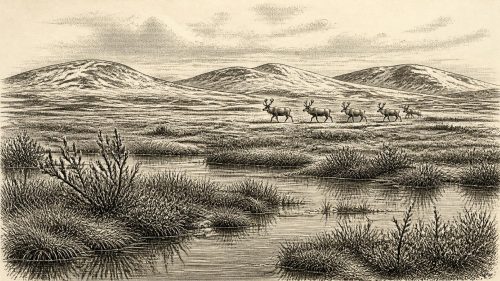
31,465 BCE is an imprecise label for a broad late Marine Isotope Stage 3 interval. At Derryvree, County Fermanagh, freshwater sediments and organic remains between glacial tills demonstrate a local ice-free episode, with treeless, wet tundra conditions, sometime roughly 34,950–29,750 BCE. Castlepook Cave, County Cork, preserves diverse cold-climate fauna, including mammoth, reindeer and hyaena, although deposits span separate episodes. A cut-marked reindeer femur may indicate a brief human visit around 33,000 years ago, but proves neither settlement nor occupation. Dynamic ice, shifting coasts and uncertain routes shaped connectivity. Ireland intermittently supported north-west European Ice Age ecosystems, while evidence remains fragmentary.
Dateline
The label 31,465 BCE is a modern chronological convenience, not a year that can be recovered from Ireland’s prehistoric record. No community on the island kept a calendar, and neither radiocarbon dating nor glacial stratigraphy can identify an event, a season or a generation with such precision more than 33 millennia ago. In terms of the conventional radiocarbon reference point of AD 1950, it falls about 33,414 calendar years before present. The responsible setting is therefore the later part of Marine Isotope Stage 3 (MIS 3), a fluctuating phase of the last Ice Age before the Last Glacial Maximum.
A Date Within Broad Ranges
At this depth in time, dates must be read as ranges. Radiocarbon years do not equate directly to calendar years because atmospheric carbon levels changed substantially through time. Calibration against independently dated records is essential, and the results can be broad or multi-peaked. The Irish deposits most relevant to this notional date cannot be narrowed to a particular calendar year. They illuminate a span of time, and the environmental conditions occurring within it.
The most important sequence is BIRM-166 at Derryvree, near Maguiresbridge in County Fermanagh. Road excavations in 1969 cut through a drumlin and revealed fine sands, freshwater silts and organic material enclosed between two separate sheets of till: sediment deposited directly by glacier ice. The order is clear. An earlier ice advance laid down the lower till; a period without ice at that locality allowed water and organic matter to accumulate; a later advance sealed the deposit beneath another till. Plant material from the freshwater series gave a conventional radiocarbon age of 30,500 +1,170/−1,030 BP. Published calibration places that broad interval approximately between 36,900 and 31,700 calibrated years BP, or roughly 34,950–29,750 BCE. The target year lies within that wide range, but cannot be fixed to a layer, a pool or an event.
Derryvree Beneath the Drumlin
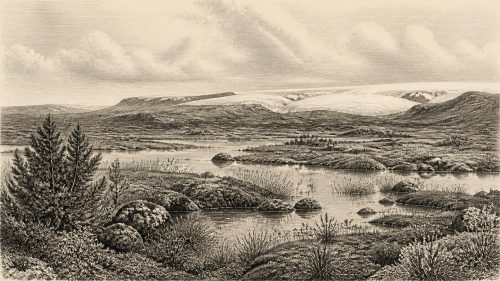
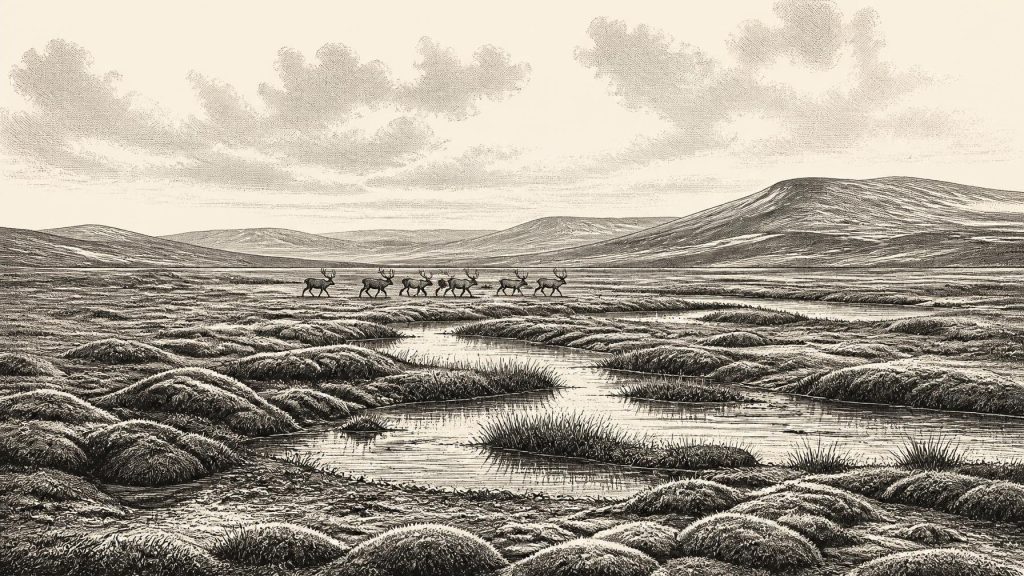
Derryvree is valuable precisely because later ice protected a fragment of an earlier landscape. Pollen survived poorly, but it was chiefly from herbaceous plants. Plant macrofossils, including an exceptional moss assemblage, and insect remains add greater definition. Together they support an interpretation of open, treeless tundra or muskeg-like ground: wet, mossy and sedgy in places, with shallow freshwater pools, sparse dry-ground vegetation and strong periglacial conditions. Seasonal thaw could have produced mud and standing water; long freezes and frost action shaped the ground.
This is evidence for a local landscape in south Fermanagh, not a map of the entire island. Ireland’s terrain, proximity to ice and exposure to Atlantic conditions meant that environments could vary sharply from one region to another. Nonetheless, Derryvree establishes an essential point: during part of MIS 3, a freshwater ecosystem existed at this northern locality between episodes of glaciation. It challenges any simple image of an Ireland uniformly entombed beneath ice throughout the later Ice Age.
The broader ice-sheet history was dynamic rather than static. The British–Irish Ice Sheet expanded and contracted in response to changing climate, sea level, topography and its own internal flow. Its maximum extent came later, around 25,000–23,000 years BP in many reconstructions, although some sectors advanced earlier and ice margins did not behave in unison. At around 31,465 BCE, the best evidence permits local ice-free ground and freshwater habitats in some places, while warning against claims that every part of Ireland was ice-free, habitable or joined to neighbouring lands in the same way.
A Cold-Climate Fauna
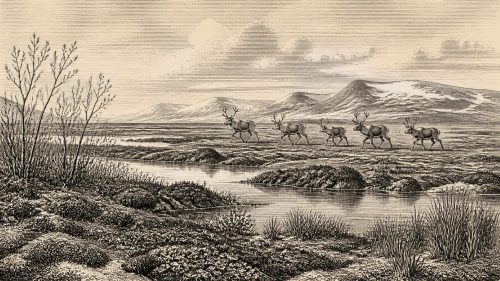
Southern cave deposits provide the other principal window on this Ireland. Castlepook Cave, near Doneraile in north County Cork, has yielded the richest well-known pre-Last Glacial Maximum vertebrate assemblage from the island. Its bones include woolly mammoth, reindeer, giant deer, brown bear, wolf, fox, Arctic fox, hare, spotted hyaena and lemmings. Such animals demonstrate that Ireland was at times part of a wider north-west European ecological world capable of receiving cold-adapted mammals.
Yet the cave collection must be handled carefully. Much was excavated in the early twentieth century, before modern standards of recording, sediment sampling and taphonomic analysis. Bones recovered from separate galleries, layers and episodes cannot automatically be treated as one simultaneous animal community. Hyaenas and other carnivores could transport and modify carcass material, while water, collapse and later disturbance could mix deposits. Improved accelerator radiocarbon dating and bone pretreatment have shown that some earlier determinations from Castlepook were substantially too young. The cave record is compelling evidence for a diverse MIS 3 fauna, but not a single frozen moment in which every listed species stood together outside the entrance.
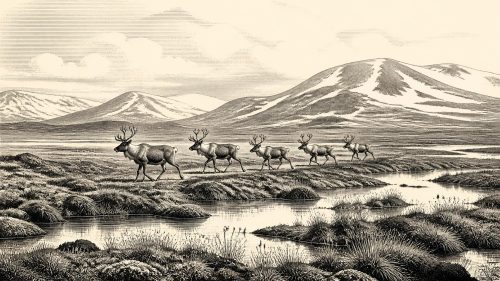
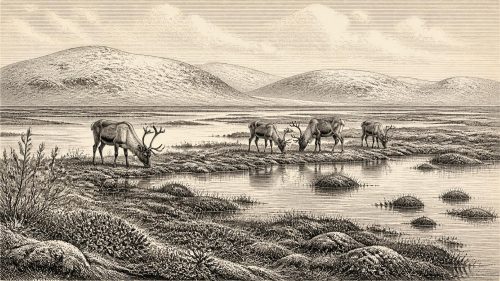
Even so, a picture emerges of open country with enough plant production to support grazers and browsers, and enough prey to support large predators and scavengers. Reindeer were especially well suited to cold, exposed landscapes; hares and lemmings point in the same direction. Mammoths and giant deer indicate that, at favourable times, the island could sustain or receive large herbivores. Their presence does not mean that the landscape was uniformly bare. Derryvree’s wetland plants show that water margins and moss-rich ground formed part of the mosaic.
The Castlepook Human Question
One reindeer femur from Castlepook has altered the discussion of Ireland’s earliest possible human activity. The bone has been reported as dating to about 33,000 years ago and carries a deep linear incision interpreted by zooarchaeologist Ruth Carden as a mark made while fresh bone was processed with a sharp stone implement. If that interpretation is confirmed, it indicates that people handled a reindeer carcass in Ireland during the wider MIS 3 period. It would push evidence for human activity vastly earlier than the better-established late Upper Palaeolithic trace from Alice and Gwendoline Cave in County Clare, dated to around 12,800–12,600 calibrated BP.
The distinction between activity and settlement is crucial. The Castlepook femur is a significant object, but it is not a campsite. No securely associated hearth, stone-tool assemblage, dwelling floor, burial, human skeleton, art object or repeatedly occupied cultural layer of this age is known from Ireland. The bone’s age dates the animal, not independently the incision, the identity of the person who made it, the place where the animal died or the duration of any visit. A cautious reading allows for a brief human incursion, perhaps by mobile Upper Palaeolithic hunters; it cannot establish a permanent Irish population.
No Kingdoms, No Recorded Conflict
Consequently, political affairs, diplomacy and organised warfare are beyond the evidence. There were no states, named peoples, rulers, borders, treaties or written traditions that can responsibly be assigned to Ireland at this time. Nor can archaeology identify a religious system, language, kinship rule, ritual practice or body of learning from a single potentially modified bone. The magnificent cave art, elaborate tool traditions and long-distance social networks known elsewhere in Upper Palaeolithic Europe provide important context, but they are not proof that equivalent practices occurred in Ireland.
Everyday life is similarly recoverable only in the most general, conditional sense. If people reached the island, they would have travelled through an exacting, seasonal environment and required practical knowledge of weather, animal behaviour, cutting technology and survival in open country. Reindeer could potentially provide meat, fat, hide, sinew, antler and bone. That is an informed possibility based on the species and wider hunter-gatherer practice, not a demonstrated Castlepook economy. No Irish evidence yet shows which resources were used, whether a hunt occurred, or whether the marked femur was taken from a carcass killed by people or encountered after death.
Connections Across a Changing Margin
Lower global sea levels altered the shape of the Irish and Celtic Seas, exposing and rearranging parts of the continental shelf. But low sea level must not be mistaken for a simple, permanent land bridge. Ice masses, marine channels, local relative sea level and changing coastlines made routes variable. The arrival of cold-adapted mammals establishes ecological connectivity at intervals; it does not specify whether every animal crossed dry land, ice, narrow water, or a combination of shifting routes. Nor does it prove the route or frequency of any human movement.
There is no evidence for trade in the later prehistoric sense. No imported toolstone, ornaments or exchange goods of this date have been securely recovered in Ireland. The only economy visible with confidence is ecological: plants accumulated energy during short growing seasons; herbivores moved through open terrain and wetlands; predators and scavengers followed them; and freshwater basins trapped the sediments that make this history visible.
A Landscape Preserved by Accident
The history of Ireland around 31,465 BCE is therefore not a year-by-year narrative but a carefully bounded reconstruction. Derryvree supplies direct environmental evidence for an ice-free freshwater and tundra landscape during a broad cold-stage interval. Castlepook demonstrates a richer Ice Age fauna than later Ireland would possess, while its marked reindeer femur raises the serious possibility of a fleeting human visit. Later glaciation both destroyed much of the evidence and, at exceptional sites, sealed what survived. Future excavation, refined dating and sedimentary DNA may change the picture. For now, the strongest conclusion is modest but remarkable: parts of Ireland supported cold, open and wet ecosystems in the later MIS 3 world, and the island stood intermittently within the ecological orbit of Ice Age north-west Europe.
Source References
Hover over a number to see the source. Select it to open the source.

- [1] A Middle Midlandian Freshwater Series at Derryvree, Maguiresbridge, County Fermanagh, Northern Ireland
- [2] The Irish Quaternary Fauna Project
- [3] A Reconsideration of the Radiocarbon Dating of the Marine Isotope Stage 3 Fauna from Southern Ireland
- [4] The Exploration of Castlepook Cave, County Cork, Being the Third Report from the Committee Appointed to Explore Irish Caves
- [5] Occurrence of Mammalia Relicts at Site Castlepook Cave
- [6] Heritage Artefacts of County Cork
- [7] Palaeoecology
- [8] The IntCal20 Northern Hemisphere Radiocarbon Age Calibration Curve (0–55 cal kBP)
- [9] First Evidence of a Late Upper Palaeolithic Human Presence in Ireland
- [10] New Insights on the Fauna of Ireland’s Younger Dryas and Early Holocene from Alice & Gwendoline Cave
- [11] The Colonization of Ireland: A Human Ecology Perspective
- [12] Growth and Retreat of the Last British–Irish Ice Sheet, 31,000 to 15,000 Years Ago: the BRITICE-CHRONO Reconstruction
- [13] Pattern and Timing of Retreat of the Last British-Irish Ice Sheet
- [14] Stratigraphic and Palaeo-Geomorphological Evidence for the Glacial-Deglacial History of the Last British-Irish Ice Sheet in the North-Western Irish Sea
- [15] Maximum Extent and Dynamic Behaviour of the Last British–Irish Ice Sheet West of Ireland
- [16] Pattern, Style and Timing of British–Irish Ice Sheet Advance and Retreat Over the Last 45,000 Years: Evidence from NW Scotland and the Adjacent Continental Shelf
- [17] Phylogeographic, Ancient DNA, Fossil and Morphometric Analyses Reveal Ancient and Modern Introductions of a Large Mammal: the Complex Case of Red Deer (Cervus elaphus) in Ireland
- [18] New Data for the Last Glacial Maximum in Great Britain and Ireland
- [19] Ireland: Submerged Prehistoric Sites and Landscapes
- [20] The Antiquity of Man in Ireland
- [21] Sedimentary Ancient DNA Reveals Late Pleistocene Faunal Connectivity Between Ireland and Eurasia
Primary Sources
- A Middle Midlandian Freshwater Series at Derryvree, Maguiresbridge, County Fermanagh, Northern Ireland
- The Irish Quaternary Fauna Project
- A Reconsideration of the Radiocarbon Dating of the Marine Isotope Stage 3 Fauna from Southern Ireland
- The Exploration of Castlepook Cave, County Cork, Being the Third Report from the Committee Appointed to Explore Irish Caves
- Occurrence of Mammalia Relicts at Site Castlepook Cave
- Heritage Artefacts of County Cork
- Palaeoecology
- The IntCal20 Northern Hemisphere Radiocarbon Age Calibration Curve (0–55 cal kBP)
- First Evidence of a Late Upper Palaeolithic Human Presence in Ireland
- New Insights on the Fauna of Ireland’s Younger Dryas and Early Holocene from Alice & Gwendoline Cave
- The Colonization of Ireland: A Human Ecology Perspective
- Growth and Retreat of the Last British–Irish Ice Sheet, 31,000 to 15,000 Years Ago: the BRITICE-CHRONO Reconstruction
- Pattern and Timing of Retreat of the Last British-Irish Ice Sheet
- Stratigraphic and Palaeo-Geomorphological Evidence for the Glacial-Deglacial History of the Last British-Irish Ice Sheet in the North-Western Irish Sea
- Maximum Extent and Dynamic Behaviour of the Last British–Irish Ice Sheet West of Ireland
- Pattern, Style and Timing of British–Irish Ice Sheet Advance and Retreat Over the Last 45,000 Years: Evidence from NW Scotland and the Adjacent Continental Shelf
- Phylogeographic, Ancient DNA, Fossil and Morphometric Analyses Reveal Ancient and Modern Introductions of a Large Mammal: the Complex Case of Red Deer (Cervus elaphus) in Ireland
- New Data for the Last Glacial Maximum in Great Britain and Ireland
- Ireland: Submerged Prehistoric Sites and Landscapes
- The Antiquity of Man in Ireland
- Sedimentary Ancient DNA Reveals Late Pleistocene Faunal Connectivity Between Ireland and Eurasia