The Derryvree Interval31344 BCE
31,344 BCE is a modern label for an uncertain interval within MIS 3, rather than a datable Irish event. Environmental evidence is fragmentary because later glaciation disturbed or destroyed deposits. At Derryvree, Fermanagh, freshwater organic sediments between tills reveal a cold, treeless, wetland landscape during an ice-free episode. Castlepook Cave, Cork, preserves remains of reindeer, mammoth, giant deer and predators, accumulated over long periods rather than as a single fauna. A marked reindeer femur may indicate early human butchery, but cannot prove settlement. Calcite records and fossils underline fluctuating climates, varied habitats, and Ireland’s prehistory before farming, monuments or societies.
Dateline
“31,344 BCE” is a modern calendar label, not a date at which archaeology can identify an Irish event, a named person or even a single season. It falls roughly 33,300 years before AD 1950, within the Late Pleistocene and Marine Isotope Stage 3 (MIS 3), a long and highly unstable part of the last Ice Age. At this depth in time, radiocarbon measurements have substantial margins of error and must be calibrated; even then, they describe ranges, not individual calendar years. The responsible subject is therefore an interval of environmental history, reconstructed from deposits, fossils and a small, debated body of possible evidence for human activity.
A Landscape Known in Fragments
Ireland at this time was neither the familiar green, wooded island of later prehistory nor necessarily a single uninterrupted expanse of ice. The last Irish Ice Sheet had not yet reached its fullest known extent, which came considerably later, during the Last Glacial Maximum. Its growth was uneven, however, and the position of ice margins changed over long periods. Some districts were glaciated, others lay beyond active ice, and still others experienced cold, periglacial conditions in which frost, seasonal thaw and meltwater shaped the ground.
That distinction is important. A map of a later ice maximum cannot simply be projected backwards onto 31,344 BCE. Nor can an organic deposit from one locality stand for the whole island. Ireland’s surviving evidence is patchy partly because later glaciers scoured, buried and reworked older landscapes. Cave deposits have also been disturbed by water, animals and early excavators. What remains permits a careful reconstruction of particular places and broad environmental tendencies, rather than a complete national picture.
The date belongs broadly within MIS 3, conventionally dated to about 57,000–29,000 years ago. Across the North Atlantic region this was a period of abrupt climatic oscillation, with relatively milder Greenland interstadials alternating with much colder stadials. The effects in Ireland included changing ice cover, drainage and vegetation. A calendar year in the thirty-second millennium BCE is therefore best treated as a point within a moving climatic system, not as a historical date in the usual sense.
Freshwater Beneath Derryvree
The most useful Irish evidence close to this notional date comes from Derryvree, near present-day Maguiresbridge in County Fermanagh. Roadworks exposed a drumlin section containing freshwater silts, fine sands and organic deposits between two layers of till: the unsorted sediment deposited by glacier ice. The sequence is eloquent even where its precise chronology is difficult. An earlier glacier crossed the site and left the lower till. Later, in a non-glacial interval, water and organic material accumulated. A subsequent ice advance sealed the deposits below another till.
Organic material from the Derryvree deposits produced the radiocarbon determination BIRM-166, conventionally reported as 30,500 ± 1,170 radiocarbon years before present. A radiocarbon age is not the same thing as a calendar age, since atmospheric carbon-14 levels have varied markedly through time. Later discussion places the deposit broadly within a calibrated range of about 36,900–31,700 calendar years before present. The modern label 31,344 BCE lies within that wide range, but this does not mean that a particular Derryvree pool existed in that precise year. It means that the deposit is an especially relevant archive for the environmental world denoted by the date.
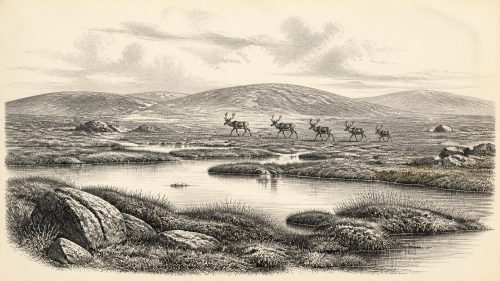
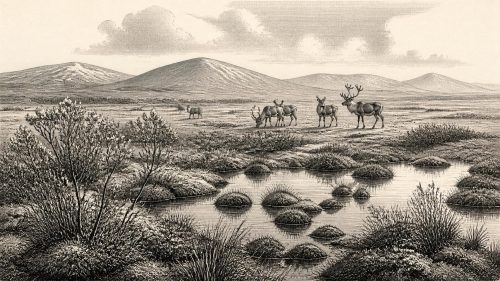
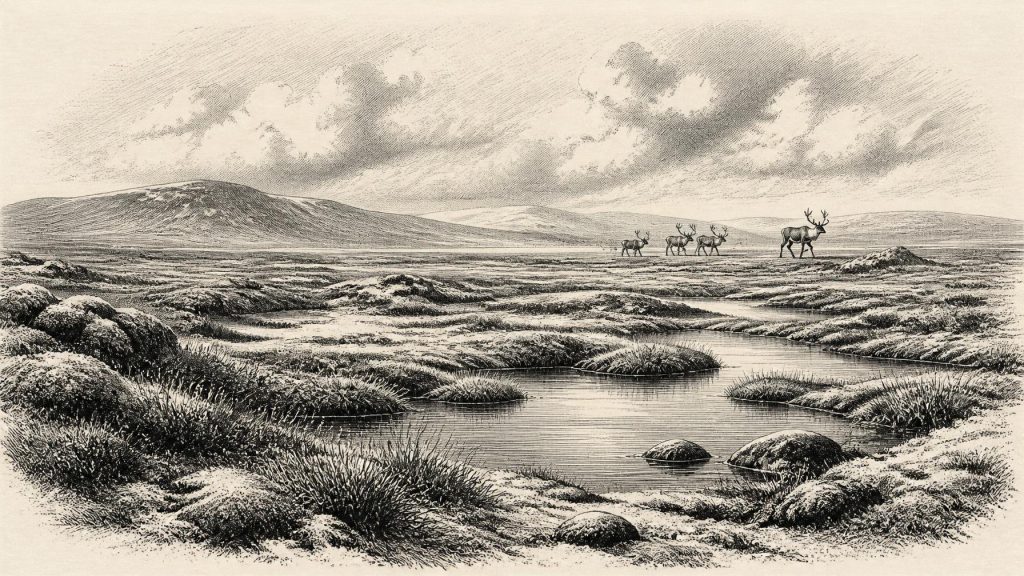
The plants and insects preserved there indicate a cold, open and treeless landscape. Mosses, sedges and wet-ground plants occupied waterlogged margins and shallow freshwater. Scholars have described the setting as muskeg-like: a peaty, mossy wetland with pools, mud and frost-influenced ground. Such a place was biologically active, but it should not be mistaken for a mild lakeside landscape. Growing seasons were likely short, winters severe and the movement of water strongly affected by frozen or seasonally frozen soil.
Derryvree provides firm evidence for a local freshwater ecosystem between glacial episodes. It supports the interpretation that parts of north-central Ireland were ice-free during sections of the Middle Midlandian cold stage. It cannot prove that every Irish region was similarly open, nor supply annual temperatures, rainfall totals or a continuous record of vegetation. Its value lies precisely in showing that Ice-Age Ireland was environmentally varied: ice, exposed ground, wetland and meltwater all belonged to its changing geography.
Open Country and Cave Fauna
Caves in the south and south-east preserve another fragmentary record. Castlepook Cave, also called Mammoth Cave, near Doneraile in County Cork, is the best-known Irish source for pre-Last Glacial Maximum mammal remains. Its collections include bones of reindeer, woolly mammoth, giant deer, brown bear, wolf, Arctic fox, lemmings and spotted hyaena. These animals did not all necessarily live together, and the cave was not a neatly layered time capsule. Bones accumulated across many millennia through natural deaths, carnivore activity, transport by water and excavation; later processes re-sorted parts of the assemblage.
That cave record nevertheless establishes that Ireland supported a far richer Pleistocene fauna than the later historical island. Reindeer and lemmings are especially consistent with cold, open habitats. Woolly mammoth, giant deer and large predators indicate landscapes capable, at different times, of supporting substantial herbivores and complex food webs. Spotted hyaenas may have used caves as dens, while bears could have sheltered in them. A bone in a cave is not automatically evidence that its owner died there, but it is evidence that animal remains entered the cave system and survived later geological upheaval.
Scientific redating has made the Castlepook record both more informative and more complicated. Improved radiocarbon pretreatment showed that several earlier measurements underestimated the age of some specimens by thousands of years. The revised work indicates that parts of the MIS 3 fauna are older than once supposed and that species such as giant deer and spotted hyaena may have disappeared locally before the Last Glacial Maximum. The lesson is methodological as well as historical: dates, species lists and old excavation accounts must be tested rather than combined into a single imagined Ice-Age scene.
The Reindeer Femur Question
One Castlepook object has particular importance for the human story. A reindeer femur has a deep linear mark interpreted by zooarchaeologist Ruth Carden as damage made on fresh bone by a sharp stone implement during carcass processing. County Cork’s heritage record associates the specimen with about 31,000 BCE. If that interpretation is upheld, it is potentially the earliest evidence that people handled an animal in Ireland, long before the securely attested terminal-Pleistocene and Mesolithic records.
Its significance must be stated with equal care. The date is primarily the age of the animal bone, not a timestamp for the mark. No securely associated hearth, stone-tool assemblage, dwelling surface, burial, food store or repeated butchery area has yet been found at this age in Ireland. Castlepook’s old deposits are also chronologically mixed. The femur may record a brief episode of butchery elsewhere, followed by scavenging or transport into the cave by carnivores. It does not demonstrate a permanent settlement at Doneraile.
Nor does it allow archaeologists to name the people involved, define their language or reconstruct a community. Upper Palaeolithic hunter-gatherers lived elsewhere in north-west Europe during this broad period, but there is no Irish assemblage from which to identify the maker of this mark, their route of arrival or the duration of their stay. The most restrained interpretation is that the bone offers a promising, important indication of a fleeting human encounter with reindeer, still requiring corroboration from artefacts, undisturbed deposits or further modified bones.
Mobility Without a Recorded Society
If people did reach Ireland in this interval, their presence was almost certainly mobile and small in scale. Open country and large herbivores could have provided seasonal hunting opportunities, while caves offered natural landmarks and occasional shelter. Yet these are possibilities derived from the wider European Upper Palaeolithic and from the Irish fauna; they are not evidence for a camp, a migration route or a resident population. The sea level was lower than today, altering coastlines and exposing land now submerged, but the precise connections between Ireland, Britain and the European mainland remain a specialised and contested palaeogeographical question. A simple overland bridge should not be assumed.
There is no responsible basis for describing political affairs, warfare, diplomacy, chiefs, tribes or territories in Ireland at 31,344 BCE. There are no Irish written records, named communities, settlements or monuments. Equally, there is no evidence for agriculture, animal husbandry, pottery, metalworking, exchange networks or trade in the later prehistoric sense. The economy visible in the evidence is ecological rather than institutional: plants grew in cold wetlands; herbivores moved through suitable habitats; predators and scavengers used the same landscape; and perhaps, on one occasion or more, human hunters processed an animal.
Religion, art, formal learning and language also remain beyond recovery for Ireland at this date. It would be wrong to infer ritual from a cave merely because caves gained ceremonial importance in other cultures and much later periods. The Castlepook femur is potentially evidence for practical carcass processing, not a symbolic object. Silence in these areas is not a failure of imagination; it is the necessary boundary between what the record can suggest and what it cannot establish.
An Island Before Its Later Histories
The strongest history for this date is environmental. Derryvree shows freshwater, vegetation and invertebrate life surviving between glacial advances in Fermanagh. Castlepook shows that large mammals and carnivores entered Irish landscapes during MIS 3, though not necessarily as one simultaneous community. Crag Cave in County Kerry adds a different kind of climatic evidence: episodes of cave-calcite growth indicate intervals when conditions permitted water to percolate through limestone, reinforcing the picture of a climate that changed sharply rather than remaining uniformly frozen.
In later millennia, advancing ice would reshape much of the island and erase or bury many traces of this world. That destructive history explains why the evidence for 31,344 BCE is so slight, yet so valuable. Ireland was not then a country of farms, kingdoms or ancestral monuments. It was a fluctuating Ice-Age landscape of exposed ground, wetlands, caves and roaming animals. The Derryvree deposits and Castlepook bones do not yield an annual chronicle. They offer something more fundamental: the rare, fragile proof that life persisted in an Irish environment repeatedly transformed by ice.
Primary Sources
- Middle Midlandian Interstadial Deposits at Greenagho, Near Belcoo, County Fermanagh, Northern Ireland
- A reconsideration of the radiocarbon dating of the Marine Isotope Stage 3 fauna from southern Ireland
- The Irish Quaternary Fauna Project
- Trimlines, blockfields and the vertical extent of the last ice sheet in southern Ireland
- Episodic speleothem deposition tracks the terrestrial impact of millennial-scale North Atlantic climate variability during MIS 3
- New insights on the fauna of Ireland's Younger Dryas and Early Holocene from Alice & Gwendoline Cave
- Dublin Radiocarbon Dates III
- Figure 6: The Subdivision of the Quaternary Period in Ireland
- Quaternary
- Soils of County Waterford
- The problem of a late quaternary landbridge between Britain and Ireland
- Deglaciation, Earth crustal behaviour and sea-level changes in the determination of insularity: A perspective from Ireland
- The Island of Ireland: Drowning the Myth of an Irish Land-bridge?
- HERITAGE ARTEFACTS of County Cork
- Spotted Hyena Skull
- On the Cave of Castlepook, Near Doneraile, Co. Cork
- Red deer in Ireland: phylogeography and population history
- The colonization of Ireland: A human ecology perspective
- First evidence of a Late Upper Palaeolithic human presence in Ireland
- Introduction to the Late Quaternary and Holocene of Northern Ireland