
Fermanagh’s Sedge Marsh31291 BCE
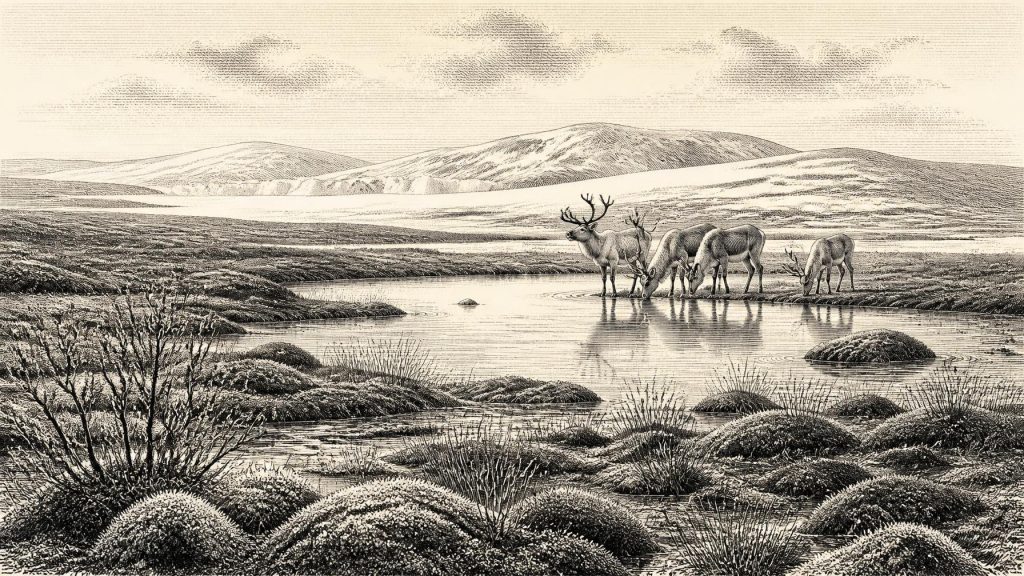
At approximately 33,240 cal BP, corresponding broadly to 31,291 BCE, Ireland experienced the climatically unstable Marine Isotope Stage 3. Ice-free and glacial conditions alternated, while lower sea levels reshaped coasts without guaranteeing land bridges. At Derryvree, County Fermanagh, freshwater sediments dated 36,900–31,700 cal BP preserve evidence of sedges, grasses, mosses and cold-adapted wetland plants in a treeless landscape. Castlepook Cave, County Cork, records a time-averaged fauna including reindeer, mammoth, giant deer, predators and lemmings. Possible cut marks on reindeer bone suggest unconfirmed human visitation. Later glaciation destroyed much evidence, leaving environmental change, rather than recorded society, as this period’s history.
Dateline
Modern calendar-year precision is not available for Ireland in 31,291 BCE. The number is best treated as a modern point within a much broader prehistoric timescale: approximately 33,240 calibrated years before present (cal BP, where “present” is conventionally 1950). Archaeology and palaeoenvironmental science can sometimes date deposits to ranges spanning centuries or millennia, but cannot identify an event occurring in this particular year. Around this point Ireland belonged to Marine Isotope Stage 3, a long, climatically unstable part of the Late Pleistocene before the Last Glacial Maximum. The most responsible history is therefore one of landscapes, animals, sediments and the severe limits of the evidence, rather than named peoples or year-specific happenings.
An Island in a Cold Interval
At roughly 33.2 thousand cal BP, Ireland was not the continuously ice-covered country it would become nearer the Last Glacial Maximum. Yet neither was it a mild or wooded island resembling later prehistoric Ireland. Temperatures and ice margins changed repeatedly across north-west Europe. The expanding British–Irish Ice Sheet was a major force in the region, but its fullest late-glacial extent came later, conventionally placed around 27,000–23,000 cal BP. Reconstructions differ over the precise timing and reach of earlier ice advances, especially because later glaciers eroded or buried much of the older record. What can safely be said is that Ireland contained ice-free ground during parts of this earlier cold phase, alongside glacial and periglacial environments, and that conditions could alter markedly over comparatively short geological timescales.
Sea level was substantially lower than today because enormous quantities of water were held in continental ice sheets. Ireland’s coastlines and surrounding shallow seas consequently looked very different. The present Irish Sea, Celtic Sea and Atlantic shelf were altered landscapes of exposed ground, ice, rivers, lakes and changing shorelines. Low sea level did not automatically create a simple, enduring land bridge from Ireland to Britain or the European mainland. Ice, water depth, local crustal movement and the shape of the sea floor all mattered. Animal arrival must therefore be inferred from fossil distributions and palaeogeography, not assumed from a neat map of one permanent corridor.
The Fermanagh Record
One of the most illuminating Irish environmental archives for this broad period lies beneath glacial deposits at Derryvree near Maguiresbridge, County Fermanagh. There, organic-rich silts and fine sands occur between tills: material laid down in freshwater conditions, later sealed beneath another phase of ice-related deposition. A radiocarbon determination from the sequence has been calibrated to about 36.9–31.7 thousand cal BP. That is a wide range, but it encompasses the modern date-label 31,291 BCE. The deposit cannot tell us what happened in one year; it can provide a defensible view of the kinds of environment present during an interval that includes it.
Plant macrofossils, pollen and insect remains from such deposits point to open, cold-country vegetation rather than forest. Sedges, grasses, mosses and herbs formed a sparse but varied cover around wet hollows and shallow water. Recorded taxa include plants now associated with northern, alpine or tundra settings, such as mountain-avens, dwarf willow, Arctic water-milfoil and bogbean. Their presence does not mean that every part of Ireland was identical. It means that a freshwater wetland in south Fermanagh supported cold-adapted communities, with sufficient summer thaw and liquid water for pools, marsh plants and insects. A treeless landscape was not lifeless: it was a mosaic of wet ground, exposed mineral soil, low vegetation and seasonally changing waters.
This evidence is particularly valuable because it is local and stratified. Fossil plants derive from a defined sedimentary setting, rather than from a general impression of what an Ice Age landscape “ought” to have contained. Even so, interpretation needs care. Pollen may travel far; seeds and beetles represent particular habitats; and a buried basin records its catchment rather than all Ireland. Derryvree offers a window onto a cold freshwater landscape, not a complete national census. Its importance lies precisely in showing that, between episodes of glaciation, some Irish ground could sustain complex wetland life.
Caves and a Changing Fauna
County Cork’s Castlepook Cave, near Doneraile and also known as Mammoth Cave, supplies the principal Irish evidence for larger animals before the Last Glacial Maximum. Its early twentieth-century excavations recovered thousands of bones and teeth from a maze of limestone passages. Reassessment using improved radiocarbon methods has demonstrated that several old determinations were too young, while also reinforcing a basic conclusion: mammals reached Ireland in Marine Isotope Stage 3, broadly between at least 45,000 and 20,000 years ago. Castlepook’s deposits include reindeer, woolly mammoth, giant deer, brown bear, wolf, Arctic fox, mountain hare, stoat, collared lemming and Norwegian lemming, as well as spotted hyena.
Those animals should not be imagined as one perfectly synchronous herd gathered at a single Irish moment. A cave deposit is a time-averaged archive. Carnivores may have dragged prey in; scavengers gnawed bones; water shifted material; and the nineteenth- and early twentieth-century excavations did not always record layers to modern standards. Some taxa may belong to different centuries, millennia or climatic episodes. Nevertheless, the assemblage establishes an important regional fact: Ice Age Ireland intermittently supported a fauna capable of living in open, cold environments. Reindeer and lemmings accord with tundra-like conditions; mammoth and giant deer point to extensive grazing country; wolves, bears and hyenas indicate a food web with substantial prey and competition.
Spotted hyena is especially striking because it is absent from modern Europe outside captivity and is known in Ireland principally from Castlepook. The cave was evidently more than a passive trap: hyenas could use sheltered chambers as dens or feeding places, helping to explain accumulations of broken and gnawed bone. That is evidence for animal behaviour, not for an Irish human camp. Likewise, the evocative chamber names bestowed by earlier investigators – including Elephant Hall and Hyenahall – describe the character of fossil finds, not ancient places with recorded inhabitants or events.
People: A Possibility, Not a Narrative
There is no securely dated settlement, hearth, stone-tool assemblage, burial or dwelling in Ireland that permits a confident account of human society in 31,291 BCE. No polity, leader, language, religious system, trade network or diplomatic relationship can responsibly be assigned to this date. The familiar categories of political affairs, warfare, social rank and organised religion belong to later evidence, not to this sparse Pleistocene record.
A reindeer bone from Castlepook has been reported as carrying a deep linear mark interpreted as a possible stone-tool cut made during butchery, and has been associated in public discussion with an age of around 33,000 years. If that interpretation and association are sustained by further work, it would indicate a fleeting Upper Palaeolithic human presence in Ireland much earlier than once accepted. It would not demonstrate permanent colonisation, a named cultural group, or a community living in the cave. The specimen comes from an old and complicated faunal archive; distinguishing a human cut from damage produced by excavation, transport, carnivores or natural processes requires microscopic study, secure provenance and direct dating wherever possible. The cautious conclusion is that human visitation is a research question of great importance, not a settled narrative for this year.
Life Without a Recorded Society
If people did reach Ireland during this interval, they would have entered a harsh, sparsely populated environment where mobility, shelter, fire, clothing and knowledge of animal movements were matters of survival. That is an inference drawn from the climate and wider Upper Palaeolithic world, not direct evidence from an excavated Irish camp. Ireland’s actual record at this date documents animals and habitats far more securely than it documents humans. There is no evidence for farming, pottery, metalworking, long-distance exchange in objects, monument building, formal cemeteries or literacy. The economy, in the only sense supported by evidence, was ecological: plants captured a brief growing season; herbivores grazed and moved; predators and scavengers followed opportunities; and water, frost and ice repeatedly rearranged the ground.
Regional change was the dominant historical process. In Fermanagh, marshes and pools could preserve a cold-climate flora during an ice-free interval. In north Cork, caves accumulated the remains of a distinctive large-mammal fauna over a long span. Across the island, later ice advances would scour landscapes, redeposit sediment and obliterate many traces that people or animals may once have left. This destructive history explains why absence of evidence cannot simply be treated as proof of an empty island. It also explains why a single cave bone or a narrow band of organic silt carries unusual weight.
For 31,291 BCE, then, Ireland’s history is not a chronicle of tribes or events. It is the history of a cold, changeable north Atlantic landscape: freshwater sedge marshes in Fermanagh; open grazing country and limestone refuges in Cork; mammals arriving, feeding, denning and dying; and a possible but unconfirmed human trace at the edge of the archaeological record. The evidence is fragmentary, but it reveals an Ireland already shaped by climatic volatility long before the later ice sheet and long before enduring human settlement.
Primary Sources
- A Reconsideration of the Radiocarbon Dating of the Marine Isotope Stage 3 Fauna from Southern Ireland
- The Irish Quaternary Fauna Project
- Late Pleistocene Chronostratigraphy and Ice Sheet Limits, Southern Ireland
- Trimlines, Blockfields and the Vertical Extent of the Last Ice Sheet in Southern Ireland
- Dimensions and Chronology of the Last Ice Sheet in Western Ireland
- Stratigraphic and Palaeo-Geomorphological Evidence for the Glacial-Deglacial History of the Last British-Irish Ice Sheet in the North-Western Irish Sea
- Early Deglaciation of the British-Irish Ice Sheet on the Atlantic Shelf Northwest of Ireland Driven by Glacioisostatic Depression and High Relative Sea Level
- Ireland: Submerged Prehistoric Sites and Landscapes
- New Data for the Last Glacial Maximum in Great Britain and Ireland
- Palaeoecology
- Castlepook Cave, County Geological Site Report
- 2022:564 – Castlepook Cave, Castlepook South, Cork
- The Exploration of Castlepook Cave, Co. Cork. With 3 Plates
- Spotted Hyena Skull
- Occurrence of Mammalia Relicts at Site Castlepook Cave
- Pleistocene Vertebrates in the British Isles
- Mid-to-Late Marine Isotope Stage 3 Mammal Faunas of Britain: A New Look
- A North-Western Habitat: the Paleoethology and Colonisation of a European Peninsula
- How Open Were European Primeval Forests? Hypothesis Testing Using Palaeoecological Data
- New Insights on the Fauna of Ireland's Younger Dryas and Early Holocene from Alice & Gwendoline Cave
- Mammoth Cave, Cork