Derryvree’s Water-Milfoil Basin31241 BCE
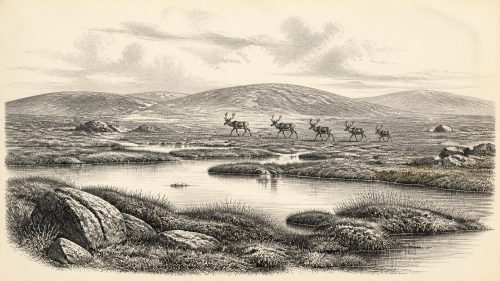
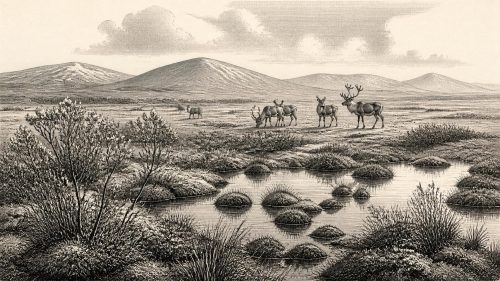
Around 31,241 BCE, Ireland was a cold, fluctuating Late Pleistocene landscape, not a historical society with known peoples or events. At Derryvree, County Fermanagh, freshwater silts between glacial tills preserve evidence of an interval between ice advances. Water-milfoil, bogbean, sedges, mosses, dwarf willow and insects indicate a wet, open tundra basin shaped by frost, pools and short summers. Elsewhere, cave remains show that cold-stage animals, including reindeer, mammoth and hyaena, reached Ireland at various times. Possible early human evidence remains disputed. Changing ice sheets, low sea levels and altered coastlines created varied conditions, while later glaciation sealed this ecological archive.
Dateline
The label 31,241 BCE offers a useful point of orientation, but it cannot describe a particular Irish year in the ordinary historical sense. It is a modern backward count, roughly 33,190 years before AD 1950, placed within the Late Pleistocene and Marine Isotope Stage 3 (MIS 3). Ireland had no writing, named peoples, political institutions or securely dated settlements that can be tied to this nominal year. Even radiocarbon determinations at this depth of time have broad uncertainties and must be calibrated into ranges rather than converted into an exact anniversary. The responsible history of Ireland at this point is therefore one reconstructed from sediments, fossil plants, insects, animal bones and the changing traces of ice.
A Date Within a Range
The most illuminating Irish evidence near this horizon comes from Derryvree, near Maguiresbridge in County Fermanagh. Roadworks in 1969 cut through a drumlin and exposed a remarkable sequence: freshwater silts and fine sands containing organic remains lay between two thick sheets of till, the unsorted sediment left by glacier ice. The central deposit was assigned the laboratory number BIRM-166 and produced a conventional radiocarbon age of 30,500 years before present, with an uncertainty of roughly a millennium either side. Published calibrated treatments place the episode broadly within about 36,900–31,700 calendar years before present.
That range overlaps the broad timescale represented by 31,241 BCE, but it does not identify a single year, season or generation. Nor does it mean that every part of Ireland looked like Derryvree at the same time. A buried wetland in south Fermanagh is a highly local archive. Its importance lies in showing that, during a cold interval between glacial advances, freshwater and plant life existed there, and that the island’s glacial history was more complicated than a simple story of continuous ice cover followed by a final thaw.
Freshwater Between Ice Sheets
At Derryvree, the order of deposits supplies the central fact. Ice had laid down a lower till; then a body of freshwater sediment accumulated in an ice-free or ice-distal local setting; later ice deposited the upper till that sealed it. The organic bed therefore preserves a landscape that existed between episodes of glaciation. It was not a benign interglacial landscape. The plant and animal remains point instead to open tundra and periglacial conditions: ground exposed to intense seasonal freezing, short summers and a climate too severe for closed woodland.
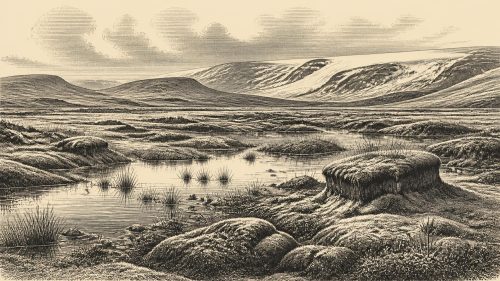
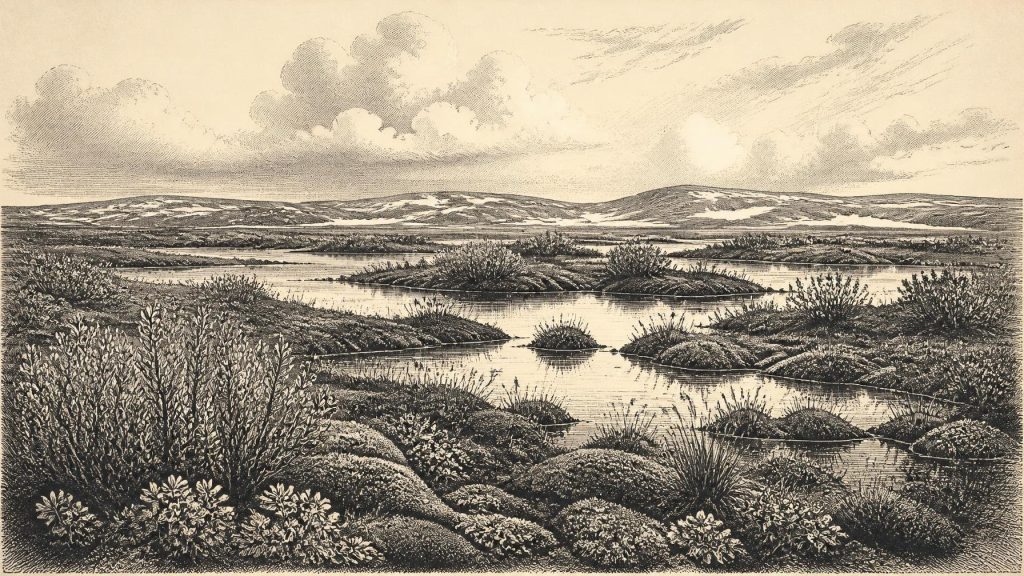
The landscape can be envisaged as a wet, largely treeless mosaic rather than as an uninterrupted white desert. Shallow pools and slow-moving or standing water occupied hollows. Mosses, sedges and hardy herbs grew where moisture and summer warmth permitted. Fossils include aquatic and wetland plants such as water-milfoil and bogbean, alongside mountain avens, dwarf willow, juniper and lesser clubmoss. These are not a list from a single meadow; they are remains gathered through the life of a changing depositional environment. Together, however, they indicate open ground, persistent wetness and vegetation adapted to cold exposure.
Insect evidence strengthens this interpretation. Beetles associated with damp moss, sedge-rich ground, pools and decaying plant matter were preserved alongside the botanical remains. Such small fossils matter because insects often respond closely to local habitats. They suggest a tundra wetland with open water and vegetated margins, sometimes compared with muskeg: waterlogged, organic-rich ground broken by pools. Frost action would have shaped the soil, while snowmelt and summer rainfall fed the basin. In a country now strongly associated with green pasture and Atlantic woodland, Derryvree records an older ecological world.
Ice, Sea and an Uneven Island
The wider Irish setting was unstable. The Late Pleistocene climate was marked by abrupt shifts, and ice sheets expanded and reorganised around Ireland, Britain and the continental shelf. Evidence from Ireland’s western coast shows substantial glacial loading during the long interval before the Last Glacial Maximum, while later geomorphological reconstructions demonstrate the large scale and changing flow of the Irish Ice Sheet. Yet these records also warn against mapping one simple ice margin onto every locality or every century. Ice could advance across one sector while other places retained exposed ground, freshwater basins or ice-free margins.
By this period, global sea level was far lower than today because enormous volumes of water were stored in continental ice. The outlines of Ireland and its surrounding shelves therefore differed greatly from the modern coastline. This does not, by itself, prove an easy land route for people or animals at any particular moment. Sea level, local ice margins, rivers, lakes and terrain all changed; the Irish Sea basin was not a permanently open highway, nor can a land bridge simply be assumed. Movement across the wider north-west European region must remain a question of shifting opportunities rather than a fixed map.
For people living much later, the action of this ice would become part of the physical inheritance of Ireland. Drumlins, streamlined hills of till, are among the most conspicuous results. Derryvree’s wetland survived precisely because later glacial sediment enclosed it within a drumlin. The preservation is paradoxical: the same processes that repeatedly disrupted the landscape also buried a small record of the life that had existed between advances.
Animals at the Edge of Evidence
Irish cave deposits and older museum collections indicate that a more diverse cold-stage fauna reached Ireland during parts of the Late Pleistocene. Reindeer, giant deer, horse, brown bear, Arctic fox, hare, lemmings, wolf, spotted hyaena and mammoth are among species reported from the pre-Last Glacial Maximum record. Castlepook Cave, near Doneraile in north Cork, is especially important because antiquarian excavations recovered remains attributed to several of these animals. Direct dates on some Castlepook bones fall in the wider pre-maximum period, around the mid-30,000s radiocarbon years before present.
These remains establish that suitable habitats and animal movements existed in Ireland at various times, but they do not supply a census for 31,241 BCE. Cave assemblages can be time-averaged: bones may have been accumulated over long spans, moved by carnivores or water, disturbed by excavation, and recovered without modern stratigraphic controls. A mammoth or hyaena bone from a cave cannot demonstrate that such an animal stood in Fermanagh—or even Cork—during this particular nominal year. The sound conclusion is narrower and more valuable: Irish environments before the Last Glacial Maximum could support, or at least receive, elements of a northern European cold-stage fauna.
Reindeer are particularly evocative because they fit the image of open, cold country, but their presence should not automatically produce a scene of human hunters. One reindeer femur from Castlepook has been dated to about 33,000 years ago and bears a possible cut-like modification. That observation has prompted serious discussion of early human activity in Ireland. It remains contested as evidence for human butchery because no securely associated stone tools, hearth, dwelling, human remains or undisturbed processing area of comparable age has yet been demonstrated. The bone is an important research problem, not a licence to proclaim a settled Palaeolithic population.
No Polities, No Proven Settlement
There is no evidence from Ireland around this date for political affairs, warfare, diplomacy, chiefs, tribes, ethnic names or territorial boundaries. These concepts depend on traces that have not survived or have not been found: settlements, burials, tools in secure context, repeated occupation surfaces or symbolic objects. Equally, there is no responsible basis for describing houses, clothing, family structure, language, religious practice, art, formal learning, exchange networks or trade on the island at this time. The absence of evidence does not prove that no person ever arrived; it means that the available evidence cannot support a historical narrative of society.
Across parts of continental Europe and Britain, Upper Palaeolithic communities were making sophisticated stone and bone tools, exploiting changing animal resources and producing forms of visual culture. That broader context makes occasional movement towards Ireland conceivable. But possibility is not proof. Ireland’s own record at this horizon remains environmental and faunal rather than securely archaeological. If humans did visit, their numbers, duration of stay, route, technology and relationship with the landscape are all unknown. They may have left no surviving trace, or apparent traces may yet be reinterpreted.
The Meaning of the Silence
For Ireland in 31,241 BCE, the decisive development was environmental rather than political: a cold, fluctuating world in which ice, frost, freshwater and sparse vegetation continually reshaped the conditions for life. Derryvree provides the clearest local testimony. Its waterlogged silts preserve a tundra wetland of pools, mosses, sedges, herbs and insects during an interval bracketed by glaciation. Castlepook and other cave collections show that Ice Age mammals formed part of the island’s wider story, while also demonstrating the limits imposed by old excavations and incomplete dating.
This is not an empty prelude to later Irish history. The sediments record real ecological communities and real environmental change, even if they cannot name a single inhabitant or event. They show an Ireland whose familiar coastlines, woods and farms did not yet exist: a cold, exposed, regionally varied land facing further ice-sheet growth. The proper historical task is not to fill that silence with invented hunters, kingdoms or rituals, but to read the surviving evidence closely—and to recognise how much of deep Ireland remains beneath the till.
Primary Sources
- A Middle Midlandian Freshwater Series at Derryvree, Maguiresbridge, County Fermanagh, Northern Ireland
- Palaeoecology: Irish Quaternary Association Field Guide No. 16
- Figure 6—The Subdivision of the Quaternary Period in Ireland
- The Irish Quaternary Fauna Project
- Radiocarbon Constraints on the History of the Western Irish Ice Sheet Prior to the Last Glacial Maximum
- 10Be Chronology of the Last Deglaciation of County Donegal, Northwestern Ireland
- Cosmogenic 10Be Chronology of the Last Deglaciation of Western Ireland, and Implications for Sensitivity of the Irish Ice Sheet to Climate Change
- Reconstructing the Last Irish Ice Sheet 2: A Geomorphologically-Driven Model of Ice Sheet Growth, Retreat and Dynamics
- Pattern and Timing of Retreat of the Last British-Irish Ice Sheet
- Growth and Retreat of the Last British–Irish Ice Sheet, 31,000 to 15,000 Years Ago: The BRITICE-CHRONO Reconstruction
- The Colonization of Ireland: A Human Ecology Perspective
- First Evidence of a Late Upper Palaeolithic Human Presence in Ireland
- New Insights on the Fauna of Ireland’s Younger Dryas and Early Holocene from Alice & Gwendoline Cave
- Phylogeographic, Ancient DNA, Fossil and Morphometric Analyses Reveal Ancient and Modern Introductions of a Large Mammal: The Complex Case of Red Deer in Ireland
- Cenozoic: Tertiary and Quaternary
- Irish Quaternary Vertebrates
- Selaginella selaginoides
- Dryas octopetala
- Myriophyllum alterniflorum
- A Revised Correlation of Quaternary Deposits in the British Isles