Maguirebridge’s Sedge and Sand31117 BCE
31,117 BCE is a modern label rather than a documented Irish year. At Derryvree near Maguiresbridge, Fermanagh, freshwater silts and sands, dated broadly to a range encompassing this date, lie between glacial tills, recording an ice-free interval during the Middle Midlandian. Fossils reveal an open, treeless periglacial mosaic of sedges, grasses, wetlands and shallow water. Castlepook Cave indicates diverse cold-stage mammals, though its disturbed collections cannot form a single contemporary fauna. No secure Irish settlement or artefacts date to this period. A modified reindeer bone may suggest an early human visit, but remains inconclusive. Evidence documents environmental change, not society.
Dateline
31,117 BCE is a modern chronological label, not a year for which Ireland possesses an event record. No contemporary Irish calendar, settlement sequence or written testimony can resolve a particular season, generation or individual at this point in the Late Pleistocene. The responsible approach is therefore to place the date within broad scientific ranges. Measured from AD 1950, it falls roughly 33,066 calendar years before present, within the Middle Midlandian phase of the last glacial cycle. The closest useful Irish evidence is a freshwater deposit at Derryvree, near Maguiresbridge in County Fermanagh, whose published radiocarbon determination of 30,500 +1,170/−1,030 radiocarbon years BP has been calibrated broadly to about 36,900–31,700 cal BP, or approximately 34,950–29,750 BCE. That range encompasses 31,117 BCE, but does not date a particular moment within it.
The distinction matters. Radiocarbon laboratories measure residual carbon-14, not BCE years directly; calibration converts that measurement through curves based on independently dated natural archives. At this antiquity, ranges are substantial and may be revised as methods improve. Nor was Derryvree a miniature Ireland. It was one locality, sampled through a temporary road cutting in 1969. Its great value lies in the sequence preserved there: it documents a changing environment at a place that later ice buried, rather than offering a national snapshot or a story of a named community.
Between Two Ice Advances
Derryvree’s evidence was exposed when works cut obliquely through a drumlin, the streamlined hill formed from glacial sediments. Archaeologists and Quaternary scientists found organic freshwater silts and fine sands enclosed between two thick, distinct sheets of till: unsorted debris deposited by glacier ice. The order of these materials is the primary evidence. First, ice had reached the site and laid down the lower till. Later, local glacier cover was absent long enough for shallow fresh water, fine sediment and organic matter to accumulate. Finally, another ice advance overran and sealed the deposit beneath an upper till. The buried bed is consequently a rare record of an ice-free interval within a longer cold-stage history.
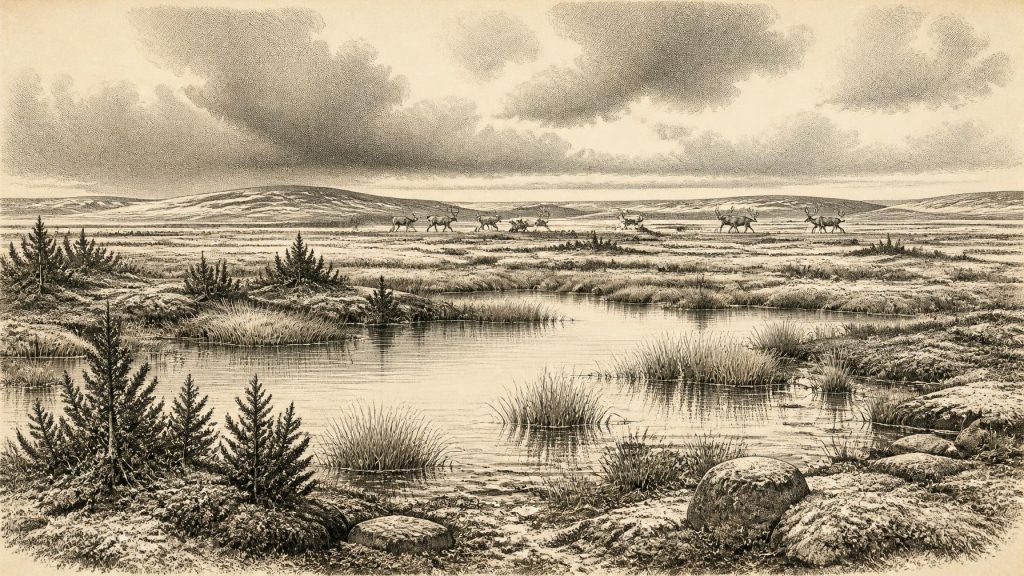
Its fossils indicate an open, treeless, periglacial landscape, described by the original investigators as tundra or muskeg-like. Grasses, sedges, herbs, juniper and mosses point to low vegetation able to tolerate cold, exposed conditions; wetland and aquatic remains show that water persisted in and around the basin during at least part of the year. This was not a forested Ireland, nor an empty, featureless ice desert. It was a mosaic in which shallow pools, saturated ground, frost-affected soils and patches of sparse vegetation could coexist. Snowmelt, seasonal freezing and thawing would have shaped the ground as powerfully as rainfall.
A Cold Country, Not Yet the Maximum
At around this broad date, Ireland stood within Marine Isotope Stage 3, a climatically unstable portion of the Late Pleistocene. Conditions were cold in comparison with the present, but the full extent of the later Last Glacial Maximum had not yet been reached. Modern reconstructions of the British–Irish Ice Sheet place major expansion after roughly 35–32 thousand years ago, with maximum limits in many sectors later, around 27–21 thousand years ago. The Derryvree sequence is therefore especially important: it demonstrates that north-central Ireland could be ice-free during part of this earlier interval, before renewed and more extensive glaciation.
This should not be converted into a neat map of an entirely open island in 31,117 BCE. Ice margins changed through time, and evidence is unevenly distributed. A site free of glacier ice in Fermanagh does not prove that every coastal, upland or western district was similarly accessible. Conversely, later ice and erosion removed or obscured much of the earlier record. The physical Ireland of this period was also geographically different. Lower global sea levels altered coastlines and continental shelves, but the existence, position and duration of practical crossings between Ireland, Britain and mainland Europe remain complicated questions of sea level, ice, water depth and local topography. Animal remains show that colonisation occurred; they do not identify a simple, permanent land route.
Animals in the Evidence
Southern Irish caves provide a complementary, though more problematic, archive. Castlepook Cave, also called Mammoth Cave, near Doneraile in County Cork is Ireland’s principal site for mammals from the last cold stage. Its collections include remains attributed to reindeer, mammoth, giant deer, wolf, fox, bear, spotted hyena and lemmings. The National Museum of Ireland’s Castlepook hyena material is a tangible reminder that Ireland once supported predators and prey foreign to the modern fauna. Radiocarbon work places movements of hyena and other mammals into Ireland broadly between about 45,000 and 30,000 years ago.
Yet cave collections demand caution. Much of Castlepook was excavated in the early twentieth century, before modern recording standards, and bones came from deposits that may have been disturbed or mixed. Reassessment using improved pretreatment and dating methods has shown that some earlier determinations are unreliable. It is not safe to arrange every animal in the collection into one simultaneous herd, food web or year. The defensible conclusion is narrower but still striking: during parts of Marine Isotope Stage 3, Ireland supported or received a diverse cold-stage fauna, and the island’s ecological history was more varied than its sparse archaeological record might suggest.
The Human Question
There is no securely excavated settlement, hearth, stone-tool assemblage, burial or dwelling in Ireland that can be assigned to 31,117 BCE. Consequently, there is no basis for describing a resident population, a language, a social hierarchy or a territory. One reindeer femur from Castlepook has been presented by zooarchaeologist Ruth Carden as bearing a deep mark made by a sharp stone tool during carcass processing, and has been publicised as evidence for human activity around 33,000 years ago. If that interpretation and its chronological association are sustained, it would be extraordinarily important: potentially an early indication that people reached Ireland during the Upper Palaeolithic.
But a single modified bone is not a settlement, and it cannot establish hunting methods, the size of a group, seasonal residence or a continuous human presence. The bone was recovered from an old cave collection, while no associated tools have yet been found. The most that can responsibly be inferred is the possibility of a brief visit by highly mobile people who possessed stone-edged technology and processed an animal. Even that remains a specific interpretation requiring further contextual excavation, taphonomic study and direct dating. Recent work at Castlepook has sought surviving undisturbed Pleistocene deposits precisely because the old collections alone cannot answer these questions.
Society Beyond Recovery
Political affairs, warfare and diplomacy are therefore not merely undocumented for this date; they are categories for which the evidence is absent. Ireland had no known kingdoms, leaders, borders, monuments or institutions in the archaeological sense. It would be misleading to transfer the social world of later prehistoric Ireland backwards into a landscape tens of millennia older. If people did enter the country, their movements were more likely governed by season, weather, animal availability and the hazards of crossing a changing north-west European landscape than by formal political boundaries.
The same restraint applies to everyday life. There is no Irish evidence from this narrow period for houses, clothing, cooking places, boats, storage, tools, ornament or art. Cold-stage ecology permits reasonable general observations about the challenges any visitor would have faced: exposure, short growing seasons, uneven resources and the need for mobility. It does not reveal what a particular family ate at Derryvree, where a camp stood, or whether people returned in subsequent years. The distinction between ecological possibility and archaeological proof is essential.
No Farms, Markets or Shrines
There was no agriculture in Ireland at this time. Fields, livestock, cereal cultivation, pottery and permanent villages belong to a vastly later Neolithic world. Nor is there evidence for trade in the ordinary historical sense. Animal dispersal and the possible movement of people imply connectivity beyond Ireland, but no imported artefact or exchange network can be assigned to 31,117 BCE. In strictly human terms, the economy is unknown. In environmental terms, the crucial economy was biological: sparse vegetation sustained herbivores where conditions allowed, while large predators and scavengers exploited those animals and, in caves, sometimes accumulated their bones.
Religion, art, formal learning and oral tradition cannot be recovered from the Derryvree sediments or the Castlepook fauna. It is reasonable to recognise that people elsewhere in Europe possessed sophisticated cultural traditions during the Upper Palaeolithic; it is not evidence that any particular Irish group did so in this year. The most reliable intellectual achievement visible here is modern rather than prehistoric: the ability of palaeoecology, stratigraphy, radiocarbon science and zooarchaeology to read traces left in mud, bone and ice-laid sediment.
An Archive Rather Than an Anniversary
The lasting significance of this notional date lies in the scale of environmental change it represents. Derryvree preserves a freshwater interval between glaciations: sedge-rich wet ground and shallow water later compressed beneath a drumlin. Castlepook preserves a separate record of animals that could enter and survive in cold-stage Ireland, though not all at once and not necessarily in the same landscape. Together, they correct two opposite misconceptions: that Ireland was simply ice-covered throughout the Late Pleistocene, and that a precise modern year can be populated with confident detail.
For 31,117 BCE, the evidence supports an Ireland of open, cold and regionally varied environments, with at least some ice-free ground and freshwater habitats during the wider dated interval. It supports the presence of cold-adapted mammals in Ireland during this broad phase, and it raises, but does not settle, the prospect of very early human visits. Everything more exact—a particular hunt, camp, conflict, belief or journey—belongs to interpretation beyond the present evidence. That uncertainty is not an empty gap in the story. It is the central historical fact of Ireland at this depth of time.
Primary Sources
- A Middle Midlandian Freshwater Series at Derryvree, Maguiresbridge, County Fermanagh, Northern Ireland
- The IntCal20 Northern Hemisphere Radiocarbon Age Calibration Curve (0–55 cal kBP)
- The Irish Quaternary Fauna Project
- A Reconsideration of the Radiocarbon Dating of the Marine Isotope Stage 3 Fauna from Southern Ireland
- Spotted Hyena Skull
- 2022:564 – Castlepook Cave, Castlepook South, Cork
- Archaeology Research Excavation Grant 2022
- Quaternary
- Extent and Timing of the Last Glacial Maximum (LGM) in Britain and Ireland: A Review
- Growth and Retreat of the Last British–Irish Ice Sheet, 31,000 to 15,000 Years Ago: The BRITICE-CHRONO Reconstruction
- Timing and Pace of Ice-Sheet Withdrawal Across the Marine–Terrestrial Transition West of Ireland During the Last Glaciation
- Exploring Controls of the Early and Stepped Deglaciation on the Western Margin of the British Irish Ice Sheet
- The Evolution of the Terrestrial-Terminating Irish Sea Glacier During the Last Glaciation
- Trimlines, Blockfields and the Vertical Extent of the Last Ice Sheet in Southern Ireland
- The Problem of a Late Quaternary Landbridge Between Britain and Ireland
- Deglaciation, Earth Crustal Behaviour and Sea-Level Changes in the Determination of Insularity: A Perspective from Ireland
- A North-Western Habitat: the Paleoethology and Colonisation of a European Peninsula
- New Insights on the Fauna of Ireland’s Younger Dryas and Early Holocene from Alice & Gwendoline Cave
- Castlepook Cave, County Cork Geological Heritage Site Report
- The Subdivision of the Quaternary Period in Ireland