The Castlepook Threshold31101 BCE
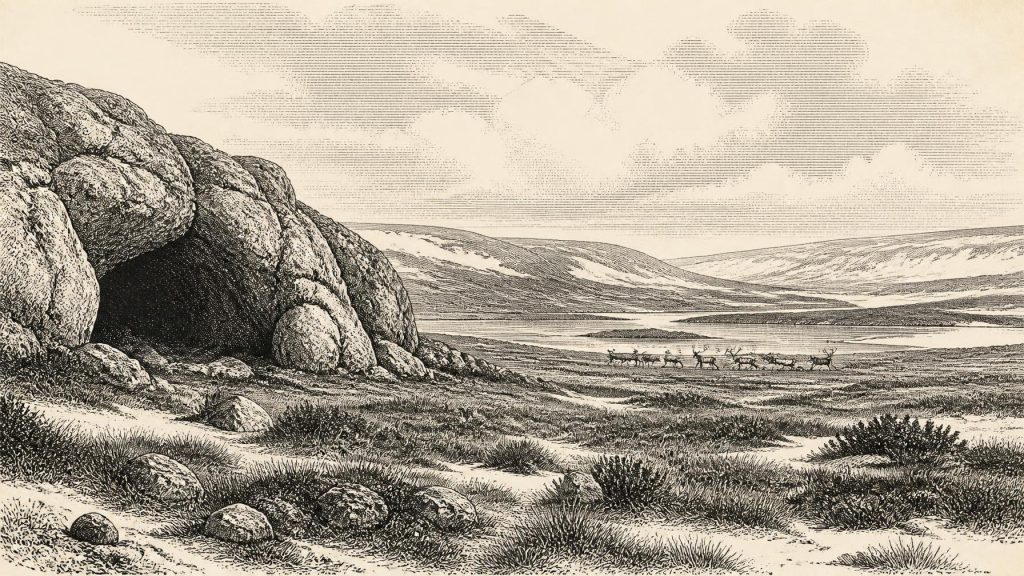
Around 31,101 BCE, Ireland experienced fluctuating Ice-Age conditions during Marine Isotope Stage 3, with expanding ice, periglacial landscapes and occasional open grazing ground. Lower sea levels altered coasts but do not prove a land bridge to Britain. Castlepook Cave, County Cork, preserves Ireland’s richest pre-Last Glacial Maximum faunal archive, containing mammoth, reindeer, giant deer, bear and hyaena remains accumulated over millennia. A cut-marked reindeer femur, dated broadly around 31,000 BC, may indicate mobile Upper Palaeolithic people processing carcasses. However, it cannot prove settlement, hunting, culture or social organisation. The evidence instead reveals changing environments and a possible early human presence.
Dateline
The label 31,101 BCE suggests a precision that the evidence cannot sustain. Nobody in Ice-Age Ireland used a calendar, and archaeology cannot identify an event, a person or even a particular season in that numbered year. In modern arithmetic it falls about 33,050 years before AD 1950, the conventional origin of “before present” dating. It belongs broadly to the later part of Marine Isotope Stage 3, a volatile phase of the last glacial period. The appropriate history is therefore one of calibrated ranges, deposits and changing environments, not an invented annual chronicle.
That distinction matters especially in Ireland. Later glaciers eroded, buried and rearranged much of the older landscape. The surviving record for this remote interval consists chiefly of animal bones, cave sediments, pollen and plant remains in scattered deposits, glacial landforms, and the results of modern re-dating. These sources can illuminate a cold, open and ecologically connected island. They cannot demonstrate an Irish nation, settlement system or political event in 31,101 BCE.
A Landscape in Transition
Ireland at this time was within the long cold phase conventionally called the Midlandian in Irish Quaternary studies. It was not simply a country locked under one unchanging blanket of ice. Climate across the North Atlantic swung abruptly between colder stadials and comparatively milder interstadials. Greenland ice-core chronologies provide the most detailed framework for those shifts, but correlation from Greenland to an individual Irish valley is necessarily interpretative rather than exact. Around the early thirties of millennia BCE, temperatures, snowfall, vegetation and ice margins could alter substantially over centuries or millennia.
Recent reconstruction of the British–Irish Ice Sheet emphasises that its growth was uneven in time and place. By about 31,000 years ago, ice was building in northern sectors and high ground, while the geographical evidence for the precise limits of Irish ice remains sparse. The fully developed maximum came later, not at one simultaneous moment everywhere. For Ireland around the date considered here, the defensible picture is a patchwork: expanding upland and regional ice, periglacial ground beyond it, and pockets of open country capable at times of supporting grazing animals. It is unsafe to colour the whole island either ice-free or fully ice-covered on the basis of one date.
Sea level was lower than it is today, exposing parts of the continental shelf and changing the shape of coasts and sea crossings. Yet lower seas do not automatically prove a dry land bridge between Ireland and Britain. The precise routes available to animals or people varied with local topography, water depth, ice, tides and climate. The animal record does show that Ireland was not biologically isolated throughout the glacial period: mammals repeatedly reached it from the wider north-west European world. How each species crossed remains a question of palaeogeography, not something that can be read directly from a cave bone.
Castlepook’s Long Bone Record
The most important Irish locality for this broad period is Castlepook Cave, near Doneraile in north County Cork, in the Awbeg valley beneath the Ballyhoura foothills. Excavations between 1904 and 1918 recovered a large and extraordinarily mixed assemblage from its narrow passages and chambers, including places named Hyaena Hall and Elephant Hall. Geological Survey Ireland describes it as the country’s richest source for vertebrate fauna before the Last Glacial Maximum. More than 2,000 bones have been recovered, with individual radiocarbon results spanning roughly 45,700 to 19,950 radiocarbon years before present. That is a valuable archive, but it is emphatically not a single, undisturbed moment in time.
Its fauna includes woolly mammoth, giant deer, reindeer, brown bear and spotted hyaena; later elements include wolves, Arctic foxes and lemmings. These remains establish that cold-adapted and open-country mammals reached Ireland during the middle and later stages of the Ice Age. They do not prove that every listed animal shared the same valley or season. Bone accumulations in caves may result from carnivores, natural deaths, water movement, sediment collapse and human excavation practices as well as from any human activity. Castlepook was a repository repeatedly altered over tens of thousands of years, not an Ice-Age village preserved beneath a floor.
Modern re-dating has increased the need for caution. Ruth Carden’s reassessment found that some earlier determinations from Castlepook and other southern Irish caves were substantially too young, in some cases by thousands of radiocarbon years. The reassessment supports a deeper Marine Isotope Stage 3 history for parts of the fauna and suggests that giant deer and spotted hyaena may have disappeared locally before the Last Glacial Maximum, around 40,000 calibrated years before present. Scientific improvement has thus made the record older and more interesting, while making simple narratives less secure.
The Marked Reindeer Femur
One Castlepook object gives this approximate year exceptional importance: a reindeer femur bearing a deep incision interpreted by zooarchaeologist Ruth Carden as a cut made by a sharp stone tool during carcass processing. County Cork heritage material catalogues the bone as c. 31,000 BC and presents it as potential evidence of Palaeolithic hunters. Public reporting has also described it as about 33,000 years old. Those shorthand expressions should not be treated as a precise calibrated calendar date or as proof of a particular day’s hunt. Radiocarbon ages require calibration against a curve such as IntCal20, and the resulting calendar estimate is a probability range rather than a point.
The incision and the date answer different questions. If the mark is genuinely a stone-tool cut and belongs to the same period as the bone, it indicates that a person used a sharp implement on a reindeer carcass in Ireland during the broad earlier Upper Palaeolithic. It does not reveal whether the animal was hunted or scavenged, whether meat, hide, sinew or marrow was sought, or whether the cutting happened at the cave. Carnivores could subsequently have carried a portion of the carcass into Castlepook. Nor has the cave yielded a securely associated hearth, stone-tool assemblage, dwelling surface, human burial or repeated food-processing area of comparable age.
It would therefore be misleading to announce a settled population, a tribe or an established Irish hunting territory. The most that can responsibly be inferred is the possibility of a brief visit by one or more highly mobile hunter-gatherers. Such people, if present, would have belonged to wider Upper Palaeolithic networks in north-west Europe, but Ireland has not produced the artefacts needed to assign them a named archaeological culture. The reindeer bone is an important proposed trace of human action; it is not a constitution for prehistoric Ireland.
Life Without a Social Record
There is no evidence from this period for political institutions, rulers, diplomacy, territorial boundaries or organised warfare in Ireland. Nor can religion, language, kinship rules, music, art or formal learning be recovered from the Castlepook material. Upper Palaeolithic communities elsewhere in Europe made sophisticated stone tools, ornaments and images, but those continental achievements must not be imported into Ireland without Irish evidence.
Everyday life can only be approached conditionally. If hunters reached Ireland, they probably travelled in very small groups, carried portable equipment, relied on fire and clothing, and moved according to weather and animal opportunity. Reindeer would have supplied meat and potentially hide, bone and sinew; other large mammals represented resources but also danger. Such possibilities are grounded in hunter-gatherer practice elsewhere, not demonstrated by a domestic camp at Castlepook. There is no basis for farming, livestock keeping, permanent houses, pottery, metalworking, markets or regular trade within Ireland at this date.
The island’s real economy was ecological. Open herb-rich ground, grasses, sedges, dwarf shrubs and scattered cold-tolerant vegetation could support herbivores; predators and scavengers followed them. Wet patches, streams and cave entrances created local contrasts within a generally cold and exposed world. Faunal evidence indicates connection to Eurasian ranges, while the absence of a broad artefact record suggests that any human use of the island was intermittent or has been lost to erosion and later ice. Both explanations may be relevant, but neither converts silence into certainty.
What This Year Can Mean
The strongest history of 31,101 BCE is consequently one of thresholds. Ireland was approaching the great expansion of the British–Irish Ice Sheet, yet parts of its landscape could still sustain a remarkable cold-stage fauna. Castlepook preserves evidence of mammoth, reindeer, giant deer, bear, wolf and hyaena across a long interval of climatic instability. Its marked reindeer femur raises the consequential possibility that people reached the island far earlier than the securely established terminal-Pleistocene evidence from Alice and Gwendoline Cave in County Clare, where a butchered bear patella has calibrated ranges of 12,810–12,590 and 12,810–12,685 years before present.
But the lesson is methodological as well as dramatic. A single mark is evidence to be tested, not a licence to populate the island with imagined camps. Around this notional year, Ireland has no written politics and no calendar history. It has a changing Ice-Age environment, an uneven fossil record, a cave archive disturbed over long periods, and one provocative object at the edge of what can presently be said. That is limited evidence, but it is enough to make the Castlepook threshold central to the deepest history of human possibility in Ireland.
Primary Sources
- Castlepook Cave, County Cork Geological Site Report
- Heritage Artefacts of County Cork
- Archaeological Heritage of County Cork
- A Reconsideration of the Radiocarbon Dating of the Marine Isotope Stage 3 Fauna from Southern Ireland
- The Irish Quaternary Fauna Project
- Growth and Retreat of the Last British–Irish Ice Sheet, 31,000 to 15,000 Years Ago: the BRITICE-CHRONO Reconstruction
- Reconstructing the Last Irish Ice Sheet 2: A Geomorphologically-Driven Model of Ice Sheet Growth, Retreat and Dynamics
- Last Glacial Maximum Cirque Glaciation in Ireland and Implications for Reconstructions of the Irish Ice Sheet
- Oscillating Retreat of the Last British-Irish Ice Sheet on the Continental Shelf Offshore Galway Bay, Western Ireland
- The Deglaciation of the Western Sector of the Irish Ice Sheet from the Inner Continental Shelf to its Terrestrial Margin
- A Stratigraphic Framework for Abrupt Climatic Changes During the Last Glacial Period Based on Three Synchronized Greenland Ice-Core Records
- A 60,000 Year Greenland Stratigraphic Ice Core Chronology
- The IntCal20 Northern Hemisphere Radiocarbon Age Calibration Curve (0–55 cal kBP)
- New Insights on the Fauna of Ireland's Younger Dryas and Early Holocene from Alice & Gwendoline Cave
- First Evidence of a Late Upper Palaeolithic Human Presence in Ireland
- Archaeology Research Excavation Grant 2022: Final Report
- Castlepook, County Cork, Excavation Report 2022
- Pattern, Style and Timing of British–Irish Ice Sheet Advance and Retreat Over the Last 45,000 Years: Evidence from NW Scotland and the Adjacent Continental Shelf
- Mammoth and Musk Ox ESR-Dated to the Early Midlandian at Aghnadarragh, County Antrim, Northern Ireland, and the Age of the Fermanagh Stadial
- The Last Glacial Maximum British–Irish Ice Sheet: A Reconstruction Using Digital Terrain Mapping