
Maguirebridge’s Buried Sedgebed31100 BCE
At roughly 31,100 BCE, Ireland lay within the unstable cold conditions of Marine Isotope Stage 3, not a precisely datable historical year. At Derryvree near Maguiresbridge, organic freshwater sediments sealed between glacial tills record an ice-free interval, calibrated broadly to 36,900–31,700 BP. Sedges, mosses, herbs and aquatic plants indicate cold, open wetlands amid changing ice cover. Comparable Fermanagh deposits and Kerry cave calcite confirm intermittent milder conditions. Cave fauna shows that reindeer, deer, mammoth and predators reached Ireland episodically. A possibly tool-marked reindeer bone from Castlepook may indicate human presence, but neither permanent settlement nor travel routes can be demonstrated.
Dateline
Modern calendar-year precision is not available for Ireland in 31,100 BCE. This is a modern label applied to a point roughly 33,050 years before AD 1950, the conventional “present” of radiocarbon chronology. No Irish community then recorded years, rulers, journeys or battles; nor does any excavated layer preserve the events of a single twelve-month span. The responsible history of this moment must therefore be written in calibrated ranges, sediments, fossils and carefully limited inference.
In archaeological terms, the date falls in the Late Pleistocene, during Marine Isotope Stage 3, within the long Midlandian cold stage of Irish Quaternary history. It was well before the Last Glacial Maximum, when ice later reached much greater extent across Ireland and the surrounding continental shelf. The climate was not simply and continuously “Ice Age cold”. It was unstable on scales far longer than a human lifetime but short in geological terms, with shifts in temperature, moisture, vegetation and ice cover. Ireland’s evidence is patchy because later glaciers eroded landscapes, moved older material and buried what survived.
A Date Within a Range
The most important Irish record relevant to this date is at Derryvree, near Maguiresbridge in County Fermanagh. Roadworks in 1969 exposed a remarkable sequence inside a drumlin: freshwater silts and fine sands, rich in organic material, lay between two tills. Till is the unsorted debris deposited directly by glacier ice. The sequence provides firm relative evidence: ice had previously occupied the site; conditions later permitted standing or slow-moving fresh water, plants and sediment to accumulate; and ice subsequently advanced across the locality again, sealing the deposit.
Organic material from the Derryvree freshwater series returned a conventional radiocarbon age of about 30,500 radiocarbon years BP, with a substantial laboratory uncertainty. Once calibrated, published estimates place the deposit broadly between about 36,900 and 31,700 calendar years BP. The modern date of 31,100 BCE lies within that broad interval. It does not, however, date every grain of silt, every fossil or every phase of the wetland to that exact year. Calibration is essential because atmospheric carbon-14 levels have varied over time, and uncertainty becomes considerable at this depth of the past.
This distinction matters. Derryvree is direct evidence for an ice-free freshwater episode at one northern Irish locality during the wider period. It is not proof that all of Ireland was ice-free at once, that the same vegetation grew everywhere, or that a particular family camped nearby in 31,100 BCE. Yet its very survival beneath later glacial deposits makes it one of the clearest windows onto the changing Irish environment before the full severity of the last glacial maximum.
Water, Sedges and Open Ground
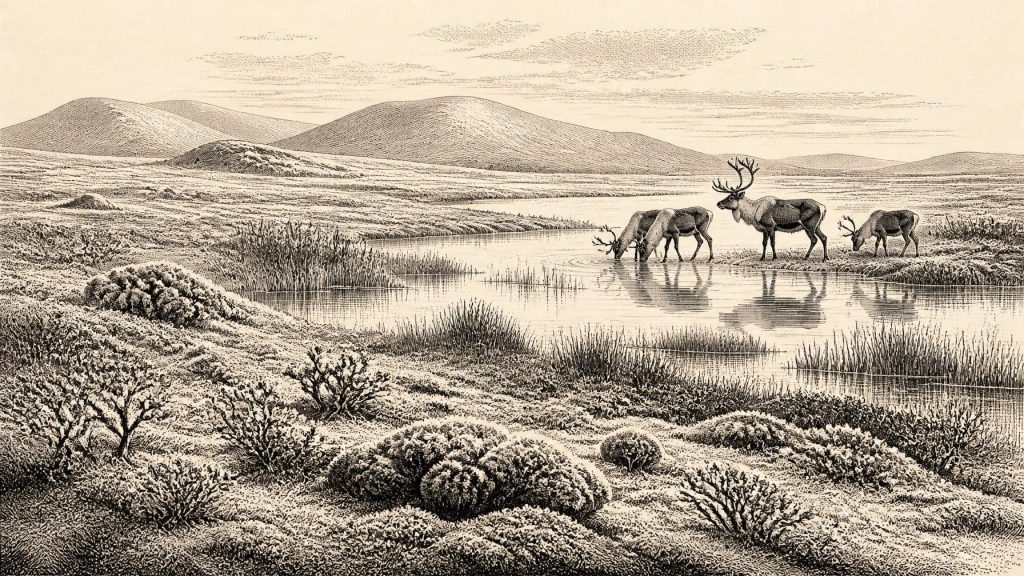
The Derryvree deposits point to a cold, open and largely treeless landscape with wet ground capable of sustaining freshwater life. Plant macrofossils, pollen and insects from such inter-till deposits are more informative about local ecology than any broad painted image of an Ice Age wilderness. Sedges, mosses, low herbs and aquatic plants indicate marshes, shallow pools and saturated hollows. The wider terrain is best envisaged as a mosaic: exposed mineral ground, wet depressions, streams or pond margins and sparse low vegetation, all shaped by short growing seasons, frost and seasonal change.
Comparable evidence from Greenagho near Belcoo, also in County Fermanagh, reinforces the conclusion that north-western Ireland experienced episodes of non-glacial conditions during the Middle Midlandian. At Greenagho, organic detritus below later till has yielded a calibrated range of roughly 37,200–35,700 years BP. It is older than the notional date considered here, but it helps establish the regional pattern: ice advance, retreat or thinning did not proceed as a single simple march. Freshwater habitats could develop in places later overwhelmed by renewed ice.
Crag Cave in County Kerry offers a second, very different environmental archive. Uranium-thorium dating of broken and reworked cave calcite shows repeated episodes of speleothem growth through Marine Isotope Stage 3. Since calcite formation in this shallow cave required liquid water moving through soil and rock, the record indicates intermittent amelioration in south-west Ireland. It should not be treated as a thermometer for a particular year at Maguiresbridge. Together with Derryvree, however, it demonstrates that late-Pleistocene Ireland contained local environmental opportunities amid an overall trajectory towards harsher glacial conditions.
Animals on a Changing Island
Cave collections, especially from southern Ireland, show that a diverse cold-stage fauna reached the island during the wider pre-maximum period. Reindeer, red deer, giant deer, woolly mammoth, brown bear, wolf, Arctic fox, mountain hare, lemmings and spotted hyaena all appear in the Irish Quaternary record, though not necessarily as contemporaries at one site or in one generation. The evidence is often from nineteenth- and early twentieth-century excavations, when recording standards were uneven and deposits could be disturbed. Modern radiocarbon re-dating has therefore been crucial, and it has altered several earlier assumptions about the age of the southern cave fauna.
Castlepook Cave, near Doneraile in north County Cork, is particularly important. Its assemblage includes remains of large herbivores and predators associated with the wider Marine Isotope Stage 3 world. Reindeer were well suited to open, cold habitats and could have moved through landscapes where wetland vegetation, grasses and herbs supplied seasonal forage. Predators and scavengers, including hyaenas, remind us that carcasses and bones do not automatically record human activity. A cave bone may have arrived through natural death, carnivore transport, scavenging, water movement or excavation disturbance.
The fauna permits a measured conclusion: Ireland was not biologically empty around this broad phase of the Late Pleistocene. It hosted, at least intermittently, animal communities whose ranges extended across north-west Europe. It does not permit a precise reconstruction of herd size, migration routes or the appearance of the countryside in 31,100 BCE. Nor should every famous Ice Age animal be placed together in an imagined scene. The correct emphasis is on changing habitats and unevenly dated evidence.
The Human Question
This date has unusual significance because a reindeer femur from Castlepook has been reported as bearing a deep mark consistent with processing by a sharp stone tool. The bone has been presented by Irish heritage authorities as approximately 31,000 BCE, making it potentially the earliest indication of human activity in Ireland by a very large margin. If that interpretation is accepted, it suggests that people reached Ireland during the Late Palaeolithic and used at least part of a reindeer carcass.
That is an important but narrow claim. A dated animal bone and a possible butchery mark do not establish a permanent settlement, a population size, a named archaeological culture, a house, a burial ground or a continuing line of descent. No securely associated camp surface, hearth, stone-tool assemblage or human remains is presently available from Castlepook for this early episode. Renewed fieldwork has sought to understand the cave’s surviving deposits and context, but the old excavations and disturbed collections impose real limits. Around 31,100 BCE, a short visit by mobile hunter-gatherers is a possibility supported by the interpretation of the marked bone; enduring occupation remains unproven.
Nothing responsible can be said of political affairs, diplomacy or organised conflict in the later historical sense. There is no evidence for polities, chiefs, territories, treaties or warfare. If people entered the island, their social world was almost certainly organised on a far smaller scale than later farming or metal-using societies. Co-operation in travel, food sharing, shelter-making and carcass processing is a reasonable general inference for highly mobile foragers, but it cannot be assigned specifically to any Irish group. Similarly, there is no direct evidence for ritual, language, visual art or formal learning in Ireland at this date.
Movement, Resources and Distance
The economy, if humans were present, would have rested on wild resources rather than farming. There were no crops, livestock, fields, pottery industries or monuments. Hunting, scavenging, gathering plant foods when seasonally available, and the practical knowledge needed to move through cold terrain are plausible elements of a Palaeolithic lifeway. But there is no Irish evidence from this horizon to identify specific weapons, clothing, boats or exchange goods. Even the journey to Ireland cannot be reconstructed with confidence.
Global sea level was lower than today because vast quantities of water were held in ice sheets, exposing areas of the continental shelf. Yet lower seas did not necessarily create a simple walkable land bridge between Ireland and Britain. The changing form of the Irish Sea basin, local ice loading, coastlines and waterways makes the issue more complex. Faunal and possible human arrival show that dispersal occurred at some point in the wider period; they do not identify a route, season or mode of crossing. Any statement that people merely walked into Ireland would exceed the evidence.
The main development around 31,100 BCE was therefore environmental, not political: a fluctuating late-Pleistocene Ireland in which freshwater wetlands and open cold-country vegetation existed in some places, mammals moved through an unstable north-west European world, and expanding ice increasingly narrowed ecological possibilities. Derryvree’s buried sedgebed preserves this reality with exceptional clarity. It offers no annual chronicle, but it records a living landscape that later ice nearly erased.
Primary Sources
- A Middle Midlandian Freshwater Series at Derryvree, Maguiresbridge, County Fermanagh, Northern Ireland
- Middle Midlandian Interstadial Deposits at Greenagho, Near Belcoo, County Fermanagh, Northern Ireland
- A reconsideration of the radiocarbon dating of the Marine Isotope Stage 3 fauna from southern Ireland
- The Irish Quaternary Fauna Project
- Irish Quaternary Vertebrates
- Phylogeographic, ancient DNA, fossil and morphometric analyses reveal ancient and modern introductions of a medium-sized mammal into Ireland
- Episodic speleothem deposition tracks the terrestrial impact of millennial-scale last glacial climate variability in SW Ireland
- The IntCal20 Northern Hemisphere radiocarbon age calibration curve (0–55 cal kBP)
- Growth and retreat of the last British–Irish Ice Sheet, 31,000 to 15,000 years ago: the BRITICE-CHRONO reconstruction
- Trimlines, blockfields and the vertical extent of the last ice sheet in southern Ireland
- Maximum extent and dynamic behaviour of the last British–Irish Ice Sheet west of Ireland
- New data for the Last Glacial Maximum in Great Britain and Ireland
- The problem of a Late Quaternary landbridge between Britain and Ireland
- The subdivision of the Quaternary Period in Ireland
- Cenozoic: Tertiary and Quaternary (until 11,700 BP)
- The Late Quaternary history of east-central Ireland
- 2022:564 – Castlepook Cave, Castlepook South, Cork
- Archaeology Research Excavation Grant 2022: Castlepook Cave, Co Cork
- Heritage Artefacts of County Cork 2021
- Archaeological Heritage of County Cork 2020
- Field Guides
- Outreach and Education Resources
- IntCal Publications
- New insights on the fauna of Ireland’s Younger Dryas: its biogeography, ecology and extinctions