Reindeer Bone, Drumlin Silt31099 BCE
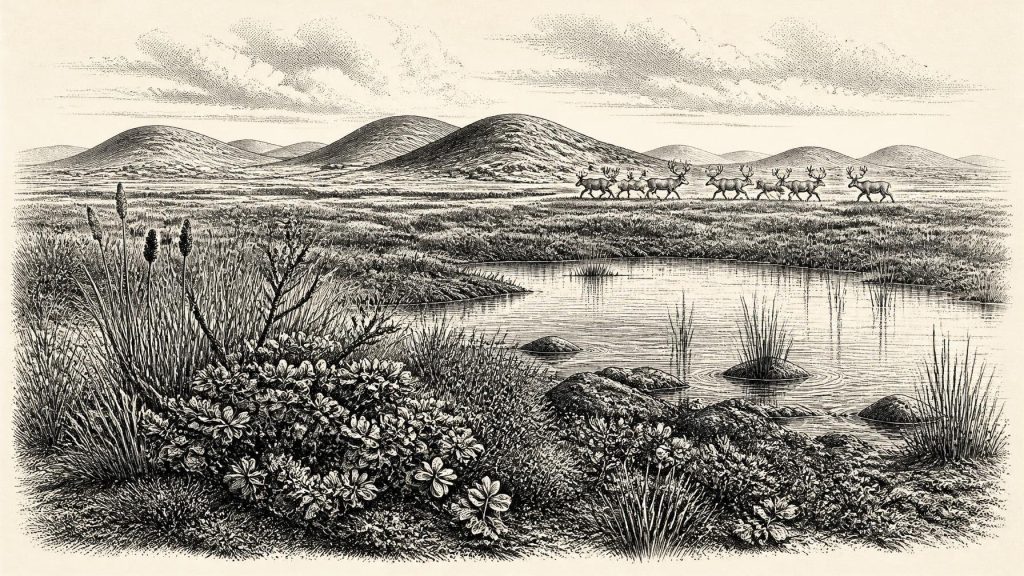
At the notional date of 31,099 BCE, Ireland was a cold, unstable Late Pleistocene landscape, not a settled country. Sediments beneath the Derryvree drumlin in County Fermanagh, dated broadly to 34,700–32,300 cal BP, show an ice-free freshwater wetland with tundra vegetation, insects and shallow water between glacial advances. Lower sea levels altered coasts, although no proven route into Ireland exists. Cave remains indicate reindeer and other cold-adapted fauna. A marked reindeer femur from Castlepook Cave may record human butchery, but cannot demonstrate residence. No settlements, artefacts, trade networks or polities are known; later ice probably destroyed much surviving archaeological evidence.
Dateline
The label 31,099 BCE cannot be attached to a known Irish event, ruler, journey or settlement. No calendar used in Ireland at this depth of time survives, and archaeological science cannot resolve a single year so far back. In simple calendar arithmetic, the date is roughly 33,050 years before the 1950 reference point used for “before present” dating, but that is not itself a radiocarbon or calibrated age. The responsible history of this moment is therefore a history of overlapping date ranges, deposits and carefully limited inferences.
Ireland lay in the Late Pleistocene, within the long cold phase conventionally called the Midlandian in Irish geology and broadly corresponding to Marine Isotope Stage 3. It was not yet the Ireland of farms, forests, monuments or permanent villages. The strongest evidence relevant to this notional year comes from two very different kinds of archive: freshwater sediments sealed beneath a drumlin at Derryvree, near Maguiresbridge in County Fermanagh, and animal bones recovered from limestone caves, especially at Castlepook near Doneraile in north County Cork. Together, they suggest a harsh but ecologically varied land, intermittently ice-free, where animals moved through open country and where a human visit is possible but far from demonstrated as a settlement.
Dating a Calendarless Landscape
The chronological problem matters. Radiocarbon results are expressed in radiocarbon years before present and must be calibrated against changing atmospheric carbon levels to estimate calendar ages. At these great ages the uncertainties are substantial. The organic Derryvree deposit produced the conventional radiocarbon determination BIRM-166, 30,500 ± 1,100 radiocarbon years BP. Later modelling has placed this evidence for ice-free conditions at about 33.5 ± 1.2 thousand calendar years BP: broadly around 34,700–32,300 cal BP. That span overlaps the approximate calendar position represented by 31,099 BCE, but it does not identify a season, generation or historical occurrence.
The deposit is especially valuable because its stratigraphy is clear. Road works in 1969 cut through a Fermanagh drumlin and exposed freshwater silts and fine sands between two distinct sheets of glacial till. The lower and upper tills record separate episodes when ice moved across the ground. Between them lay sediments formed where liquid water, plants and small animals existed. Derryvree is thus direct evidence against imagining every part of Ireland as continuously entombed beneath ice throughout the later Ice Age. It does not mean that the whole island was warm, wooded or hospitable; it demonstrates a local environmental interval within an unstable glacial world.
A Fen Beneath the Ice
Pollen, plant macrofossils and insect remains from Derryvree recover a surprisingly precise ecological outline. The vegetation was predominantly open and tundra-like, rather than forest. Sedges, grasses, dwarf shrubs and cold-adapted herbs occupied wet and exposed ground. The record includes mountain-avens, dwarf willow, juniper, clubmosses and bogbean (Menyanthes trifoliata), while aquatic and marginal plants indicate shallow fresh water and marshy margins. Mosses and insect evidence add to the impression of a wetland mosaic: pools, seepage, muddy shores and vegetated ground within an otherwise cold, windswept landscape.
This was not barren terrain. In summer, low vegetation could provide forage and nesting cover; in winter, frost, snow cover and scarce daylight would have imposed severe constraints. Trees were absent or negligible locally. There is no evidence for cultivated crops, managed pasture, clearance, fields or domestic livestock. The people who later transformed Irish landscapes through farming were more than twenty-five millennia in the future. Derryvree’s importance lies precisely in its modest scale: a buried patch of freshwater habitat preserves organisms that would otherwise have vanished beneath later ice and sediment.
Ice, Water and a Changing Coast
At about this point in the Late Pleistocene, climate across the North Atlantic was capable of sharp shifts. Ice sheets were growing and reorganising, but the maximum expansion of the last Irish Ice Sheet came later, broadly within the period c. 27,000–23,000 calendar years BP, with details varying regionally and remaining debated. The later ice would scour, bury and rearrange much of Ireland’s surface record. That destructive history helps explain why evidence for an earlier human presence is so scarce: open-air camps, wooden structures and lightly used hunting places would have had little chance of survival.
Sea level was markedly lower than today because water was stored in continental ice sheets. Ireland’s shoreline therefore extended beyond many modern coasts, and plains now submerged beneath the Atlantic and Irish Sea formed part of the wider landscape. Yet lower sea level should not automatically be translated into a simple land bridge or an easy route for people. The precise geography of coasts, channels, glaciers and seasonally dangerous waters changed through time. No excavated route, boat or crossing place from this period has been found in Ireland. Any movement of animals or people must remain an inference from broader north-west European geography, not an established Irish journey.
Reindeer, Hyenas and Cave Archives
Irish cave deposits and older collections demonstrate that Late Pleistocene Ireland supported a richer large-mammal fauna than the modern island. Reindeer are especially relevant to open, cold-country environments. Other fauna documented in Irish Quaternary records include woolly mammoth, giant deer, horse, brown bear, wolf, Arctic fox, lemming and spotted hyena. Not every species was necessarily present in the same district or century, and cave assemblages often mix remains accumulated over long periods. A cave is not a census of one living landscape. Bones may have arrived through carnivore activity, natural deaths, water movement or excavation disturbance.
Castlepook Cave, also known historically as Mammoth Cave, illustrates both the promise and limitation of this evidence. Its animal remains were recovered during antiquarian excavations, principally in the early twentieth century, before modern recording standards. A reindeer femur from the collection has been publicly reported as approximately 33,000 years old and to carry a deep mark interpreted as stone-tool damage made during carcass processing. If that diagnosis and chronology are upheld by continuing work, the bone may indicate that a person handled a reindeer in Ireland at a time relevant to this article.
The Human Question
The Castlepook femur is potentially momentous, but it cannot bear more weight than it contains. One marked bone is not evidence for a village, an enduring population, a named culture or a political territory. It cannot tell us whether people killed the animal, found it already dead, removed meat or hide, broke the carcass elsewhere, or lost a processed fragment that later entered the cave. Nor does it establish a precise date for the mark itself. There is no securely associated hearth, stone-tool assemblage, dwelling floor, burial, food store or repeated butchery area from Ireland at around 31,099 BCE.
The broader European comparison is informative only at a general level. Elsewhere in north-west Europe, Upper Palaeolithic Homo sapiens groups made stone tools, exploited animal resources, used hides and maintained social connections across considerable distances. Such practices make a brief Irish visit conceivable. They do not prove that a comparable community was resident in Ireland. The better-established Irish evidence for human activity is much later: a butchered bear bone from Alice and Gwendoline Cave in County Clare dates to 12,810–12,590 cal BP, while more sustained settlement belongs to the post-glacial world. The gap is a warning against filling a sparse record with an imagined population.
No Polities, No Proven Trade
Political affairs, diplomacy and organised conflict cannot responsibly be described for Ireland at this date. There are no names, boundaries, forts, monuments, weapons assemblages or settlement hierarchies. Equally, there is no evidence of trade in the later sense: no imported tools, exchange goods or established sea routes can be assigned to this period. If people reached Ireland, their economy would most plausibly have depended on highly mobile hunting, scavenging and gathering in a seasonal landscape, but that is an interpretation drawn from comparable Upper Palaeolithic lifeways rather than a directly excavated Irish household.
Religion, language, music, art and learning are beyond recovery here. The absence of evidence is not evidence that people lacked beliefs, stories or technical knowledge; it means that Ireland has yielded no material traces through which such matters can be studied for this interval. The appropriate historical emphasis is environmental survival and evidential restraint. Derryvree shows that cold-age Ireland contained freshwater wetlands and plant life between phases of glaciation. Castlepook raises the serious possibility that people encountered its reindeer. Between those statements lies a vast space that archaeology cannot yet fill.
A Fragile Window
For 31,099 BCE, Ireland appears not as an empty stage but as a difficult, changing environment whose evidence has survived by accident. A silt bed beneath a drumlin records sedges, bogbean and shallow water; cave collections preserve the bones of animals moving through open country; a single marked femur invites, but does not settle, a profound question about human presence. Later ice would reshape the island and erase much of what had existed. The history of this notional year is therefore not a story of kings or communities. It is the story of a brief scientific window onto an Ice Age Ireland that was alive, cold, mobile and largely beyond the reach of calendar history.
Primary Sources
- A Middle Midlandian Freshwater Series at Derryvree, Maguiresbridge, County Fermanagh, Northern Ireland
- Exploring Controls of the Early and Stepped Deglaciation on the Western Margin of the British-Irish Ice Sheet
- Pattern and Timing of Retreat of the Last British-Irish Ice Sheet
- The Last Glacial Maximum
- Last Glacial Maximum Cirque Glaciation in Ireland and Implications for Reconstructions of the Irish Ice Sheet
- Trimlines, Blockfields and the Vertical Extent of the Last Ice Sheet in Southern Ireland
- New Data for the Last Glacial Maximum in Great Britain and Ireland
- The Irish Quaternary Fauna Project
- First Evidence of a Late Upper Palaeolithic Human Presence in Ireland
- New Insights on the Fauna of Ireland's Younger Dryas and Early Holocene from Alice & Gwendoline Cave
- The IntCal20 Northern Hemisphere Radiocarbon Age Calibration Curve (0–55 cal kBP)
- A Stratigraphic Framework for Abrupt Climatic Changes During the Last Glacial Period Based on Three Synchronized Greenland Ice-Core Records
- European Vegetation During Marine Oxygen Isotope Stage 3
- Middle Midlandian Interstadial Deposits at Greenagho, Near Belcoo, County Fermanagh, Northern Ireland
- Freshwater Organic Deposits and Stratified Sediments Between Early and Late Midlandian Till Sheets, at Aghnadarragh, County Antrim, Northern Ireland
- The Quaternary Period in Ireland: An Assessment
- Heritage Artefacts of County Cork
- 32564: Castlepook Cave, Co. Cork
- The Late Quaternary History of East-Central Ireland
- Irish Pleistocene Biostratigraphy