Maguirebridge Fresh-Water Series30959 BCE
30,959 BCE cannot be reconstructed as a specific Irish historical year; evidence describes only broad Late Pleistocene conditions. At Derryvree, County Fermanagh, freshwater sediments between glacial tills show that local ice-free wetlands supported tundra plants and insects during climatic instability. Castlepook Cave, County Cork, preserves bones of mammoth, reindeer, giant deer, predators and other cold-adapted fauna, although they represent different depositional episodes. A marked reindeer femur may indicate human carcass processing about 33,000 years ago, but remains unconfirmed and does not demonstrate settlement. There is no evidence for polities, beliefs, farming or permanent communities. Glaciation later transformed and obscured evidence.
Dateline
30,959 BCE is not a recoverable year in Irish history. It is a modern calendar label placed roughly 32,900 years before the conventional radiocarbon baseline of AD 1950, within the Late Pleistocene and Marine Isotope Stage 3. No Irish calendar, written testimony, settlement sequence or dated archaeological layer can tell us what occurred in that particular year. The responsible history is therefore one of broad, calibrated and radiocarbon-dated ranges: changing ice, water, plants, animals and a possible, still unconfirmed trace of human activity.
The evidence is exceptionally fragmentary. Much of Ireland was later overridden or reshaped by ice during the Last Glacial Maximum, while coastlines have altered radically and any former lowland sites may now lie beneath the sea. What remains comes principally from deposits trapped between glacial sediments, from cave bones, and from painstaking reassessment of old museum collections. These sources are more informative about environment and animal movement than about politics, communities or beliefs.
A Point Within Deep Time
The nearest major environmental anchor is Derryvree near Maguiresbridge in County Fermanagh. Roadworks exposed a remarkable sequence within a drumlin: a lower till, organic-rich freshwater sediments and fine sands, then a later upper till. Till is material deposited by glacier ice. The order of these layers demonstrates that ice covered the locality, retreated or ceased to occupy it locally long enough for water and organic sediment to gather, and later advanced again. It records environmental instability on a scale of millennia, not an annual episode.
Organic material from the Derryvree freshwater deposits produced a radiocarbon determination of 30,500 radiocarbon years before present, with a substantial uncertainty. Radiocarbon ages are not calendar ages: atmospheric carbon-14 has varied through time, so measurements must be calibrated against independently dated records. IntCal20 provides a calibration curve extending to 55,000 calendar years before present, but uncertainty remains considerable at this depth. The Derryvree deposit is consequently best treated as evidence for a broad cold-stage interval around the later Middle Midlandian, not proof that its pools, plants or insects were alive in 30,959 BCE exactly.
This distinction matters. The numbered year lies in a phase of repeated climatic shifts before the fullest development of the last British–Irish Ice Sheet. Modern reconstructions show that expansion, maximum extent and retreat were neither simple nor simultaneous across Ireland and Britain. A local wetland in Fermanagh cannot supply a weather report for every valley, coast or upland on the island. Yet Derryvree establishes an important fact: parts of Ireland could sustain an ice-free terrestrial and freshwater environment during an otherwise cold and increasingly glacial age.
Wet Tundra Between Glaciers
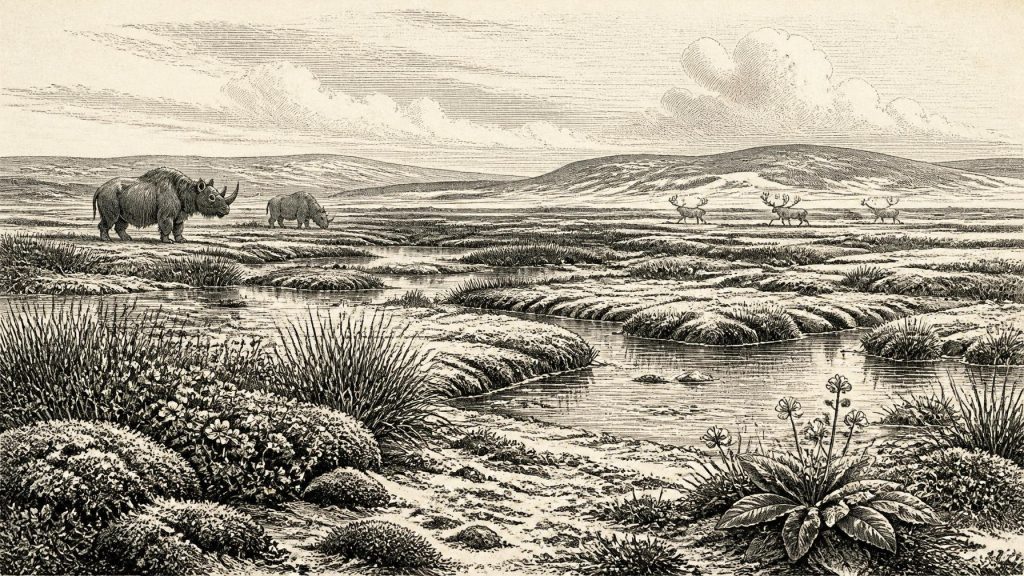
Derryvree’s plant and insect remains indicate an open, treeless landscape of northern aspect. Fossil mosses, sedges and aquatic plants, including bogbean and mountain avens, point to shallow freshwater, wet ground and patches of low vegetation rather than woodland. Pollen and macrofossils support the interpretation of a muskeg-like tundra wetland: waterlogged places rich in plant matter, interspersed with pools and surrounded by cold-country vegetation. Insects reinforce the picture of severe conditions, especially harsh winters, while also showing that this was not a lifeless sheet of ice.
Such evidence permits a restrained reconstruction of everyday ecology. During a short growing season, plant cover would have taken advantage of saturated soils, meltwater and open ground. In winter, freezing and thawing would have affected drainage, soil stability and vegetation. Wind exposure and seasonal contrasts were likely important. The familiar wooded and farmed countryside of later Irish history did not exist. Neither did the blanket of bog, hedgerow, field and settlement that now gives so much of Ireland its character.
It would be wrong, however, to picture every part of the island as identical tundra at once. Derryvree is a local archive preserved by unusual geological circumstances. Cave deposits in Munster and other scattered sites record different moments in long, complicated histories of deposition. The most secure conclusion is not that Ireland had one fixed Ice Age landscape, but that habitats expanded, contracted and changed as ice margins, temperature, precipitation and sea level changed.
Castlepook’s Animal Archive
At Castlepook Cave, near Doneraile in north County Cork, animal remains offer a second and very different window. The cave system produced a striking Pleistocene assemblage during excavations led by the naturalist Richard J. Ussher in the early twentieth century and from later discoveries. Its recorded fauna includes woolly mammoth, reindeer, giant deer, brown bear, wolf, Arctic fox, lemmings, hare and spotted hyaena. Direct dates and later reassessments indicate that some of this material belongs to the period before the Last Glacial Maximum, broadly overlapping the wider world relevant to this article.
These bones demonstrate that cold-adapted and large-ranging mammals reached Ireland at different points during the Late Pleistocene. They do not prove that all listed species lived together at Castlepook in one year, or even one century. Caves are complex archives. Carnivores may drag in prey; animals can die naturally, bones can be carried by water, and excavators may disturb or remove the sedimentary sequence. The old investigations also left incomplete contextual records by modern standards. A cave fauna is therefore evidence of presence and deposition, not an instant photograph of a living community.
Even so, the range of animals is historically significant. Reindeer and mammoth evoke open country with extensive grazing potential; hyaena and wolf indicate predators and scavengers within that food web. Small mammals such as lemmings help identify cold conditions. Giant deer, bears and foxes remind us that the island’s Pleistocene fauna was unlike its later historic fauna. The animals’ presence also implies intermittent connections, whether through changing coastlines, sea ice, narrow marine passages or other routes that remain debated. Low sea level altered the geography of the Irish Sea region, but there is no safe basis for imagining a simple, permanent land bridge or a single migration corridor at this exact date.
The Reindeer Femur Question
One Castlepook object carries exceptional potential. A reindeer femur fragment, recovered in 1972 and later examined by the zooarchaeologist Ruth Carden, has been publicly reported as approximately 33,000 years old. It bears a deep linear modification interpreted as damage made by a sharp stone implement while the bone was fresh. If that identification and its association with the animal’s death are upheld through full specialist publication and further contextual evidence, it may represent human processing of a reindeer in Ireland far earlier than the formerly accepted record.
That possibility must not be inflated into a settled Ice Age Ireland. The radiocarbon result dates the animal bone, rather than automatically dating the incision or identifying who made it. The mark itself requires taphonomic judgement: specialists must distinguish tool damage from carnivore activity, breakage, sediment abrasion and other processes. Nor has Castlepook produced a securely associated hearth, stone-tool assemblage, dwelling floor, burial, food-preparation area or undisturbed occupation surface of comparable age. The femur is, at most, evidence for a possible act of carcass processing; it is not evidence for a village, a permanent population or a named people.
If people did reach Ireland during this broad interval, they were likely highly mobile hunter-gatherers operating within wider north-west European social and ecological networks. That is an inference from the period’s wider archaeology, not a demonstrated Irish social structure. A successful visit to a cold and variable landscape would have required practical knowledge: animal behaviour, seasonal movement, shelter, fire, clothing, stone-working and cooperation. Yet none of these can be assigned to a particular group in Ireland from the present evidence.
No Polities, No Recorded Beliefs
There were no identifiable Irish kingdoms, borders, diplomatic relations, rulers or wars in 30,959 BCE. Nothing supports claims about tribes, languages, law or ethnic identities. “Ireland” itself is used here only as a geographical convenience for the landmass that later became the island, not as a political or cultural community. Similarly, there is no direct Irish evidence from this date for ritual monuments, formal burial practice, cave art, religious institutions, teaching or written learning.
Upper Palaeolithic communities elsewhere in Europe possessed rich cultural traditions, sophisticated stone technologies and, in some regions, remarkable art. Those comparisons provide context for what a short human incursion into Ireland might have involved, but cannot fill the Irish evidential silence. To import continental art, beliefs or named archaeological cultures into Castlepook without Irish finds would be speculation.
An Economy of Landscapes, Not Markets
There is likewise no evidence for farming, herding, metalworking, long-distance trade or permanent economic institutions. The only possible subsistence activity directly relevant is the contested processing of a reindeer carcass at Castlepook. If human, it suggests the acquisition of meat, marrow, hide, sinew or other animal resources, but it cannot reveal whether the animal was hunted, scavenged, killed elsewhere or brought to the cave. Derryvree’s wetland plants and insects tell us about available habitats, not ownership or exchange.
The most important development around this notional date was therefore environmental. Ireland was part of a fluctuating Ice Age world, sometimes capable of supporting freshwater wetlands and cold-adapted mammals, but moving towards the major glaciation that would transform the landscape and erase or bury much earlier evidence. The Derryvree sediments and Castlepook bones preserve brief, uneven glimpses across that transformation. They offer a compelling prehistory precisely because they demand caution: a living landscape can be recovered in outline, but a calendar year, a human community and its story cannot.
Primary Sources
- A Middle Midlandian Fresh-Water Series at Derryvree, Maguiresbridge, County Fermanagh, Northern Ireland
- Figure 6.— The Subdivision of the Quaternary Period in Ireland
- Irish Pleistocene Biostratigraphy
- The Irish Quaternary Fauna Project
- New Insights on the Fauna of Ireland’s Younger Dryas and Early Holocene from Alice & Gwendoline Cave
- The IntCal20 Northern Hemisphere Radiocarbon Age Calibration Curve (0–55 cal kBP)
- Growth and Retreat of the Last British–Irish Ice Sheet, 31,000 to 15,000 Years Ago: The BRITICE-CHRONO Reconstruction
- Growth and Retreat of the Last British–Irish Ice Sheet, 31 000 to 15 000 Years Ago: The BRITICE-CHRONO Reconstruction
- Trimlines, Blockfields and the Vertical Extent of the Last Ice Sheet in Southern Ireland
- Dimensions and Chronology of the Last Ice Sheet in Western Ireland
- Ireland: Submerged Prehistoric Sites and Landscapes
- The Problem of a Late Quaternary Landbridge Between Britain and Ireland
- The Island of Ireland: Drowning the Myth of an Irish Land-Bridge?
- Introduction to the Glacial Sand and Gravel Landscapes of Northern Ireland
- Introduction to the Late Quaternary and Holocene of Northern Ireland
- Menyanthes trifoliata L.
- Dryas octopetala L.
- Heritage Artefacts of County Cork
- The Castlepook Cave Project
- Mammoth Cave, County Cork
- Ireland’s Palaeolithic Archaeology – Fleeting Footprints in a Frozen Land
- Sedimentary Ancient DNA Reveals Late Pleistocene Faunal Connectivity Between Ireland and Eurasia
- Last Glacial Maximum Cirque Glaciation in Ireland and Implications for Reconstructions of the Irish Ice Sheet