Maguirebridge’s Winter Waters30931 BCE
30,931 BCE cannot be reconstructed as a specific Irish year, but falls within a broad MIS 3 interval of climatic instability. Derryvree, County Fermanagh, preserves freshwater deposits between glacial tills, indicating cold, treeless tundra-like wetlands with grasses, sedges, herbs, juniper, mosses, insects and seasonal water. Cave remains, notably from Castlepook, attest changing populations of reindeer, mammoth, giant deer, predators and other cold-adapted animals. A marked reindeer femur may indicate early human butchery, though its context prevents certainty. No settlements or polities are known. Glacial erosion and altered coastlines limit evidence, suggesting occasional mobile visitors in Ireland rather than established communities.
Dateline
30,931 BCE is a modern chronological label, not a year that can be recovered from Ireland’s archaeological record. No calendar, written account, settlement sequence or securely dated event allows historians to identify what happened in this particular year. In radiocarbon terms it lies roughly 32,880 years before the conventional present of AD 1950, but radiocarbon results at this depth must be calibrated and are expressed as broad probability ranges rather than single calendar years. The most responsible account is therefore of Ireland during the later part of Marine Isotope Stage 3 (MIS 3), a climatically unstable phase of the last Ice Age, rather than of an imagined annual history.
A Date Within a Broad Interval
The best Irish environmental evidence close to this notional date comes from Derryvree, near Maguiresbridge in County Fermanagh. Roadworks in 1969 cut through a drumlin and revealed fine sands, silts and organic freshwater deposits enclosed between two layers of till, the debris left by glacial ice. The sequence is decisive in one important respect: ice had occupied the locality, then a period without overriding ice allowed water, sediment, plants and small animals to accumulate, before a later advance deposited the upper till and sealed the record.
Organic material from the Derryvree freshwater series produced a conventional radiocarbon age of 30,500 +1,170/−1,030 radiocarbon years BP. Calibration produces a much broader calendar-age estimate, commonly discussed as approximately 36,900–31,700 calibrated years BP. The label 30,931 BCE falls within that wide span, but cannot be attached to a particular bed, season, plant or animal at Derryvree. The deposit documents a cold-stage interval lasting far longer than a human lifetime, not a dated occurrence in a named year.
This distinction guards against a misleadingly simple picture. Ireland was not yet necessarily blanketed everywhere by the later Last Glacial Maximum ice sheet, but neither was it a green, wooded island. Ice margins, mountain glaciers, sea level, rivers and coastlines changed on regional and millennial scales. The British–Irish Ice Sheet was entering a major phase of growth and reorganisation around this broad period, while its precise extent varied from place to place. A wetland at one Fermanagh locality cannot supply a weather report for Cork, the western uplands or every intervening lowland.
Wet Ground Between Glacial Advances
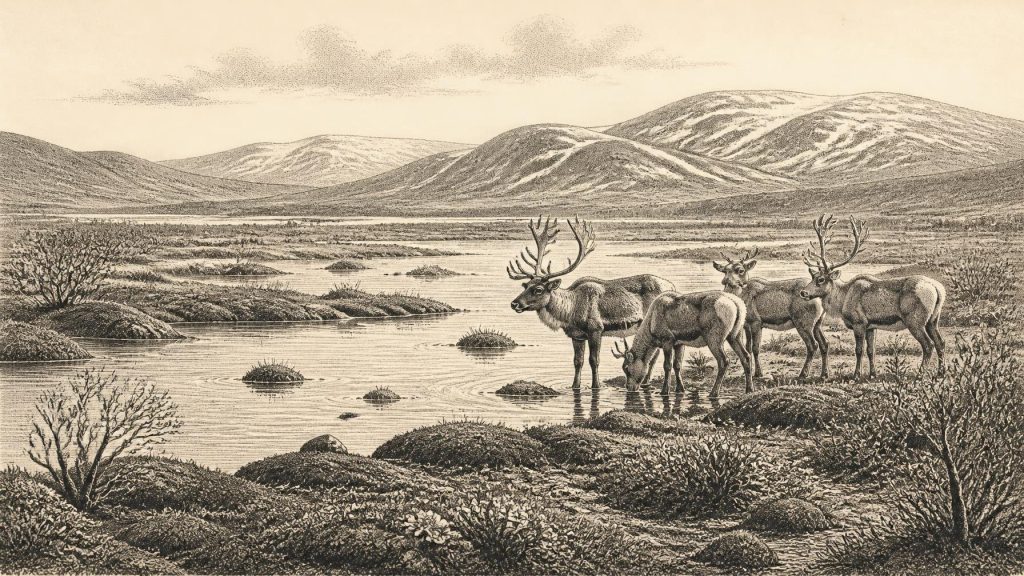
Derryvree nevertheless gives an unusually tangible glimpse of life in part of Ireland. Pollen, plant macrofossils, mosses and insect remains point to a cold, open, largely treeless environment. Grasses, sedges, herbs and juniper formed much of the vegetation. Fossil remains of bogbean, water-milfoil, mountain-avens and lesser clubmoss are particularly informative: some indicate shallow or slow-moving freshwater and wet margins, while others are characteristic of exposed, cold-climate ground. Mosses and insects reinforce the interpretation of saturated, plant-rich hollows and pools.
Earlier investigators used the word “muskeg” for this landscape. The term should not conjure a modern Irish bog transplanted unchanged into the Ice Age. It is better understood as a mosaic of wet, organic ground, shallow pools, sedgy margins, sparse vegetation and frost-disturbed surfaces. Winters were severe, the growing season short, and trees were absent or extremely scarce around the deposit. A few poorly preserved pollen grains from trees cannot securely demonstrate local woodland: pollen can travel far and older material may be reworked. The combined evidence, however, strongly supports open tundra-like country rather than forest.
Such ground could be biologically active despite its severity. Water remained available at least seasonally; aquatic and wetland plants grew; insects completed their life cycles; and grazing mammals could use patches of herbage. Yet productivity was strongly seasonal, shelter limited and weather exposure acute. The landscape was not an empty white plain, but it was a demanding environment whose habitable patches may have shifted as watercourses, snow cover, frozen ground and nearby ice changed.
Animals at Ireland’s Western Edge
Late Pleistocene cave deposits, especially at Castlepook Cave near Doneraile in north County Cork, show that Ireland supported or received a striking range of mammals during MIS 3. The cave assemblages include reindeer, woolly mammoth, giant deer, brown bear, wolf, Arctic fox, mountain hare, lemmings and spotted hyaena. These animals should not be presented as a single herd or a perfectly contemporary community. Cave deposits accumulated over long periods, and bones may have been introduced by carnivores, water, collapse, excavation disturbance and human collection. Modern redating has also shown that some older radiocarbon determinations from Irish caves were too young.
Even with those cautions, the faunal record establishes a changing northern environment connected, at intervals, to wider north-west European animal ranges. Reindeer and lemmings suit the image of open, cold terrain; mammoth and giant deer point to the capacity of parts of the landscape to sustain large herbivores; hyaenas and wolves reveal predators and scavengers within the food web. Caves were not neutral census sites. A hyaena den, for example, records where bones were carried and consumed rather than a balanced sample of every animal beyond its entrance. But taken with the Fermanagh wetland evidence, the bones make clear that severe conditions did not mean lifelessness.
The Reindeer Femur Question
One object from Castlepook has made this era especially important for Irish archaeology: a reindeer femur from the historic cave collection, reported as around 33,000 years old and bearing a deep mark that zooarchaeologist Ruth Carden has interpreted as damage from a sharp stone tool during carcass processing. County Cork’s heritage publication dates the bone broadly to about 31,000 BC. If that assessment is upheld, it would be the earliest presently claimed indication that people handled an animal in Ireland, far earlier than the securely documented terminal-Pleistocene human evidence.
The claim deserves serious attention but not embellishment. The bone dates the death of the reindeer, not necessarily the instant when the mark was made. The femur was recovered in early twentieth-century cave work, not from a modern sealed excavation in which stone tools, a hearth, butchered remains and occupation surfaces lay together. Caves are especially difficult contexts because carnivores may transport, gnaw and scatter bones, while sediment movement and old excavation practices may disrupt associations. Identifying a cut mark requires specialist comparison with natural breakage, teeth, trampling and other damage.
If the incision was made by a person, the direct conclusion is modest but remarkable: someone used a sharp lithic edge on a reindeer carcass in Ireland during this broad period. It does not demonstrate a permanent population, a village, a named people, a language or a continuous lineage leading to later inhabitants. It cannot tell us whether the animal was hunted, scavenged, processed elsewhere, or carried into the cave by predators after people had removed meat, hide, sinew or marrow. A brief visit by highly mobile Upper Palaeolithic hunter-gatherers following seasonal resources is a reasonable interpretation, but it remains interpretation rather than established fact.
No Polities, No Proven Settlements
There is no evidence from Ireland around this time for political institutions, rulers, diplomacy, warfare, territorial states, trade networks, farming, domestic livestock or permanent settlements. Nor is there material evidence from which to reconstruct religious ceremonies, artistic traditions, education or formal systems of learning. These absences reflect the thinness and survival of the record. Later ice repeatedly eroded surfaces, buried old landforms and altered drainage; falling sea levels changed coastlines, while subsequent sea-level rise drowned former lowlands. Potential campsites may have been destroyed, concealed beneath sediments or lost offshore.
Should the Castlepook femur represent human activity, the most that can responsibly be said about everyday economy is that a mobile party may have exploited a large animal using a stone cutting implement. Reindeer would have offered meat, hide, sinew, fat, antler and bone, but none of these uses is independently demonstrated at Castlepook. There is no Irish assemblage of tools from which to identify a particular Upper Palaeolithic tradition. Equally, there is no basis for assuming people remained through worsening glacial conditions. The evidence permits a possible encounter; it does not establish settlement.
An Island Not Yet Familiar
The Ireland evoked by Derryvree and Castlepook was therefore neither the island of later farmers nor a timeless frozen wilderness. It was a changing edge-land of freshwater pools, mossy wet ground, sparse herbs, exposed mineral soils and animal movements, increasingly affected by expanding ice. Fermanagh preserves the environmental detail because a later glacier sealed it beneath till. Cork’s caves preserve bones because limestone cavities sheltered them, although often in complicated and mixed deposits. Both are fortunate survivals from a landscape whose ordinary surfaces have largely vanished.
For 30,931 BCE, the central historical fact is uncertainty disciplined by evidence. Calibrated ranges, glacial stratigraphy, fossil plants, insects and animal bones can illuminate the conditions of a broad Late Pleistocene interval. They cannot yield an annual chronicle. Ireland was capable of supporting cold-adapted ecosystems, and perhaps of receiving occasional human visitors, before the major glacial expansion that would later transform the island again. That is already a profound chapter of Irish deep history, even though it contains no names, no dates remembered at the time, and no securely known human community.
Primary Sources
- The Irish Quaternary Fauna Project
- Irish Quaternary Association Field Guide 16: Fermanagh
- Early Midlandian–Middle Midlandian, Pleistocene, Northern Ireland
- A Reconsideration of the Radiocarbon Dating of the Marine Isotope Stage 3 Fauna from Southern Ireland
- Heritage Artefacts of County Cork
- 2022:564 – Castlepook Cave, Castlepook South, Cork
- Irish Pleistocene Biostratigraphy
- The IntCal20 Northern Hemisphere Radiocarbon Age Calibration Curve (0–55 cal kBP)
- The IntCal20 Northern Hemisphere Radiocarbon Age Calibration Curve (0–55 cal kBP)
- Growth and Retreat of the Last British–Irish Ice Sheet, 31,000 to 15,000 Years Ago: the BRITICE-CHRONO Reconstruction
- The Timing and Magnitude of the British–Irish Ice Sheet Between Marine Isotope Stages 5d and 2
- Timing and Pace of Ice-Sheet Withdrawal Across the Marine–Terrestrial Transition West of Ireland During the Last Glaciation
- Trimlines, Blockfields and the Vertical Extent of the Last Ice Sheet in Southern Ireland
- Sedimentary and Foraminiferal Records of Late Quaternary Environmental Change West of Ireland and Implications for the Last British–Irish Ice Sheet
- BSBI: Menyanthes trifoliata
- BSBI: Selaginella selaginoides
- BSBI: Dryas octopetala
- First Evidence of a Late Upper Palaeolithic Human Presence in Ireland
- New Insights on the Fauna of Ireland’s Younger Dryas and Early Holocene from Alice & Gwendoline Cave
- The Stratigraphic Position and Age of the Gortian