Derryvree’s Silted Fen30929 BCE
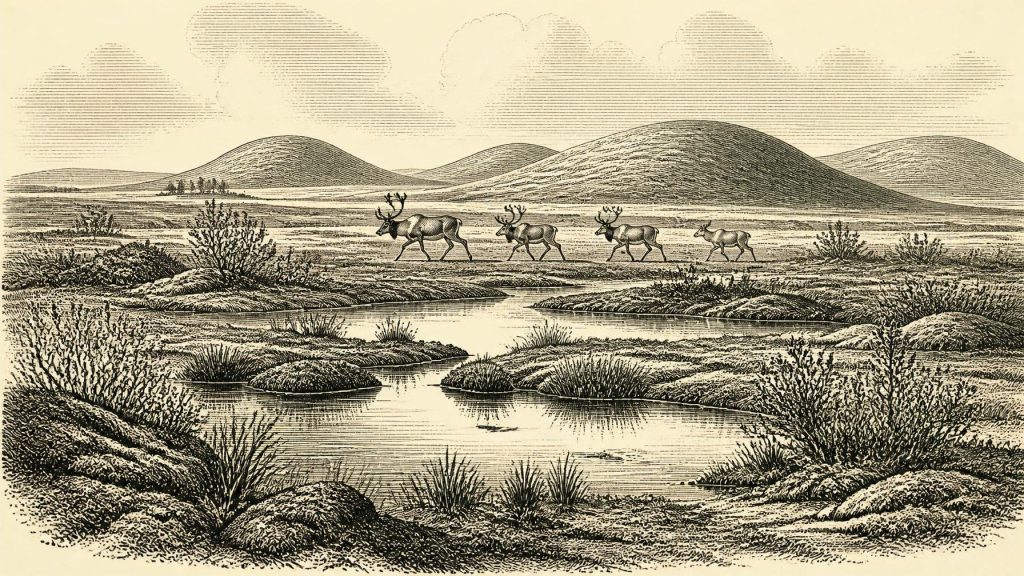
30,929 BCE is not recoverable as a precise Irish historical year, but falls within MIS 3 of the Late Pleistocene. Derryvree, County Fermanagh, preserves freshwater silts between glacial tills, indicating a locally ice-free, treeless wetland during a broadly dated interval spanning this horizon. Castlepook Cave, County Cork, records reindeer, mammoth, giant deer, predators and other cold-stage fauna in open habitats. A cut-marked reindeer femur may indicate Upper Palaeolithic human activity, but cannot prove settlement, routes or permanence. No evidence supports polities, trade, language or ritual. Subsequent glacier growth obscured this fluctuating pre-Last Glacial Maximum landscape across much of the island.
Dateline
30,929 BCE is a modern calendar label, not a year that can be recovered from Ireland’s prehistoric record. No written calendar, named ruler, settlement sequence or event can be placed in this particular year. In radiocarbon terms it falls about 32,878 years before AD 1950, within the Late Pleistocene and Marine Isotope Stage 3 (MIS 3). The responsible approach is therefore to use broad, calibrated ranges rather than pretend to annual precision. The best Irish environmental sequence for this horizon is at Derryvree, near Maguiresbridge in County Fermanagh: organic freshwater sediments there have been calibrated broadly to about 36,900–31,700 calendar years before present. That wide span includes 30,929 BCE, but it does not prove that the deposit records this exact year or that conditions were identical across the island.
A Wetland Between Ice Advances
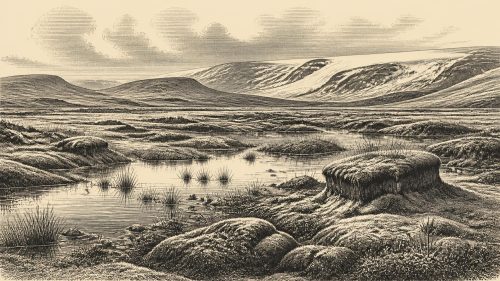
Derryvree was revealed by road-cutting through a drumlin, one of the streamlined hills which now characterise much of Fermanagh. Excavators found organic-rich silts and fine sands sandwiched between two substantial layers of till, the stony sediment left by glacier ice. The sequence has an unusually clear implication: after one phase of glaciation, freshwater and wetland sediments accumulated at the site; only later did ice return or expand across it, sealing the evidence below another till layer. It is a record of an interval and of environmental change, not a portrait of an individual year.
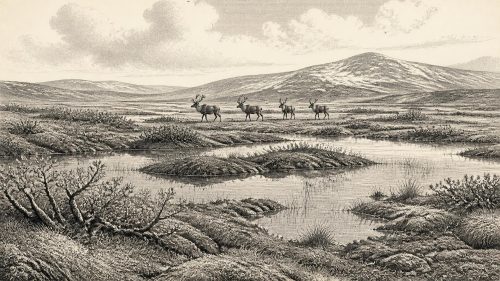
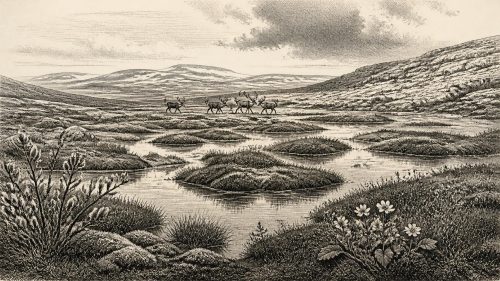
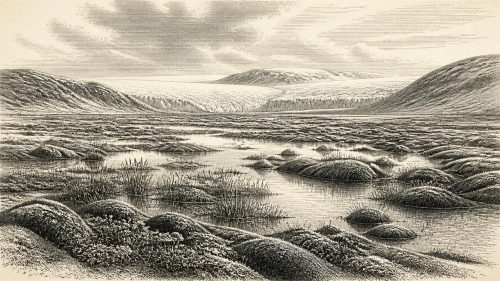
The plants preserved in these sediments point to a treeless, cold-stage wetland or muskeg landscape. Mosses, sedges and aquatic plants could thrive in shallow water, saturated ground and pools, while low-growing tundra vegetation occupied better-drained patches. Such evidence does not justify imagining a single uniform plain: watercourses, small basins, exposed mineral ground and patches of snow or frost would have created a mosaic of habitats. Nor should the word “tundra” suggest permanent lifelessness. Short growing seasons could still sustain a productive summer flora, insects and grazing animals.
Derryvree also demonstrates why the old picture of an Ireland continuously smothered by ice throughout the later Ice Age is too simple. Around this broad period, glaciers, ice caps and ice-free terrain changed repeatedly and did not behave in the same way in every region. Syntheses of the British–Irish Ice Sheet suggest substantial growth after roughly 32,000–31,000 years ago, leading towards a far later maximum in the mid-twenties thousand years before present; yet the evidence for the opening stages remains sparse and regional. Models and field evidence consequently allow different local conditions at similar dates. Fermanagh’s buried wetland proves an ice-free episode at that locality, while it cannot map the state of every mountain, coast or sea channel in Ireland.
The Cork Faunal World
County Cork supplies a second, very different window. Castlepook Cave, near Doneraile, has produced one of Ireland’s most important collections of Ice Age animal remains. Work on the cave’s faunas, including reassessment of older radiocarbon determinations, places significant parts of its pre-Last Glacial Maximum record in MIS 3, broadly around 34,000–35,000 years ago. These are not necessarily exactly contemporary with 30,929 BCE; nevertheless, they show the kinds of animals that occupied southern Ireland during the same long climatic phase.
Reindeer are central to this picture, but the assemblage was richer than a single herd species. Mammoth, giant deer, brown bear, wolf or other canids, fox, hare, lemming and spotted hyaena have all been identified among the Pleistocene remains associated with the cave’s wider record. The combination indicates open country capable of supporting grazers, browsers and large predators, alongside sheltered limestone terrain where caves could trap sediment and preserve bone. Cave deposits, however, are not straightforward inventories of a living landscape. Carnivores can drag carcass parts underground; water can move fragments; digging and later disturbance can mix deposits. A bone in a cave does not automatically show where an animal died, grazed or was killed.
For everyday life in the literal sense, this is the strongest direct evidence available: animals moved through a cold, open and hazardous landscape; predators competed for meat and shelter; seasonal water and vegetation shaped where grazing was possible. There is no basis for assigning a population size, estimating a human diet across Ireland, or imagining villages. The famous image of a settled “Ice Age Ireland” is especially misleading for this date. The Irish evidence is sparse because later ice sheets eroded, reworked and buried older deposits, as well as because any human visits may have been brief.
The Reindeer Femur Question
Castlepook matters to human history because a reindeer femur has been radiocarbon dated to about 33,000 years ago and bears a deep mark interpreted by palaeozoologist Ruth Carden as a cut made with a sharp stone tool during carcass processing. County Cork’s heritage publication treats it as evidence that Stone Age hunters were present in the area around 31,000 BCE. If that interpretation is sustained, it would push the evidence for human activity in Ireland dramatically earlier than the well-attested Mesolithic settlement of the early Holocene.
Its limits are as important as its promise. The femur is not a house floor, hearth, stone-tool scatter, human burial or stratified camp. It cannot tell us whether people killed the reindeer, scavenged part of a carcass, processed it elsewhere before the bone entered the cave, or stayed in Ireland beyond a short visit. It certainly cannot establish a permanent population in 30,929 BCE. The mark is best understood as a potentially consequential trace of Upper Palaeolithic activity, not as proof of an Irish community with a continuous history from this time.
Even travel routes remain uncertain. Lower global sea levels altered the geography of the Irish Sea basin, but changing coastlines, glacial margins and subsequently submerged landscapes make it unsafe to draw a neat land bridge on a map for one notional year. A possible human presence implies that people could reach the territory now called Ireland, whether across exposed land, ice, water or a changing combination of these; it does not yet reveal their route, homeland or frequency of movement.
No Polities, No Proven Trade
Political affairs, diplomacy and organised warfare are beyond the reach of the evidence. There are no named groups, leaders, boundaries, meeting places or weapons caches from Ireland at this horizon. The struggle visible in the record is ecological rather than political: large carnivores and scavengers, changing herds, freezing conditions and advancing ice. A humanly made cut mark, if confirmed, would show subsistence activity, not conflict between communities.
The same restraint is necessary for economy and trade. Reindeer and other animals could have offered meat, hide, sinew, bone, antler and fuel, but no Irish assemblage of this age demonstrates how such materials were shared or exchanged. No locally secure stone-tool industry has been identified, and no imported ornaments, raw materials or other evidence can demonstrate trade networks. Comparisons with contemporaneous hunter-gatherers elsewhere in north-west Europe can suggest that mobile groups often possessed sophisticated knowledge of animals, seasons, stone and routes; they cannot fill the Irish evidential gap with facts.
Culture Beyond Recovery
There is likewise no responsible evidence for language, kinship, religion, art, ritual or formal learning in Ireland in this period. The absence of evidence does not mean that visiting people lacked beliefs, stories or skills. It means that Ireland has not yielded material traces from which their particular forms can be recovered. A marked bone is not an artwork; a cave is not automatically a shrine; and the impressive survival of mammoth or hyaena remains does not identify cultural meaning.
What can be said is that survival in such country demanded practical knowledge: reading animal movement, anticipating weather, finding water, navigating open ground and obtaining shelter. Those are interpretations grounded in the environmental setting rather than discoveries of named traditions. The nearest secure conclusion is modest but significant: Ireland was part of a wider Late Pleistocene world of fluctuating cold, open habitats and mobile fauna, with a possible fleeting human presence.
A Landscape Before the Maximum
30,929 BCE therefore belongs neither to a wholly ice-covered Ireland nor to a settled prehistoric island. It belongs to an unstable threshold before the Last Glacial Maximum. At Derryvree, an intertill freshwater bed preserves the memory of pools, sedges and mossy wet ground in an interval when ice was absent locally. At Castlepook, cave bones preserve a southern fauna of reindeer, predators and other cold-stage animals; one marked femur raises, but does not settle, the question of human hunters. Later glacier expansion transformed the island and obscured much of this earlier world. The history of this date is consequently a history of evidence itself: silt between tills, bones in caves, calibrated age ranges and the discipline of knowing where interpretation must stop.
Primary Sources
- A Middle Midlandian Freshwater Series at Derryvree, Maguiresbridge, County Fermanagh, Northern Ireland
- A reconsideration of the radiocarbon dating of the Marine Isotope Stage 3 fauna from southern Ireland
- Trimlines, blockfields and the vertical extent of the last ice sheet in southern Ireland
- Growth and retreat of the last British–Irish Ice Sheet, 31,000 to 15,000 years ago: the BRITICE-CHRONO reconstruction
- Extent and timing of the Last Glacial Maximum (LGM) in Britain and Ireland: a review
- The timing and magnitude of the British–Irish Ice Sheet between Marine Isotope Stages 5d and 2: implications for glacio-isostatic adjustment, high relative sea levels and ‘giant erratic’ emplacement
- Behavioural tendencies of the last British–Irish Ice Sheet revealed by data–model comparison
- Deglaciation chronology of the Donegal Ice Centre, north-west Ireland
- Late Pleistocene chronostratigraphy and ice sheet limits, southern Ireland
- New data for the Last Glacial Maximum in Great Britain and Ireland
- Pattern and timing of retreat of the last British-Irish Ice Sheet
- The Irish Quaternary Fauna Project
- Figure 6.— The subdivision of the Quaternary Period in Ireland
- Heritage Artefacts of County Cork
- The Mesolithic in Ireland: when was it?
- The IntCal20 Northern Hemisphere Radiocarbon Age Calibration Curve (0–55 cal kBP)
- IntCal Publications
- UCD School of Archaeology Research Day 2022
- Archaeological excavations at Killuragh Cave, Co. Limerick: a persistent place in the landscape from the Early Mesolithic to the Late Bronze Age
- Ireland's Palaeolithic Archaeology – Fleeting Footprints in a Frozen Land