Maguirebridge Drumlin Exposure30792 BCE
Thirty-thousand-seven-hundred-and-ninety-two BCE is a modern chronological label, not a recoverable Irish year. Derryvree, County Fermanagh, preserves freshwater organic sediments between glacial tills, indicating a local ice-free MIS 3 interval with cold, treeless wetlands, tundra vegetation and periglacial conditions. Castlepook Cave, County Cork, contains disturbed accumulations of mammoth, giant deer, reindeer, carnivores and other cold-stage fauna spanning millennia, demonstrating intermittent ecological connections with north-west Europe. An incised reindeer femur may indicate Upper Palaeolithic butchery, but cannot prove permanent settlement. No evidence supports institutions, farming, villages or cultural traditions. Later ice advances reshaped and obscured this fragmentary record within Ireland’s glacial landscapes.
Dateline
30,792 BCE is not a recoverable Irish year in the modern sense. No calendar, written testimony, named person, settlement sequence or event can be assigned to it. The date is a modern label, roughly 32,741 years before the radiocarbon reference year of AD 1950, and it falls within the later part of Marine Isotope Stage 3 (MIS 3), an unstable interval of the last Ice Age. The responsible history of Ireland at this depth in time is therefore not an annual chronicle. It is a reconstruction from buried sediments, fossil plants and insects, animal bones, cave stratigraphy and broad scientific date ranges.
The closest Irish environmental evidence comes from Derryvree, near Maguiresbridge in County Fermanagh. Organic freshwater sediments there produced radiocarbon determination BIRM-166, conventionally dated to 30,500 +1,170/−1,030 radiocarbon years before present. Radiocarbon years are not calendar years: changing atmospheric carbon-14 means that such results must be calibrated. Published discussion places the Derryvree material broadly at about 36,900–31,700 calibrated years before present, approximately 34,950–29,750 BCE. The requested date falls within that wide interval, but it cannot identify a particular season, pool, animal or human action. It is an appropriate point from which to examine an Irish cold-stage landscape, not a date on which a specific occurrence can be claimed.
A Wetland Between Ice Advances
Derryvree was exposed by roadworks in 1969, when a cutting passed through a drumlin about two kilometres north-east of Maguiresbridge. The sequence was unusually revealing: one body of glacial till below, freshwater silts and fine sands with organic deposits in the middle, and another thick till above. Till is the unsorted mixture of clay, stones and debris laid down by glacier ice. The order of the layers establishes a basic environmental history. Ice had occupied the locality; an ice-free interval followed, allowing standing or slow-moving fresh water, plants and sediment to accumulate; then a later advance buried the wetland beneath fresh glacial debris.
This does not show that all Ireland was ice-free at once. It demonstrates local ice-free conditions in north-central Ireland during part of a long and changeable period. The later British–Irish Ice Sheet eroded, redistributed or sealed much older evidence across the island, making such protected deposits exceptionally valuable. Wider work on the ice sheet indicates that its pre-Last Glacial Maximum history involved advances and retreats during MIS 3, while its fullest later expansion belongs to the succeeding colder phase. Ireland around this notional date was therefore not simply either “under ice” or “ice-free”. Conditions varied by locality, altitude and time.
Treeless Ground and Cold Water
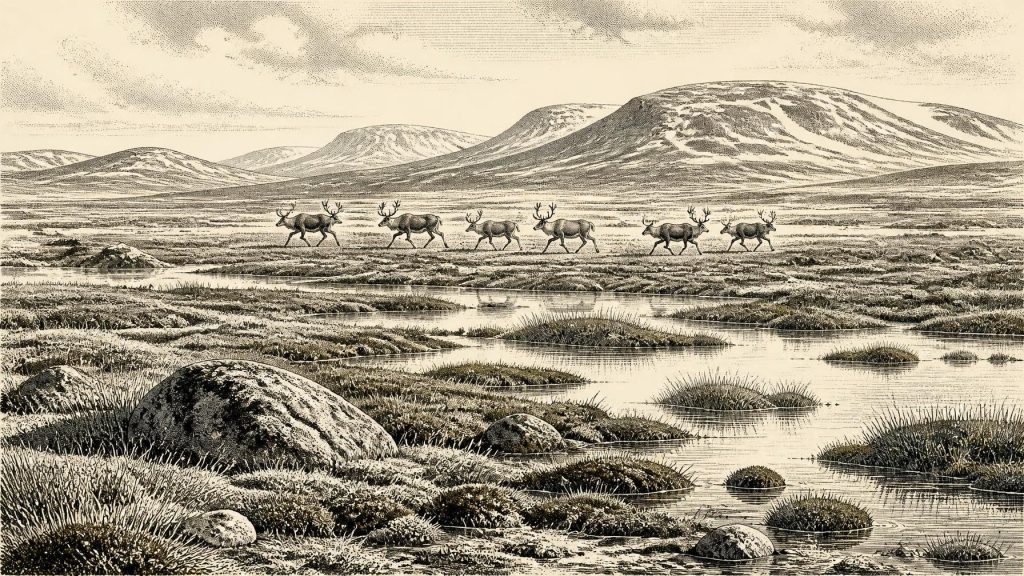
The fossil content at Derryvree provides the clearest evidence for everyday environmental conditions. Plants, mosses and insects point to open tundra or muskeg-like country: wet ground, shallow pools, sedgy margins, mossy surfaces and sparse, low vegetation rather than woodland. Grasses, sedges, juniper and herbs were among the reported indicators, while the invertebrate evidence supports a severe periglacial climate. Periglacial does not mean that a glacier covered the spot; it means a landscape strongly governed by cold, frost, seasonal thaw and the proximity of ice.
Such country was neither empty nor uniform. In warmer months, wetland margins could have been biologically productive, with aquatic plants and plant-rich mud supporting insects and grazing animals. Winters, however, were likely long and hard. The vegetation record does not allow a precise reconstruction of temperature or snowfall for 30,792 BCE, and it cannot supply a neat map of rivers, hills and coasts across Ireland. It does show that the familiar wooded island of later prehistory did not yet exist. The landscape available to animals, and perhaps to occasional people, was open, cold and vulnerable to rapid climatic change.
Castlepook’s Bone Archive
In County Cork, Castlepook Cave near Doneraile preserves another important but very different source. Excavations in the early twentieth century recovered more than 2,000 bones from galleries in the limestone cave. The collection includes woolly mammoth, giant deer, reindeer, brown bear, spotted hyena, wolf, Arctic fox and lemmings. It establishes that Ireland, during overlapping portions of the Middle and Late Pleistocene, could support a much richer cold-stage fauna than the modern island. It also suggests connections across the Irish Sea at times when animals could reach and leave the island, though the exact routes, shorelines and durations of those connections remain uncertain.
Castlepook should not be read as a single, intact hunting camp. Its bones accumulated over a long period, with individual radiocarbon dates stretching from roughly 45,700 to 19,950 years before present. Water movement disturbed deposits, and carnivores used the cave or carried material into it. Hyenas in particular are central to the cave’s history: Castlepook is Ireland’s principal evidence for the species, and a cave den or scavenging refuge can bring together remains from many episodes and places. The animal list is strong evidence for a cold-stage ecosystem; it is weak evidence for any one year, season or simultaneous animal community.
Nonetheless, the fauna makes Derryvree’s open wetlands easier to imagine in regional context. Reindeer were adapted to cold, open country and could exploit broad seasonal ranges. Mammoth and giant deer imply substantial forage somewhere in the wider landscape, while wolves and hyenas indicate large carnivores moving through it. These animals did not form a timeless “Ice Age Ireland” tableau. Their remains represent different dates and circumstances. Yet together they show that the island could intermittently function as part of the wider north-west European world of mobile herds, predators and treeless habitats before the Last Glacial Maximum transformed the physical landscape again.
The Mark on a Reindeer Femur
The most arresting possible human evidence close to this period is a reindeer femur from Castlepook. County Cork heritage publications identify it as dating to about 31,000 BCE and describe a deep incision interpreted by zooarchaeologist Ruth Carden as a cut made with a sharp stone tool during butchery. If that interpretation is sustained, the mark indicates that a person or people handled a reindeer carcass in Ireland during the Upper Palaeolithic. It would be far earlier than the substantial evidence for Mesolithic settlement after the final retreat of the ice.
Its importance requires caution rather than embellishment. A dated animal bone is not automatically a date for the making of a mark, and a mark interpreted as a stone-tool incision must be separated from damage caused by carnivore teeth, trampling, water transport, sediment abrasion, excavation or later handling. Nor is the femur from a sealed occupation floor with associated stone tools. No securely associated hearth, dwelling, burial, human skeleton, lithic assemblage or concentrated food-preparation area of comparable age has been recovered from Ireland. Castlepook’s disturbed, antiquarian excavation history makes those absences particularly significant.
The evidence can therefore support a modest but consequential possibility: a brief episode of carcass processing by Upper Palaeolithic visitors, perhaps people following or exploiting reindeer. It cannot demonstrate a permanent population, a named migration, a language, descent from later Irish communities, or a settled “first Irish” society. Nor can it establish whether people killed the animal, encountered a carcass, processed it outside the cave, or reached the island regularly. The distinction between direct evidence and inference is especially important in a period where one altered bone can carry great interpretative weight.
What Cannot Be Recovered
There is no evidence from Ireland around 30,792 BCE for political institutions, rulers, warfare between communities, diplomacy, formal trade routes, agriculture, permanent villages, religious monuments, writing or organised systems of learning. It would be misleading to fill these silences with assumptions drawn from much later prehistoric Ireland. No known economy of farming, metalworking or exchange can be assigned to this date. If people were present, their likely subsistence practices can only be inferred broadly from European Upper Palaeolithic comparisons and the local presence of large game; those comparisons are not evidence that a particular Irish group behaved in a particular way.
There is likewise no basis for identifying ritual or artistic traditions on the island at this time. Continental Europe contains abundant Upper Palaeolithic evidence of sophisticated technologies, art and social practices, but Ireland has not yielded comparable securely dated material from this interval. The responsible conclusion is not that no culture existed among any visitors, but that the Irish record cannot yet reveal it. Archaeology records survival and discovery as much as past activity, and later glaciation, shifting sea levels, cave disturbance and limited excavation have all narrowed what remains visible.
An Island in Transition
The principal development around this date was environmental, not political: Ireland stood within a fluctuating northern Atlantic cold stage, with some localities capable of supporting open wetlands and a diverse fauna before greater ice expansion. Derryvree records a freshwater interval preserved between glaciers. Castlepook records mammals, carnivores and cave processes accumulated over many millennia. The incised reindeer femur offers a provocative but still limited prospect of human activity. Together they replace an older image of a uniformly lifeless, permanently frozen Ireland with a more complex one—yet they do not justify a conventional national history for a single year.
For 30,792 BCE, then, the most historically honest picture is of cold, largely treeless ground; wet basins and pools in at least part of Fermanagh; mobile herds and predators in landscapes that included Cork; and ice whose later advances would reshape and obscure much of the record. The people, if present, remain almost invisible. The sediments and bones endure as the evidence: precise enough to establish an extraordinary Ice Age world, but not precise enough to turn a modern numbered year into an event.
Primary Sources
- A Middle Midlandian Freshwater Series at Derryvree, Maguiresbridge, County Fermanagh, Northern Ireland
- Irish Pleistocene Biostratigraphy
- The Irish Quaternary Fauna Project
- Figure 6.— The Subdivision of the Quaternary Period in Ireland
- Trimlines, Blockfields and the Vertical Extent of the Last Ice Sheet in Southern Ireland
- The Timing and Magnitude of the British–Irish Ice Sheet Between Marine Isotope Stages 5d and 2
- Growth and Retreat of the Last British–Irish Ice Sheet, 31,000 to 15,000 Years Ago: the BRITICE-CHRONO Reconstruction
- Exploring Controls of the Early and Stepped Deglaciation on the Western Margin of the British-Irish Ice Sheet
- Devising Quality Assurance Procedures for Assessment of Legacy Geochronological Data Relating to Deglaciation of the Last British-Irish Ice Sheet
- The IntCal20 Northern Hemisphere Radiocarbon Age Calibration Curve (0–55 cal kBP)
- Castlepook Cave, County Geological Site Report
- Quaternary Geological Map of Ireland 1:500,000
- Heritage Artefacts of County Cork
- Archaeological Heritage of County Cork
- 32564 — Castlepook Cave, County Cork
- Spotted Hyena Skull
- New Insights on the Fauna of Ireland’s Younger Dryas and Early Holocene from Alice & Gwendoline Cave
- Our Ancient Landscapes: Hunter-Gatherers in Ireland
- The Colonization of Ireland: A Human Ecology Perspective
- Ireland: Submerged Prehistoric Sites and Landscapes