BIRM-166 Organic Horizon30575 BCE
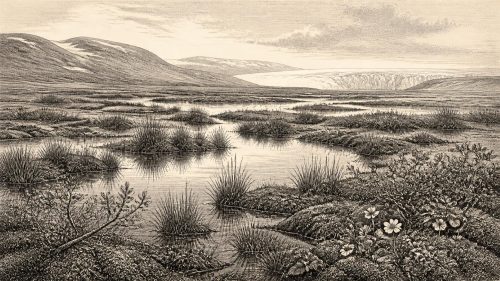
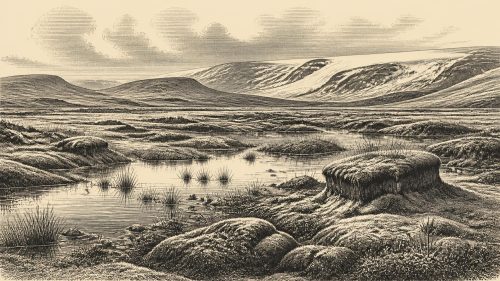
Thirty thousand five hundred and seventy-five BCE is a modern label within a broad calibrated range, not a recoverable prehistoric year. At Derryvree, County Fermanagh, the BIRM-166 organic horizon records a cold, freshwater wetland formed during an ice-free interval between glacial advances in Marine Isotope Stage 3. Plant, insect and animal evidence indicates open, treeless periglacial conditions. Cave faunas in southern Ireland show that large mammals and predators occurred regionally, though not necessarily together or contemporaneously. No secure evidence confirms human settlement, agriculture, trade, religion or political organisation. Later glaciation destroyed or altered much evidence, making cautious reconstruction essential there.
Dateline
A Date Without a Calendar
30,575 BCE is a useful modern label, not a date that people, animals or landscapes in prehistoric Ireland could have recognised. At this depth of time, no historical calendar, annual chronicle or named event exists. Nor can archaeology identify what happened in one particular year. The responsible approach is to set the date within broad, calibrated ranges and to distinguish a deposit’s direct evidence from the larger story inferred from it.
This point falls in the later part of Marine Isotope Stage 3, during the Midlandian glacial cycle in Ireland and before the Last Glacial Maximum. The closest exceptionally informative Irish record is at Derryvree, near Maguiresbridge in County Fermanagh. There, roadworks exposed freshwater silts, fine sands and organic layers between two tills: deposits laid directly by ice. The sequence proves that ice occupied this locality, then withdrew or ceased to cover it long enough for water and wetland sediments to accumulate, before ice returned and sealed the evidence below another till.
A radiocarbon determination from the organic bed, BIRM-166, was reported as 30,500 radiocarbon years before present, with a substantial uncertainty. Radiocarbon years are not calendar years. When considered through modern calibration, the result belongs to a broad interval rather than a point, commonly expressed at roughly 36,900–31,700 calibrated years before present, or approximately 34,950–29,750 BCE. Thus 30,575 BCE lies within the possible calendar range, but cannot be isolated as the precise moment when the Derryvree wetland existed. The evidence illuminates an interval around this date, not a Tuesday in prehistory.
Fresh Water Between the Ice
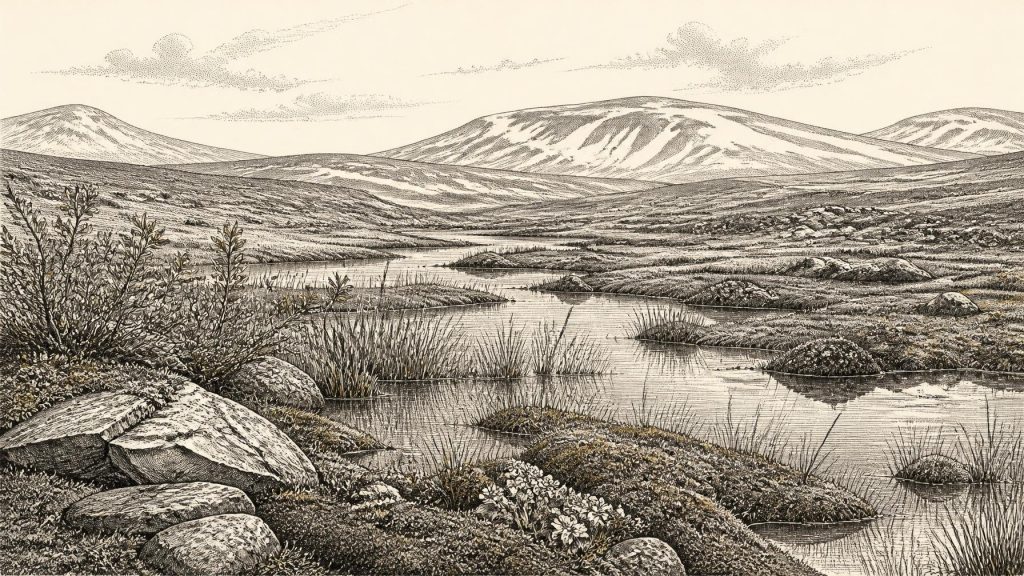
Derryvree is important because it counters an over-simple picture of an Ireland continuously buried beneath ice throughout the last cold stage. Its organic horizon records a local ice-free episode in Fermanagh. Plant remains, pollen, mosses, insect evidence and small animal remains point to cold, open, treeless conditions beside fresh water. Sedges and aquatic plants indicate a shallow pool, marshy margin or slow-moving water; dwarf shrubs and arctic-alpine plants indicate exposed, demanding ground beyond it. The landscape was not modern bogland, forest or farmland, but a periglacial wetland within a wider mosaic of mineral soil, sparse vegetation, seasonal frost and open water.
The word ‘tundra’ is a useful shorthand, provided it is not treated as a photograph of the whole island. The Derryvree fossils directly identify organisms from one sedimentary setting. From them, and from comparable northern European environments, researchers infer a cold open landscape with short growing seasons, probably shaped by frost action and marked seasonal contrasts. The deposit does not demonstrate that every Irish valley looked identical, nor that conditions remained unchanged for centuries. Its great strength is its local specificity: it preserves life around a body of fresh water in a period otherwise heavily disrupted by later glaciation.
At 30,575 BCE, Ireland’s future terrain was still being repeatedly remodelled. Ice expansion, retreat, meltwater, frozen ground and sediment movement determined which valleys held water, which surfaces were scoured away and which plant communities could survive. The drumlin that later enclosed the Derryvree layer is itself a reminder that the visible landscape is partly an archive of moving ice. Much evidence for older ground surfaces, campsites and animal tracks was almost certainly removed, buried or redeposited by subsequent glacial action.
Animals on an Open Island
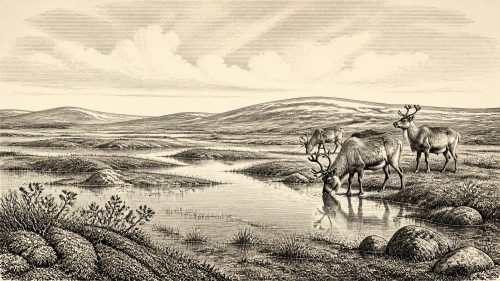
Southern Irish caves offer a separate, though imperfect, window on the fauna of this general late-Pleistocene world. Castlepook Cave near Doneraile in County Cork produced remains attributed to mammoth, reindeer, giant deer, horse, brown bear, wolf, Arctic fox and spotted hyaena, among other animals. Modern re-dating has shown that some older radiocarbon results from the cave require caution and that parts of the assemblage are older than once thought. Cave deposits are not neat snapshots: bones may have accumulated over long spans, been moved by water or carnivores, and entered deposits disturbed by earlier excavation.
Nevertheless, these remains establish an important regional point. Ireland was capable, during parts of Marine Isotope Stage 3, of supporting or receiving substantial cold-stage mammals and their predators. Grazing animals such as reindeer and horse imply available forage across open country; mammoth and giant deer suggest broader ecological variety than a single marsh could supply. Carnivores, especially spotted hyaena, show that animal carcasses and hunting opportunities formed part of a functioning food web. It would be irresponsible, however, to place every species together at Derryvree in 30,575 BCE. The Fermanagh wetland and Cork caves are different kinds of archive, separated by distance and potentially by many millennia.
Sea level was far lower than today because immense volumes of water were held in northern ice sheets. That transformed the continental shelves around Ireland and Britain, but it does not provide proof of a convenient, permanent land route or regular migration corridor at this exact date. Animal movements depended on changing coastlines, sea ice, rivers, topography, food and ice margins. The evidence supports mobility and ecological connection with north-west Europe; it does not yield a mapped road into Ireland.
People: A Necessary Silence
There is no securely excavated human settlement in Ireland dated to around 30,575 BCE: no accepted hearth, stone-tool floor, dwelling, grave, art panel or human bone from this interval. Consequently there is no sound basis for describing Irish political affairs, leaders, warfare, diplomacy, tribal territories or institutions. Terms such as kingdom, clan and nation would be anachronistic even if people had briefly visited the island.
A reindeer femur from Castlepook has attracted attention because a linear mark has been interpreted as a possible cut or chop made on fresh bone with a stone tool. If that interpretation were conclusively established, it could point to a very early human encounter with an animal in Ireland. Yet a marked bone without a securely associated tool assemblage, occupation surface or modern contextual excavation cannot demonstrate a resident community. The date of a bone is not automatically the date or cause of every mark upon it. The claim is therefore best treated as a question for further taphonomic study, not as evidence for an established Irish Upper Palaeolithic society.
This silence matters for everyday life as much as for politics. We cannot responsibly reconstruct huts, clothing, language, kinship, seasonal hunting plans or cooking practices for Ireland at this date. Continental Europe had Upper Palaeolithic populations with sophisticated technologies and cultural traditions, but importing their art, rituals or identities into Ireland would confuse nearby evidence with local proof. An Irish human presence remains unconfirmed for this particular interval.
No Economy, No Cult, No Diplomacy
There is likewise no evidence for agriculture, herding, metalworking, pottery, long-distance exchange or trade networks in Ireland around 30,575 BCE. The environmental record contains no cereal cultivation, domestic animals, fields, trackways or settlements. If people ever entered the island during a favourable window, they may have travelled lightly and left traces later destroyed by ice; that is a possibility, not a demonstrated economy. The same boundary applies to religion and learning. Caves containing animal bones were not thereby shrines, and a wetland deposit was not a ceremonial landscape merely because it survives.
Conflict can be discussed only at the ecological level. Predators competed with one another and scavenged carcasses; glaciers advanced over soil, vegetation and earlier deposits; frost and meltwater repeatedly reorganised habitats. These were profound pressures on life, but they were not wars or political crises. The most consequential regional change was environmental: Ireland was entering the long sequence of ice-sheet growth that would culminate later, during the Last Glacial Maximum. Research on the British–Irish Ice Sheet indicates that its greatest later extent belongs broadly to about 27,000–23,000 calibrated years before present in several sectors, not to this numbered year.
An Island Known by Fragments
The strongest account of Ireland around 30,575 BCE is therefore neither a story of kings nor a blank page. It is a carefully bounded reconstruction. At Derryvree, a cold freshwater wetland existed during an ice-free interval between glacial advances. Its fossils reveal sedges, aquatic plants, mosses and other cold-adapted life in an open periglacial setting. Cave faunas elsewhere show that large mammals and predators reached Ireland during the broader Marine Isotope Stage 3 world, though not necessarily simultaneously or at the same place. Later ice profoundly altered the survival of evidence.
BIRM-166’s value lies in that combination of precision and restraint. It anchors a real Irish locality within a broad calibrated age range, shows that ice-sheet history was uneven rather than uniform, and permits a vivid but disciplined picture of shallow water, low vegetation, cold air and animal movement. It does not provide a year-specific event, a human biography or a prehistoric state. For 30,575 BCE, that distinction is not a limitation on the history: it is the history’s essential truth.
Primary Sources
- A Middle Midlandian Freshwater Series at Derryvree, Maguiresbridge, County Fermanagh, Northern Ireland
- Exploring Controls of the Early and Stepped Deglaciation on the Western Margin of the British Irish Ice Sheet
- A Reconsideration of the Radiocarbon Dating of the Marine Isotope Stage 3 Fauna from Southern Ireland
- The Irish Quaternary Fauna Project
- Dublin Radiocarbon Dates II
- The IntCal20 Northern Hemisphere Radiocarbon Age Calibration Curve (0–55 cal kBP)
- IntCal Publications
- Timing and Pace of Ice-Sheet Withdrawal Across the Marine–Terrestrial Transition West of Ireland During the Last Glaciation
- Growth and Retreat of the Last British–Irish Ice Sheet, 31,000 to 15,000 Years Ago: the BRITICE-CHRONO Reconstruction
- Maximum Extent and Dynamic Behaviour of the Last British–Irish Ice Sheet West of Ireland
- Early Deglaciation of the British-Irish Ice Sheet on the Atlantic Shelf Northwest of Ireland Driven by Glacioisostatic Depression and High Relative Sea Level
- The Deglaciation of the Western Sector of the Irish Ice Sheet From the Inner Continental Shelf to its Terrestrial Margin
- Dimensions and Chronology of the Last Ice Sheet in Western Ireland
- Last Glacial Maximum Cirque Glaciation in Ireland and Implications for Reconstructions of the Irish Ice Sheet
- Trimlines, Blockfields and the Vertical Extent of the Last Ice Sheet in Southern Ireland
- Middle Midlandian Interstadial Deposits at Greenagho, Near Belcoo, County Fermanagh, Northern Ireland
- Freshwater Organic Deposits and Stratified Sediments Between Early and Late Midlandian (Devensian) Till Sheets, at Aghnadarragh, County Antrim, Northern Ireland
- BRITICE Glacial Map, Version 2: A Map and GIS Database of Glacial Landforms of the Last British–Irish Ice Sheet
- Figure 6.— The Subdivision of the Quaternary Period in Ireland
- Introduction to the Glacial Sand and Gravel Landscapes of Northern Ireland