The Fermanagh Bogbean Seed30486 BCE
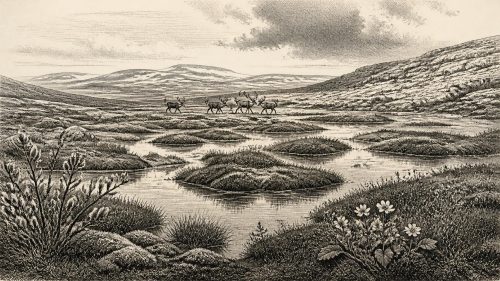
Around 30,486 BCE, Ireland lay within the climatically unstable Late Pleistocene, although no event can be dated to that specific year. At Derryvree, County Fermanagh, freshwater sediments between glacial tills preserve bogbean, other cold-adapted plants, insects and wetland evidence, showing temporary open, treeless habitats between ice advances. Castlepook Cave, County Cork, contains chronologically mixed remains of mammoth, reindeer, giant deer, predators and other fauna, indicating episodic continental-style ecosystems. A possibly tool-marked reindeer bone may suggest early human contact, but no secure settlement evidence exists. Ireland was environmentally dynamic, not historically documented, with research needed to refine its Ice Age record.
Dateline
Modern calendar-year precision is not available for Ireland in 30,486 BCE. No written records, named individuals, dated settlements or recoverable events can be assigned to that year. The responsible approach is to place it within the Late Pleistocene, before the Last Glacial Maximum, and to use broad calibrated ranges rather than pretend that archaeology can identify a particular season or generation. The most illuminating Irish evidence is environmental: a buried freshwater deposit at Derryvree near Maguiresbridge, County Fermanagh, and a wider, chronologically complex collection of Ice Age animal remains from Castlepook Cave near Doneraile, County Cork.
Dating a Lost Landscape
The numbered year falls within Marine Isotope Stage 3, a long and climatically volatile part of the last Ice Age. At Derryvree, roadworks exposed a remarkable sequence beneath and between glacial deposits. A lower till, laid down directly by ice, was followed by freshwater silts, fine sands and organic material; a later upper till sealed the sediments. The relative sequence is secure: ice occupied the locality, an interval of water and living vegetation followed, and ice later returned. But the duration of each stage, and its relationship to every other district of Ireland, cannot be read with annual precision.
The organic layer produced radiocarbon determination BIRM-166, conventionally reported as 30,500 radiocarbon years before present, with a substantial uncertainty of +1,170 and −1,030 years. In radiocarbon terminology, “present” means AD 1950, not the present day. Because atmospheric carbon-14 has varied through time, that result is not equivalent to 30,500 calendar years. Published calibrations place it broadly at about 36,900–31,700 calibrated years before present, approximately 34,950–29,750 BCE. Thus 30,486 BCE belongs within the wide period potentially illuminated by Derryvree, but cannot be attached to one particular layer, plant, animal or episode at the site.
Fresh Water Between Ice Advances
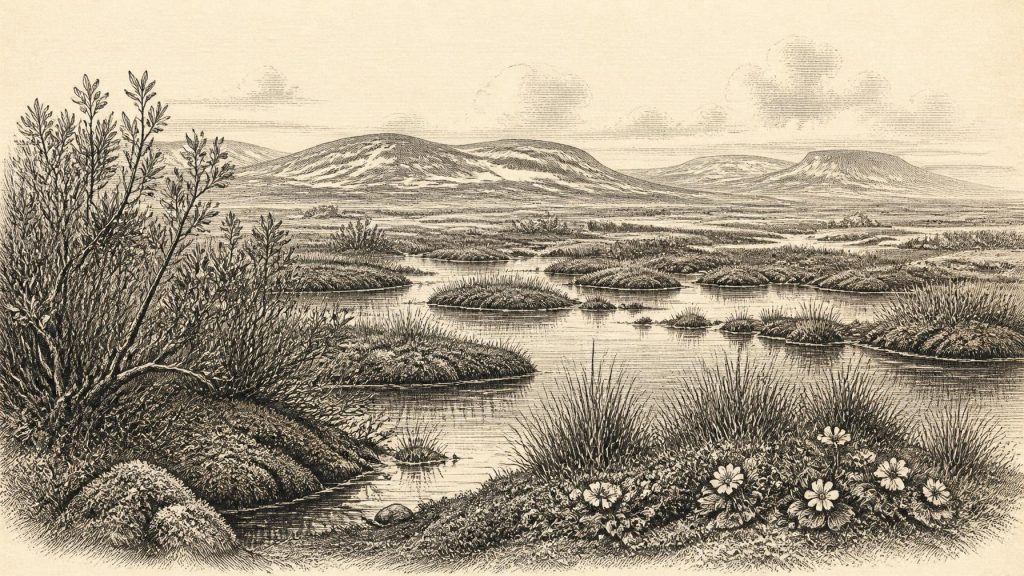
Derryvree is important because it demonstrates that this part of Fermanagh was not continuously smothered by glacier ice throughout the later Ice Age. In the interval represented by the freshwater deposits, a hollow or shallow basin held standing or slow-moving water. Silt settled in it; organic matter accumulated; plants, mosses and small invertebrates left traces. Later glacial action buried this delicate archive under fresh sediment. The modern drumlin landscape is therefore not itself a frozen relic from 30,486 BCE, but it contains a sealed record of an older episode.
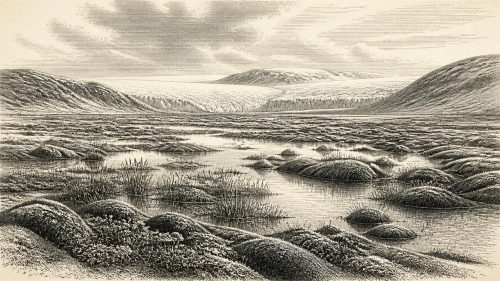
The plant evidence indicates a cold, open and treeless environment, often described as tundra or periglacial wetland. That terminology should be used carefully. It does not mean an exact replica of a modern Arctic landscape, nor an unbroken carpet of one vegetation type across the island. The deposit represents a particular basin and its catchment. Yet its plant macrofossils, pollen, mosses and insect evidence provide firm grounds for picturing a mosaic of shallow water, muddy edges, sedge-rich hollows, damp mossy ground and exposed mineral surfaces.
The most evocative fossil is a seed of bogbean, Menyanthes trifoliata, a wet-ground plant still familiar from shallow, nutrient-poor water and marshy margins. It was accompanied by evidence for hardy plants suited to cold, open conditions, including dwarf willow, mountain-avens and lesser clubmoss; water-milfoil indicates freshwater. These remains establish neither a mild climate nor productive woodland. Rather, they show that even in a severe environment, summer thaw and persistent water could sustain a locally diverse wetland community. Short growing seasons and hard winters are more consistent with the evidence than any vision of a green, wooded Ireland.
An Island in Climatic Motion
Ireland’s ice history at this depth in time remains difficult to reconstruct. The British–Irish Ice Sheet did not simply switch between two states, wholly absent or wholly covering the island. Its margins grew and retreated at different rates in different sectors, while changing sea level, topography and North Atlantic conditions altered routes for water, ice and animals. The Derryvree sequence proves an ice-free or non-glacial interval at one Fermanagh locality, not that every valley and coast was open at the same moment. Conversely, nearby ice need not have made every habitat lifeless.
For 30,486 BCE, it is therefore safer to speak of changing opportunities than of a fixed map. Open ground, freshwater basins and grazing country may have appeared during favourable intervals; advancing ice, frozen ground and altered drainage could then have closed or transformed them. This instability is central to the history of the island. The landscape was not a passive backdrop awaiting people: it was repeatedly remade by ice, meltwater, wind, frost and sediment movement, processes that also destroyed or buried much of the evidence needed to reconstruct it.
The Animal Evidence from Cork
Castlepook Cave, also known as Mammoth Cave, near Doneraile in north County Cork, supplies the most striking evidence for Ireland’s broader Ice Age fauna. Excavations begun by Richard J. Ussher and colleagues in the early twentieth century recovered a large and complicated bone assemblage, much of which is now in the National Museum of Ireland. The cave has produced remains attributed to woolly mammoth, reindeer, giant deer, brown bear, wolf, fox, mountain hare, lemmings and spotted hyena. It is the National Museum’s most important Irish site for mammal remains from the last cold stage.
These bones do not form a single, perfectly preserved scene. Some were carried into the cave by carnivores; some may derive from natural deaths, water movement or disturbed deposits; and early excavators worked before modern standards of stratigraphic recording. Direct dates show that significant parts of the fauna belong to different moments within the Late Pleistocene. The careful conclusion is that Ireland supported, or was reached by, sizeable grazing mammals and their predators during favourable phases of this long period. It is not safe to claim that every listed species grazed together outside Castlepook in 30,486 BCE.
Spotted hyena is especially instructive. A cave may have been a den or a place into which scavengers dragged bones, so a concentration of animal remains is not automatically the debris of a human hunt. Reindeer and mammoth nonetheless suggest extensive open habitats capable of sustaining large herbivores, while predators and scavengers reveal a functioning food web. The animal world of Pleistocene Ireland was far richer, and more continental in character, than the fauna of the modern island.
People: A Possible but Unproven Presence
The question of people in Ireland is both important and unresolved. A reindeer femur from Castlepook has been reported as carrying a deep mark interpreted as damage made by a sharp stone tool during butchery. The bone has been associated publicly with an age of roughly 33,000 years. If that interpretation and association are upheld by continuing research, it would be Ireland’s earliest known indication that people handled an animal, far earlier than the securely attested Mesolithic settlement of the early Holocene.
It would still not prove a permanent population in 30,486 BCE. Castlepook has not yielded a securely associated house floor, hearth, stone-tool assemblage, burial, storage pit or camp site of this age. Nor have human bones been found. The marked femur may point to a brief visit by mobile hunter-gatherers, perhaps linked to wider Upper Palaeolithic populations in north-west Europe, but that remains an interpretation rather than a demonstrated history of a community. The cave deposits themselves require careful taphonomic study before human action can be separated confidently from carnivore damage and other processes.
No Kingdoms, Farms or Recorded Beliefs
There is no evidence for political institutions, diplomacy, warfare between organised polities, trade networks, religious monuments, literacy or formal learning in Ireland at this date. It would be misleading to supply them merely because later periods have such categories. No farms, livestock, fields, pottery, metalwork, roads, boats or managed woodland belong to this Irish horizon. The only “economy” that can be described securely is ecological: plants capturing a short season of growth; herbivores grazing and moving through open country; predators and scavengers using carcasses and shelter; water and ice redistributing sediment.
If people were present, they were not demonstrably settlers in the later agricultural sense. Their likely technology, if the cut-mark interpretation is correct, would have included stone-edged tools capable of processing animal carcasses. Nothing presently permits an account of their language, kinship, ritual, artistic traditions, territorial claims or relations with other groups. The absence of this evidence is not proof that such social life did not exist; it is a limit on what the surviving Irish record can responsibly reveal.
A Seed Rather Than a Chronicle
The bogbean seed from beneath the Fermanagh tills offers a better model for this year than an imagined historical episode. It is direct evidence for a plant in a freshwater setting during a broad span of the Late Pleistocene. From it, its associated flora, sediments and insects, researchers infer an open, cold wetland. From Castlepook’s cave fauna they infer ecological connections with the wider north-west European world. From the possible reindeer butchery mark they identify a question of profound importance: whether people reached Ireland long before its later, sustained settlement.
Ireland around 30,486 BCE was therefore not a blank, frozen void, but neither was it a land of known tribes or dated events. It was an environmentally dynamic place in which freshwater life persisted between glacial advances, large mammals and carnivores moved through suitable landscapes, and any human presence remains fragmentary. Further excavation, direct dating and re-examination of old collections may sharpen the picture. They are unlikely, however, to turn this modern calendar year into a historical date in the ordinary sense.
Primary Sources
- A Middle Midlandian Freshwater Series at Derryvree, Maguiresbridge, County Fermanagh, Northern Ireland
- Archaeology Research Excavation Grant 2022: Castlepook Cave Project Final Report
- 2022:564 – Castlepook Cave, Castlepook South, Cork
- Spotted Hyena Skull
- Ice Age Ireland: Cool Fossils!
- Guide to the National Museum of Ireland – Natural History
- Menyanthes trifoliata
- A Stratigraphic Framework for Abrupt Climatic Changes During the Last Glacial Period Based on Three Synchronized Greenland Ice-Core Records
- The Timing and Magnitude of the British–Irish Ice Sheet Between Marine Isotope Stages 5d and 2
- Growth and Retreat of the Last British–Irish Ice Sheet, 31,000 to 15,000 Years Ago: the BRITICE-CHRONO Reconstruction
- Stratigraphic and Palaeo-Geomorphological Evidence for the Glacial-Deglacial History of the Last British-Irish Ice Sheet in the North-Western Irish Sea
- Trimlines, Blockfields and the Vertical Extent of the Last Ice Sheet in Southern Ireland
- Radiocarbon Constraints on the Age of the Maximum Advance of the British–Irish Ice Sheet in the Celtic Sea
- New Data for the Last Glacial Maximum in Great Britain and Ireland
- The Irish Quaternary Fauna Project
- The Colonization of Ireland: A Human Ecology Perspective
- A North-Western Habitat: the Paleoethology and Colonisation of a European Peninsula
- New Insights on the Fauna of Ireland’s Younger Dryas and Early Holocene from Alice & Gwendoline Cave
- Archaeological Excavations at Killuragh Cave, Co. Limerick
- Mammoth Cave, County Cork
- Pleistocene Vertebrates in the British Isles
- Mammals: National Museum of Ireland – Natural History Collections