The Castlepook Butchery Problem30485 BCE
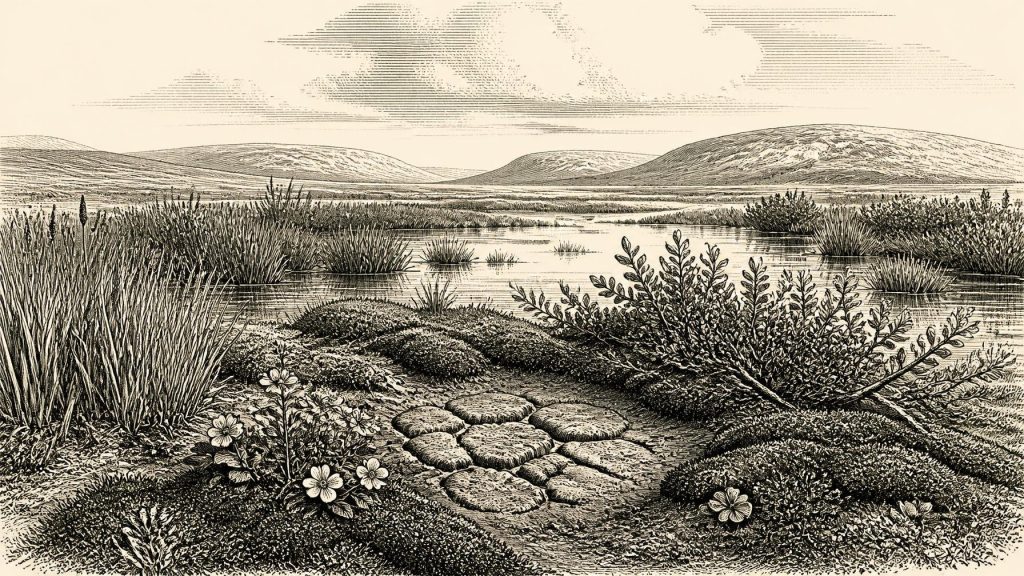
30,485 BCE is a modern chronological approximation, not a documented Irish year. Derryvree, County Fermanagh, preserves an ice-free interval within Marine Isotope Stage 3: cold, treeless wetlands supported sedges, dwarf willow, aquatic plants, mosses and insects between glacial advances. Castlepook Cave, County Cork, contains remains of reindeer, mammoth, giant deer, predators and other cold-stage fauna, although its mixed deposits span long periods. A cut-marked reindeer femur may indicate Upper Palaeolithic butchery, but cannot prove settlement or continuity. No contemporary population, politics, religion, economy or routes can be reconstructed. Increasing glaciation later transformed these intermittent habitats across much of the island.
Dateline
The label 30,485 BCE must not be mistaken for a recoverable Irish calendar year. It is a modern chronological convenience: expressed in the “before present” convention used in radiocarbon work, it lies roughly 32,434 years before AD 1950. No inscription, annual deposit, named ruler or contemporary human chronicle permits a year-by-year account. What archaeology can offer is a carefully bounded picture of Ireland during the later Pleistocene, within Marine Isotope Stage 3, when climatic conditions shifted repeatedly and the island’s landscapes, animals and possible human visitors were shaped by advancing and retreating ice.
A Date Within a Long Range
The closest securely dated Irish environmental record is not a settlement but a buried freshwater deposit at Derryvree, near Maguiresbridge in County Fermanagh. Roadworks in 1969 cut through a drumlin and exposed organic silts and fine sands trapped between two distinct beds of glacial till. The sequence establishes an important order of events: glacier ice had first laid down the lower till; water, sediment, plants and small animals then occupied the site during an ice-free interval; later ice overrode the ground and sealed the deposit beneath an upper till.
Organic material from Derryvree produced the conventional radiocarbon determination BIRM-166, 30,500 radiocarbon years BP, with a substantial uncertainty of +1,170 and −1,030 years. Published older calibrations have placed this broadly around c. 36,900–31,700 calibrated years BP. The notional date 30,485 BCE therefore falls within the wide period that the Derryvree evidence may illuminate, but it cannot be assigned to an individual sediment layer, plant or season. Calibration converts radiocarbon measurements into calendar estimates by reference to independently dated records; at this depth in time, ranges remain broad and can be revised as calibration curves improve. The responsible conclusion is chronological proximity, not precision.
Freshwater Between the Ice Sheets
Derryvree is especially valuable because its fossils show that the northern Irish interior was not simply an uninterrupted white expanse beneath glacier ice. During the interval represented by the silts, there was open ground and standing or slowly moving freshwater. Pollen, plant macrofossils, mosses and insect remains indicate a cold, treeless, periglacial setting: a landscape influenced by severe winters, freezing and thawing, and proximity to ice, but capable of supporting life in favourable hollows and through short growing seasons.
The plant evidence is more informative than a general description of “tundra”. Published identifications include sedges, mountain avens, dwarf willow, lesser clubmoss, bogbean and water-milfoil. Mountain avens and dwarf willow are plants of exposed, cold ground; sedges and mosses point to damp margins; bogbean and water-milfoil demonstrate shallow freshwater. Together they suggest a mosaic rather than a uniform plain: pools, wet sedge fringes, mossy patches, sparse low vegetation and areas of bare or frost-disturbed mineral soil. A few tree-pollen grains would not justify reconstructing woodland. The strongest evidence is for open vegetation, not forest.
This was an austere but not lifeless environment. Summer daylight could support plant growth, insects and productive wet places. Winter brought cold, wind and limited cover. The Derryvree deposit preserves local conditions at one Fermanagh locality, not a complete map of Ireland. Even so, it demonstrates that landscapes suitable for freshwater communities occurred during a wider climatic interval before the full development of the Last Glacial Maximum, when much of Ireland was later covered by extensive ice.
Animals at Ireland’s Western Edge
Southern cave deposits add a different kind of evidence. Castlepook Cave, also called Mammoth Cave, near Doneraile in north County Cork, has yielded a remarkable late Pleistocene fauna. Reindeer, woolly mammoth, giant deer, brown bear, wolf, fox, Arctic fox, spotted hyaena, mountain hare and lemmings are among animals reported from the cave assemblage. Revised radiocarbon research on southern Irish faunas has strengthened the conclusion that several cold-stage mammals were present in Ireland during Marine Isotope Stage 3, well before the Last Glacial Maximum.
Yet Castlepook cannot be treated as a photograph of a single moment. Much of its material was recovered in antiquarian excavations, cave deposits accumulated across long spans, and carnivores could have dragged bones into dens. Later disturbance and older radiocarbon methods further complicate the record. Individual species may have occupied the district at different times and in different habitats. The cave nevertheless shows that Ireland was part of a wider north-west European world in which large herbivores, predators and scavengers could reach its western margins during suitable intervals.
The most arresting object from Castlepook is a reindeer femur bearing a deep linear mark interpreted by zooarchaeologist Ruth Carden as damage made by a sharp stone tool during carcass processing. Heritage publications have associated the bone with an age of about 33,000 years ago. If that interpretation and broad chronology are confirmed, it could be evidence that one or more Upper Palaeolithic people handled a reindeer in Ireland during the wider period relevant to this article. It would be a major discovery, but it remains a single and contextually difficult find rather than proof of a permanent settlement.
People: Possibility, Not a Population History
No excavated dwelling, hearth, stone-tool floor, burial, human skeleton or securely associated hunting camp is known in Ireland for 30,485 BCE. The Castlepook bone cannot establish how many people arrived, where they came from, how long they remained or whether they returned. Nor can it demonstrate a continuous population descended from later Irish communities. The earliest firmly documented human evidence from Ireland is much later: a butchered brown-bear patella from Alice and Gwendoline Cave in County Clare, dated to the terminal Pleistocene, c. 12,810–12,590 calibrated BP.
If people did reach Ireland in the earlier interval, comparison with better-attested Upper Palaeolithic groups elsewhere in north-west Europe allows only cautious inference. They may have travelled in small, mobile parties, carried portable stone tools, understood seasonal animal movements and made temporary use of sheltered places. Such comparisons are not evidence for particular Irish camps, clothing, languages, kinship systems or ritual practices. Ireland has yielded none of the local archaeological contexts needed to transfer the rich cultural record of continental Europe directly to Cork or Fermanagh.
No Kingdoms, No Diplomacy, No Cult
Political affairs, warfare and diplomacy are beyond recovery for this date. There is no evidence for chiefs, territorial polities, alliances, raids or boundaries in Ireland. Equally, archaeology provides no basis for describing a religion, sacred site, mythic tradition, art style or formal learning. Cave occupation by hyaenas, and cave use by occasional people if the Castlepook interpretation proves correct, must not be converted into claims about ceremonies or beliefs. Silence in the record is itself historically important: the evidence is environmental and faunal, with at most a fleeting human trace.
Economy and trade are similarly untraceable. There was no farming, livestock husbandry, cereal cultivation, metalworking or built village landscape. A possible act of butchery would show subsistence use of animal flesh, hides, marrow or sinew, not an organised hunting economy across the island. Lower global sea levels altered the Irish Sea basin and exposed land now submerged, but the surviving evidence does not permit a reliable reconstruction of a particular coastline, a fixed land bridge, or a route followed by people in this exact period. Movement between Ireland and Britain may have been easier at some times than today, yet ease of access does not demonstrate occupation.
Gathering Ice
The broad regional story was one of increasing instability. Ireland’s late Midlandian glaciation was not a single simple advance: geological records indicate repeated fluctuations in ice extent and shifting local conditions. Derryvree’s organic bed is a reminder that ice-free terrain and freshwater environments existed before later glacial activity buried the site. The global and British-Irish ice maximum still lay ahead, conventionally placed broadly between about 26,500 and 19,000 calibrated years BP, although the build-up began earlier and varied around the Irish Sea basin.
For Ireland around this notional date, then, the most important development was environmental rather than political. In Fermanagh, cold open wetlands sustained a specialised tundra flora. In southern cave country, a diverse fauna reveals intermittent connections with wider European ecosystems. At Castlepook, one marked reindeer bone poses an unresolved question about human presence. Future excavation, direct dating and improved analysis of museum collections may refine that question. They cannot turn 30,485 BCE into a known day in Irish history, but they can make the deep past less empty: a changing island of shallow waters, sparse plants, large mammals, predators and encroaching ice.
Primary Sources
- Middle Midlandian Freshwater Series at Derryvree, Maguiresbridge, County Fermanagh, Northern Ireland
- Pleistocene Glaciations in Ireland
- Landscapes and Environments of the Last Glacial-Interglacial Transition: A Time of Amazingly Rapid Change in Ireland
- Figure 6—The Subdivision of the Quaternary Period in Ireland
- The Evolution of the Terrestrial-Terminating Irish Sea Glacier During the Last Glaciation
- Exploring Controls on the Last Glacial Termination in the British-Irish Ice Sheet
- New Data for the Last Glacial Maximum in Great Britain and Ireland
- Radiocarbon Constraints on the Age of the Maximum Advance of the British-Irish Ice Sheet in the Celtic Sea
- The Irish Quaternary Fauna Project
- A Reconsideration of the Radiocarbon Dating of the Marine Isotope Stage 3 Fauna from Southern Ireland
- New Insights on the Fauna of Ireland's Younger Dryas and Early Holocene from Alice & Gwendoline Cave
- First Evidence of a Late Upper Palaeolithic Human Presence in Ireland
- Palaeolithic Ireland – New Evidence Emerges from the Emerald Isle
- Archaeological Heritage of County Cork
- Heritage Artefacts of County Cork
- Castlepook Cave Excavation, County Cork, 2022
- Mammoth Cave, County Cork
- The IntCal20 Northern Hemisphere Radiocarbon Age Calibration Curve (0–55 cal kBP)
- IntCal20
- Menyanthes trifoliata: Fossil Record in Fermanagh