Castlepook’s Uncertain Cutmark30392 BCE
Labelled 30,392 BCE, this period cannot be reconstructed as a precise Irish year. Derryvree, County Fermanagh, preserves freshwater deposits between glacial tills, dated broadly to 34,950–29,750 BCE, indicating treeless wetlands with hardy plants during an ice-free interval. Castlepook Cave, County Cork, contains a long, mixed assemblage of Ice Age fauna, including mammoth, reindeer, giant deer, bear and hyaena. A marked reindeer bone may indicate stone-tool carcass processing, but disturbed contexts and absent associated artefacts leave human presence unproven. Together, the sites reveal variable cold landscapes, shifting ice and animal movement, while supporting only the possibility of brief seasonal human visits.
Dateline
30,392 BCE is a useful modern label, but it must not be mistaken for a date at which Ireland’s past can be observed year by year. No contemporary calendar, settlement sequence or historical record allows that kind of precision. In archaeological terms, the label falls roughly 32,341 years before the conventional radiocarbon reference point of 1950, within the later part of Marine Isotope Stage 3, a highly unstable phase of the last Ice Age. The responsible picture is therefore one of broad calibrated ranges, individual deposits and cautious comparison—not of a named event occurring in a particular Irish year.
A Date Beyond Annals
The closest Irish evidence is uneven in both geography and age. In north County Cork, Castlepook Cave near Doneraile preserves an exceptionally important collection of Pleistocene animal remains. In County Fermanagh, at Derryvree near Maguiresbridge, a road cutting exposed organic freshwater sediments trapped between layers of glacial till. Neither site supplies an annual chronicle. Each instead records episodes within a changing Ice Age landscape, and each has its own difficulties of dating, preservation and interpretation.
Radiocarbon ages are not calendar ages. Carbon-14 concentrations in the atmosphere have varied through time, so a measurement must be calibrated against independently dated records. The Derryvree organic deposit produced the conventional radiocarbon result BIRM-166, 30,500 ± 1,100 radiocarbon years before present. Modern calibration places it broadly at about 36,900–31,700 calibrated years before present, or approximately 34,950–29,750 BCE. That wide range encompasses the modern label 30,392 BCE, but it does not prove that the Derryvree wetland existed in that exact numbered year. It is an environmental window relevant to the period, not a date-stamped scene.
An Island in a Changing Ice Age
Ireland was not simply a white, uniformly frozen island. Its climate and ice cover changed repeatedly across millennia. Research on the British–Irish Ice Sheet shows that ice expanded, thinned and shifted in response to abrupt North Atlantic climatic changes. Around the wider interval represented by this article, parts of Ireland may have supported open ground while other districts were influenced by advancing ice, cold-based conditions or glacial drainage. Local evidence must not be enlarged into a map of the whole island.
The sea was also far lower than it is today, because vast quantities of water were locked in continental ice sheets. Ireland’s coastlines and connections with Britain were consequently unlike those of the modern island, although the exact availability of routes varied with sea level, local ice margins and terrain. It is reasonable to say that animals and perhaps people could have moved through a wider north-west European landscape during suitable phases. It is not reasonable to claim a single permanent land bridge, a fixed migration route or an inhabited Irish population for 30,392 BCE.
The broader climatic setting was severe and variable. Greenland ice-core records show repeated abrupt shifts between colder stadials and comparatively milder interstadials during this stage of the last glacial period. Such changes affected snowfall, vegetation, river regimes and the viability of animal movement across north-west Europe. For Ireland, the principal lesson is instability: landscapes could alter faster than the slow, timeless image often suggested by the phrase ‘Ice Age’.
Derryvree’s Freshwater Evidence
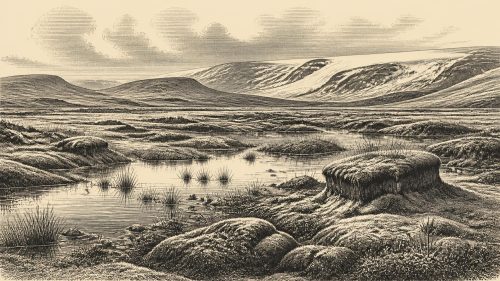
Derryvree offers the clearest Irish evidence for conditions during a broadly comparable ice-free interval. There, freshwater silts, fine sands and organic material lay between two tills: unsorted sediment deposited by glacier ice. The sequence establishes an order of events. Ice occupied the locality; later, water and vegetation accumulated in an open environment; finally, renewed glacial activity buried and protected the deposit. This is powerful evidence for local environmental change, even though it cannot determine the conditions of every Irish valley at once.
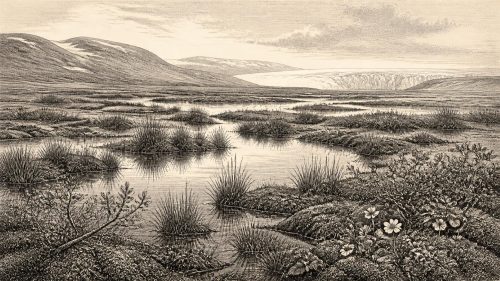
Plant remains from the freshwater series point to a treeless, cold-region mosaic rather than forest. Mosses, sedges, grasses and hardy herbs grew around pools, marshy ground and seasonally wet margins. Aquatic plants demonstrate standing or slowly moving fresh water. Dwarf willow and other low shrubs indicate that the landscape was not biologically barren. In favourable summer conditions, sheltered ground could support a short but active growing season; winter frost, exposed terrain and prolonged snow cover would nevertheless have imposed severe limits.
This was not a settled countryside. There were no fields, livestock enclosures, roads or villages. Yet it was a living environment in which vegetation stabilised some surfaces, insects and small animals occupied wet ground, and larger mammals could exploit open grazing. The Derryvree record is especially valuable because later ice sealed it below till, preserving traces that would otherwise have been scoured away. Its very survival is exceptional, and warns against treating the thin Irish record as a full census of what existed.
Castlepook and the Faunal Landscape
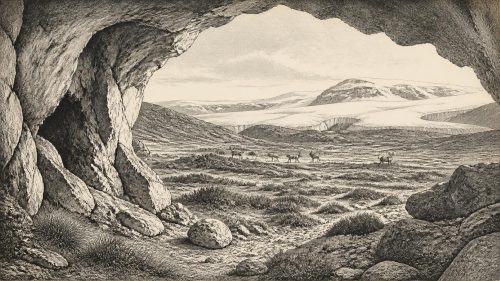
Castlepook Cave supplies a complementary archive from the south. More than 2,000 bones have been recovered from its passages and chambers, with direct dates spanning a long part of the middle and late Ice Age. Its pre-Last Glacial Maximum fauna includes woolly mammoth, giant deer, reindeer, brown bear and spotted hyaena. These animals did not necessarily live together at one moment, nor does the cave represent a single hunting camp. It was a repository into which bones accumulated through carnivore activity, natural death, water movement and excavation disturbance over a very long period.
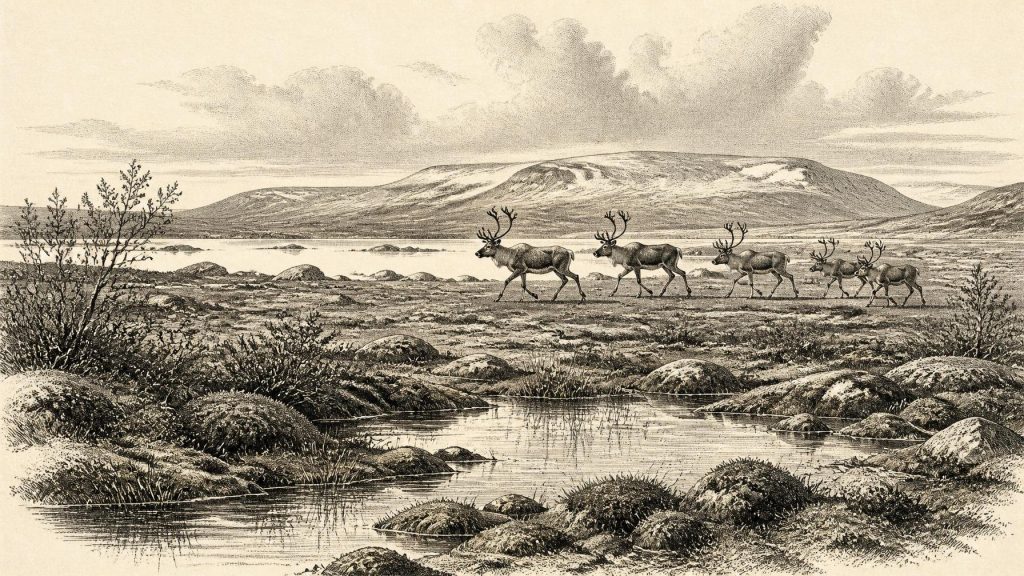
Nevertheless, the assemblage demonstrates that Ireland participated in the animal world of glacial north-west Europe. Reindeer were adapted to cold open country; mammoths and giant deer signal substantial grazing landscapes; hyaenas indicate carnivores capable of transporting and modifying carcasses. Brown bears and wolves belonged to a more varied ecological community. Their presence tells us more securely about environments and animal dispersal than about human numbers or behaviour.
Dating work has also transformed this picture. Improved pretreatment and accelerator radiocarbon techniques have shown that several older Irish cave dates underestimated the age of specimens, in some cases by thousands of years. Castlepook therefore illustrates a wider lesson in prehistoric research: a date is not a permanent fact detached from method. New sampling, calibration and contextual study can substantially revise the chronology.
The Reindeer Bone Question
The most arresting possible human clue is a reindeer femur from Castlepook reported as carrying a deep mark interpreted as having been made by a sharp stone tool during carcass processing. Public heritage accounts have placed the bone at roughly 31,000 BCE, and the find has rightly prompted renewed interest in the possibility of an Upper Palaeolithic human presence in Ireland.
Its significance must, however, be stated precisely. A cut mark on one bone, if confirmed as a fresh-bone stone-tool incision and securely associated with the animal’s age, would show that a person handled part of a reindeer carcass. It would not by itself demonstrate a permanent population, a settlement, a named hunting group, a language or a route of arrival. No securely associated hearth, stone-tool assemblage, built shelter, burial, human skeleton or occupation surface of this age has yet been established at Castlepook. The cave’s antiquarian excavations and disturbed deposits make contextual control particularly important.
There is also no basis for assigning the activity to Neanderthals or Homo sapiens from the bone alone. By this broad period, modern humans were present elsewhere in western Europe, but Ireland has supplied no human remains from which the identity of a visitor can be determined. The most responsible conclusion is deliberately modest: Castlepook may preserve evidence of a very early, brief human encounter with an Irish animal landscape, but the proposition remains far narrower than a story of occupation.
No Polities, but Possible Encounters
Political affairs, diplomacy and organised warfare cannot be recovered for Ireland at this date. There were no states, kingdoms, written laws or monuments from which authority can be inferred. Nor is there evidence for religious observance, formal art or learning in Ireland around 30,392 BCE. Silence on these subjects is not a claim that Ice Age people elsewhere lacked culture; it recognises that Irish evidence does not support projecting continental cave art, burials or social systems onto this island.
If people did reach Ireland during an ice-free phase, their economy would have depended on mobility, close knowledge of weather and animals, and the use of portable equipment—most plausibly stone tools, organic clothing and temporary shelter. Such a livelihood is an interpretation drawn from Upper Palaeolithic societies elsewhere, not a directly excavated Irish household. The Castlepook bone can at most suggest carcass processing: food, hide, sinew, marrow or other materials may have been valuable, but the particular purpose cannot be recovered.
Trade in the later historic sense is equally invisible. A small travelling group could have carried stone, knowledge and social ties across wider landscapes, but no Irish assemblage of this age establishes exchange networks. In practical terms, the chief ‘economy’ demonstrated by the evidence is ecological: plants exploiting a short growing season, herbivores using open ground, predators following prey, and glaciers repeatedly remaking access to land and water.
A Fragile Deep Past
The most important development around this notional year was not a recorded human event but the precariousness of Ireland’s Ice Age habitats. Derryvree preserves a freshwater tundra-like environment between glacial advances. Castlepook preserves a long, mixed faunal archive and an unresolved potential trace of human butchery. Together they show that Ireland was neither empty of life nor securely inhabited in any demonstrable continuous sense.
For 30,392 BCE, then, the historical task is to resist false certainty. Calibrated ranges, stratigraphy, animal bone and plant remains reveal an island of cold open landscapes, wetlands and shifting ice margins. They permit the possibility of a human visit, not a biography of a people. That distinction is not a limitation to be overcome by imagination; it is the essential achievement of responsible prehistoric history.
Primary Sources
- A Middle Midlandian Freshwater Series at Derryvree, Maguiresbridge, County Fermanagh, Northern Ireland
- Cork County Geological Site Report: Castlepook Cave
- A reconsideration of the radiocarbon dating of the Marine Isotope Stage 3 fauna from southern Ireland
- The Irish Quaternary Fauna Project
- Radiocarbon constraints on the history of the western Irish ice sheet prior to the Last Glacial Maximum
- Growth and retreat of the last British–Irish Ice Sheet, 31,000 to 15,000 years ago: the BRITICE-CHRONO reconstruction
- Growth and retreat of the last British–Irish Ice Sheet, 31,000 to 15,000 years ago: the BRITICE-CHRONO reconstruction
- Deglaciation chronology of the Donegal Ice Centre, north-west Ireland
- Timing and pace of ice-sheet withdrawal across the marine–terrestrial transition west of Ireland during the last glaciation
- The timing and magnitude of the British–Irish Ice Sheet between Marine Isotope Stages 5d and 2
- Stratigraphic and palaeo-geomorphological evidence for the glacial-deglacial history of the last British-Irish Ice Sheet in the north-western Irish Sea
- The IntCal20 Northern Hemisphere Radiocarbon Age Calibration Curve (0–55 cal kBP)
- IntCal Publications
- A New Greenland Ice Core Chronology for the Last Glacial Termination
- Independent tephrochronological evidence for rapid and synchronous oceanic and atmospheric temperature rises over the Greenland stadial-interstadial transitions between ca. 32 and 40 ka b2k
- New insights on the fauna of Ireland's Younger Dryas and Early Holocene from Alice & Gwendoline Cave
- New Insights on the Fauna of Ireland's Younger Dryas and Early Holocene from Alice & Gwendoline Cave
- Heritage Artefacts of County Cork
- 2022:564 – Castlepook Cave, Castlepook South, Cork
- Advice to the Public: Caves and Archaeology
- Irish Quaternary Association
- References and Recommended Reading: Irish Quaternary Association Guide 16
- The Geological Heritage of County Leitrim