BIRM-166’s Uncertain Wetland30339 BCE
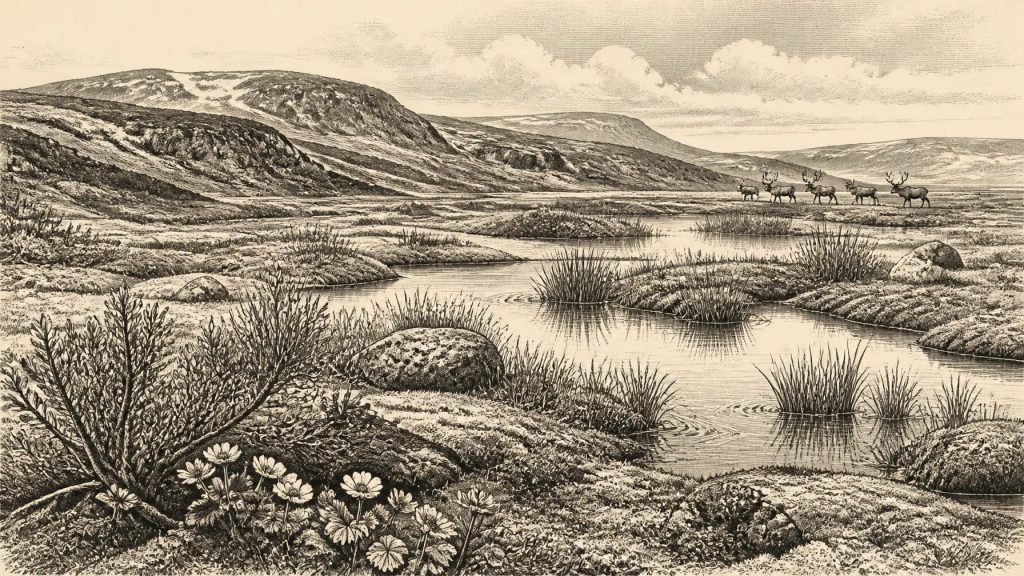
Thirty millennia BCE is a modern label, and Ireland’s conditions can only be reconstructed through environmental and archaeological evidence. At Derryvree, Fermanagh, an imperfectly dated organic wetland layer indicates cold, treeless tundra-steppe, freshwater pools and wet ground before renewed glaciation buried it beneath sands and till. Castlepook Cave, Cork, preserves remains of mammoth, reindeer, giant deer, predators and fauna, demonstrating ecological links with north-west Europe. A marked reindeer femur may record early human butchery, but lacks secure contextual evidence. No settlements, polities or cultures can be identified. The period is best understood as environmentally volatile, with fragmentary archives requiring investigation.
Dateline
30,339 BCE is a modern calendar label, not a date that people in Ireland could have known or recorded. There were no written chronicles, named rulers, settlements with calendrical records, or political institutions that archaeology can identify for this point in the Late Pleistocene. Modern year-by-year precision is therefore unavailable. The responsible way to approach this notional year is through broad calibrated ranges, geological sequences and environmental evidence. Around 32,300 calendar years before AD 2000, Ireland lay within Marine Isotope Stage 3, a fluctuating phase of the last glacial cycle that preceded the Last Glacial Maximum.
That distinction matters. Ireland was not simply a uniformly frozen white island awaiting the final ice advance. Its climates, ice margins, vegetation and animal communities changed repeatedly over millennia. A year such as 30,339 BCE falls within a landscape whose character must be inferred from scattered cave bones, buried sediments, pollen and plant macrofossils, rather than narrated as an episode. The strongest Irish evidence relevant to the period comes from a buried wetland deposit at Derryvree near Maguiresbridge, County Fermanagh, and from the rich but chronologically complex animal assemblage at Castlepook Cave near Doneraile, County Cork.
A Date with Wide Margins
The conversion of deep-prehistoric ages into BCE dates can give a deceptive appearance of exactness. Radiocarbon years are not calendar years: concentrations of atmospheric carbon-14 have varied through time, so radiocarbon determinations must be calibrated against independently dated records. Calibration is especially difficult and broad at this depth in time. The current IntCal20 curve reaches back to 55,000 calibrated years before present, but its ranges remain substantial. Nor does a date on sediment necessarily identify the moment at which every grain was deposited, let alone a human action.
The important Fermanagh determination, BIRM-166, was obtained from organic material in a moss-rich mud and fine-sand horizon at Derryvree. Its conventional radiocarbon age was 30,500 years BP, with a large uncertainty of +1,170/−1,030 years. In calibrated terms it belongs broadly to the middle part of the last glacial cycle, rather than to one pinpointable historical year. It is also a legacy bulk-organic-sediment date, not a modern accelerator date on a single seed, bone or twig. Later assessments of British–Irish Ice Sheet chronology consequently classify it as problematic for tightly dating ice movements. Yet it remains important evidence that this part of Fermanagh had experienced an ice-free or non-glacial interval before later ice deposited till above it.
Thus Derryvree does not prove that an open wetland stood there in precisely 30,339 BCE. It does, however, illuminate the kind of cold, dynamic world that could occur in Ireland in the broad millennia surrounding the date. The lesson is methodological as much as environmental: uncertainty is not an absence of evidence, but part of what the evidence honestly says.
The Derryvree Landscape
At Derryvree, roadworks exposed a sequence in which organic freshwater deposits lay between glacial sediments. The buried layer contained organic silts and fine sands, with mosses, plant remains and freshwater indicators. Studies identified a flora including sedges, dwarf willow, mountain avens, bogbean and water-milfoil, alongside mosses and other cold-tolerant plants. These remains point to open tundra or tundra-steppe vegetation around shallow freshwater pools, marshy margins and seasonally wet ground. They do not suggest woodland, cultivated fields or a settled agricultural landscape.
The plants also supply a more detailed picture than the word ‘tundra’ sometimes conveys. Dwarf willow could survive close to the ground in exposed places; sedges and mosses could occupy saturated soils; aquatic plants indicate at least seasonal bodies of fresh water. In summer, a brief growing season could produce a patchwork of green around ponds and meltwater channels, while exposed ground beyond them was likely sparse, windy and vulnerable to frost action. Permafrost or prolonged seasonal freezing was probably an important influence on drainage, soil development and the formation of shallow basins.
This was a landscape on the edge of change. The organic bed is overlain by sands interpreted as proglacial deposits and then by till, material laid down directly by glacier ice. The sequence preserves a local environmental reversal: freshwater and plants first, followed by the approach or expansion of ice. It cannot tell us the pace of that change from one human lifetime to the next, but it demonstrates that the Irish Ice Sheet was neither timeless nor static. Across the island, ice accumulation and retreat altered drainage systems, stripped earlier deposits and repeatedly removed much of the archaeological record that might otherwise have survived.
Animals in a Cold Mosaic
Cave collections from southern Ireland show that Late Pleistocene Ireland supported a far more varied animal community than the modern island. Castlepook Cave, also called Mammoth Cave, has produced remains of woolly mammoth, reindeer, giant deer, brown bear, arctic fox, mountain hare, wolves, lemmings and spotted hyaena. Not every species was necessarily present together, and the assemblage accumulated over a long period through carnivore activity, natural deaths, water movement and antiquarian excavation. Still, it establishes that Ireland formed part of wider north-west European ecological networks during portions of the last glacial cycle.
Reindeer are especially evocative because their movements could have linked grazing grounds across open country. Mammoth, giant deer and hyaena underline that this was not an impoverished wilderness. Predators, scavengers and herbivores occupied a changing mosaic of grassland, herbs, wet ground and rocky shelter. The regional pattern must nevertheless remain cautious. A cave bone is evidence that an animal died, was carried, or was deposited there; it does not map a stable population across all Ireland. Direct dates from Castlepook have also shown that some older determinations from Irish faunal collections require reassessment with improved pretreatment and calibration.
Lower global sea levels changed the geography beyond Ireland’s present coast, exposing broad shelf landscapes in places. But the exact configuration of coasts, sea crossings, ice and habitable routes varied through the glacial cycle. There is no securely documented route by which animals, still less people, reached Ireland at this particular time. The evidence supports connectivity in ecological terms, not a confidently drawn road across a vanished landscape.
The Castlepook Question
One object makes the human question impossible to ignore: a reindeer femur from Castlepook Cave, held in the National Museum of Ireland’s Natural History collections. It has been reported as about 33,000 years old and bears a deep mark interpreted by zooarchaeologist Ruth Carden as damage made with a sharp stone tool while fresh, perhaps during butchery. If that interpretation and its chronological association are confirmed, it would be evidence that a person handled a reindeer in Ireland before the Last Glacial Maximum—far earlier than the long-established terminal-Pleistocene evidence from County Clare.
Its importance should not be inflated into a lost Irish civilisation. The bone offers no securely associated hearth, stone-tool assemblage, shelter, burial, art, occupation floor, language or named cultural group. The date measures the age of the reindeer bone, not an exact day of cutting. Moreover, Castlepook’s major collections were recovered during early excavations, when contextual information was more limited than modern excavation standards demand. Recent work has located surviving stratified Pleistocene deposits and seeks decisive in-situ evidence, including lithics, hearths or further modified bones. Until that work produces such associations, the femur is best described as a significant but limited claim for very early human activity.
No Polities, No Proven Diplomacy
For 30,339 BCE, political affairs, diplomacy, warfare, religion, learning and trade cannot responsibly be reconstructed as Irish institutions. There is no evidence for chiefs, territories, alliances, ritual sites, formal exchange networks or organised conflict on the island. Likewise, there is no basis for attributing a social identity, language or ancestry to any possible visitors represented by the Castlepook bone. Upper Palaeolithic communities elsewhere in Europe made sophisticated tools, art and ornaments, but those achievements cannot be transferred automatically to Ireland.
At most, if people did reach Ireland during this broad period, their economy would have depended on mobile foraging, acute knowledge of animal behaviour and short seasonal opportunities in a harsh environment. That is an interpretation drawn from the ecology of the landscape and wider European hunter-gatherer practice, not a demonstrated Irish settlement pattern. The material record cannot tell us whether a small party hunted here, processed a carcass found by chance, or visited only fleetingly.
An Archive Beneath Later Ice
The principal story around this date is therefore environmental volatility and archaeological survival. Derryvree’s buried wetland preserves a glimpse of freshwater life in a cold, treeless Fermanagh before renewed glaciation sealed it beneath later sediments. Castlepook preserves the bones of animals that moved through a different southern Irish setting, together with a provocative possible trace of human butchery. Both archives survived only imperfectly, and both require continuing re-examination with modern dating, taphonomic analysis and carefully controlled excavation.
Rather than claiming a year-specific drama, 30,339 BCE should be understood as part of a deep interval when Ireland’s future landscapes were being physically remade by cold, water, vegetation and ice. The evidence is fragmentary, but it is enough to replace the old image of an empty, featureless Ice Age island with a more compelling one: an unstable periglacial world of pools, sedges, grazing animals, predators and perhaps, briefly and uncertainly, human hands.
Primary Sources
- A Middle Midlandian Freshwater Series at Derryvree, Maguiresbridge, County Fermanagh, Northern Ireland
- Table 6. Previously Published 14C Ages
- A Reconsideration of the Radiocarbon Dating of the Marine Isotope Stage 3 Fauna from Southern Ireland
- The Irish Quaternary Fauna Project
- Heritage Artefacts of County Cork
- Ireland's Palaeolithic Archaeology – Fleeting Footprints in a Frozen Land
- First Evidence of a Late Upper Palaeolithic Human Presence in Ireland
- First Evidence of a Late Upper Palaeolithic Human Presence in Ireland
- New Insights on the Fauna of Ireland's Younger Dryas and Early Holocene from Alice & Gwendoline Cave
- The Colonization of Ireland: A Human Ecology Perspective
- Pattern and Timing of Retreat of the Last British-Irish Ice Sheet
- Pattern and Timing of Retreat of the Last British-Irish Ice Sheet
- Spatio-Temporal Dynamics of Speleothem Growth and Glaciation in the British Isles
- The IntCal20 Northern Hemisphere Radiocarbon Age Calibration Curve (0–55 cal kBP)
- The IntCal20 Northern Hemisphere Radiocarbon Age Calibration Curve (0–55 cal kBP)
- A Stratigraphic Framework for Abrupt Climatic Changes During the Last Glacial Period Based on Three Synchronized Greenland Ice-Core Records
- A Stratigraphic Framework for Abrupt Climatic Changes During the Last Glacial Period Based on Three Synchronized Greenland Ice-Core Records
- Stable Stadial and Interstadial States of the Last Glacial's Climate Identified in a Combined Stable Water Isotope and Dust Record from Greenland
- Reindeer Bone Found in Cork Cave Shows Human Activity in Ireland 33,000 Years Ago
- The Mesolithic in Ireland: When Was It?