Lynch, O’Neill and Brussels1967 CE
In 1967, Jack Lynch’s government renewed Ireland’s application to join the European Economic Community, regarding integration as economically necessary despite dependence on Britain; Charles de Gaulle’s November veto of British entry again stalled progress. Free post-primary education began in September, widening access, particularly for rural pupils, while censorship law limited bans’ duration. Northern Ireland’s Civil Rights Association and Derry Housing Action Committee organised demands over discrimination and housing; Lynch nevertheless met Terence O’Neill in Belfast. Dublin hosted Rosc ’67, pairing international modern art with Irish treasures amid controversy over excluding Irish artists. Patrick Kavanagh died, marking transition in Irish culture.
Dateline
In 1967 the Republic of Ireland was moving outwards while confronting the unfinished business of its own modernisation. Jack Lynch had been taoiseach for only a year, succeeding Seán Lemass in November 1966, and he inherited both the ambition and the constraints of the Lemass era: a state opening its economy after decades of protection, yet still closely tied to Britain; an expanding educational system, yet deep inequalities of opportunity; and a constitutional claim to unity, yet little practical influence over Northern Ireland. The year did not produce a single dramatic rupture. Its importance lies instead in several firmly dated decisions and encounters which revealed the direction of travel—and the obstacles ahead.
Europe as Economic Necessity
The central foreign-policy decision came on 10 May, when Lynch formally asked the six states of the European Economic Community to open negotiations on Irish membership. Ireland had first applied in 1961. That application had stalled when President Charles de Gaulle blocked Britain’s proposed entry in January 1963. The 1967 initiative was therefore a renewal rather than an entirely new departure, but it confirmed that the Irish government regarded participation in European integration as essential to the country’s economic future.
The connection with Britain was inescapable. Britain was Ireland’s largest trading partner, and the 1965 Anglo-Irish Free Trade Agreement had already begun the difficult process of lowering barriers between the two economies. Irish manufacturers faced greater competition as protection was reduced; agricultural producers looked towards the possibilities of larger continental markets and the developing Common Agricultural Policy. Dublin could not easily contemplate a European future in which Britain joined the Community and Ireland remained outside it. Lynch’s letter explicitly restated his predecessor’s acceptance of the Community’s aims and noted that Irish domestic and external policy had continued to take prospective membership into account.
This was an outward-looking programme, but not an effortless one. The OECD’s survey of Ireland, published in 1967, described an economy in which investment had fallen during 1966 after restrictive fiscal and monetary measures, while public capital spending had been cut back from the expectations of the Second Programme for Economic Expansion. Industrial output was growing, but unevenly; agriculture remained fundamental to livelihoods and exports. For many households, particularly outside the larger towns, modernisation was not an abstract policy but a question of whether there was employment nearby, whether younger relatives would need to emigrate, and whether new roads, schools and services could reach their district.
European hopes were checked before the year ended. On 27 November de Gaulle again vetoed British entry to the EEC. Because Irish accession was so closely connected to Britain’s application, the veto again prevented negotiations from proceeding. This was a disappointment, not a reversal of policy. Ireland’s application remained a declaration that its future should not be confined to the economic orbit of its nearest neighbour. Yet 1967 showed how little control Dublin possessed over the decisive diplomatic calculation in Paris.
Education Reaches Further
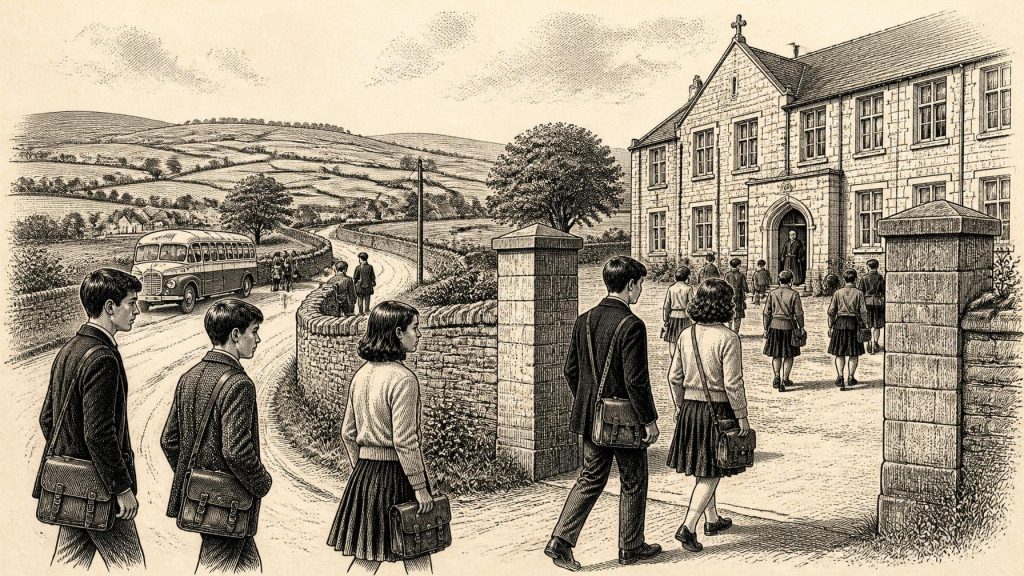
A more immediate change took effect on 1 September: the scheme for free post-primary education began. Minister for Education Donogh O’Malley had made the politically startling announcement in 1966, but 1967 was the year in which it entered school life. The Department’s circular provided for free post-primary education, while national transport arrangements were developed to make attendance practicable for pupils who lived far from a suitable school. Its importance lay not merely in fees saved. In a country where secondary education had often depended on family means, distance from a school and local provision, the measure enlarged the expectation that children would remain in education after primary school.
It would be misleading to portray the change as instantaneous social equality. Buildings, teachers, transport and places had to be supplied; existing secondary, vocational and comprehensive schools differed greatly in resources and catchment. The state still relied heavily on denominational school management, as it had for generations. Nonetheless, September 1967 marked a clear alteration in the relationship between family, school and state. For rural households especially, bus travel became part of the ordinary routine through which a wider educational horizon could be reached. The scheme helped create the conditions for later expansion in senior-cycle and higher education, even though those results belonged to later years.
Another measure pointed to a changing, if still cautious, public culture. The Censorship of Publications Act became law on 11 July. It did not end book censorship: the Censorship of Publications Board retained the power to prohibit works judged indecent or obscene. But it provided that such prohibition orders would normally expire after twelve years, and enabled the Board to make a further order if it considered one justified. Books that had been banned for more than twelve years were released unless re-prohibited. The legislation was therefore a limited liberalisation rather than a sweeping cultural revolution, but it acknowledged that a permanent ban was increasingly difficult to defend in a society exposed to wider publishing, travel and broadcasting.
A Northern Question Changes Form
Across the border, 1967 saw the organisation of grievances that would soon transform Irish politics. On 1 February the Northern Ireland Civil Rights Association was formed. Its programme called for reform rather than the immediate constitutional overthrow of Northern Ireland: universal adult suffrage in local government elections, an end to manipulation of electoral boundaries, fairer access to public housing and public employment, repeal of the Special Powers Act, and the disbandment of the Ulster Special Constabulary. The association emerged from earlier campaigning, notably by the Campaign for Social Justice, which had publicised Catholic grievances about housing and discrimination.
These issues must be placed carefully in the year itself. The large civil-rights marches, violent confrontations and political crisis most closely associated with the movement were developments of 1968 and afterwards, not events of 1967. Yet the founding of NICRA was a consequential moment because it created an all-Northern-Ireland body able to connect local complaints to demands for civil rights. The later Cameron inquiry concluded that several grievances raised by NICRA and its supporters—including housing allocation, local-authority appointments, franchise restrictions and electoral boundaries—were justified in fact. In November 1967, the Derry Housing Action Committee was also formed, indicating that inadequate housing and local political power were becoming organised public questions in the city.
The governments in Dublin and Belfast nevertheless maintained a fragile channel of contact. On 11 December Lynch met Northern Ireland’s prime minister, Terence O’Neill, in Belfast. The encounter continued the pattern established by Lemass and O’Neill in 1965, the first official meeting between heads of government from the two jurisdictions since 1925. Such meetings did not resolve partition, and neither leader could easily escape opposition within his own political setting. O’Neill’s modest modernising gestures were contested by hard-line unionists; Lynch’s government continued to uphold the constitutional claim to national unity. Still, the meeting mattered as evidence that dialogue remained possible at precisely the time when pressure for reform in Northern Ireland was acquiring a more organised voice.
Culture, Memory and an International City
Dublin’s cultural life offered a different expression of international engagement. Rosc ’67 opened on 13 November at the Royal Dublin Society grounds in Ballsbridge and the National Museum on Kildare Street, remaining open into January 1968. Organised under the chairmanship of architect Michael Scott, it placed major international modern painting alongside celebrated early Irish objects such as the Tara Brooch, the Ardagh Chalice and the Book of Kells. The juxtaposition made an ambitious claim: Ireland’s ancient artistic inheritance could be presented not as a closed nationalist treasure-house but in conversation with contemporary international art.
Rosc also exposed tensions within that aspiration. The exhibition brought works by leading international artists to Dublin, but no Irish artists were included in the first Rosc. That absence became controversial, and it illustrated a recurring question for a rapidly opening Ireland: who would define its modern culture, and on what terms would Irish artists participate in it? The exhibition was thus both a landmark of cosmopolitan confidence and a reminder that cultural prestige could be imported as well as created at home.
The year closed with a significant literary loss. Patrick Kavanagh died in Dublin on 30 November, shortly after becoming ill while attending an Abbey Theatre production of Tarry Flynn in Dundalk. His death removed a writer whose poems and prose had given rural Monaghan, Dublin streets and the Grand Canal an unusually direct imaginative presence. Kavanagh’s career had never fitted neatly into official versions of Irish culture: he could be sharply critical of pieties, literary fashions and provincial complacency. His death in 1967 therefore formed a quiet counterpoint to Rosc’s institutional grandeur—a reminder that modern Irish culture was also sustained by the stubbornly individual voice.
By year’s end, Ireland had asked again to enter Europe, widened access to post-primary schooling, cautiously revised censorship law and maintained official northern dialogue. None of these developments settled the major questions before the island. But together they make 1967 a year in which the Republic’s institutions began reaching more decisively beyond inherited limits, even as events in Northern Ireland were gathering force that would soon test every assumption about reform, sovereignty and coexistence.
Primary Sources
- Timeline of Events, 1919–69
- Ireland’s Application for Membership to the EEC (Dublin, 10 May 1967)
- Ireland and the EU: A History
- The Accession of Ireland to the European Communities, 1972–2022
- OECD Economic Surveys: Ireland 1967
- A New Basic Model of the Irish Economy
- Statistical Abstracts – Historical Series
- Provision of Free Post Primary Education
- 50 Years on: Reflecting on the Legacy of Free Second Level
- Report: School Transport in Ireland
- Censorship of Publications Act 1967
- Censorship of Publications Bill, 1967
- The Civil Rights Campaign: A Chronology of Main Events, 1964–1972
- Cameron Report: Disturbances in Northern Ireland, Chapters 10–16
- Housing and Religion in Northern Ireland, Section 2
- O’Neill, Terence Marne
- Lynch, John Mary (‘Jack’)
- Lemass, Seán
- Rosc ’67 Exhibition
- Introducing ROSC 50 – 1967 / 2017
- Kavanagh, Patrick Joseph
- Death of Patrick Kavanagh
- Seán Lemass Retires 1967
- Jack Lynch Appointed Taoiseach