Booterstown and the Oath1927 CE
In 1927, Irish Free State politics moved decisively towards parliamentary competition. Fianna Fáil won 44 seats in June but initially refused the Oath of Allegiance. Kevin O’Higgins’s assassination at Booterstown exposed continuing republican violence, prompting the Public Safety Act. In August, de Valera and his deputies entered the Dáil, treating the oath as a political formula; September’s election established Fianna Fáil as the principal opposition. Government advanced land reform, liquor regulation, jury law and electrification. Partition remained entrenched, while diplomatic activity strengthened international status. Joyce’s Pomes Penyeach reflected Irish culture’s international reach. Unresolved divisions remained, but conflict shifted towards elections.
Dateline
For the Irish Free State, 1927 was the year in which the unfinished politics of revolution were driven decisively into parliamentary channels. Two general elections, the assassination of Kevin O’Higgins and the entry of Éamon de Valera’s Fianna Fáil into Dáil Éireann made the year unusually compressed and consequential. The events are firmly dated; their significance lay in a broader change. Less than five years after the Civil War’s outbreak, the State was still contested by armed republicans and by those who rejected the Treaty settlement. Yet, by the autumn, the principal republican opposition was seated at Leinster House and competing for power through elections rather than abstention.
A First Test at the Polls
The first general election was held on 9 June. It was the first national election fought by Fianna Fáil, founded by de Valera in 1926 after his break with abstentionist Sinn Féin. The party sought a republican route into electoral politics while refusing the Oath of Allegiance required before members could take their seats. Its campaign therefore combined a promise to remove the oath with an attempt to win votes from those dissatisfied with the cautious, fiscally restrained administration of W. T. Cosgrave’s Cumann na nGaedheal.
The result transformed the arithmetic of the Dáil without producing a settled alternative government. Cumann na nGaedheal fell from 63 seats in 1923 to 47. Fianna Fáil won 44, while Labour, the Farmers’ Party, the National League and independents retained enough strength to make the chamber fragmented. Because Fianna Fáil deputies initially remained outside, Cosgrave could continue at the head of a minority administration, supported case by case. But the result demonstrated that republican opinion could command a mass vote under a new party label. It also diminished the remaining abstentionist Sinn Féin, which won only five seats.
Political uncertainty was accompanied by routine but important state-building measures. The Electoral (Amendment) Act of 22 May revised electoral arrangements before the June contest. The Juries Act, enacted on 26 May, consolidated jury law, but it also revealed the uneven character of citizenship in the new State: women who met the relevant property qualification were generally exempt from service unless they applied to serve. Parliamentary debates made clear that the government expected few women to do so. Equality in political voting had not translated into equal participation in every civic duty.
The Killing at Booterstown
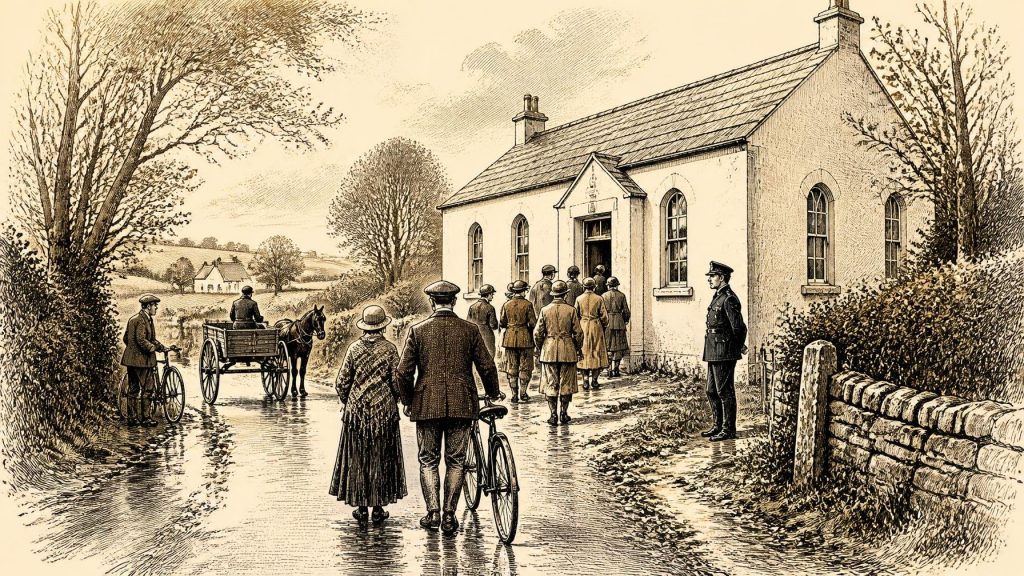
On Sunday 10 July, Kevin O’Higgins was shot while walking from his home at Booterstown, County Dublin, to Mass. He died later that day. O’Higgins was vice-president of the Executive Council and minister for justice; following the June election he had also assumed responsibility for external affairs. At thirty-five, he was one of the Free State’s most formidable and controversial ministers. His work had been central to establishing police, courts and civilian authority after the Civil War, while his record also bound him to the harsh emergency policies of the conflict, including executions and internment.
The murder was an immense personal and political shock. Its perpetrators were IRA members acting without an order from the organisation, but the killing nevertheless exposed the persistence of an armed republican milieu beyond the constitutional sphere. It also altered the immediate political atmosphere. O’Higgins had represented, perhaps more clearly than any colleague, the Free State government’s determination that there should be one authority, one army and one legal order. His death made the question of violence inseparable from the question of whether republican deputies would accept the institutions they had been elected to enter.
Security and Parliamentary Entry
Cosgrave’s government responded with legislation. The Public Safety Act received enactment on 11 August. It enabled the Executive Council to declare associations unlawful, created severe powers against activities connected with such bodies, and restricted the publication and circulation of material deemed to assist them. Crucially, the Act stated that provisions contrary to the Constitution could operate as temporary constitutional amendments. It was a striking assertion of emergency authority by a State that had been created in violence and still feared its renewal. Critics accepted the gravity of O’Higgins’s murder while warning that security legislation could be used against legitimate political opposition.
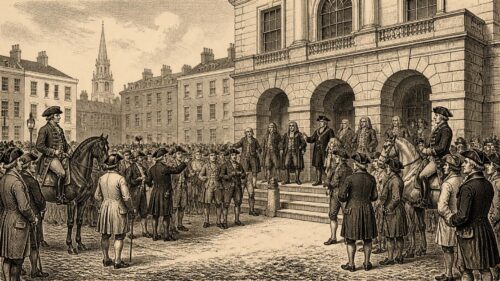
Alongside this measure came an Electoral (Amendment) (No. 2) Bill requiring candidates to declare in advance that, if elected, they would take their seats and the constitutional oath. The immediate target was abstentionism. Fianna Fáil now faced an unavoidable choice: remain outside the legislature and risk political marginalisation, or enter it under a formula it had denounced. On 12 August, de Valera and his colleagues took their seats. De Valera portrayed the oath as an empty political formula rather than a binding renunciation of republican principles. Whatever the rationale, the practical effect was profound. A large republican party had accepted participation in the Free State’s parliament, even while pledging to change that State from within.
The government’s survival remained precarious. A Labour motion of no confidence, supported by Fianna Fáil after its entry, produced a tied division rather than a replacement administration. Cosgrave sought and obtained a dissolution on 25 August. The second general election of the year followed on 15 September. Cumann na nGaedheal recovered to 62 seats, while Fianna Fáil rose to 57; Labour declined to 13 and smaller groups lost ground. Cosgrave remained President of the Executive Council, but the outcome confirmed a new two-party contest. The Sixth Dáil met in October with Fianna Fáil established as the principal opposition rather than an abstentionist force beyond the chamber.
Law, Land and the Shape of Daily Life
Political drama did not halt the ordinary business of government. Several enactments in 1927 illuminate the concerns of daily life and administration. The Land Act, passed on 21 May, amended the machinery of land occupation, ownership and purchase. Its technical provisions belonged to the longer project of the Land Commission: adjusting holdings, completing transfers and dealing with land purchase annuities. For much of rural Ireland, where the household farm remained the central economic unit, such legislation mattered more immediately than high constitutional language. It reflected the continuing effort to settle the inherited land question through law, finance and redistribution rather than landlord power or agitation.
The Intoxicating Liquor Act of 20 May regulated public-house opening more tightly. It established familiar restrictions on trading hours, including closures on Sundays, Christmas Day, Good Friday and Saint Patrick’s Day, with limited exceptions. Such controls spoke to concerns about public order, work discipline and morality, but they also shaped sociability in town and countryside. The public house was a commercial premises, meeting place and venue for political talk; regulation of its doors and hours was therefore part of the State’s presence in everyday routines.
Modernisation appeared in a more visibly ambitious form with the Electricity (Supply) Act, enacted on 28 May. It established the statutory basis for the Electricity Supply Board and a national electricity system, closely associated with the Shannon hydro-electric scheme then under construction. The Act transferred important functions and gave the new board wide powers over generation, transmission and supply. Electrical development would not immediately transform every village or farmstead in 1927, but the legislation marked a commitment to a networked national infrastructure. It joined the great Shannon project to an administrative framework intended to carry power outward from Ardnacrusha over the years ahead.
Partition and the Outside World
Partition remained a fixed condition of Irish life. On 12 April, the Royal and Parliamentary Titles Act changed the formal title of the Westminster parliament to the Parliament of the United Kingdom of Great Britain and Northern Ireland. The wording acknowledged in British law that most of Ireland was no longer within the United Kingdom, while confirming the distinct constitutional position of the six counties. Northern Ireland continued under the unionist government of James Craig. The political systems north and south consequently evolved on separate tracks, even as families, markets, railways, churches and sporting ties continued to cross the border.
For the Free State, international status was another field in which sovereignty was being made practical. Official memoranda of 1927 stressed diplomatic representation in Washington, missions in Britain and continental Europe, League of Nations membership, and the State’s separate standing at the Geneva Naval Conference. These were not merely ceremonial claims. They concerned who could speak for Ireland abroad, make trade connections and exercise full powers at international negotiations. O’Higgins’s death left Cosgrave temporarily responsible for external affairs before Patrick McGilligan’s appointment in the autumn, a reminder of how heavily the young administration had relied on a small group of ministers.
A Culture Beyond the Crisis
The year’s cultural life also extended beyond the State’s immediate borders. In Paris, Shakespeare and Company published James Joyce’s Pomes Penyeach in 1927, a small collection that gathered poems written across two decades. Its publication was a reminder that Irish literary modernism was international in production and readership even when its imagination remained intensely Irish. Meanwhile, constitutional politics, legislation and expanding state institutions were creating the domestic setting in which later arguments about national culture, language, censorship and public morality would unfold.
By year’s end, Ireland had not resolved the Treaty division, the partition question or the relationship between security and civil liberty. It had, however, crossed a crucial threshold. O’Higgins’s killing showed that political violence had not disappeared; the Public Safety Act showed how readily the State could invoke exceptional power. Yet Fianna Fáil’s entry into the Dáil and the second election’s polarised result moved the central contest from guns and boycotts towards votes, debates and the difficult business of parliamentary opposition.
Primary Sources
- Irish Elections 1922 to 1944
- Dáil Elections since 1918
- Assassination of the Vice President, Dáil 1927
- Public Business: No Confidence Motion, 16 August 1927
- O'Higgins, Kevin Christopher
- Cosgrave, William Thomas
- De Valera, Éamon (‘Dev’)
- Public Safety Act, 1927
- Electoral (Amendment) (No. 2) Bill, 1927
- Electoral (Amendment) Act 1927
- Juries Act, 1927
- Juries Bill, 1927—Second Stage
- Jury Service
- Land Act, 1927
- Intoxicating Liquor Act, 1927
- Electricity (Supply) Act, 1927
- About ESB
- Sixth Dáil
- External Affairs and the Imperial Conference
- Memorandum by the Department of External Affairs on the Status of the Irish Free State
- Volume 3: Documents on Irish Foreign Policy, 1926–1932
- Royal and Parliamentary Titles Act, 1927
- Pomes Penyeach
- Eamon de Valera Papers: Descriptive Catalogue