Cork Reprisals1920 CE
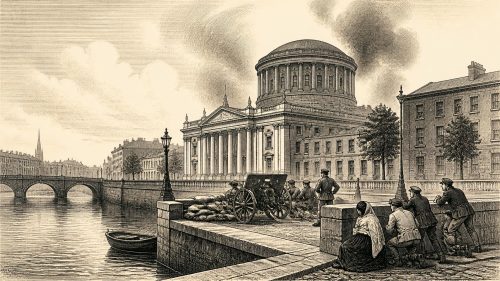
In 1920, Ireland’s political crisis widened into conflict across elections, workplaces, civic institutions and homes. Sinn Féin and Labour gained local authority, helping Dáil Éireann establish parallel courts, finance and propaganda, while Britain answered with emergency powers, troops, Black and Tans and Auxiliaries. IRA attacks, reprisals and executions, including Kevin Barry’s, intensified war. Cork symbolised the crisis through Tomás MacCurtain’s murder, Terence MacSwiney’s hunger-strike death and the city’s burning. Bloody Sunday and Kilmichael deepened violence. Labour resistance exposed regional divisions. Sectarian expulsions in Belfast accompanied the Government of Ireland Act, which legislated partition, shaping the 1921 truce and eventual negotiations.
Dateline
In 1920 Ireland’s political crisis became a war that reached into council chambers, streets, workshops, sporting grounds and private homes. The republican movement worked to make the Irish Republic proclaimed in 1916 and asserted by Dáil Éireann in 1919 function as a government in practice. The British state responded with expanded policing, military force and new emergency powers. Meanwhile, unionist fears of an all-Ireland parliament were translated into a constitutional settlement that would divide the island. The year did not simply produce dramatic violence: it also altered local democracy, working life and the language through which people understood authority.
Ballot Boxes and Parallel Government
The municipal elections of January and the county and rural district elections of June were important tests of popular allegiance. Conducted under an enlarged franchise and proportional representation, they gave Sinn Féin and Labour substantial representation in many places, while unionism remained dominant in much of north-east Ulster. In Cork, republican and Labour councillors gained control of the Corporation; Tomás MacCurtain, a leading Cork Volunteer, became the city’s first Sinn Féin lord mayor on 30 January. Across much of the country, elected local bodies supplied the republican cause with a democratic claim that armed action alone could not provide. These were the last local elections held on an all-Ireland basis under the existing system of government.
That claim did not mean that the Dáil governed securely or uniformly. Its ministers, courts, loan collectors and publicity staff operated in the shadow of Dublin Castle, British troops and the Royal Irish Constabulary (RIC). Republican arbitration and Dáil courts could offer an alternative for civil disputes, but their reach depended on local participation and on the weakening of Crown institutions. The Dáil’s Internal Loan, closed in July 1920, raised funds by public subscription; its propaganda department sent the Irish Bulletin to overseas newspapers and politicians, publicising raids, arrests and reprisals. In this way, administration, finance and information became parts of the struggle for legitimacy.
Escalation and Emergency Law
Violence intensified through the year. The IRA attacked police barracks, patrols and intelligence targets, while Crown forces mounted raids and arrests and increasingly used reprisals. The British government recruited former servicemen as RIC temporary constables, widely known as the Black and Tans, and deployed the Auxiliary Division, composed principally of former army officers. These formations were distinct, though contemporaries and later memory often grouped them together. Their arrival changed daily experience in many towns and villages: checkpoints, searches, damaged premises, disrupted travel and the danger of collective punishment accompanied the wider conflict.
Westminster enacted the Restoration of Order in Ireland Act on 9 August. It authorised regulations under wartime emergency legislation when ordinary law was judged inadequate and extended trial by court martial to crimes in Ireland. Its consequences were soon visible in the treatment of prisoners. Kevin Barry, a 18-year-old University College Dublin student and Volunteer convicted by court martial for his role in an ambush in which three British soldiers died, was hanged in Mountjoy Prison on 1 November. He was the first person executed for a capital offence under the new Act. His age, refusal to recognise the court and execution made him a powerful republican symbol, while the British authorities presented the sentence as part of restoring order.
Conflict also affected labour and transport. From May to December, many dockers and railway workers participated in a munitions strike, refusing to move troops or military material. The action demonstrated that the war could be resisted through workplace decisions as well as through armed operations. Yet it was neither universal nor free of regional division: on the Great Northern Railway, which linked Belfast with Dublin and other southern towns, workers did not join in the same way. Such differences foreshadowed the increasingly divergent political environments developing north and south.
Cork’s Civic Martyrs
Cork became an emblem of the year’s accelerating cycle of killing and reprisal. Shortly after 1 a.m. on 20 March, armed men disguised as police entered the home of Lord Mayor Tomás MacCurtain and shot him in front of his family. A subsequent inquest named named policemen and government officials in a verdict of wilful murder, though the precise chain of responsibility remains debated. MacCurtain’s killing brought the vulnerability of ostensibly civic office into sharp relief. His successor as lord mayor, Terence MacSwiney, was elected on 30 March.
MacSwiney was arrested on 12 August while presiding over a Sinn Féin court at Cork City Hall, sentenced by court martial four days later and imprisoned in Brixton, London. He refused food and died there on 25 October after 74 days on hunger strike. His death gave the conflict an international moral and political dimension. Newspapers followed his condition closely; demonstrations and appeals for his release arose in Britain, continental Europe and the United States. For many supporters, a Catholic civic leader dying in prison was evidence of British coercion; for the government, releasing him threatened to weaken the resolve of the security forces. His funeral in Cork, attended by vast crowds, made mourning a public assertion of republican allegiance.
Violence in Dublin and Cork
The most notorious day of the year came on Sunday 21 November. That morning, IRA units in Dublin attacked men identified by the republican intelligence network as British intelligence personnel and alleged agents, killing fourteen people. Later that afternoon, Crown forces entered Croke Park during a Dublin–Tipperary challenge football match and opened fire. Fourteen spectators and players ultimately died, among them the Tipperary footballer Michael Hogan and three boys aged ten, eleven and fourteen. The victims’ occupations included labourer, mechanic, farmer, publican and butcher’s employee: the dead show that political violence was borne by people attending an ordinary sporting occasion, not only by combatants. Croke Park thereafter acquired a significance in Irish cultural memory far beyond sport.
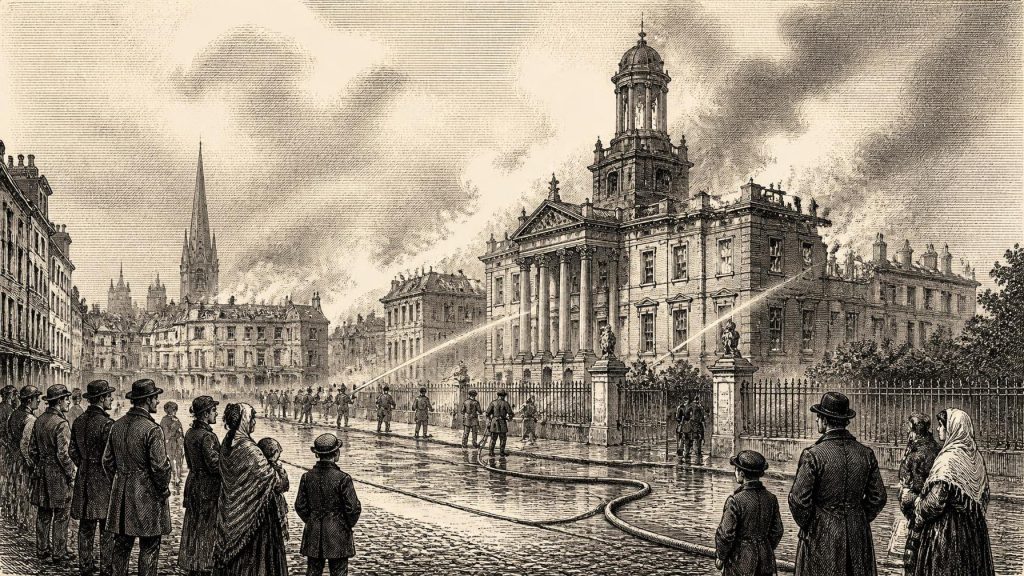
One week later, on 28 November, Tom Barry’s West Cork flying column ambushed Auxiliary policemen at Kilmichael. Seventeen Auxiliaries and three IRA volunteers were killed. The engagement was a major IRA success, but its interpretation has remained contentious, particularly over claims of a false surrender and the killing of wounded men. What is firmly established is that Kilmichael deepened the atmosphere of fear and reprisal in County Cork. On the night of 11–12 December, following an IRA ambush in the city, Crown forces burned and looted substantial parts of Cork’s commercial centre, including City Hall and the Carnegie Library. The destruction put businesses, records and civic institutions alike in peril, leaving a material scar on a city already exhausted by curfews, raids and insecurity.
Ulster’s Fracturing Society
Events in the north showed that the conflict could not be understood only as a contest between the IRA and the Crown. In June, nationalists secured a narrow majority on Londonderry Corporation, after which serious sectarian violence erupted in the city. In July, loyalist crowds in Belfast drove Catholics and Protestant socialists—denounced as “rotten Prods”—from shipyards, engineering works, mills and other workplaces. Thousands lost employment over the wider period. The expulsions broke solidarities built in Belfast’s recent labour militancy and made religious and political identity immediate tests of personal safety and access to wages.
The constitutional answer proposed by the British government was not the republic sought by Sinn Féin, nor the unitary Home Rule settlement rejected by Ulster unionists. The Government of Ireland Act received royal assent on 23 December 1920. It provided for separate parliaments and governments for Northern Ireland and Southern Ireland, both remaining within the United Kingdom, as well as a Council of Ireland. The Act did not create the Northern Ireland administration during 1920—its principal provisions came into operation in 1921—but it put partition into law. Nationalists rejected the measure, while unionists prepared to exercise authority within the six-county jurisdiction it envisaged.
A Year of Irreversible Change
By year’s end, no settlement had been achieved. The Dáil’s position had been strengthened by local electoral success, fundraising, courts and international publicity, even as its military campaign and British repression became more severe. Éamon de Valera’s 27 October appeal to President Woodrow Wilson for recognition of an independent Irish republic illustrated the continuing search for diplomatic legitimacy, but it produced no recognition. The British government had instead legislated for a divided form of Home Rule. In 1920, then, Ireland’s future was being fought over simultaneously through ballots, law, workplaces, prisons, streets and the international press. The decisions and deaths of that year made the truce and negotiations of 1921 more likely, but also ensured that any later settlement would have to confront the partition already set in motion.
Source References
Hover over a number to see the source. Select it to open the source.

- [1] MacSwiney, Terence James | Dictionary of Irish Biography
- [2] MacCurtain, Tomás | Dictionary of Irish Biography
- [3] Barry, Kevin Gerard | Dictionary of Irish Biography
- [4] Collins, Michael | Dictionary of Irish Biography
- [5] De Valera, Éamon (‘Dev’) | Dictionary of Irish Biography
- [6] Government of Ireland Act 1920
- [7] Government of Ireland Act, 1920
- [8] Restoration of Order in Ireland Act, 1920
- [9] Restoration of Order in Ireland Bill, 6 August 1920 | Hansard
- [10] Royal Irish Constabulary, 1836–1922 | The National Archives
- [11] Democracy and Change: The 1920 Local Elections in Ireland
- [12] Cork Corporation (City Council) Minute Books 1912–1923
- [13] The War in Cork | Cork Public Museum
- [14] Who Burnt Cork City? | Cork City Council
- [15] The Irish Bulletin Newspaper (1919–1921) | National Library of Ireland
- [16] Dáil Éireann Loan | National Library of Ireland Catalogue
- [17] Remembering Bloody Sunday at Croke Park | GAA
- [18] GAA Unveils Headstones to Mark 99th Anniversary of Bloody Sunday
- [19] The First Dáil Éireann | History Ireland
- [20] The Government of Ireland Act 1920 | History Ireland
- [21] ‘Rotten Prod’: James Baird and Belfast Labour | Ulster University
- [22] The Making of a Minority, Chapter 4: Towards Partition | CAIN
- [23] Ireland 1900–1925: Crisis, War and Revolution | Public Record Office of Northern Ireland
- [24] 1912–1923 Timeline | UCD Decade of Centenaries
Primary Sources
- MacSwiney, Terence James | Dictionary of Irish Biography
- MacCurtain, Tomás | Dictionary of Irish Biography
- Barry, Kevin Gerard | Dictionary of Irish Biography
- Collins, Michael | Dictionary of Irish Biography
- De Valera, Éamon (‘Dev’) | Dictionary of Irish Biography
- Government of Ireland Act 1920
- Government of Ireland Act, 1920
- Restoration of Order in Ireland Act, 1920
- Restoration of Order in Ireland Bill, 6 August 1920 | Hansard
- Royal Irish Constabulary, 1836–1922 | The National Archives
- Democracy and Change: The 1920 Local Elections in Ireland
- Cork Corporation (City Council) Minute Books 1912–1923
- The War in Cork | Cork Public Museum
- Who Burnt Cork City? | Cork City Council
- The Irish Bulletin Newspaper (1919–1921) | National Library of Ireland
- Dáil Éireann Loan | National Library of Ireland Catalogue
- Remembering Bloody Sunday at Croke Park | GAA
- GAA Unveils Headstones to Mark 99th Anniversary of Bloody Sunday
- The First Dáil Éireann | History Ireland
- The Government of Ireland Act 1920 | History Ireland
- ‘Rotten Prod’: James Baird and Belfast Labour | Ulster University
- The Making of a Minority, Chapter 4: Towards Partition | CAIN
- Ireland 1900–1925: Crisis, War and Revolution | Public Record Office of Northern Ireland
- 1912–1923 Timeline | UCD Decade of Centenaries