Ralahine and Carrickshock1831 CE
In 1831, Ireland experienced escalating conflict over tithes, compulsory payments supporting the established Church, despite most occupiers being Catholic. Organised resistance, including Patt Lalor’s boycott strategy, culminated at Carrickshock, County Kilkenny, where twelve constables and a process-server were killed. The census recorded approximately 7.8 million people amid poverty and land pressure. Edward Stanley established the basis for non-denominational national education. At Ralahine, County Clare, an Owenite co-operative sought security through shared labour and profits. Catholic and evangelical institutions developed, while James Hardiman’s Irish Minstrelsy promoted Irish-language poetry. The year combined coercion with reform, social experimentation, demographic observation and cultural assertion.
Dateline
In 1831 Ireland’s deepest arguments about authority were acted out in fields, fairgrounds, chapels and small market towns. The year is best remembered for the Tithe War’s sharp escalation in the south-east, culminating in the fatal confrontation at Carrickshock, County Kilkenny, on 14 December. Yet it also produced projects intended to change Irish society by less coercive means: a new state-backed framework for elementary education, the remarkable Owenite experiment at Ralahine in County Clare, and works of scholarship that presented Irish-language poetry to a wider reading public. These developments did not belong to one simple story. They reveal an island in which religious grievance, rural insecurity, governmental reform and social experiment were all intensely present.
A Charge on the Land
The immediate source of much conflict was the tithe. Agricultural occupiers were obliged to pay it for the support of the established Church of Ireland, although most of the population was Roman Catholic and, in Ulster, many Protestants were Presbyterian. The Tithe Composition Act of 1823 had aimed to substitute fixed money payments for payments in kind, but it did not remove the fundamental resentment felt by people asked to finance a church to which they did not belong. It also left collection dependent on local legal processes, distraint of livestock and sales which neighbours could obstruct.
Resistance had begun before 1831, but during this year it became organised and conspicuous. On 10 February, at a repeal meeting in Maryborough, Queen’s County, the substantial farmer Patrick “Patt” Lalor declared that he would not pay tithes and would allow his property to be seized, confident that no buyer would bid for it. When sheep were subsequently taken, Lalor marked them “Tithe”; the wider point was to make seizure commercially useless. His call combined non-payment with a boycott of purchasers, a form of collective action that made an individual debt a community question.
At Graiguenamanagh in County Kilkenny, the confrontation moved from speech to an extended contest over enforcement. On 3 March Major George Browne brought 120 members of the County Kilkenny Constabulary into the district to protect tithe collection. Retrospective parliamentary evidence described police and drivers ranging over the countryside for two months, while inhabitants watched for them, signalled their approach and concealed cattle. The authorities could collect only part of one parish’s arrears despite the exceptional force committed. The episode showed why tithe resistance was difficult to defeat: it rested not simply on isolated attacks but on warning systems, refusals to buy distrained stock, social pressure on process-servers and the practical knowledge of a rural population.
Government records from the year preserve the language of alarm. Reports sent to Dublin Castle described sustained refusal in Graigue and nearby areas, and threats against clergy or those employed in collection. Such documents naturally recorded the official view, often casting opponents as a dangerous “lower order”; nevertheless, they demonstrate that the administration understood it faced widespread refusal rather than a handful of ordinary debt cases. By December, peers at Westminster were acknowledging that the existing system had become politically untenable in substantial parts of Ireland.
Carrickshock’s Deadly Warning
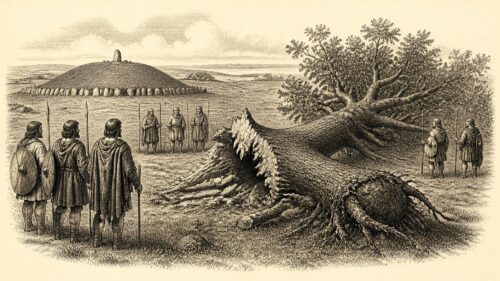
The gravest event of the year came at Carrickshock, near Hugginstown in south Kilkenny. On 14 December, a party of County Kilkenny constables, led by Chief Constable James Gibbons, accompanied the process-server Edmund Butler while tithe processes were served in the Knocktopher area. They were met and pursued by local people. In the ensuing confrontation, Gibbons and eleven sub-constables were killed; Butler also died, while others were dangerously wounded. Three local men were reported dead as well.
The immediate circumstances and the number of later deaths have been described differently in later accounts, but the contemporary official report is unambiguous about the scale of the initial loss among the police. Carrickshock was exceptional because resistance killed representatives of the enforcing power, rather than the reverse. It shocked the administration, intensified fears of a wider rising and made armed recovery of tithes still more fraught. It would be misleading, however, to treat the event as a planned national insurrection. It arose from a local enforcement party, a local population and an already entrenched campaign against a particular system of church taxation. Its national importance lay in the warning it gave: coercion could turn a disputed levy into lethal conflict.
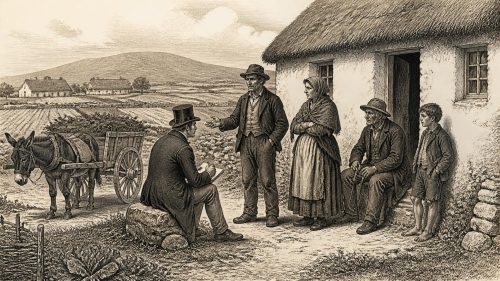
For ordinary rural families, the struggle was inseparable from the precarious economics of small holdings and labour. Cattle, crops and household goods were not abstract assets. Their seizure could threaten food, rent, work and standing within a neighbourhood. Conversely, the refusal to buy seized animals made solidarity economically costly. Tithe resistance was therefore at once religious, political and material: a protest against the established church, an assertion of local collective power, and an attempt to protect scarce resources.
Counting a Crowded Island
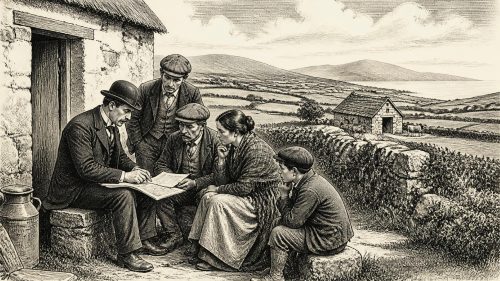
On 30 May the 1831 census enumeration was undertaken. Its published totals placed Ireland’s population at roughly 7.8 million, a striking increase on 1821 and a reminder of the pressure upon land, employment and food supplies before the Great Famine. Enumerators worked through local administrative units in a country where most people lived outside towns and where family survival often depended on tiny plots, seasonal work, turf, potatoes, livestock and informal reciprocal help.
The census is an important landmark, but its evidential limits must be kept in view. Nearly all original household returns for 1831 were destroyed in the Public Record Office fire of 1922. Surviving fragments are precious but geographically limited; for example, some later religious summaries connected with County Londonderry survive. The national aggregate can show the scale of population, but it cannot restore the detailed voices of most households. Nor should later estimates of religious affiliation be casually presented as if they were questions asked of every household on census day.
In parliamentary debate during 1831, Irish poverty was discussed as a major public problem. Members argued over whether Ireland required a poor law, public works, reform of property relations or some combination of relief and employment. No Irish poor-law system was created in this year; the formal Poor Inquiry would begin only in 1833. Still, the debates are revealing. They indicate that contemporaries saw chronic underemployment and mendicancy not as marginal conditions but as questions bound up with the stability of the state.
Education Without Proselytism?
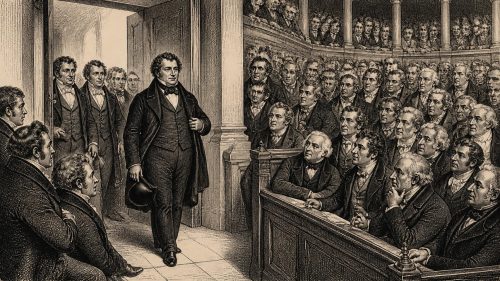
Another response to Ireland’s divisions came from government. On 31 October, Edward Stanley, Chief Secretary for Ireland, addressed the Duke of Leinster on the formation of a Board of National Education. The Stanley Letter set out an experimental, state-supervised scheme intended to provide elementary education for poorer children across religious divisions. Its stated principle was that children of different denominations could receive secular instruction together, while religious teaching would be arranged separately.
This was not an instant nationwide school network, nor did it end disputes over education. Rather, 1831 established the institutional basis of the national system. The scheme displaced the privileged position that the Kildare Place Society had held in distributing parliamentary grants. Catholic confidence in that society had declined because grants had reached schools associated with proselytising instruction. Stanley’s proposal recognised that a system regarded as a vehicle for conversion could not command broad support. Its aspiration to separate common learning from denominational teaching was therefore both educational policy and political strategy.
The tension was profound. Education promised literacy, numeracy and greater opportunity; it also raised anxieties over parental authority, clerical influence and religious identity. The new Board could offer rules, grants and inspection, but its schools would ultimately depend on local managers, teachers and communities. The national system’s future reach was not guaranteed in 1831; what was firmly established was the governmental decision to attempt it.
Ralahine’s Different Remedy
While the state designed a national educational framework, a smaller and more unusual initiative began in County Clare. On 7 November the Ralahine Agricultural and Manufacturing Co-operative Association came into existence on the estate of John Scott Vandeleur near Newmarket-on-Fergus. It was an Owenite experiment, shaped by the ideas associated with Robert Owen and organised with the assistance of Edward Thomas Craig.
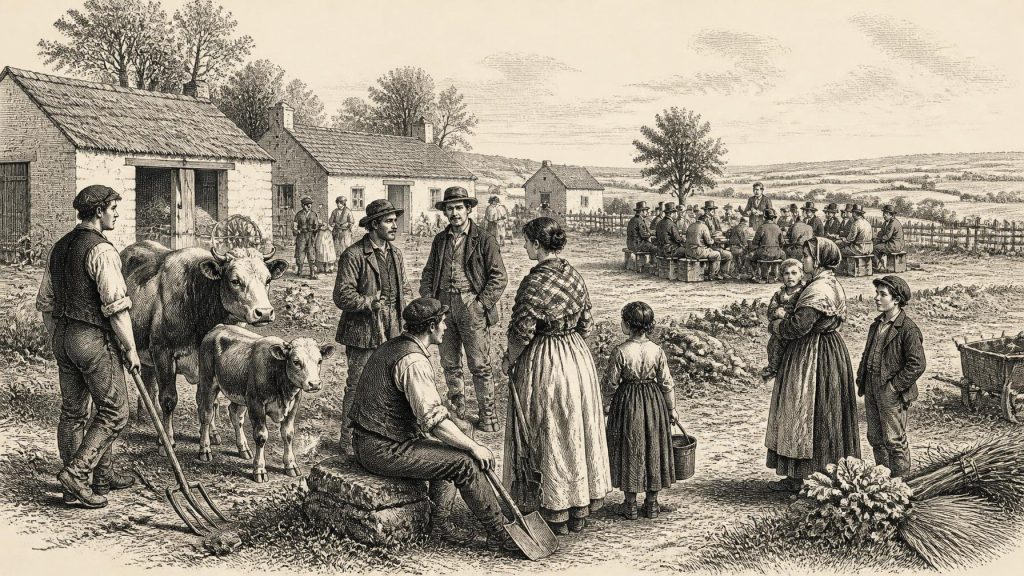
Fifty-two tenants and workers initially formed the community on 618 acres. They leased land, buildings, livestock and equipment from Vandeleur, paid rent and supplied specified produce, but were also promised a share in profits and mutual provision against sickness, age and hardship. A committee was to govern the association; adult improvement and children’s education were declared among its purposes. In a county troubled by agrarian violence and secret-society activity, the project was intended partly to create orderly, regular employment and cooperation.
Ralahine should not be romanticised as a wholly independent peasant commonwealth. Vandeleur retained ownership and held a powerful place within its arrangements; the community’s financial risks were not equally shared. Nonetheless, its creation in 1831 was a genuine departure from the ordinary landlord-and-labourer relationship. At the same moment that tithe disputes exposed the coercive edge of rural society, Ralahine tested whether collective work, common capital and agreed rules could produce security and peace. Its later collapse lay ahead; in 1831, the experiment had only just begun.
Faith, Print and Cultural Assertion
Religious institutions were also changing in ways that did not fit the simple opposition of Catholic majority and established church. In 1831 Pope Gregory XVI erected the Roman Catholic diocese of Galway, ending the older wardenship arrangement; George Joseph Plunkett Browne was consecrated its first bishop at Athlone on 23 October. On Achill, the evangelical clergyman Edward Nangle visited during a western relief effort and resolved to establish a Protestant mission there. The permanent settlement at Dugort would not be occupied until 1834, so it must not be treated as an accomplished mission colony in 1831. Yet Nangle’s visit belongs to the year as the beginning of an undertaking that would later become a major and contentious feature of religious life in Mayo.
Culture, too, registered a growing desire to collect and dignify Irish inheritance. James Hardiman published Irish Minstrelsy; or, Bardic Remains of Ireland in two volumes in 1831, presenting Irish verse with English poetic translations. The book did not preserve an untouched oral world, and translation necessarily reshaped what readers encountered. Even so, it made a public argument that Irish-language poetry possessed antiquity, artistry and intellectual weight. In a year of disputes over church, land and schooling, that was itself a significant cultural assertion.
Thus 1831 left no single settlement. Carrickshock demonstrated the danger of enforcing an unpopular religious tax by force. The Stanley Letter sought a workable institutional accommodation between denominations. Ralahine attempted a local answer to poverty and conflict through co-operation. Census-taking and cultural publication made Ireland more legible to government and readers alike, even as much of its everyday life remained beyond the surviving record. The year’s importance lies in that contrast: confrontation was real and deadly, but so were efforts to remake Irish society through education, association and print.
Primary Sources
- The Registered Papers of the Chief Secretary’s Office: 1831 Outrage Reports
- The Registered Papers of the Chief Secretary’s Office: Carrickshock Report, 1831
- Tithes (Ireland), House of Lords debate, 15 December 1831
- Tithes (Ireland), House of Commons debate, 13 March 1832
- Official Census Returns and Census Substitutes
- The Tithe Applotment Books, 1823–37
- Lalor, Patrick (‘Patt’), Dictionary of Irish Biography
- O’Connell, Daniel, Dictionary of Irish Biography
- Ralahine: An Irish Owenite Community (1831–1833)
- Vandeleur, John Scott, Dictionary of Irish Biography
- The Ralahine Commune
- Constitution, Laws and Regulations of the Ralahine Agricultural and Manufacturing Cooperative Association
- The Owenite Community at Ralahine, County Clare, 1831–33: A Reassessment
- Stanley Letter
- Copy of a Letter from the Chief Secretary for Ireland to the Duke of Leinster
- The Stanley Letter
- Census Through History
- 1831 Census: Abstract of Answers and Returns under the Population Acts, Ireland
- State of the Irish Poor, House of Commons debate, 10 August 1831
- Poor-Laws (Ireland), House of Commons debate, 29 August 1831
- Nangle, Edward Walter, Dictionary of Irish Biography
- Edward Nangle and the Achill Island Mission
- Our Diocese: Diocese of Galway
- Hardiman: Irish Minstrelsy