Kilmainham’s Queen Caroline Revolt1820 CE
George IV’s accession in 1820 left Ireland under the Union, with limited property-based representation and Catholic exclusion from Parliament. Henry Grattan’s death removed a leading advocate of Catholic relief. Post-war depression and private-bank failures disrupted credit, trade and livelihoods, while Cork’s North Cathedral burned. The Dublin Gas Act, completion of the Lough Allen Canal, local schooling and the Royal Dublin Society reflected gradual improvement. Irish people also participated in Antarctic exploration and Cape Colony migration. In December, County Dublin freeholders at Kilmainham challenged an official loyal address, condemning the king’s treatment of Queen Caroline and Ireland’s distress, foreshadowing O’Connell’s mobilisation.
Dateline
In 1820 Ireland entered a new reign but not a new political order. George III died on 29 January, ending a sixty-year reign and bringing the Prince Regent to the throne as George IV, king of the United Kingdom of Great Britain and Ireland. The accession mattered in Ireland because the Union of 1801 had made the crown, Westminster and Dublin Castle the principal constitutional framework of government. Yet the formal language of loyalty concealed a country marked by restricted representation, unresolved Catholic claims, post-war economic strain and sharply unequal access to power. The year’s clearest political drama came not from a change of government, but from a contentious meeting of County Dublin freeholders at Kilmainham in December.
A New King, an Unchanged Union
George IV’s succession did not restore an Irish parliament. Ireland continued to send 100 members to the Westminster House of Commons, while executive administration remained centred on Dublin Castle under the lord lieutenant, the Earl Talbot. The new king’s name could be invoked in addresses, proclamations and ceremonies, but the practical questions facing Irish people were more immediate: rents, employment, debt, religious standing and the limited ability of most inhabitants to influence public decisions.
The death of the crown triggered a United Kingdom general election, held constituency by constituency between March and April. Irish contests formed part of that election rather than a separate national poll. Parliament also passed the Parliamentary Elections (Ireland) Act in February, tightening procedures around the registry material used at county polls. Such administrative measures did not make the franchise broad. Voting remained connected to property qualifications, and the political world of elections was dominated by landlords, local interests, borough corporations and the expensive rituals of nomination, canvassing and polling. Roman Catholics who met the property requirements could vote, but they could not sit at Westminster. Catholic emancipation was therefore still an unresolved constitutional issue in 1820, not an achievement already secured.
On 4 June Henry Grattan died in London. His death had symbolic weight far beyond his current parliamentary usefulness. Grattan had been the great parliamentary advocate of the late eighteenth-century Irish legislature and, after the Union, a persistent supporter of Catholic relief. He had agreed shortly before his final illness to renew the issue in parliament. His passing did not end Irish constitutional argument, but it removed a figure who linked the pre-Union political generation with the continuing campaign against Catholic exclusion.
Depression and the Banking Panic
The most immediate national disturbance of 1820 was economic. The end of the Napoleonic wars had left Ireland, like Britain, exposed to falling prices and a difficult post-war adjustment. For farmers and tenants, land taken or valued during the high-price wartime years could become impossible to sustain when agricultural prices declined. Merchants faced reduced trade and uncertain credit. These stresses were particularly dangerous in an economy served by numerous local private banks, whose notes circulated as everyday money.
In Cork, Roche’s Bank closed on 25 May, while Leslie’s Bank suspended payment. The shock spread rapidly. Research on the crisis shows that banking failures and runs soon affected Limerick, Waterford, Clonmel, Carrick-on-Suir and Kilkenny; pressure then reached Dublin. Newport’s Bank at Waterford was among the institutions brought down in the crisis. The consequences were not confined to wealthy account holders. When local notes lost value or could no longer be exchanged, commercial payments stalled, wages and produce sales became harder to settle, and those holding notes faced direct loss. The Bank of Ireland assisted some Dublin private banks, but the episode exposed the fragility of provincial credit at a moment when much of the country was already living with low prices and insecure livelihoods.
The crisis should not be mistaken for a single, uniform famine or a nationwide insurrection. Its effects varied by place, occupation and access to cash. Nevertheless, it intensified the wider insecurity of rural and urban life. Landlords sought rents, farmers needed markets, labourers depended on irregular employment, and shopkeepers and traders needed reliable means of payment. The financial panic made each of those relationships more precarious. It also helps explain why official optimism about improvement could coexist with acute local distress.
Fire, Faith and Civic Improvement
On 3 June, the Roman Catholic Cathedral of St Mary and St Anne in Cork was devastated by fire, leaving only the shell of the recently completed building. The catastrophe was widely recorded as arson, although the circumstances and responsibility have remained less secure than the fact of the destruction itself. The North Cathedral had been dedicated only in 1808. Its ruin was therefore a severe blow to Cork’s Catholic community, whose ability to build and sustain a cathedral had itself been a significant sign of the weakening of the old penal order. Bishop John Murphy began the task of restoration, eventually employing George Richard Pain; the rebuilt cathedral would reopen later in the decade.
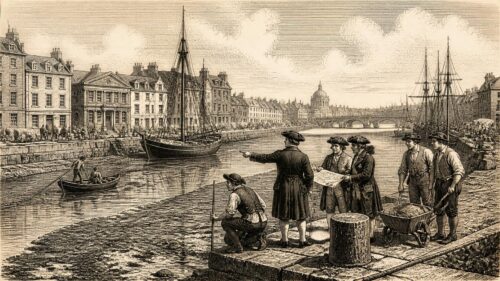
Elsewhere, 1820 supplied more prosaic signs of urban and institutional change. On 8 July Parliament passed the Dublin Gas Act, authorising a company to light the city and its suburbs with gas. This was permission and a financial framework, not an instant transformation of every Dublin street. Gas works, mains and street lighting still had to be financed and constructed. Even so, the act marked an important shift in the imagined city: safer and more regular illumination, commercial investment in public utilities, and a new industrial presence on the streets and beside the Liffey.
In the north-west, the Lough Allen Canal reached completion in December. Its four-and-a-half-mile line connected Lough Allen with the upper Shannon at Battlebridge, promising a route by which coal from the Arigna district could enter the wider inland-waterway network. Construction was effectively finished in 1820, although the canal opened to traffic in February 1821. The distinction matters: the year brought the engineering connection, while regular commercial use followed. The project represented hopes that inland navigation could bind peripheral mineral country to Dublin and other markets, though cheaper imported sea-coal would limit those hopes.
Learning and Useful Knowledge
Education remained patchy, voluntary and denominationally sensitive. In Bray, the beginnings of the Bray Male School, later St Cronan’s Boys’ National School, belong to 1820. Its modest origins in parochial schooling offer a useful counterpoint to grander schemes of reform. For many children, education depended on local clergy, charitable patrons, fees, family labour demands and the availability of a teacher rather than on any universal public system. The Kildare Place Society was then an important voluntary agency promoting education for the poor, but its supposedly non-denominational approach, including the place of scripture reading, was already generating Catholic unease.
In Dublin, the Dublin Society acquired a new designation when George IV became its patron: it became the Royal Dublin Society. The change was ceremonial, but the institution’s work was practical. It promoted agriculture, manufacture, arts and scientific knowledge through premiums, collections, lectures and instruction. Its royal title demonstrated how improvement projects could seek prestige through the crown even while the country’s politics remained deeply contested. The RDS’s activities also point to a central feature of early nineteenth-century Ireland: many initiatives in science, farming and technical education were channelled through learned societies and private or semi-public bodies rather than through a modern state apparatus.
Irish Connections Beyond the Island
Two events in 1820 illustrate how Irish lives were tied to wider imperial and maritime worlds. On 30 January, Edward Bransfield, a naval officer born at Ballinacurra in County Cork, led a British survey expedition that sighted the mountainous land of the Antarctic Peninsula. He was among the first people known to have seen the Antarctic mainland. Bransfield’s achievement was not an Irish state venture, but his career shows the reach of Irish-born sailors within the Royal Navy and the empire’s expanding geography.
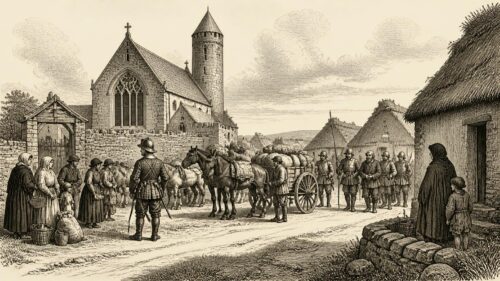
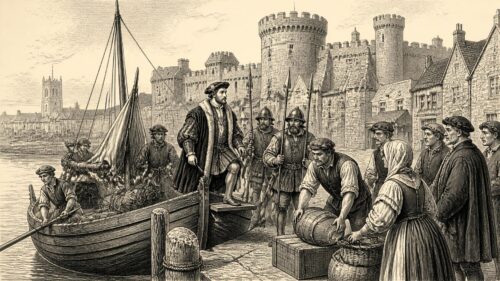
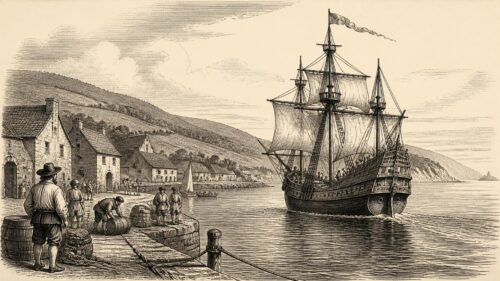
On 12 February the transports East Indian and Fanny sailed from Cork with parties of settlers for the Cape Colony. The passengers included families directed towards settlement in southern Africa under the British government scheme of 1820. Departure from Cork did not mean that all emigrants shared a single Irish identity or motive, but it demonstrates the port’s place in imperial migration. For people who left, the journey offered a possible escape from insecurity or an opportunity for land; for the communities they departed, it was part of a longer pattern in which Irish ports connected local pressures to colonial settlement.
The Kilmainham Meeting
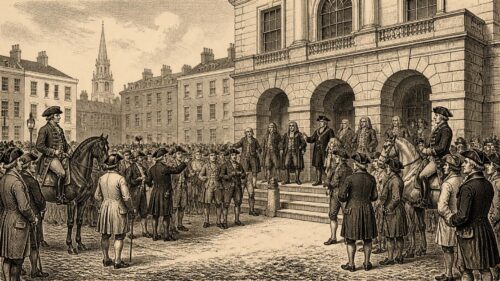
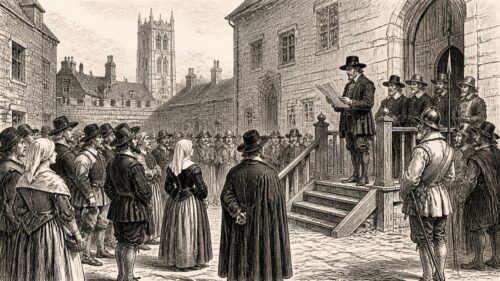
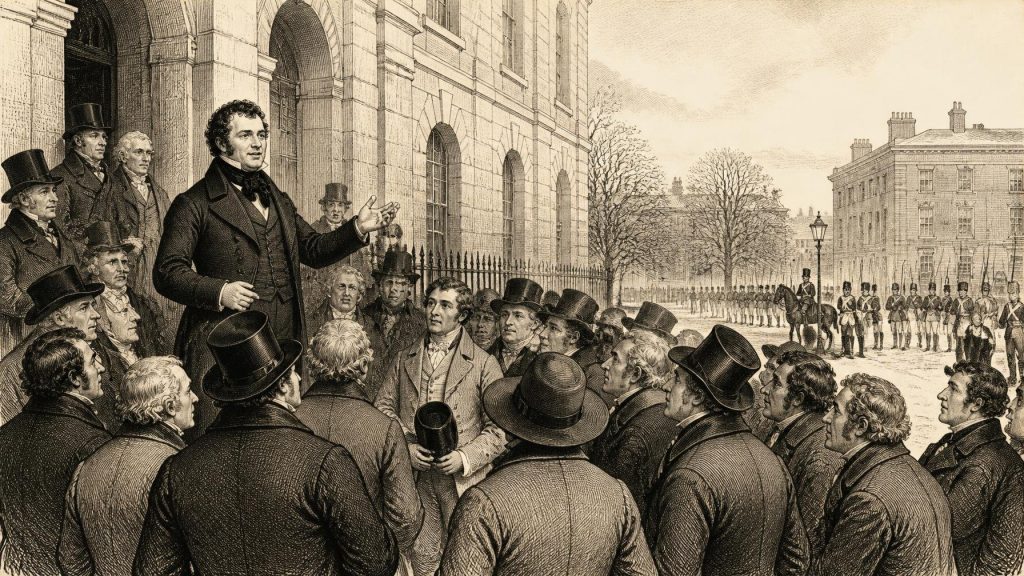
The year ended with a political confrontation that anticipated Daniel O’Connell’s later mastery of public mobilisation. On 30 December, County Dublin freeholders assembled at Kilmainham Courthouse after the high sheriff, Sir Richard Steele, called a meeting intended to produce a loyal address to George IV. The immediate background was the king’s highly unpopular attempt to divorce Queen Caroline. Across Britain and Ireland, sympathy for the queen supplied critics of the crown with a powerful language of moral outrage.
O’Connell and other opponents, including Lord Cloncurry and Archibald Hamilton Rowan, resisted the official management of the meeting. When Steele sought to maintain control, soldiers were ordered to clear the courthouse. O’Connell’s side reassembled across the road and issued its own address. It condemned the king’s treatment of Queen Caroline and directed his attention to the ‘distress’ and ‘miseries’ suffered by Ireland since the Union. The episode was called a revolt by later commemorators, but it was not an armed rising. Its importance lay in procedure, speech and legitimacy: who could speak for the county, whether an official address represented its freeholders, and how Irish grievances might be voiced within public political forms.
Thus 1820 closed with no constitutional settlement and no easy restoration of confidence. A new monarch, a shaken banking system, a burned cathedral, projects of education and infrastructure, and a defiant Kilmainham meeting together reveal an Ireland in transition. The year’s events did not yet produce mass Catholic organisation or parliamentary reform. They did, however, make visible the institutions, pressures and political language from which those later movements would grow.
Primary Sources
- Chronology of Irish History
- The Parliamentary Elections (Ireland) Act 1820
- Repeal
- Grattan, Henry
- O'Connell, Daniel
- Bi-centenary of Daniel O’Connell’s revolt in Kilmainham Courthouse, 30 December 1820
- The Select Speeches of Daniel O'Connell, M.P.
- Wildcat bankers or political failure? The Irish financial pantomime, 1797–1826
- Roche, James
- History of the Cathedral of St. Mary & St. Anne
- Dublin Gas Act 1820
- Commercial Buildings
- Lough Allen Canal
- The Registered Papers of the Chief Secretary's Office: 1820
- Bransfield, Edward
- Remembering Edward Bransfield
- History of South Africa since September 1795, Volume 1
- Setting Forth
- RDS Manuscripts
- History
- Historical Commentaries for 1818
- The Last County – Lifestyles