The Catholic Board Reassembles1812 CE
In 1812, Catholic politics revived through the Catholic Board, which defended constitutional petitioning against Convention Act restrictions. Daniel O’Connell emerged as a forceful opponent of the proposed Crown veto over bishops’ appointments. At Westminster, Henry Grattan secured a Commons vote favouring consideration of Catholic claims, but no emancipation legislation followed. Robert Peel’s appointment as chief secretary strengthened Dublin Castle’s resistance. Wartime markets supported agricultural output and trade, yet rural households faced insecure holdings, rents and poverty. Wakefield surveyed these inequalities; Edgeworth’s The Absentee criticised distant landlordism. Sadler’s balloon attempt provided a fleeting spectacle amid unresolved political, social and economic tensions.
Dateline
In 1812 Ireland’s most consequential development was not a battle or a statute, but the return of organised Catholic political action to public life. The island had been part of the United Kingdom for eleven years, yet the Union had not resolved the question that shadowed it from the beginning: whether the large Catholic majority could be admitted fully to the political constitution. During this year, Catholic leaders reassembled in Dublin, Parliament briefly moved towards considering their claims, and a young Robert Peel arrived as chief secretary to an administration firmly hostile to further concession. These were dated developments. They took place against a wider setting which cannot be reduced to a single year: a wartime rural economy, marked by high demand for food; a society of sharp inequalities in landholding and religion; and a country whose political business was now transacted principally at Westminster rather than in its former parliament house in Dublin.
A Public Catholic Organisation
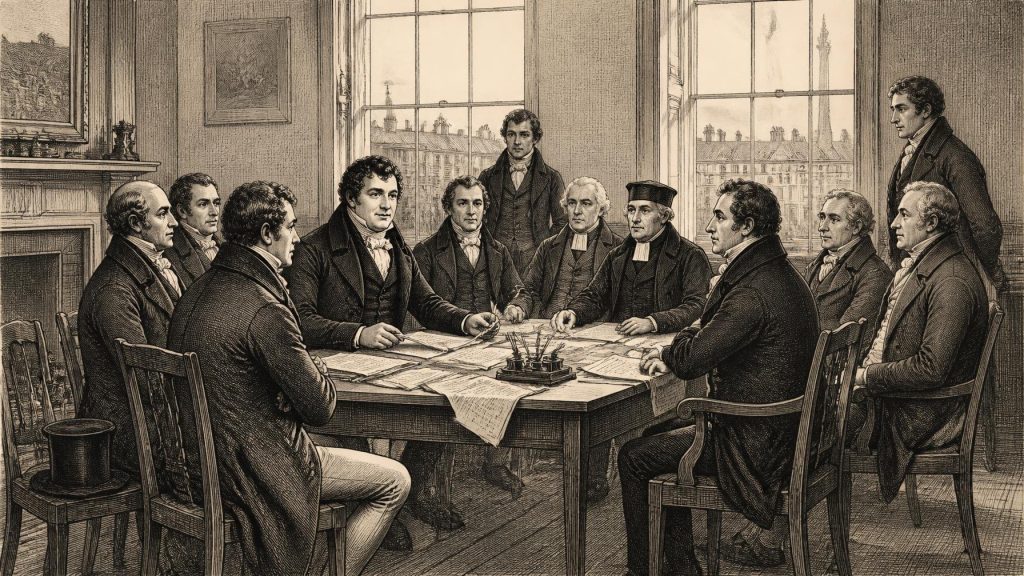
The Catholic cause had survived the Union, but its representative bodies faced a legal and political obstacle. The Convention Act of 1793 was intended to prevent representative assemblies from claiming a rival political authority. Catholic activists therefore had to devise forms of organisation that could petition, correspond and deliberate without giving the Dublin Castle administration an easy legal pretext to suppress them. In 1812, the Catholic Board became the principal vehicle for that work. It drew together members of the Catholic gentry, lawyers, merchants and clergy, while seeking links with county opinion beyond the capital.
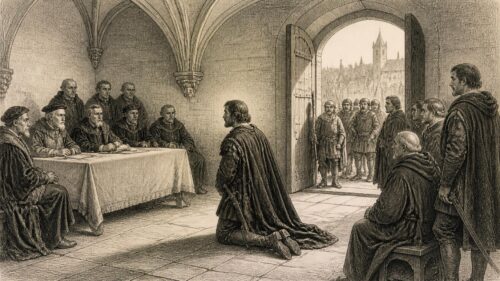
One firmly dated document shows both the Board’s emergence and its defensiveness. On 2 April, at a meeting of the Catholic Board, Irish Catholics adopted a declaration answering the accusation that their earlier general committee was a seditious assembly under the Convention Act. Its significance lay in the argument as much as in the wording. Catholic political action was presented not as a challenge to lawful government, but as the constitutional petitioning of subjects denied equality by religious tests. This was an important claim in a kingdom where Catholics could vote under the relief legislation of 1793 and could enter several professions, yet remained excluded from Parliament and many of the highest offices of state.
Daniel O’Connell, then a rising barrister rather than the national leader he would become, was already prominent in this world. He brought forensic energy, political instinct and an insistence that Catholics should not purchase civil equality at the expense of their Church’s independence. That last issue mattered intensely in 1812. Some advocates of relief believed that Protestant fears might be met by allowing the Crown an effective negative control over the appointment of Catholic bishops: the proposed “veto”. O’Connell opposed the idea. To him and many clerical opponents, a government permitted to interfere in episcopal nominations could make the Catholic hierarchy dependent upon the very state from which Catholics sought equal treatment.
The disagreement should not be mistaken for Catholic indifference to emancipation. Rather, it exposed two competing calculations. One held that a guarded compromise could unlock Westminster. The other believed that political rights purchased by state control over religious leadership would be insecure and dishonouring. The controversy also revealed an enduring fact about Irish public life: religion, property and political representation could not easily be separated. The Catholic Board was not yet the mass organisation of the later Catholic Association, but 1812 helped establish the habits of committee work, public declaration, county communication and legal argument on which later campaigns would build.
Westminster Hears the Claims
The political drama extended beyond Dublin. Catholic petitions reached the House of Commons, where Henry Grattan remained the best-known parliamentary advocate of relief. On 24 April the Commons resumed debate on his motion for a committee on the civil disabilities of Roman Catholics. The long debate exposed the distance between the language of loyalty used by Catholic petitioners and the distrust voiced by many Protestant opponents. Supporters argued that Catholics paid taxes and tithes, served the Crown and had demonstrated attachment to the state. Opponents insisted that a constitution they understood as Protestant could not safely admit Catholics to legislative power.
In June, the Commons accepted by 225 votes to 106 a motion in favour of considering Catholic claims. That vote was a real parliamentary advance, and it offered Irish campaigners grounds for hope. It was not, however, emancipation. No law followed in 1812. The result instead showed that the question could command a substantial majority in the Commons while still encountering formidable resistance in government, in the Lords, and among sections of Protestant public opinion. The contrast between a favourable motion and the absence of legislation is central to understanding the year: constitutional politics moved, but did not yet deliver.
For Irish Catholics, the very location of the debate was consequential. The old Irish parliament had disappeared in 1801. Grattan, once the celebrated defender of that parliament’s independence, now argued the Catholic case in London as one of Dublin’s members at Westminster. The Union made access to British party politics and imperial war arguments more important, but it also made Irish petitioners dependent on a legislature geographically and socially distant from many of them. The Board’s efforts in Dublin were therefore not a substitute for Westminster lobbying; they were its necessary Irish counterpart.
Peel at Dublin Castle
In August Robert Peel became chief secretary for Ireland. He was only twenty-four, but the post placed him at the centre of the Irish executive, working with the lord lieutenant, Charles Lennox, fourth duke of Richmond. Richmond had made continued opposition to further Catholic concessions a condition of remaining in office during 1812. Peel arrived from Lord Liverpool’s new ministry with similar assumptions: he regarded emancipation as unacceptable without securities for what ministers called the Protestant constitution.
It would be misleading to attach Peel’s later Irish policing measures to his first months in office. The centrally directed peace-preservation force associated with his chief secretaryship belonged to 1814, not 1812. What changed in 1812 was personnel and political direction. Dublin Castle acquired an energetic chief secretary whose long tenure, lasting until 1818, would make him a defining administrator of Union Ireland. At the moment of his arrival, however, his principal relevance was immediate: the political opening suggested by the June vote had met an executive prepared to resist it.
Government authority rested on more than policy at the Castle. Local magistrates, grand juries, landlords, clergy, military forces and the established Church all formed parts of the social machinery through which order was maintained. That machinery was uneven. Its weight was especially felt by poorer Catholics, who paid rents to landlords and, in many districts, tithes towards the Church of Ireland although they worshipped elsewhere. Such grievances did not automatically produce a single national politics, but they gave the equality demanded in petitions a material as well as constitutional meaning.
Fields, Cabins and Wartime Markets
There was no national census in 1812 from which to reconstruct every household, and no responsible account should pretend to offer a statistical snapshot that the evidence cannot sustain. Yet Edward Wakefield’s An Account of Ireland, Statistical and Political, published that year after extensive travel and enquiry, provides a contemporary, if often judgemental, survey of the country. It described a landscape in which tillage, pasture, potato plots, turf fuel, livestock and small-scale manufacture varied markedly between regions. Its evidence needs to be read critically, but its publication itself is revealing: Ireland was being observed, classified and discussed as a problem of government, improvement and political economy.
The larger economic setting was the continuing Napoleonic war. Wartime demand and high prices had encouraged the extension of tillage during the preceding years. Grain, cattle, butter and other produce connected Irish estates and ports to British markets, while many rural families relied on precarious combinations of a little land, seasonal labour, potatoes, milk when affordable, and spinning or weaving. Prosperity at the level of export or rent did not mean security at the level of the cabin. Holdings were frequently small, tenures uncertain, and the pressure of rent persistent.
Ulster contained a different but connected pattern. Linen remained the leading Irish manufacture, supported by flax cultivation, domestic spinning and weaving, bleaching grounds, merchants and markets. Belfast was developing as a commercial and manufacturing town, although mechanised cotton production also competed for capital and labour in the region. Elsewhere, cottage spinning and weaving offered vital supplementary earnings, particularly for women and children, but these employments were vulnerable to changing markets and machinery. The Ireland of 1812 was therefore neither simply agricultural nor uniformly industrial: it was a society in which the household economy of field, loom, fuel-bank and market was increasingly tied to war and commerce beyond the island.
These conditions help explain why absentee landlordism remained such a potent subject. It was not merely a moral complaint about landlords living in London. It concerned where rental income was spent, who supervised estates, whether tenants could obtain redress, and whether local wealth supported local employment and improvement. The question was being argued in political economy, in conversation and in literature.
Edgeworth’s Ireland
Maria Edgeworth gave that issue one of its most durable imaginative forms in The Absentee, published in 1812 as part of Tales of Fashionable Life. Her novel follows Lord Colambre, heir to an Irish estate, as he recognises the consequences of his family’s London-centred life and encounters the people affected by distant management. It offered no simple social documentary: it is fiction, shaped by comedy, romance and Edgeworth’s own assumptions about rank and reform. Nonetheless, its appearance belongs securely to this year and its subject was unmistakably Irish.
Edgeworth’s solution was paternal rather than democratic. Good landlords should reside, learn, administer fairly and accept obligations to tenants; moral reform should repair a damaged relationship between estate and people. Yet the novel’s power came from its recognition that absence had consequences. At a moment when Irish political representation had also been removed to London, a story about landlords drawing Irish income while living elsewhere carried an unusually sharp resonance.
A Balloon over Dublin
One smaller, vividly dated event offered a very different image of Ireland’s connection with the wider world. On 1 October the English aeronaut James Sadler ascended in a balloon from Belvedere House near Drumcondra, intending to cross the Irish Sea. He did not complete the planned passage safely: after an ordeal over the water, he was rescued by a fishing boat. The attempt was spectacle, experiment and danger combined. It did not alter Irish politics, but it briefly drew crowds’ attention from the contested ground of religion and government to the modern wonder of flight.
Thus 1812 was a year of expectation rather than settlement. Catholics had recreated a public political board, Westminster had acknowledged that their claims deserved consideration, and the Dublin administration had acquired a chief secretary committed to limiting concession. In fields and towns, the wartime economy could sustain output while leaving ordinary livelihoods exposed. In print, Edgeworth made absentee power a national subject. Ireland entered the year under Union; it left it with the central unresolved question of that Union more clearly organised, more publicly argued and more difficult to ignore.
Primary Sources
- Declaration of the Roman Catholics of Ireland, adopted at a meeting of the Catholic Board, 2 April 1812
- Mr. Grattan's Motion for a Committee on the Civil Disabilities of the Roman Catholics—Adjourned Debate
- Petition from Mayo Respecting the Roman Catholics of Ireland
- Catholic Emancipation
- Key Government Officials, 1801–1852
- Robert Peel
- Charles Lennox
- An Account of Ireland, Statistical and Political
- History of the Commercial and Financial Relations between England and Ireland from the Period of the Restoration, Part 17
- Pre-famine Clare — Society in Crisis
- Food Rioting in Ireland in the Eighteenth and Nineteenth Centuries: The ‘Moral Economy’ of the Irish Crowd
- ‘Wholesome Regulation and Unlimited Freedom’: Governing Market Space in Southern Ireland Before the Famine
- The Belfast Cotton Industry Revisited
- Wildcat Bankers or Political Failure? The Irish Financial Pantomime, 1797–1826
- The National Tale, 1800–30
- The Absentee
- Maria Edgeworth’s The Absentee
- Reform, Religion, and Radicalism
- Balloon. [Sadler's Balloon at Dublin, October 1st, 1812.]
- James Sadler
- The Office of the Chief Secretary of Ireland: Chronology