Hearts of Steel1772 CE
In 1772, George Townshend’s departure and Simon Harcourt’s arrival as Lord Lieutenant altered Dublin Castle’s leadership without changing Ireland’s dependence on British imperial authority or its patronage-based, unrepresentative parliament. Ulster’s Hearts of Steel protest exposed rural insecurity over rents, leases, taxes and evictions; government answered with troops, targeted legislation and a later pardon, rather than structural reform. Parliament granted Catholics restricted long-term leases of bog land, a limited economic concession preserving wider penal disabilities. The London-Derry Journal’s foundation and revived siege commemoration illustrated print’s growing civic role. Meanwhile, linen, improvement and institutions coexisted with inequalities in land, religion and power.
Dateline
In 1772, Ireland’s political centre changed hands while a crisis in the northern countryside exposed the limits of authority from Dublin Castle. The year does not offer one all-transforming national event. Instead, its securely dated developments connect the world of parliamentary patronage, the grievances of Ulster tenants, guarded concessions to Catholics, and the growing reach of print. They show an eighteenth-century kingdom governed through an Irish parliament, yet tightly bound to the British Crown and Westminster, where prosperity and insecurity could exist strikingly close together.
A Viceroy Departs
George Townshend, Lord Lieutenant since 1767, remained in office through most of 1772. His viceroyalty had already altered the mechanics of Irish politics. Earlier administrations had relied heavily on powerful parliamentary managers, commonly called ‘undertakers’, who delivered votes in return for influence over offices and patronage. Townshend had sought instead to construct a more directly managed Castle interest in the Irish House of Commons. That made the Lord Lieutenant’s government less dependent on a few grandees, but it also increased the importance of pensions, places and personal bargaining.
The parliamentary session concluded in June 1772. It ended an important stage in Townshend’s difficult administration rather than resolving the deeper constitutional questions around it. Ireland had its own parliament in College Green, but its legislation remained subject to the procedures imposed by Poynings’ Law and to the superior claims of the British parliament asserted in 1720. Its electorate was narrow, its House of Commons was heavily shaped by borough patronage, and the Catholic majority of the population could not sit there. Parliamentary life could be eloquent, sociable and sophisticated; it was not broadly representative.
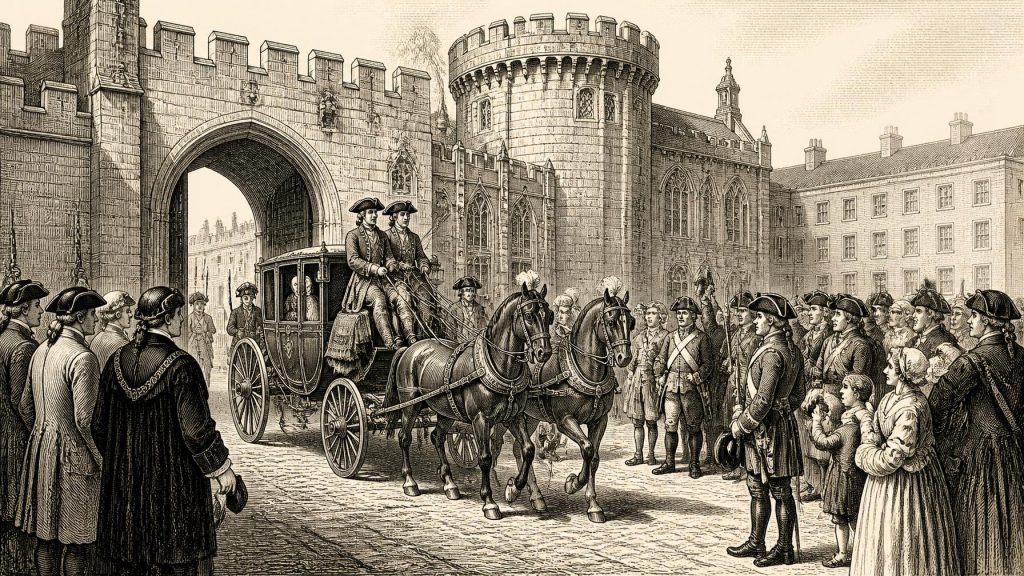
On 29 October, Townshend was replaced as Lord Lieutenant by Simon Harcourt, Earl Harcourt, a soldier, courtier and former ambassador in Paris. Harcourt was sworn in on 30 November, accompanied by John Blaquiere as chief secretary. The replacement was not a transfer of power from London to Dublin, but an adjustment within imperial government. Harcourt inherited the Castle interest Townshend had assembled and a political system in which the distribution of offices and favours remained indispensable. His arrival nevertheless signalled that the British ministry had tired of Townshend’s confrontational style and wanted a steadier hand in Ireland.
Steelboys in Ulster
The most urgent disturbance of the year lay far from Dublin. The Hearts of Steel, or Steelboys, had emerged amid disputes over rent, leases, eviction and local taxation in Ulster. Their agitation had roots before 1772, especially in areas where estate reorganisation and the expiry of leases enabled landlords or middlemen to demand steeply increased rents and entrance fines. The movement cannot responsibly be reduced to a single cause: conditions differed between estates and counties. But its members repeatedly connected hardship to rents, cess, tithes and the loss of a secure place on the land.
Many Steelboys were Protestant smallholders, labourers or linen-connected rural people, including Presbyterians as well as members of the established Church. That mattered. This was not a simple clash between a Protestant ruling class and Catholic tenants. It was, in large part, a revolt within Ulster’s Protestant and dissenting population against landlords, agents and the burdens of local government. At the same time, Catholic people remained subject to major legal disabilities, while the Church of Ireland retained the established position and the tithe system weighed upon those outside it.
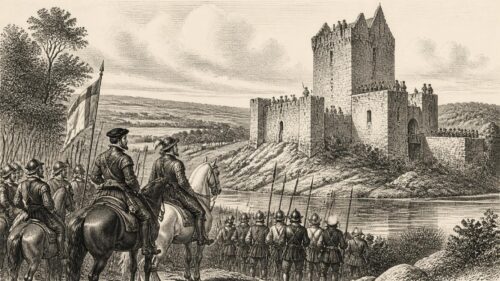
Events around Gilford in County Down brought the confrontation into sharp relief in early March. Richard Johnston, the local proprietor, faced a large Steelboy mobilisation after the arrest of alleged leaders on his estate. The ensuing disorder, remembered as the Battle of Gilford, involved armed confrontation, damage to property and Johnston’s flight from his castle. Exact numbers offered in later accounts should be treated with caution, but there is no doubt that the episode demonstrated both the movement’s capacity for collective action and the weakness of ordinary local control.
The government responded with law as well as troops. On 23 March, a proclamation specifically named persons called the Hearts of Steel after an attack on the cattle property of John Blackwood. Five days later, on 28 March, the Lord Lieutenant gave royal assent to an act directed against violent and threatening offenders in Antrim, Down, Armagh, Londonderry and Tyrone, including those who resisted the levying of public taxes. Its unusually explicit geographic focus showed how serious the authorities considered the northern unrest. The statute described the offenders in the language of disorder and violence; it did not address the economic arrangements that had helped to produce the conflict.
Coercion was therefore accompanied by an acknowledgement, at least in official private discussion, that harsh estate practice had consequences. A general pardon was proclaimed in November for insurgents who returned to obedience, although prosecutions, military activity and fear had already left their mark. The disturbances did not disappear neatly at the turn of the year. Yet 1772 was the year in which the Steelboys’ local grievances became unmistakably a kingdom-wide concern, debated by government and answered by exceptional legislation.
Bog Land and Catholic Constraint
Against this background, the session that ended on 2 June produced a small but significant alteration in the legal position of Catholics. Legislation allowed Catholics to lease limited quantities of unreclaimed bog land for long terms, provided the land met restrictions intended to keep the concession away from towns and established markets. The measure encouraged improvement: draining, reclaiming and cultivating land that was represented as unprofitable. It also recognised, in narrowly economic terms, that Catholic labour and capital could be useful to the kingdom.
Its limits were as revealing as its promise. This was not Catholic emancipation, nor did it undo the penal code’s wider restrictions on property, education, office-holding and political participation. It concerned a carefully bounded category of land and a specified purpose. Still, in the exact circumstances of 1772, it marked a departure from the assumption that Catholics should be excluded from economic improvement. The state could invite them to reclaim bog while continuing to deny them equality in public life.
News, Memory and the Town
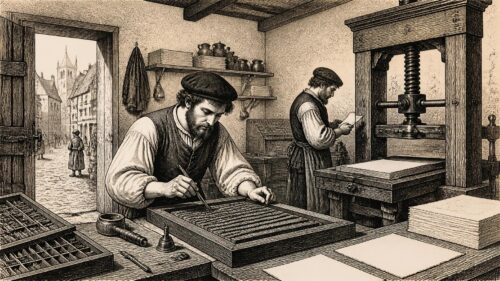
Print supplied another thread through the year. On 3 June, the London-Derry Journal and General Advertiser first appeared. A newspaper’s founding was not equivalent to a political revolution, but a regular local paper helped connect a provincial town and its hinterland to commercial notices, shipping intelligence, official announcements and debates that travelled across Ireland and the Irish Sea. It also created a more durable public record of local opinion.
That record captured an act of civic memory in Londonderry later in the summer. In August 1772, the newspaper reported a revived commemoration of the 1689 siege: bells rang, a flag was displayed from the cathedral steeple, and the mayor, corporation and freemen processed to worship before dining together. The occasion was consciously Protestant and civic, but it was not yet the later, highly formalised ritual familiar from subsequent centuries. In 1772, it demonstrates how an urban corporation used commemoration, church ceremony and print to define the city’s public identity.
Improvement and Uneven Life
Elsewhere, the routines of improvement continued. The Dublin Society maintained its work of encouraging agriculture, manufactures, useful knowledge and practical education, while estate owners, tenants, merchants and craftsmen made decisions shaped by markets, credit and weather. Linen remained central to many Ulster households: spinning and weaving linked small farms to dealers, bleaching greens, ports and overseas consumers. Such activity did not shield rural families from rent pressure. Indeed, the combination of commercial opportunity and insecure tenure helps explain why improvement could be experienced as promise by landlords and as danger by tenants.
The year also belongs to culture and learning in a quieter sense. Mary Tighe, later celebrated for her poetry, was born in Dublin on 9 October 1772. Her birth did not alter the public affairs of that year, but it is a useful reminder that Ireland’s literary future was being formed within households shaped by education, religion, family connection and access to books. Her father, William Blachford, was librarian of Marsh’s Library, one of Dublin’s important institutions of learning. Such settings stood in marked contrast to the exclusion of most Irish people from formal political power.
A Year of Exposure
By the end of 1772, Harcourt was installed at Dublin Castle, Townshend’s political machine survived, and the northern disorders had drawn repression and limited conciliation from the state. The year’s developments did not settle Ireland’s problems. They exposed them. An Irish parliament could legislate against rural violence while remaining socially narrow; an administration could concede a restricted Catholic leasehold right while preserving the larger penal structure; and a growing print culture could carry both commercial information and contested memories of the past.
For contemporaries, the immediate questions were practical: who would pay the rent, who controlled the borough, who could reclaim land, and whether order could be restored in Ulster. In retrospect, those questions reveal the fractures beneath eighteenth-century Irish stability. 1772 was a year in which government changed its face, but the struggles over land, religion, representation and authority remained firmly in view.
Primary Sources
- Townshend, George | Dictionary of Irish Biography
- Harcourt, Simon | Dictionary of Irish Biography
- Tighe, Mary | Dictionary of Irish Biography
- Proceedings of the Irish House of Lords, 1771–1800
- Lord Donegall and the Hearts of Steel
- Irish Legislation Database: Home
- Calendar of Home Office Papers of the Reign of George III, 1772
- The Ulster Land War of 1770: The Hearts of Steel
- Sources: National Library of Ireland Catalogue
- Add MS 38208: Ireland Correspondence, 1772–1775
- RDS Proceedings: Dublin Society, 1772
- RDS Digital Archive: Dublin Society Council Minute Books
- Derry Journal — Browse by Title
- Remembering the Siege of Derry
- Background: Chronology of Key Events 1169 to 1799
- Religion: Background to Statutes
- Constitutional Differences: Parliament and Ireland
- Pre-Union Irish Statutes 1169 to 1800
- Statute Law Revision Act 2015
- Irish Revenue, 1660–1800: A Dataset
- Fugitive Pieces of Irish Politics, During the Administration of Lord Townshend
- The Origins of the Ulster Manuscript Tradition, 1690–1800: Some Initial Observations
- The Constitutional and Parliamentary History of Ireland Till the Union