Wood’s Patent1722 CE
In 1722 George I authorised English ironmaster William Wood to mint up to 360 tons of copper halfpence and farthings for Ireland, initiating a controversy over currency, trade and political authority. Issued in London without Irish parliamentary consultation, the fourteen-year patent alarmed critics amid Ireland’s restricted autonomy following the 1720 Declaratory Act, although Swift’s attacks and parliamentary condemnation came later. Ireland’s rural economy, unequal imperial trade and unreliable small change formed its background. Executive government, policing proclamations and penal restrictions demonstrated state power. Dublin simultaneously celebrated Hanoverian rule with George I’s statue, while print culture widened constitutional unease more widely.
Dateline
In 1722, a decision taken in London set in motion one of the most resonant Irish controversies of the eighteenth century. The immediate subject was humble: copper halfpence and farthings, the coins of small purchases, market change and daily reckoning. Yet the patent issued to the English ironmaster William Wood raised questions much larger than its metal. Who could decide what money Ireland should use? Was Ireland’s trade being protected? And how far did the kingdom’s own political institutions matter within the Hanoverian monarchy?
A London Patent for Ireland
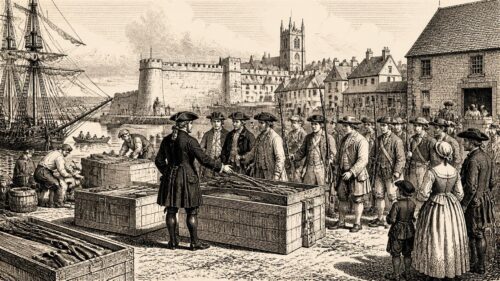
The firmly dated turning-point came on 16 June 1722. George I directed that an indenture be prepared granting William Wood an exclusive fourteen-year licence to coin copper halfpence and farthings for use in Ireland. The proposed maximum was 360 tons of copper, conventionally valued at £100,800. Wood was a Wolverhampton ironmaster and manufacturer, not an Irish merchant or official; the coins were to be made in London rather than at an Irish mint.
This was not a minor administrative adjustment. Copper was essential to the everyday economy because it enabled transactions too small for gold or silver. A hawker, labourer, servant, small shopkeeper or market customer might encounter its absence directly. But the patent’s scale was striking, and the right had been awarded through royal patronage in Britain. The later public quarrel became notorious for its pamphlets and satire, but its foundations belong squarely to 1722: an English manufacturer had received a lucrative royal licence to manufacture the small change of Ireland.
It is important not to carry the later crisis backwards too quickly. Jonathan Swift’s Drapier’s Letters, the celebrated anonymous attacks on Wood’s coinage, did not appear until 1724. Nor did the Irish House of Commons issue its formal denunciation of the patent until 1723. The patent of 1722 was therefore the beginning of the dispute, not its noisy climax. Likewise, surviving accounts do not justify a confident claim that Wood’s coppers were already circulating widely in Irish markets during this calendar year. Production and distribution developed over the following years.
Money, Trade and Unease
The proposal touched a genuine economic vulnerability. Ireland’s currency was uneven, and small coin was useful; a shortage of dependable change could impede retail exchange. At the same time, a very large copper issue might be feared as a threat to confidence, prices and the retention of gold and silver. Such anxieties were not merely technical. They concerned the purchasing power of ordinary people as well as the credit of merchants, landlords and revenue collectors.
Broader evidence from the early eighteenth century places this issue in an economy still overwhelmingly rural. Much of Ireland’s population lived through small-scale agriculture and seasonal labour, while cattle, beef, dairy produce and, increasingly, linen connected the island to external markets. England was Ireland’s dominant overseas market, though trade was structured by imperial restrictions and by the unequal political relationship between the two kingdoms. The linen export boom is more securely measurable a few years later than in 1722 itself; it should therefore be treated as an expanding setting rather than as a sudden event of this year.
Wood’s patent gave those wider conditions a sharp political form. It seemed to make Irish commercial life subject to an external decision in a particularly intimate sphere: the coins passed from hand to hand in local exchange. Archbishop William King of Dublin, already a prominent defender of Irish constitutional interests, became a central opponent of the projected coinage during the controversy that began in these years. The dispute would allow political criticism to be expressed through the practical language of weights, values, trade and household loss.
Government Without Parliament
Ireland remained a kingdom under George I, with a lord lieutenant, privy council and parliament in Dublin, but its autonomy had been severely constrained. The British Declaratory Act of 1720 had asserted the British parliament’s authority to legislate for Ireland and made the British House of Lords the final court of appeal in Irish causes. That recent assertion lay behind much elite sensitivity in 1722. The argument over copper could not be separated from the question of whether Irish interests were to be heard before policies affecting Ireland were imposed.
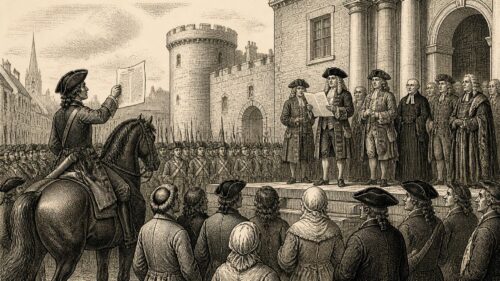
There was no sustained parliamentary session in Dublin during 1722 in which to test the matter. A proclamation of 11 February postponed parliament until 31 July, and another of 6 September postponed it again until 25 March 1723. Administration continued through the executive. Charles FitzRoy, second duke of Grafton, was lord lieutenant, while Archbishop King served among the lords justices in the 1722–23 commission. The pattern illustrates a key feature of government: major matters could be managed through Crown and executive channels while the representative legislature was absent.
The Wood patent consequently became a revealing constitutional provocation. Its opponents would later insist that it had been obtained without proper Irish consultation. In 1722, however, the most responsible conclusion is narrower: the licence was authorised at the British centre of government for currency intended for Ireland, at a moment when Irish political figures were still absorbing the implications of the 1720 settlement.
Order, Policing and Penal Constraint
Official proclamations from 1722 offer brief but valuable glimpses beyond high politics. On 25 January, the government offered a reward for the capture of Sir Andrew Aylmer and others. On 23 April, another proclamation concerned the murder of the wife of Captain de Quinsack and the pursuit of an escapee from Kerry gaol. On 4 June, men described officially as “tories, robbers and rapparees” in counties Tyrone and Dublin were ordered to surrender. A proclamation of 16 November sought information leading to the capture of Andrew Cullen.
These notices do not, by themselves, prove an island-wide crime wave. Their language was that of the governing authorities, and terms such as “rapparee” carried long political as well as criminal associations. They do demonstrate that the administration used rewards, proclamations and county-level enforcement to project authority across a country where roads, distances and local loyalties complicated policing.
Religion was entwined with that authority. The penal laws enacted from the 1690s through 1719 remained a lived framework in 1722. They restricted Catholic political, educational, religious and property rights, although enforcement varied greatly by place and circumstance. The vast Catholic majority continued to worship and organise communal life under these restraints, while the established Church of Ireland held legal privilege. Presbyterians, concentrated especially in Ulster, also faced disabilities under the religious settlement even where their commercial and demographic importance was considerable.
A proclamation of 21 July offering a reward for the apprehension of Francis Quin, a Catholic priest, makes the coercive potential of that system visible in a specific year. It should not be used to claim that every Catholic priest was then being hunted or that enforcement was uniform. Rather, it records the state’s continuing willingness to deploy older anti-Catholic law and security language against an individual cleric. The everyday Ireland of 1722 was thus neither wholly immobilised by the penal system nor free from it: worship, inheritance, schooling, office-holding and local status were all shaped by rules that placed communities unequally before the state.
Dublin’s Hanoverian Display
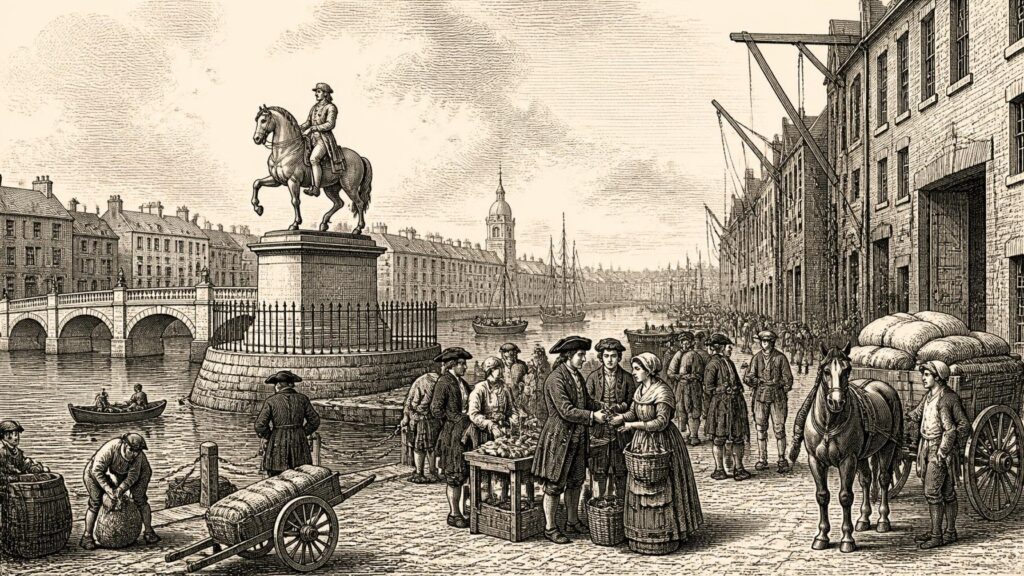
On 1 August, Dublin staged a more public assertion of the political order. An equestrian statue of George I, made by the sculptor John Nost, was unveiled on the pier at the west side of Essex Bridge. The city had purchased it for £2,000. The occasion coincided with the riding of the franchises, a civic ceremony associated with the city’s municipal privileges. On the bridge beside the Liffey, monarchical display and urban corporate identity were deliberately joined.
The statue belonged to a changing Dublin. The city’s population and built fabric were growing, and its quays, bridge approaches, markets, churches and official buildings made it the principal centre through which government, law, print and commerce were concentrated. Yet the ceremony also reveals the narrowness of formal civic representation. Dublin Corporation and the public rituals it sponsored were institutions of the Protestant political order, not a transparent expression of the whole city’s inhabitants.
Print nonetheless offered a widening, if still restricted, arena for political awareness. The National Library of Ireland records the Dublin Mercury as published from 1722 to about 1724. This does not establish how broadly any particular issue circulated, but it is evidence of a Dublin news culture in which commercial notices, official information and political argument could travel beyond private correspondence. Such networks would matter greatly once the coinage dispute intensified.
Deaths, Births and Intellectual Afterlives
On 11 March, John Toland died in England. Born at Ardagh in County Londonderry, Toland had become one of the most provocative Irish-born writers of his generation: a republican, religious critic, antiquarian and advocate of free inquiry whose works circulated far beyond Ireland. His death was not an Irish political event in itself, but it closed the career of a thinker who had repeatedly used Irish history, especially arguments about the early Irish church and druids, to challenge orthodox religious and political authority.
On 29 May, James FitzGerald was born in Dublin, second son of the nineteenth earl of Kildare. He could not, of course, affect the affairs of 1722, but his birth is securely dated and later mattered greatly: he became the twentieth earl of Kildare and first duke of Leinster, a leading figure in eighteenth-century Irish politics. It is a reminder that the established elite whose interests were stirred by Wood’s patent was also renewing itself through dynastic family life.
The evidence for 1722 does not support a claim of a decisive battle, famine or general environmental catastrophe in Ireland. Its significance lies elsewhere. A copper patent, seemingly prosaic, exposed the connections between everyday exchange, imperial power and constitutional grievance. Dublin marked loyalty to George I in bronze on Essex Bridge, while a licence issued in his name began to raise doubts about how Ireland was governed. The controversy was only beginning, but the essential issue had already been coined.

Primary Sources
- Statute Law Revision Act 2015
- Dublin Diary #OnThisDay
- William Wood, ironmaster, of Wolverhampton: Signet Warrants for licences for him to coin money for American colonies and Ireland: 1722
- Detailed report on the trial at London of Wood's copper coinage for Ireland
- The Coinage of Ireland in Copper, Tin, and Pewter
- The Pamphlet Controversy about Wood's Halfpence (1722–25) and the Tradition of Irish Constitutional Nationalism
- William Wood (1671–1730)
- William King
- Hugh Boulter
- John Toland
- James Fitzgerald
- Theophilus Bolton
- John Garzia (Garcia)
- Luke Gardiner
- William Nicolson
- Samuel Molyneux
- State of the establishment, Dec. 1722; copy of a letter from the Lords Justices to the Duke of Grafton
- Dublin Mercury
- Slave Codes and Penal Laws in Eighteenth-Century Jamaica and Ireland: A Comparative and Historiographical Survey
- The Penal Laws: Origins, Purpose, Enforcement and Impact
- Securing the Protestant Interest: The Origins and Purpose of the Penal Laws of 1695
- Penal Laws
- The Exchange Business of the Irish Banks in the Eighteenth Century
- History of the Commercial and Financial Relations between England and Ireland from the Period of the Restoration
- Chief Governors of Ireland