Queen Anne1702 CE
William III’s death brought Queen Anne to the thrones of England, Scotland and Ireland, proclaimed in Dublin on 18 March. Her accession preserved a Protestant administration founded after Williamite war, while Catholics remained politically excluded and Jacobite legitimacy persisted. Ireland was governed by lords justices after Rochester’s departure, with Thomas Erle combining military and civil responsibilities amid War of Spanish Succession. Protestant elites resented Westminster’s resumption of forfeited estates and restrictions on woollen exports. December consultations at Dublin Castle addressed parliament, taxation and war costs without resolution. Michael Boyle died; Portarlington Huguenots gained lease security; Swift received his Trinity doctorate.
Dateline
For Ireland, 1702 was not a year of battle on its own soil, nor of a sitting parliament or a dramatic change in statute. Its importance lay instead in a succession, an uneasy transition in government, and a late-year attempt to reckon with the kingdom’s political and financial problems. The death of William III removed the monarch whose victory in Ireland had helped settle the Williamite war. Queen Anne inherited a Protestant administration still shaped by that conflict, a Catholic majority excluded from political power, and a governing class increasingly frustrated by decisions made across the Irish Sea.
A New Queen Proclaimed
William III died at Kensington on 8 March 1702. On that day Anne, his sister-in-law and the Protestant daughter of the deposed James II, became queen of England, Scotland and Ireland. The wording matters: these remained separate kingdoms under the same sovereign. Ireland possessed its own executive, courts, revenue and parliament, but the crown’s Irish government was closely controlled from London and Irish legislation remained constrained by Poynings’ Law.
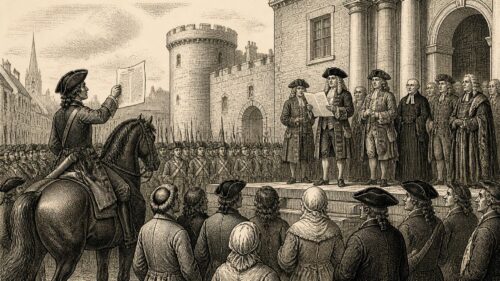
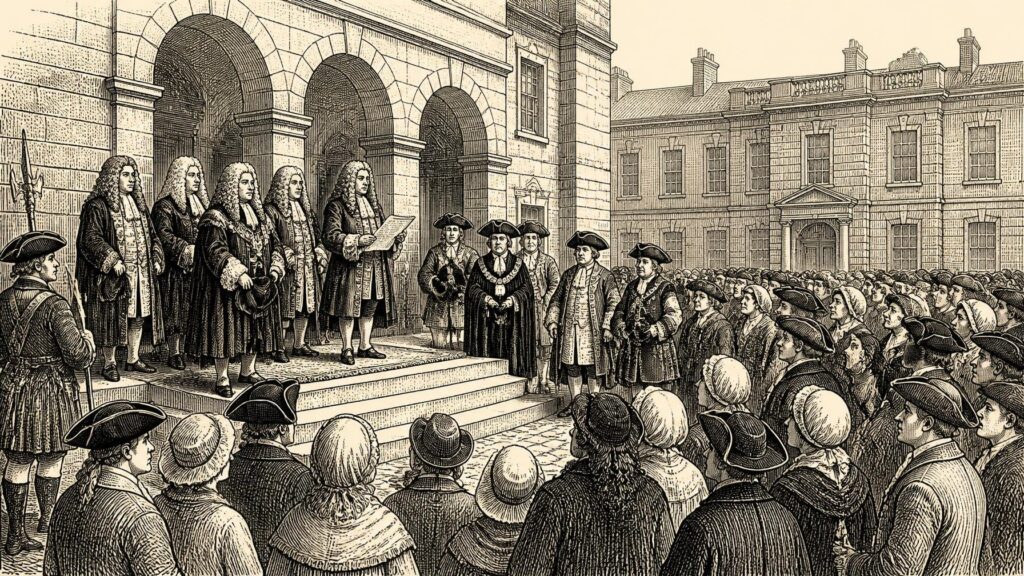
The accession was formally made visible in Dublin ten days later. On 18 March, the lords justices, privy councillors, the lord mayor and other leading figures proclaimed Anne in the capital. Such ceremonies were political acts rather than mere ritual. Dublin’s civic elite publicly affirmed continuity after the death of the king associated with the Boyne, Aughrim and the post-war confiscations. The proclamation also announced the survival of a Protestant political order at a moment when France continued to support the exiled Stuart claimant, James Francis Edward.
Anne’s succession did not resolve the fundamental problem of legitimacy for all inhabitants. Her title rested upon the revolution settlement of 1688–91 and the Act of Settlement of 1701, which had secured a Protestant succession. For the established Church of Ireland, for officeholders and for many beneficiaries of Williamite land grants, this settlement was a safeguard. For Jacobites, and for many Catholics who had experienced military defeat, dispossession or exclusion after 1691, it was a reminder that the state had been remade without their consent.
Government Without a Resident Viceroy
The machinery of Irish rule was unsettled even before William died. Laurence Hyde, earl of Rochester, remained lord lieutenant, but had left Ireland on 4 January 1702 after a short residence. He governed largely from London. Following Anne’s accession, a new commission of three lords justices was established to manage affairs in Ireland. One of them was Major-General Thomas Erle, commander-in-chief of the land forces in Ireland and an English soldier with growing responsibilities in Dublin.
This was not an autonomous Irish ministry. The Castle administration answered ultimately to the crown and English ministers. Yet its members had to assess conditions in a kingdom where Protestant political opinion was becoming notably assertive. Erle’s position joined military command to civil government at precisely the point when European conflict was widening. Ireland was a strategically important western kingdom, with ports, garrisons and a recent history of invasion. Security plans therefore mattered even though no new campaign erupted in Ireland during 1702.
The War of the Spanish Succession made these concerns more pressing. Anne came to the throne amid confrontation with France and Spain, and war with France followed that spring. The conflict was fought principally overseas and on the Continent, but Ireland was connected to it in several ways. Irish Protestant officials worried about coastal security and domestic loyalty; Irish Catholic exiles and their descendants served in French forces; and Irish resources formed part of the wider fiscal and military system supporting the crown. The island was not a passive hinterland. It was a guarded kingdom whose government expected European war to have local consequences.
The year also demonstrated the continuing reach of Irish aristocratic networks beyond Ireland. James Butler, second duke of Ormond, a Dublin-born magnate and leading Protestant Tory, commanded troops in the unsuccessful Cadiz expedition and in the subsequent attack on Vigo Bay. He was not yet lord lieutenant of Ireland: that appointment belonged to 1703. His prominence in Anne’s military affairs nevertheless helped make him a plausible figure for a future Irish administration.
Forfeitures, Trade and a Deferred Parliament
The largest immediate political difficulty was not rebellion but property. In 1700 the English parliament had resumed many of William III’s Irish forfeited estates. This reversal of royal grants alarmed Protestant purchasers, officeholders and landowners who had believed the post-war settlement secure. The issue was larger than individual estates. It suggested that property in Ireland, however legally acquired, might be altered by Westminster intervention. That resentment joined older anger at the English parliament’s 1699 restriction on the export of Irish woollen manufactures.
Neither grievance should be exaggerated into a united Irish nationalism. The aggrieved political community was overwhelmingly Protestant, propertied and represented through corporations, the established church, the army and the political connections of Dublin. It nevertheless had a real sense that the kingdom’s interests were being subordinated. The curtailment of woollen exports affected merchants, manufacturers and labourers through a wider economy already exposed to weak demand and uncertainty. It also encouraged advocates of linen as an alternative field of production, though the great institutional drive behind Irish linen belonged to later decades.
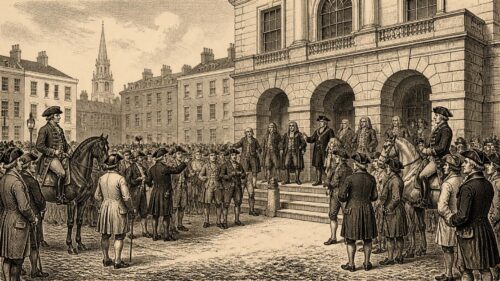
No Irish parliament met in 1702. The previous parliament had ended in 1699, while a new one was increasingly recognised as necessary. Its absence gave administrative consultation unusual importance. During the closing months of the year, the lords justices sought the opinions of leading officials and politicians about Ireland’s condition and about the prospect of calling parliament. The discussions culminated in a December meeting at Dublin Castle. Erle promised to do what he could for Irish concerns, but reportedly added that Ireland ought reasonably to bear part of the cost of the war against France.
That proposition exposed the problem at the heart of the year. The crown needed money, military readiness and political co-operation. Irish Protestants wanted security for land, attention to commerce and recognition of the kingdom’s constitutional dignity. New taxation, however, was never popular, and the prospect that Ireland might finance a war directed from London sharpened existing grievances. The December consultation did not settle these questions. It prepared the ground for the difficult parliament called in 1703.
Confessional Boundaries
Political debate among Protestant elites took place within a society divided sharply by law and religion. Roman Catholics formed the great majority of the population but did not participate on equal terms in public life. The penal measures of the 1690s had restricted Catholic access to arms, office and public authority. The 1697 legislation against Catholic bishops and regular clergy remained part of the legal environment in 1702. The more comprehensive anti-Catholic legislation commonly associated with Anne’s reign had not yet been enacted; it is important not to project the 1703 measures backwards into this year.
The Church of Ireland, though representing a minority of the population, was established by law, endowed with tithes and interwoven with government. Its senior clergy sat in the house of lords and exercised local influence through parishes, schools, courts and patronage. On 10 December, Michael Boyle, archbishop of Armagh, died at his Dublin home in Oxmantown and was buried privately in St Patrick’s Cathedral. Boyle had been not only primate but lord chancellor and lord justice earlier in his long career. His death marked the passing of a Restoration churchman whose public life had spanned civil war, restoration, revolution and Williamite rule.
At the same time, Protestant Ireland was not religiously uniform. Anglicans, Presbyterians and French Protestant refugees did not share identical institutions or interests. At Portarlington, the Huguenot settlement received an important measure of security in 1702 when leases associated with Henri de Massue, Lord Galway, were recognised after the disruption caused by the resumption of forfeited estates. The settlement’s French Reformed character also faced pressure towards conformity with the Church of Ireland. This was a small but revealing episode: land policy, religious identity and the state’s preference for a Protestant settler interest were closely entwined.
Learning, Print and Daily Continuity
Evidence for the ordinary routines of 1702 is thinner than evidence for councils and bishops. Most people continued to live through seasonal agriculture, household labour, local markets, rents, tithes and the obligations imposed by landlords and parish structures. The political decisions taken in Dublin and London reached them unevenly, but trade restrictions, military expenditure and the ownership of land could shape wages, prices, tenancy and opportunity. A responsible account of the year should acknowledge that connection without pretending that every household experienced events in the same way.
Dublin also remained a centre of learning and print. Jonathan Swift took the degree of doctor of divinity at Trinity College Dublin in 1702, while retaining his Church of Ireland livings and links with the capital. During the same year Esther Johnson, later celebrated as ‘Stella’, and Rebecca Dingley moved to Dublin at Swift’s invitation. These were private movements, not public events of state, but they belong to the cultural landscape of the year. Swift was not yet the famous satirist of A Tale of a Tub or the dean of St Patrick’s, but he was already a cleric and scholar placed within the networks of Dublin, Laracor and English political life.
Thus 1702 closed with no Irish battlefield and no parliamentary statute to define it. Its decisive scenes were a proclamation in Dublin, private calculations about estates and revenue, a meeting in Dublin Castle, a primate’s quiet funeral, and the continuing adjustment of communities from Portarlington to the capital. Anne’s accession brought continuity in constitutional form, but it also opened a reign in which Ireland’s unsettled questions of land, religion, taxation and dependence would become harder to contain.

Primary Sources
- Succession to the Crown: Queen Anne
- William III
- Erle, Thomas
- Hyde, Laurence
- Boyle, Michael
- Swift, Jonathan
- Butler, James
- King, William
- Marsh, Narcissus
- Forbes, Sir Arthur
- Hamilton, Gustavus
- The Proclamations of Ireland, 1660–1820, Vol. 2: James II, 1685–1691; William and Mary, 1689–1702; Anne, 1702–1714
- The Proclamations of Ireland 1660–1820: Volume 2 Preview
- Add MS 15895
- English Ministers, Irish Politicians and the Making of a Parliamentary Settlement in Ireland, 1692–5
- The ‘Union’ Representation of 1703 in the Irish House of Commons
- The Irish Revenue System: Government and Administration, 1689–1702
- Huguenots of Portarlington
- ‘Like Amphibious Animals’: Irish Protestants, Ancient Britons, 1691–1707
- ‘Riot and Rescue’ and Anti-Taxation Protest
- Problems in the Interpretation and Revision of Eighteenth-Century Irish Economic History
- Huguenot Records from Portarlington