Taaffe’s Imposture1668 CE
In 1668, Restoration Ireland was shaped by contested landownership, religious insecurity and English trade restrictions. Franciscan James Taaffe, claiming forged papal authority, convened clergy, appointed visitors and sought to discipline Catholic divisions over the Remonstrance. Rome repudiated him by October, while alarm over unauthorised papal jurisdiction hastened his collapse. Lord Lieutenant Ormond faced vulnerability and rivalry with the Earl of Orrery, who resigned the Munster presidency. Debt, estate rebuilding and inheritance reflected post-war recovery and unresolved confiscation. English cattle-import prohibitions constrained livestock producers, prompting commercial adaptation. Deaths of George Hamilton and Patrick D’Arcy highlighted property succession and the Catholic generation.
Dateline
A Year Best Seen Through Documents
Ireland in 1668 was not marked by a great battle, a meeting of parliament, or a dramatic change of sovereign. Charles II remained king; James Butler, duke of Ormond, remained lord lieutenant; and the Restoration land settlement continued to define who possessed property, influence and security. Yet the year was far from uneventful. Its best-documented Irish drama unfolded in and around Dublin among Catholic clergy, government officials and a Franciscan friar, James Taaffe. Claiming extraordinary papal authority that he did not possess, Taaffe attempted to impose order on a divided Catholic church. His forged commission exposed the precarious place of Catholic religious organisation in Restoration Ireland and made ecclesiastical disagreement a matter of public government.
The episode belonged to a wider political world that was itself unsettled. Ormond’s authority had enemies in England and rivals within Ireland; Roger Boyle, earl of Orrery, the powerful lord president of Munster, was in open disagreement with him. Meanwhile, the economic consequences of English restrictions on Irish cattle and provisions bore heavily on a society still rebuilding after the wars, confiscations and population dislocation of the preceding decades. The events securely dated to 1668 are therefore revealing not because they transformed Ireland overnight, but because they show how land, religion, office and trade remained tightly connected.
Taaffe Arrives in Dublin
James Taaffe was a Franciscan with good family and court connections, but he arrived in Ireland in March 1668 under deliberately ambiguous credentials. He had travelled through Brussels and London, and was associated with Henrietta Maria, Charles II’s Catholic mother. Rome wished to counter the influence of Peter Walsh and other Irish Catholic clergy who had supported the Loyal Remonstrance: a controversial declaration of political allegiance to Charles II which insisted that Irish Catholics rejected doctrines thought to release subjects from obedience to their prince. For some Catholic churchmen, the Remonstrance offered a way to demonstrate loyalty and seek toleration. For opponents, it conceded too much to a Protestant monarchy and improperly touched questions reserved to papal judgement.
Taaffe’s mission was intended to heal, or at least discipline, this division. In practice it sharpened it. Ormond had heard rumours that Taaffe claimed papal powers, declined to meet him, and warned that the exercise of papal jurisdiction could bring arrest. Such caution was characteristic of the Restoration government’s approach. Catholic worship and clerical organisation survived, but the state did not recognise an independent Catholic ecclesiastical jurisdiction. The government’s concern was not only theological. Any body of clergy able to appoint officers, collect money, punish opponents and communicate with Rome could look, to Protestant officials, like an alternative source of political allegiance.
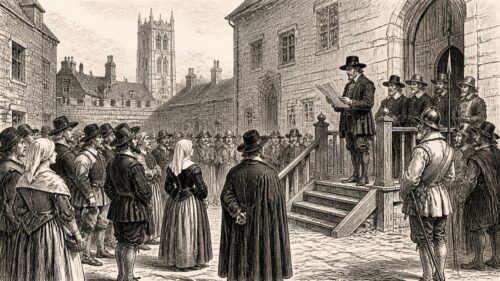
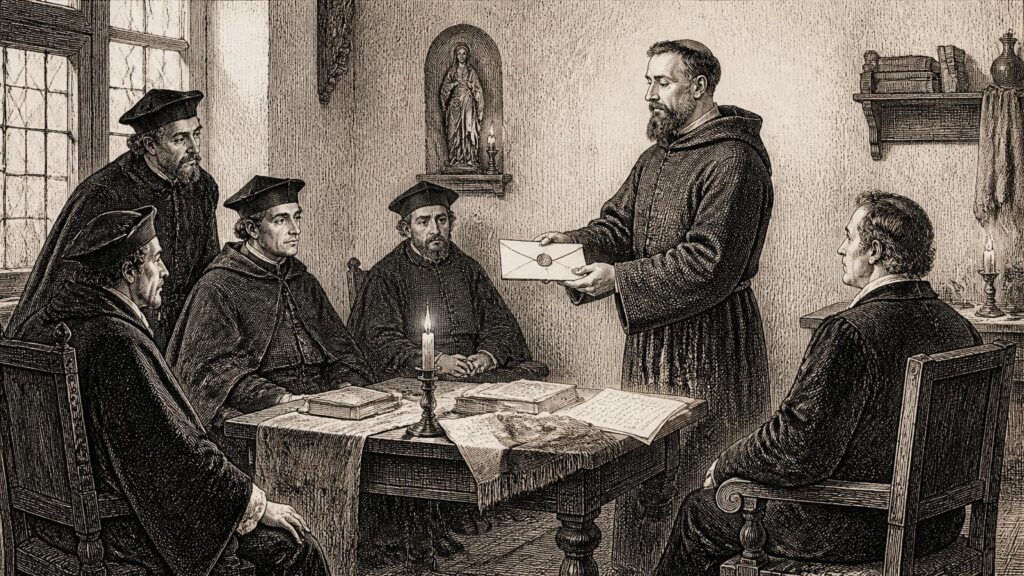
In early April Taaffe convened an assembly of Irish clergy. There he displayed what he represented as an authenticated copy of a papal bull dated 20 August 1667. The document purported to make him papal commissary and apostolic visitor for Ireland, with unusually wide authority to supervise the clergy. It was a forgery. At the time, however, its claim was accepted with reluctance after Patrick Plunkett, Catholic bishop of Ardagh, examined the copy and affirmed its authenticity. The episode should not be mistaken for evidence that Irish clergy were gullible or politically passive. Rather, it demonstrates the difficulty of verifying Roman authority across a kingdom where Catholic institutions operated without official standing, communications were slow, and factional rivalry was acute.
A Forged Bull in Action
Taaffe acted quickly. On 9 May he issued a decree in Dublin designed to regulate disputes between secular clergy and members of religious orders. Four days later, on 13 May, he appointed visitors for dioceses across Ireland. Their stated work was administrative: settling conflicts, enforcing the new decree and levying a contribution from clergy to meet Taaffe’s expenses and finance intended journeys to London and Rome. Their selection also had a political edge. Many were associated with the remonstrant party, and opponents complained that the visitors used their supposed powers to remove adversaries, challenge local authority and excommunicate those who resisted.
This was a contest over the shape of Irish Catholic survival. The secular clergy, attached to dioceses and parishes, and the regular orders, especially Franciscans, had overlapping claims to pastoral authority and access to scarce resources. Bishops, friars, gentry patrons and congregations all had interests in who could minister, collect funds or speak for the church. Taaffe’s initiative did not create these tensions, but gave them a new and explosive form. A commissioner sent in the pope’s name could have rearranged influence throughout the island. That possibility explains both the initial seriousness with which his claims were treated and the speed of the reaction once Rome’s true view became known.
By the middle of October, Taaffe’s position had collapsed. Clerics received communications from Rome repudiating his pretensions, and Plunkett confronted him in Dublin. In the same month the arrest of one of Taaffe’s visitors, Ronan Maginn, for exercising papal jurisdiction brought the affair to wider Protestant notice. The danger to Taaffe was now political as well as ecclesiastical: public alarm made it much harder for the lord lieutenant or the king to appear accommodating. On 17 October Taaffe wrote to Rome, admitted that he had forged the bull and agreed to stop claiming to be papal commissary. He did not leave Dublin until 1669, but the decisive unravelling belongs firmly to 1668.
Ormond, Orrery and Uneasy Authority
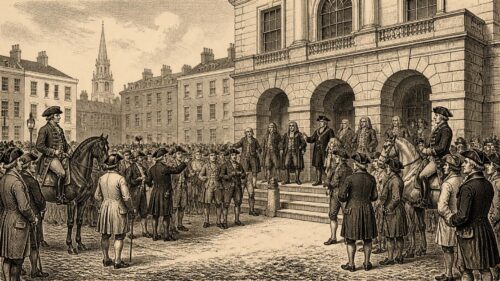
The Taaffe affair occurred while the structure of Restoration government was under strain. Ormond governed from Dublin Castle as the king’s lord lieutenant, but his position depended on confidence at court and cooperation from powerful men in Ireland. During 1668 he faced attacks and manoeuvres connected with the shifting politics of Charles II’s court. A hostile parliamentary move against him in England in March failed, but it was a warning that Irish government could be contested in Westminster and Whitehall as well as in Dublin. Correspondence from the year shows Ormond repeatedly consulting his son, Thomas Butler, earl of Ossory, about the insecurity of his position.
His most formidable Irish rival was Orrery. A leading Protestant landowner, soldier, author and political organiser, Orrery had been lord president of Munster since 1660 and had helped shape the Restoration settlement. He possessed extensive patronage, parliamentary followers and military standing. The relationship between the two men had long mixed cooperation with distrust. Their differences became irreconcilable in 1668, and Orrery resigned the Munster presidency during the year. The surviving correspondence allows the conflict to be dated to this period, but does not justify turning it into a single, neatly dated confrontation.
The importance of the quarrel lay in what it revealed. Provincial presidencies, military offices and estate connections gave men such as Orrery a reach that was more than local. Munster’s ports, landed wealth and Protestant plantation communities made its presidency especially valuable. Ormond sought a government directed from Dublin Castle; Orrery represented a powerful regional interest that expected a large share in directing policy. Their dispute did not bring conflict to the streets, but it weakened the coherence of an administration already vulnerable to suspicion at court.
Land, Debt and the Work of Recovery
For many inhabitants, however, the great questions of 1668 were less dramatic than the Taaffe scandal. They concerned rents, titles, debts, tithes, timber, livestock and the uncertain consequences of the land settlement. The Acts of Settlement and Explanation had established the broad terms of post-Cromwellian ownership before 1668, but they could not erase competing memories of confiscation or settle every claim. Protestant soldiers, adventurers and purchasers sought secure possession; restored royalists and a limited number of Catholic claimants sought recognition; tenants faced the practical consequences of whichever proprietor prevailed. The legal settlement was thus an ongoing social process, not a finished event.
Credit networks show the scale of that process. Dublin’s statute staple, a legal mechanism for registering debts, connected merchants, aristocrats, clergy, officials, craftsmen, farmers and women from across Ireland. Post-Restoration transactions remained substantial, even as the average size of bonds rose. This does not mean that prosperity was evenly shared. It does show that rebuilding estates and businesses required credit, paper obligations and personal trust across confessional and regional lines.
A surviving letter of 2 October 1668 from Sir St John Brodrick to Margaret, countess of Orrery, offers a small but valuable glimpse of this material world. Building work on Boyle property at Itermorrogh and Ballymartyr was advancing, but there was a shortage of deal boards. Timber had to be sought in Cork and farther west before winter made transport more difficult; prices were a concern. It is only one estate’s correspondence, and cannot stand for all Ireland. Yet it captures the practical labour behind elite recovery: houses repaired or enlarged, materials purchased on credit, servants and agents dispatched, and seasonal weather shaping decisions.
The Cattle Barrier
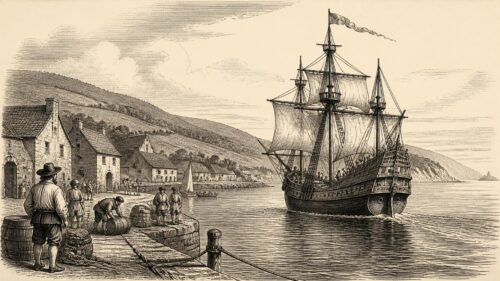
Trade policy made such recovery harder. Ireland’s cattle, sheep and animal products had become central to exports after the Restoration, but English landowners and politicians regarded Irish competition as a threat. The English prohibition on imports of Irish livestock and certain meat products, introduced through the cattle legislation of 1666–67, remained a defining burden in 1668. On 9 May 1668 royal assent was given to an additional English act against the importation of foreign cattle, reinforcing the protectionist framework within which Irish producers had to operate.
The restriction was not merely a quarrel between governments. Cattle had supported farmers, graziers, dealers, shippers, port towns and landlords receiving rent from livestock country. With the English market obstructed and Scotland also restricting Irish imports, producers had fewer dependable outlets. The pressure encouraged efforts to find continental and colonial markets and increased the importance of salted provisions, hides, wool and other alternatives. But adaptation was neither immediate nor painless. The year should therefore be understood as one in which the cattle barrier was an established economic fact, not as the moment when all later patterns of Irish trade were already complete.
Deaths and Inheritance
Two deaths also illuminate the post-war order. On 14 April George Hamilton, fourth Baron Hamilton of Strabane, died at Kenure near Rush, County Dublin, and was buried at St Mechlin’s Church. His young son Claud succeeded to the Strabane title and estates. The Hamilton inheritance linked County Tyrone, Dublin residence and the long aftermath of wartime confiscation: George had regained family lands after the Restoration. His death therefore placed their management in a minor’s hands at a moment when property remained politically sensitive.
Patrick D’Arcy, the Catholic lawyer and former Confederate statesman, also died in Dublin in 1668; the precise date is not securely established. D’Arcy had helped frame the Confederate Catholic government’s constitutional arrangements in the 1640s. After Cromwellian confiscation he had lost land and professional standing, though the Restoration allowed him to resume legal work without restoring his estates. His death closed the life of a man who embodied an older Catholic political class: learned in law, loyal to monarchy in principle, yet deeply marked by the failure to secure a durable Catholic settlement.
Thus 1668 was a year of exposed limits. Taaffe’s counterfeit commission showed that religious authority could not be rebuilt by assertion alone. Ormond’s dispute with Orrery showed that royal government rested on rival networks of power. The cattle barrier showed that Irish recovery remained dependent on decisions made elsewhere. Beneath these high matters, estate letters, debt instruments and inheritance recorded the ordinary work of repair in a country still living with the consequences of war.

Primary Sources
- Taaffe, James
- Boyle, Roger
- The Irish Viceroyalty in the Restoration Period
- The Papal Mission to Ireland of James Taaffe in 1668
- A Collection of the State Letters of the Right Honourable Roger Boyle, The First Earl of Orrery
- Calendar of Orrery Papers
- History of the Commercial and Financial Relations between England and Ireland from the Period of the Restoration
- History of the Commercial and Financial Relations between England and Ireland from the Period of the Restoration, Part 3
- History of the Commercial and Financial Relations between England and Ireland from the Period of the Restoration, Part 8
- Charles II, 1667 & 1668: An Additional Act against the Importation of Forreign Cattel
- The Anglo-Irish Livestock Trade of the Seventeenth Century
- Economic Trends, 1660–91
- The Provision Trade
- The Statute Staple in Early Modern Ireland
- Restoration Dublin in the Ireland of its Time c. 1660–1700
- James Butler, First Duke of Ormond 1610–1688
- Reasons for Repealing the Act against the Importation of Cattle from Ireland
- Sources for Irish Women’s History: Ormonde Papers and Other Seventeenth-Century Collections
- George Hamilton, 4th Baron Hamilton of Strabane
- Patrick D’Arcy