O’Rourke’s Execution1591 CE
In 1591, Tudor authority pressed unevenly upon Gaelic Ireland through military, legal and administrative measures. Brian na Múrtha O’Rourke, lord of West Bréifne, fled to Scotland after invasion, was surrendered to England, tried for treason and executed at Tyburn, demonstrating the crown’s expanding reach. Monaghan’s contested settlement and mass pardons revealed efforts to reorganise lordship and land. Hugh O’Neill’s marriage to Mabel Bagenal intensified Ulster rivalries. Catholic appointments and continental contacts sustained religious networks and official fears of foreign intervention. Annalistic deaths and praise for lords preserved Gaelic values. Although no rebellion began, distrust and dispossession sharpened conditions preceding war.
Dateline
In 1591 Ireland’s political weather was unsettled without yet becoming general war. The Tudor state had extended its reach unevenly through sheriffs, garrisons, grants and legal process, but powerful Gaelic lordships still governed wide territories through kinship, clientage and customary law. The year’s most dramatic Irish event occurred outside Ireland: Brian na Múrtha O’Rourke, lord of West Bréifne, was carried from Scottish refuge to an English courtroom and then to execution at Tyburn. His fate made a formidable warning. It also showed how deeply Irish affairs now involved the neighbouring kingdoms, continental Catholic networks and the institutions of the Elizabethan crown.
West Bréifne’s Fallen Lord
O’Rourke had ruled West Bréifne, centred on much of modern County Leitrim, for a quarter of a century. He was no provincial curiosity. His lordship occupied a strategic corridor between Connacht and Ulster, while his household, fighting men, dependants and alliances gave him real regional importance. He had dealt pragmatically with the crown at times, received knighthood, and then become an increasingly troublesome opponent of royal policy. His support for survivors from the wrecked Spanish Armada and his resistance to the Connacht presidency made him especially suspect in Dublin and London.
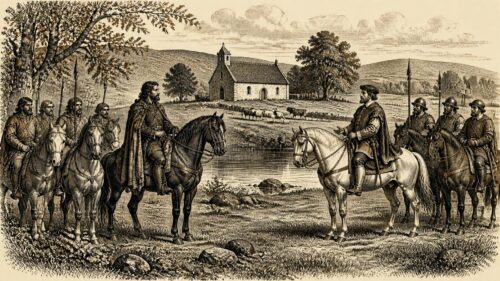
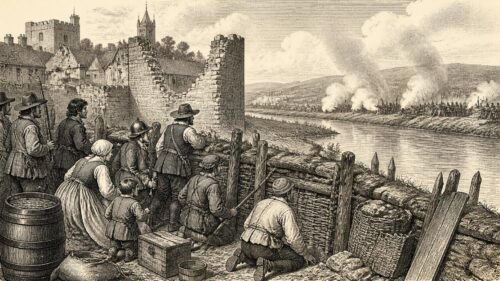
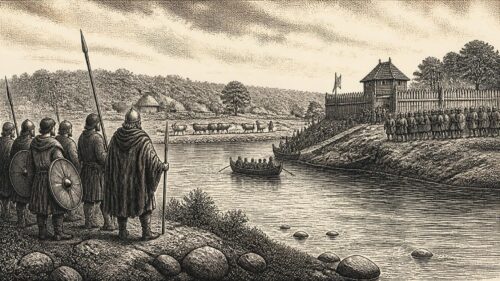
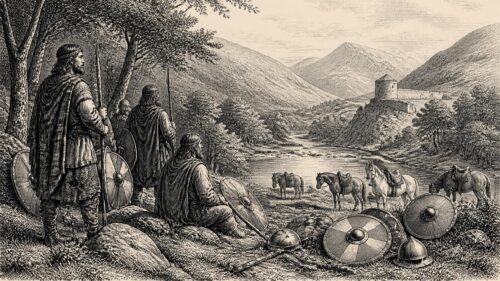
The immediate setting for his downfall lay in the crown’s drive to break or reorder autonomous lordships on Ireland’s western and northern margins. Sir Richard Bingham, president of Connacht, had pressed hard upon O’Rourke’s territory. West Bréifne was invaded in 1590, compelling O’Rourke to seek protection first among allies in Tír Conaill and then, early in 1591, in Scotland. This was not an implausible destination for an Irish lord. The North Channel was a busy political and commercial sea road, travelled by chiefs, mercenaries, clergy, merchants and displaced families. O’Rourke brought horses and dogs intended as gifts for James VI, and hoped for aid or at least asylum.
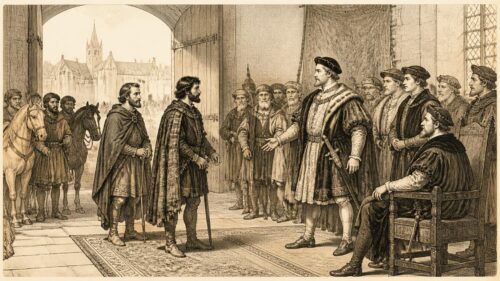
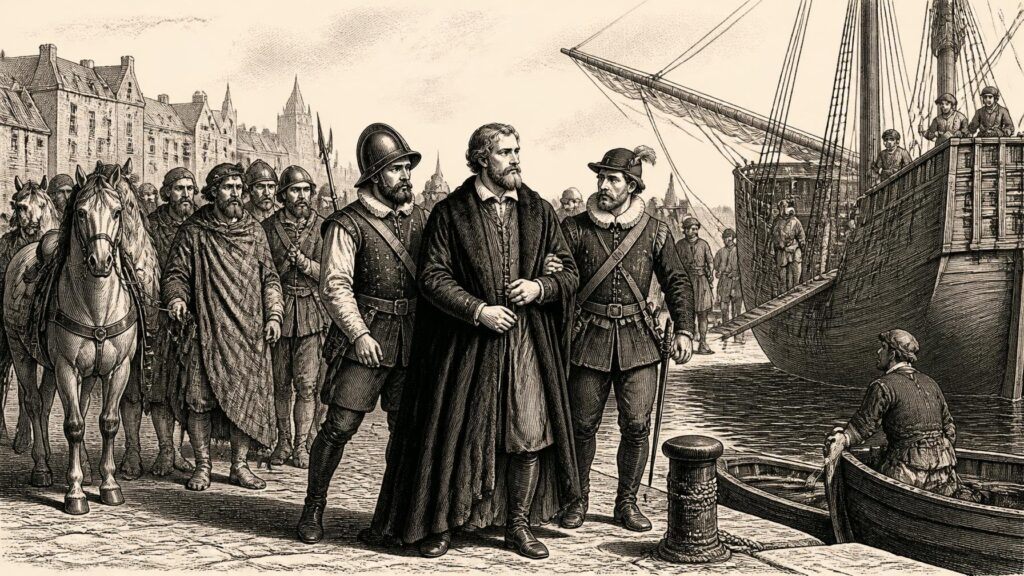
James would not receive him. Elizabeth I’s government demanded his delivery, and Scottish ministers agreed. On 3 April O’Rourke was arrested at Glasgow and handed over to English custody. Contemporary material indicates that the removal provoked serious local disorder. Glasgow had trading connections across the Irish Sea; creditors feared unpaid debts, while Irish adherents resented the seizure. The episode matters because it was more than the personal misfortune of an exile. Scotland’s cooperation denied Irish opponents of the Tudor regime an important refuge and demonstrated that dynastic diplomacy could reach into the affairs of a Gaelic lordship.
O’Rourke was brought to London, arraigned at Westminster on 28 October, and executed at Tyburn on 3 November. The legal case was politically charged. He was prosecuted for treasonable acts in Ireland, including dealings with Spaniards and alleged offences against the queen’s authority. The indictment was translated into Irish for him, an unusually revealing detail: the English court was trying a man who stood at the meeting-point of two languages, two legal cultures and rival understandings of lordship. His conviction and the full traitor’s punishment followed swiftly. The Annals of the Four Masters, written from a later Gaelic learned perspective, remembered his death as a great calamity for the Irish, praising his generosity, hospitality and support for poets, churchmen and men of learning.
A Warning in Law and Land
The execution did not instantly settle West Bréifne. O’Rourke’s son Brian Óg succeeded to the family leadership and the struggle over the lordship continued. Yet the removal of Brian na Múrtha weakened a political household whose authority had depended on its ability to protect followers, reward clients and defend its country. In Gaelic Ireland, the death or displacement of a lord could unsettle not only a ruling family but tenants, military retainers, ecclesiastical dependants and learned families attached to it.
For the crown, such cases offered a different lesson. Government did not rely upon battlefield victories alone. It combined military pressure with indictments, pardons, land grants and the creation of shire institutions. The surviving Irish chancery records for 1591 include a remarkably long pardon for named MacMahon, O’Reilly, MacDonnell and other inhabitants of Monaghan. Its dense roll of personal names and townlands gives a glimpse of a society the administration wished to bind to royal authority person by person. Pardon was both a route back into favour and an assertion that the crown could define rebellion, obedience and lawful possession.
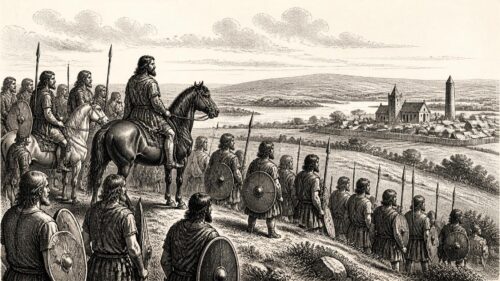
Monaghan was especially sensitive. Hugh Roe MacMahon, its lord, had been executed in 1590 after conflict with the government over exactions and authority. His lordship was then partitioned; church lands were assigned to English servitors, a garrison was planted at Monaghan town, and English common law and shire administration were advanced. These were developments of 1590 rather than new measures securely dated to 1591, but their consequences were central to the following year. They suggested to neighbouring lords that a comparable transformation might be imposed upon their own countries. The mass pardon of 1591 should therefore be read not as proof of peace, but as evidence of the effort required to make the settlement work.
Marriage at Drumcondra
Another firmly dated event of 1591 joined private life to high politics. On 3 August Hugh O’Neill, earl of Tyrone, married Mabel Bagenal at Drumcondra, near Dublin. Mabel was the sister of Sir Henry Bagenal, marshal of the army in Ireland and a leading crown officer in Ulster. O’Neill had sought Henry’s consent and been refused. Mabel was taken from Turvey to the house of Sir William Warren at Drumcondra, where Thomas Jones, the Protestant bishop of Meath, performed the ceremony after satisfying himself of her consent.
The marriage has often been retold as romance, but its political implications were immediate. O’Neill was a Gaelic lord who also held an English earldom and had long proved adept at working within crown structures while extending his own power. A marriage recognised according to English law could have strengthened his connection with an influential Newry-based military family. Instead it inflamed the hostility between Tyrone and his new brother-in-law. Henry Bagenal saw the match not as reconciliation but as an affront and a danger. O’Neill, meanwhile, had reason to fear the growth of Bagenal’s authority in an Ulster being subjected to garrisons, commissions and reforming schemes.
The episode also illuminates the layered identities of late Elizabethan Ireland. The officiant was a bishop of the established church; the groom was associated with the Catholic political world of Ulster; the bride came from an English military family settled at Newry; and the marriage took place in a gentleman’s house close to Dublin. No simple division between ‘English’ and ‘Irish’ explains this world. Family interest, law, confession, place, language and military power overlapped constantly. Yet the marriage did not erase political rivalry. It sharpened it.
Churches, Exile and Catholic Connection
Religion was likewise lived through competing institutions rather than neat territorial blocks. On 20 March, Seamus Ó hÉilidhe, known in English as James O’Hely, was appointed Roman Catholic archbishop of Tuam by the Holy See. His appointment affirmed the continuity of a Catholic hierarchy operating despite the Elizabethan religious settlement and despite the difficulty of exercising authority openly. The western province contained towns, lordships and parishes in which official ecclesiastical arrangements, local custom and Catholic allegiance did not necessarily coincide.
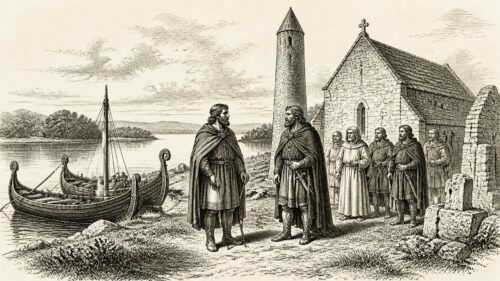
Outside Ireland, Edmund MacGauran, Catholic archbishop of Armagh, was active in Iberian and European networks during this period. His travels and negotiations were part of a wider search for money, arms and intervention on behalf of Irish Catholic interests. It would be wrong to treat this as evidence that a united rising already existed in 1591: the major war conventionally called the Nine Years’ War did not begin until 1593. But clerical movement between Ireland, Spain, Portugal, Rome and the Low Countries linked local grievances to a larger Catholic and Habsburg world.
That connection haunted official thinking. The Armada’s wrecks had left weapons, survivors and memories along Ireland’s coasts; O’Rourke’s assistance to Spaniards remained part of the case constructed against him. In government eyes, Catholic loyalty, foreign invasion and Gaelic resistance could appear inseparable. In reality, Irish responses were varied. Lords calculated local advantage, towns guarded trade, clergy maintained religious communities where they could, and ordinary households navigated demands from landlords, soldiers, churchmen and officials.
Losses Recorded at Home
The annals preserve a quieter register of 1591. They record deaths among the O’Brien and MacMahon kindreds, including Murchadh O’Brien on 25 February and Donnchadh O’Brien on 8 February. They also note violent deaths among branches of the de Burghs and MacDonnells. Such notices are fragments rather than a complete social survey, but they remind us that succession, feud and household violence continued alongside great affairs of state.
Most striking is the obituary for Turlough Roe O’Boyle, who died at his camp around St Brigid’s feast and was buried with honour at Donegal. The annalist described him as a patron of poets and pilgrims, a defender of church and learning, and a generous protector of poor and weak people. Such language was conventional praise, but it identifies values expected of a successful lord: open-handed hospitality, cultural patronage, religious protection and care for dependants. War and government papers dominate the surviving archive; the annals preserve another measure of public standing.
By the end of 1591, no island-wide rebellion had broken out. Nevertheless, the year had tightened the threads from which conflict would soon be woven. O’Rourke’s death showed the reach and severity of Tudor power. The Monaghan settlement made neighbouring lords fear further dispossession. O’Neill’s marriage turned a possible alliance into a bitter feud. Catholic appointments and overseas contacts sustained hopes and suspicions beyond the state’s control. Ireland entered 1592 with its political order still intact, but with trust between crown and many northern and western powers markedly diminished.
Source References
Hover over a number to see the source. Select it to open the source.

- [1] Annals of the Four Masters: Annal M1591
- [2] Annals of the Four Masters: Edition Information
- [3] Calendar of the State Papers Relating to Ireland, Volume 4: August 1588–September 1592
- [4] Calendar of the State Papers Relating to Ireland, Volume 4, Internet Archive copy
- [5] State Papers Ireland, 1509–1782
- [6] O’Rourke, Brian na Múrtha
- [7] O’Rourke (Ó Ruairc), Brian Ballach
- [8] O’Neill, Hugh
- [9] Bagenal (Bagnal(l)), Sir Henry
- [10] Magauran, Edmund
- [11] Fiant: 33 Eliz I (1590–1591), Item 5603
- [12] Calendar of State Papers Relating to Scotland: Scottish Series, 1589–1603
- [13] Calendar of State Papers Relating to Scotland: Internet Archive copy
- [14] State Papers Foreign, 1509–1782
- [15] British History Online: Institute of Historical Research Digital Collection
- [16] Tuam Archdiocese
- [17] Tuam: Irish Historic Towns Atlas Text
- [18] Parke’s Castle
- [19] The Parish of Clonturk
- [20] The Elizabethan Court Day by Day: Irish and Scots
- [21] Texts Beginning with C: Calendar of State Papers Relating to Ireland
- [22] Hugh O’Donnell, McHugh Dubh (Aodh Ó Domhnaill)
Primary Sources
- Annals of the Four Masters: Annal M1591
- Annals of the Four Masters: Edition Information
- Calendar of the State Papers Relating to Ireland, Volume 4: August 1588–September 1592
- Calendar of the State Papers Relating to Ireland, Volume 4, Internet Archive copy
- State Papers Ireland, 1509–1782
- O’Rourke, Brian na Múrtha
- O’Rourke (Ó Ruairc), Brian Ballach
- O’Neill, Hugh
- Bagenal (Bagnal(l)), Sir Henry
- Magauran, Edmund
- Fiant: 33 Eliz I (1590–1591), Item 5603
- Calendar of State Papers Relating to Scotland: Scottish Series, 1589–1603
- Calendar of State Papers Relating to Scotland: Internet Archive copy
- State Papers Foreign, 1509–1782
- British History Online: Institute of Historical Research Digital Collection
- Tuam Archdiocese
- Tuam: Irish Historic Towns Atlas Text
- Parke’s Castle
- The Parish of Clonturk
- The Elizabethan Court Day by Day: Irish and Scots
- Texts Beginning with C: Calendar of State Papers Relating to Ireland
- Hugh O’Donnell, McHugh Dubh (Aodh Ó Domhnaill)