

Cavan Castle Broken1514 CE
Dateline
In 1514 Ireland was not governed from a single centre, nor did political power stop at the edge of the English lordship. The young Gerald FitzGerald, ninth earl of Kildare and the king’s deputy, sought to demonstrate that he had inherited his father’s authority. Yet his forces encountered rival lordships whose leaders could raise their own military followings, command castles, make agreements and settle disputes by hostage-taking, compensation and war. The Irish annals record campaigns in Laois, Breifne, Munster and Ulster; a contemporary churchman writing to England described a country rich in foodstuffs but insecure by land and sea. Taken together, the evidence gives 1514 a striking character: a year of destruction, negotiated order and hard-won displays of lordship.
A New Deputy’s Campaigns
Gerald Óg had succeeded his father, Gearóid Mór, in September 1513 and had been confirmed as lord deputy by Henry VIII that November. This distinction matters because one later annalistic entry places the elder earl’s death under 1514. Other contemporary annalistic evidence, modern scholarship and the dating in official records put Gearóid Mór’s death in September 1513. Thus the military activity recorded in 1514 belongs to his son, not to a final campaign by the celebrated eighth earl.
The Annals of Ulster and the Annals of Loch Cé first place Kildare in the lands of the O’Mores of Laois. His host demolished the castle of Cuilentragh, cut down the Coill Mór, or great wood, and pillaged the surrounding country. This was more than incidental damage. A castle was a defensible residence, storehouse and local centre of authority; woodland supplied fuel, building material, pannage and cover for people and livestock. To break a castle and fell a wood was to make a pointed assault on an opponent’s capacity to endure and recover. The annals also record that the son of Toirdhealbhach Óg Mac Domhnaill, Kildare’s constable of gallowglasses, was killed by the Laois men. Kildare’s success therefore came at a cost and underlines the importance of professional Scottish-derived heavy infantry within magnate armies.
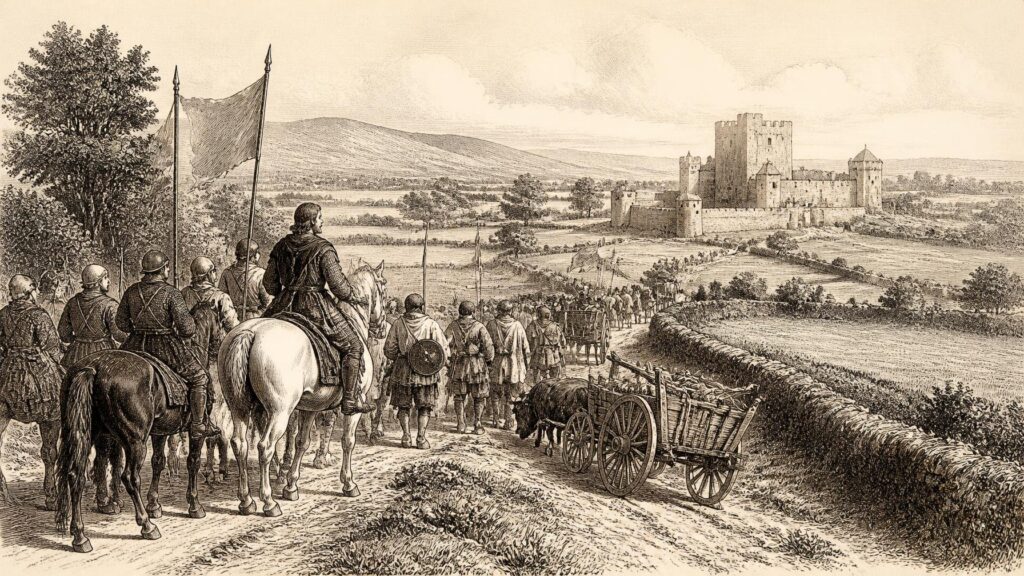
The deputy next projected force north-westwards into East Breifne, the O’Reilly lordship centred on Cavan. The Annals of Ulster date this expedition more closely than most events of the year: it took place shortly before Lammas, 1 August. Kildare’s host broke down Cavan castle and defeated Aodh O’Reilly, son of Cathal. Aodh, his brother Philip, a son of Philip and numerous leading members of the Muintir Raghallaigh were killed; the annals specify fourteen nobles and principal men, besides an uncounted number of others. Maine Mac Cabe was captured. Such lists were not merely a tally of casualties. They registered a blow against the kin group from which a lord drew counsellors, military captains, marriage alliances and claims to rule.
It would be misleading, however, to call this straightforward royal conquest. Kildare was simultaneously an English crown officer and a great Irish magnate, exercising power through his own retainers, family connections and negotiated overlordship. The defeat of Aodh O’Reilly strengthened Kildare’s position over Breifne, but did not turn the region into a securely administered county. Eóghan Ruadh O’Reilly succeeded his brother, and the O’Reilly lordship continued. The campaign displayed hierarchy; it did not abolish local political life.
Fire and Rivalry in Munster
Munster likewise shows a political landscape shaped by competing affinities rather than by neat provincial blocs. James, son of Maurice FitzGerald, earl of Desmond, joined O’Carroll in an attack on Piers Butler. They burned Trian-Mheánach completely. Piers came after them with his host, accompanied by the sons of Thomas FitzGerald and by gallowglasses and mounted troops belonging to Kildare; nevertheless, the raiders withdrew safely. The brief entry conveys the limits of a pursuer’s advantage in a country where mobile forces could burn, take cattle and disperse before a larger army could compel a battle.
Kildare himself entered Munster and burned Uí Chonaill, the territory associated with James of Desmond. James assembled his full muster, while Toirdhealbhach O’Brien of Thomond came with the leading men of his district to support him. No pitched battle followed: Kildare withdrew successfully before the opposing hosts met. This was not an empty outcome. Mustering allies, threatening an invasion and compelling an enemy to calculate the risks of engagement were central acts of government in a world where permanent armies and regular state finance were slight. But it also reveals why the deputy’s authority depended on continual movement and repeated demonstrations of strength.
Ulster’s War and Settlement
The year’s most important diplomatic settlement was made far from Dublin. Aodh Dubh O’Donnell of Tír Chonaill captured and destroyed Coleraine castle after Domhnall O’Catháin breached a guarantee. He then raided Gailenga, burning and plundering as far as Cruachan Gailenga. These attacks were part punishment, part resource-taking and part declaration that an agreement backed by a lord’s honour could have serious consequences when broken.
At the same time, O’Donnell and Art Óg O’Neill of Tír Eógain prepared for a larger confrontation. The annals say that both sides hired many men and remained encamped opposite one another for a long period. Earlier in the year Art had defeated rival O’Neill factions, taking horses, armour and prisoners or captives, and thereby established an undisputed lordship in Tír Eógain. Yet war gave way to settlement. Through the counsel of leading people, O’Donnell and O’Neill met on the bridge at Ardstraw, made peace and entered into spiritual kinship, described as ‘gossipred’.
The agreement had practical as well as ceremonial content. O’Neill granted new charters and confirmed older ones concerning Cenél Moen, Inishowen and Fermanagh in O’Donnell’s favour. O’Donnell, in return, released Niall Óg O’Neill, who had long been held as a pledge for fidelity. The exchange shows that written instruments, public ritual and hostages could work together in Gaelic diplomacy. A hostage was not simply a prisoner: his person guaranteed a relationship between ruling families. Peace did not make the northern lordships subordinate to Kildare or to the English crown; rather, it arranged their relations on terms recognised by their own political order.
O’Donnell also had vessels drawn onto Lough Erne and stayed for a considerable time on Inishkeen. From this lake-borne base his forces harried and burned an island, then made peace with the people of Fermanagh after imposing his authority. The entry is a useful corrective to any picture of inland Ireland as cut off from water transport. Loughs, rivers, coasts and islands were strategic routes, while long ships and boats enabled a lord to bring armed men and supplies into places difficult to reach by road.
Church, Learning and Everyday Resources
The annals note deaths that point to the institutions sustaining local communities. Patrick Ó Duibhleacháin, abbot of Kells, and Aodh mac Giolla Chríost Ó Fiaich, vicar of Ardstraw, died during the year. They are brief notices, but they attest to clerical offices embedded in major ecclesiastical landscapes. The death of Tadhg Ó Dálaigh of Corcomroe is more revealing still: he was remembered as an oide lé dán, a teacher of poetry, and as a generous host. Learned families preserved legal, genealogical and literary knowledge, while hospitality remained a measure of status and an obligation of lordship. Warfare and learning existed in the same society, not in separate worlds.
A letter of 7 June from John Kite, archbishop of Armagh, to Thomas Wolsey provides an English official’s sharply partisan view of conditions. Kite called Ireland ill ordered, but also described it as plentiful in corn, cattle, fish and fowl. He had hired a Chester ship carrying ordnance and men of war, which he said had helped protect the coast; he reported a hard fight near Dublin against Breton pirates, and stated that Drogheda had manned and victualled vessels in response. His language was designed to urge intervention from England, so it cannot be treated as a neutral survey. Even so, it illuminates everyday foundations of power in 1514: grain and livestock, fishing and provisioning, port towns capable of supplying ships, Irish Sea links with Chester, and the persistent danger that piracy posed to commerce and communication.
A Year of Contested Authority
What happened in 1514 was not the beginning of a new Tudor system, nor an uncomplicated continuation of medieval politics. Kildare’s destruction at Cuilentragh and Cavan advertised the reach of the deputyship, while the losses among his own gallowglasses and the survival of the O’Reilly lordship exposed its limits. In Munster, rival earls and regional lords mobilised without a decisive encounter. In Ulster, O’Donnell and O’Neill combined raiding with a carefully structured peace at Ardstraw. Along the coast, merchants, townsmen, clerics and sailors confronted the hazards of the Irish Sea. The year is best understood not as a single national story, but as a connected series of contests over castles, woods, cattle, waterways, written rights and human pledges.
Primary Sources
- The Annals of Ulster, Year U1514
- Annals of the Four Masters, Part 2: M1514
- Annals of the Four Masters
- Annals of Loch Cé, Year LC1514
- Annála Connacht, Year 1513
- The Annals of Ulster, Year U1513
- State Papers, Ireland 1509–1547 (SP 60/1–12)
- FitzGerald, Gerald (Gearóid Óg, Garrett McAlison)
- FitzGerald, Gerald (Gearóid Mór)
- O'Donnell (Ó Domhnaill), Sir Aodh Dubh
- O'Reilly (Ó Raghallaigh), Cathal
- Butler, Piers (‘Piers Ruadh’)
- Fitzgerald, Maurice fitz Thomas
- O'Neill (Ó Néill), Aodh
- The Hegemony of the Earls of Kildare, 1494–1520
- English Lordship of Ireland and the Irish Sea World: Re-assessing the Origins of the Kildare Ascendancy, c.1390–c.1513
- The Red Book of the Earls of Kildare
- Annals of the Kingdom of Ireland, Volume V
- The Geraldines and Medieval Ireland
- Tudor Re-Conquest in County Kildare