Croghan Succession1490 CE
In 1490, Ireland’s fragmented political order was shaped by local warfare, disputed succession and negotiated authority. Feidhlimidh Fionn Ó Conchobhair Ruadh defeated rival kinsmen near Croghan before dying, prompting Ruaidhrí’s election and further instability in Connacht. Raids, cattle seizures and crop destruction burdened communities. In Ulster, Ó Néill factions fought over castles, Aodh Óg Ó Domhnaill seized Ballyshannon, and Conn Ó Néill and Aodh Ruadh Ó Domhnaill maintained an armed stalemate. Henry VII summoned Kildare, whose indispensability reflected Dublin’s limited reach. Papal appointments, learned deaths, maritime links and a cautiously reported earthquake reveal an interconnected, unsettled society across the island.
Dateline
In 1490 Ireland was not governed from a single political centre. Henry VII was lord of Ireland, and Gerald FitzGerald, eighth earl of Kildare, exercised the office of deputy governor; yet the reach of Dublin government was limited and negotiated. Across much of the island, Gaelic and Gaelicised lordships controlled land, people, castles and military followings. The annals for this year are especially rich in Connacht and Ulster. They record a sequence of raids, contested successions, killings and captivities which show politics being conducted at local level, but with consequences reaching far beyond individual territories.
The year’s most consequential western development was the death of Feidhlimidh Fionn Ó Conchobhair Ruadh, lord of the O’Connor Roes. The Annals of the Four Masters place his death on Easter Monday, in the house of the MacGeraghtys, and say that he was buried at Roscommon, the ancestral burial place of his line. This was not merely the passing of a regional chief. Feidhlimidh had, after years of factional struggle, established himself as the undisputed head of the O’Connor Roe kindred. The same annals call him a man whose name had spread terror through surrounding territories and whom the Síol Muireadhaigh expected might one day unite Connacht.
Feidhlimidh Fionn’s Last Campaign
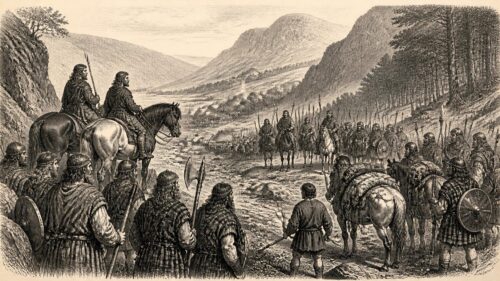
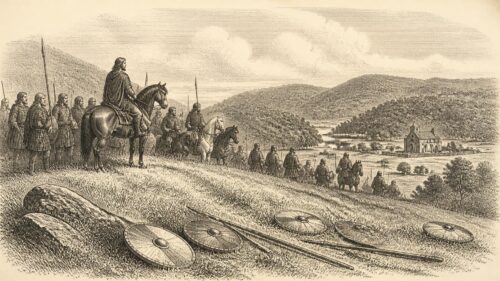
His death followed an active and violent opening to the year. Feidhlimidh raided opponents in Uí Maine, including the country around Turlach-na-mBruigheol, Muine Fraechnat, Druim Turlach and Cluain Gamhnach. His rivals, including the sons of Ruaidhrí and other kinsmen hostile to him, gathered gallowglasses and met his force on the plain of Croghan. The chronicler presents the encounter as an exceptionally bitter family battle: men faced one another who had killed each other’s fathers and relatives. Feidhlimidh prevailed. Tomaltach Mac Dermot, tánaiste of Moylurg, and Cormac, son of Tadhg and grandson of Ruaidhrí Buidhe, were killed; Donnchadh Mac Dowell and a number of gallowglasses and kerns were captured.
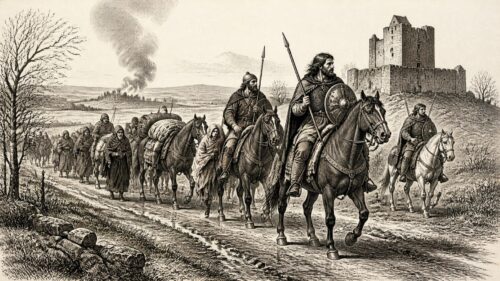
The account is a reminder that lordship depended on more than inherited title. It required the ability to assemble allies, retain professional soldiers, punish challengers and seize livestock. Cattle were movable wealth, food, tribute and political leverage. Raiding therefore affected far more than warriors: it disrupted herds, household supplies and the labour of tenants and dependants. Later in the same year the descendants of Tadhg Ó Conchobhair entered Moylurg with their cattle, cut the standing corn for their own use and drove inhabitants away. Such notices give a rare view of the immediate burden of aristocratic conflict on farming communities.
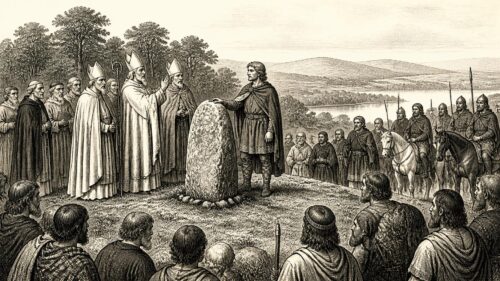
Feidhlimidh’s burial did not settle the question of power. Ruaidhrí, son of Feidhlimidh, was elected in his place during 1490. That election followed the Gaelic principle that leadership could pass among eligible adult males of a ruling kindred rather than automatically to the eldest son. It also guaranteed that a death could reopen rival claims. Tadhg Buidhe, Feidhlimidh’s nephew, appears to have advanced a claim without success, while Feidhlimidh’s sons retained strong interests. The year’s fighting among branches of the O’Connors, Mac Dermots and their allies was thus not background disorder: it was the practical, destructive process through which authority was negotiated.
Castles, Cattle and the Northern Stand-Off
Ulster was no calmer. On 7 May, according to the Annals of Ulster, Feidhlimidh, grandson of Aodh Buidhe Ó Néill, captured and demolished the castle of Éadan-dubh-Cairrge, held by Niall, son of Conn, son of Aodh Buidhe. The seizure of a castle mattered because such places were bases for storing supplies, sheltering retainers and asserting control over a district. The annals add that Feidhlimidh raided the sons of Conn and killed Godfrey Ó Maolcraoibhe. This was a conflict within the broader Ó Néill world, not a simple contest between supposedly separate ‘Irish’ and ‘English’ zones.
Another dispute exposed a generational fracture within the O’Donnell lordship of Tír Chonaill. Aodh Óg, later known as Aodh Dubh, seized Ballyshannon castle from his father, Aodh Ruadh Ó Domhnaill, and from his senior half-brother Conn, who was expected to succeed. The Four Masters report that, shortly before Christmas, Aodh Óg plundered the sons of Donnchadh Maguire and drove off 400 cows to Ballyshannon, where they were slaughtered. The castle warders had surrendered the place to him without consulting Aodh Ruadh. The episode demonstrates both the strategic value of Ballyshannon, at the Erne estuary, and the fragility of paternal authority when a fortress, its garrison and access to local resources could be won by a rival son.
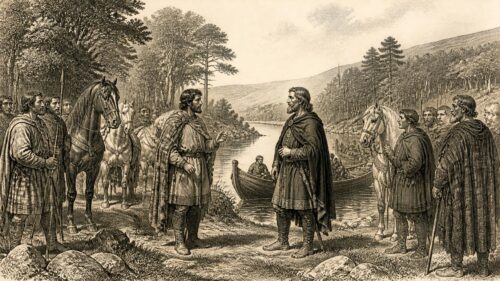
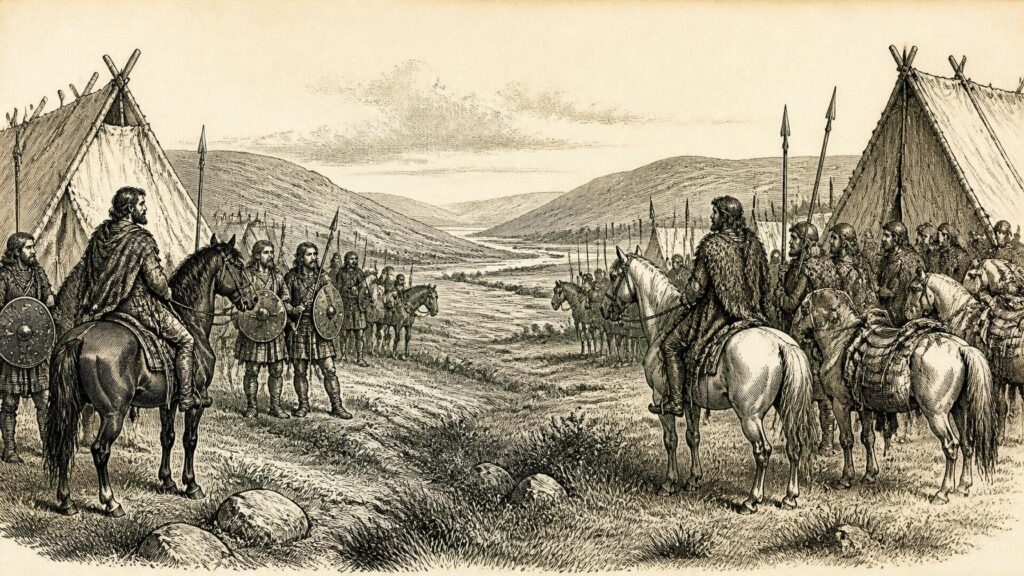
The year ended with an uneasy confrontation between Conn Ó Néill of Tír Eoghain and Aodh Ruadh Ó Domhnaill. From All Saints’ Day until Christmas, their camps faced one another: Ó Néill at Cairrgin and Ó Domhnaill at Druim Bó. The Annals of Ulster are strikingly exact about the condition: there was neither peace nor truce, but neither was there battle. This was armed diplomacy in its most precarious form. Each leader displayed strength, protected his followers and waited to see whether the other would yield, withdraw or receive reinforcements. The stand-off foreshadowed renewed conflict, but it should not be inflated into a battle which the sources explicitly say did not occur.
Connections across the North Channel remained important. In June John Ó Catháin was seized by a ship from Inveraray in Argyll, while the annals also report the killing at Inverness of Aonghus, son of the MacDonald lord of the Isles, by an Irish harper, Diarmait Ó Cairbre. These were not routine Irish events, but they reveal the close maritime and political world shared by Ulster, western Scotland and the Hebrides. Ships could carry traders, warriors, envoys or captives; coastal rulers had to reckon with power arriving from, or escaping by, sea.
Kildare and the King’s Unease
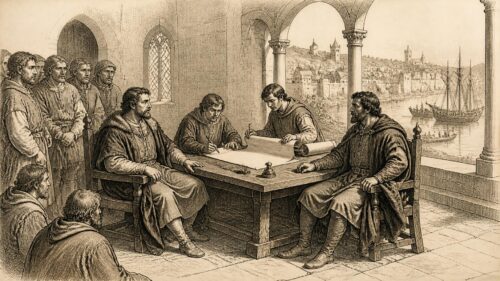
In the lordship centred on Dublin, the relationship between Kildare and Henry VII entered a more uneasy phase. In July 1490 the king summoned Kildare to court. The earl did not answer until June 1491, when he pleaded that he could not leave Ireland because defence required his presence. Leading Irish peers, including Nicholas St Lawrence, baron of Howth, supported the view that Kildare was necessary in Ireland. This was a significant assertion of local political reality. The Crown still distrusted Kildare after his former support for the Yorkist pretender Lambert Simnel, but it lacked an easy substitute for a magnate whose connections, armed following and experience underpinned government in and around the Pale.
That tension was not resolved in 1490. It is therefore misleading to treat later Tudor measures as if they already governed the year. Poynings’ Law, for example, lay four years in the future. What can responsibly be said is that Kildare’s position rested on a difficult balance: loyalty to Henry VII, authority within the English lordship, and the practical need to deal with neighbouring Irish rulers. The northern stalemate and the west’s shifting alliances were part of the setting in which his claimed indispensability made sense.
Church Office and Learned Society
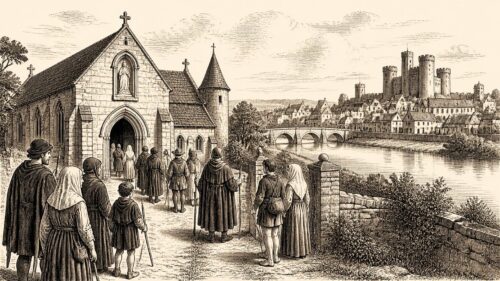
A firmly dated ecclesiastical development occurred in Rome on 21 April. Pope Innocent VIII confirmed the position of Tadhg Mac Cárthaigh, better known as Thaddeus McCarthy, by recognising Hugh O’Driscoll as bishop of Ross but appointing McCarthy to the united bishopric of Cork and Cloyne following William Roche’s resignation. The decision ended one jurisdictional dispute only to place McCarthy amid another. Gerald FitzGerald already held the see’s temporal position, and the powerful earl of Desmond supported him. McCarthy’s appointment thus illustrates that papal provision did not by itself guarantee possession, income or obedience in Ireland. Episcopal office joined spiritual authority to local family power, urban interests and control of church property.
The annals also preserve glimpses of a learned society sustained by churches, schools and aristocratic patronage. Matthew Mac Conaing, vicar of Abbeylara, a canon of Drumlane, and Fergus Ó hEoghain, an anchorite of Inishkeen, were among clerics recorded as dying in the year. John Ó Dálaigh of Breifne, described as a professor of bardic learning, died on 18 October. John Ó hUiginn, called chief poet of Ireland, and Finn Ó hEachthighearna, chief tympanist of Ireland, also died. Such titles point to recognised hierarchies within professional learned and musical communities. Their work in genealogy, praise poetry, history, law and performance served courts and households, preserving claims, reputation and memory.
One of the year’s most revealing personal notices concerns Margaret, wife of Thomas Ó Raghallaigh. The Annals of Ulster describe her as learned in Latin, English and Irish before reporting that she was killed on 4 May by Thomas’s son. The notice does not make her exceptional learning typical of all women, nor does it explain the circumstances of the killing. But it securely demonstrates that multilingual literacy could be publicly acknowledged and valued in a late medieval Irish elite household.
A Cautious Record of Disaster
The Four Masters alone place an earthquake at Sliabh Gamh in 1490, saying that about one hundred people, as well as horses and cattle, perished, that foul fish were cast up, and that a lake formed. The report is vivid but uncorroborated by the other principal annals consulted for this year. It should therefore be treated as a later annalistic tradition rather than as securely measurable evidence for casualties or landscape change. Even so, its preservation shows how environmental shocks could be interpreted as events worthy of record alongside lordly deaths, raids and ecclesiastical appointments.
1490 was consequently a year of sharply local incidents with wider meaning. A leading Connacht lord died after victory over his own kin; rival houses damaged crops and displaced people; northern dynasties confronted one another without battle; a papal appointment exposed the limits of distant authority; and learned men and women appear briefly in the record. Ireland’s political map remained plural, connected by warfare, marriage, ships, churches, cattle and patronage. The year did not produce a single national turning point, but it vividly reveals the unstable foundations on which power rested.
Source References
Hover over a number to see the source. Select it to open the source.

- [1] The Annals of Ulster, Year U1490
- [2] Annals of the Four Masters, Volume 4 English Translation
- [3] Annals of the Four Masters, Irish Text, Part 12
- [4] Annála Connacht
- [5] FitzGerald, Gerald (Gearóid Mór)
- [6] O'Neill (Ó Néill), Conn
- [7] O'Connor Roe (Ó Conchobhair Ruadh), Feidhlimidh Fionn
- [8] O'Connor Roe (Ó Conchobhair Ruadh), Tadhg Buidhe
- [9] O'Donnell (Ó Domhnaill), Sir Aodh Dubh
- [10] O'Donnell (Ó Domhnaill), Aodh Ruadh
- [11] MacCarthy, Blessed Thaddeus (Mac Carthaigh, Tadhg, Thady)
- [12] O'Neill (Ó Néill), Niall Mór
- [13] O'Neill (Ó Néill), Conn ‘Bacach’
- [14] Blessed Thaddeus McCarthy, Bishop of Cork and Cloyne, 1490–1492
- [15] English Lordship of Ireland and the Irish Sea World: Re-assessing the Origins of the Kildare Ascendancy, c.1390–c.1513
- [16] Annals Of Loch Cé Vol II
- [17] Irish Manuscripts Commission: Digital Editions Links
- [18] Irish Manuscripts Commission
- [19] Tudor Re-Conquest in County Kildare
- [20] Comital Rebellion and Rehabilitation in Late Medieval Ireland: The Gaelic Dimension and the Crisis of the 1490s
Primary Sources
- The Annals of Ulster, Year U1490
- Annals of the Four Masters, Volume 4 English Translation
- Annals of the Four Masters, Irish Text, Part 12
- Annála Connacht
- FitzGerald, Gerald (Gearóid Mór)
- O'Neill (Ó Néill), Conn
- O'Connor Roe (Ó Conchobhair Ruadh), Feidhlimidh Fionn
- O'Connor Roe (Ó Conchobhair Ruadh), Tadhg Buidhe
- O'Donnell (Ó Domhnaill), Sir Aodh Dubh
- O'Donnell (Ó Domhnaill), Aodh Ruadh
- MacCarthy, Blessed Thaddeus (Mac Carthaigh, Tadhg, Thady)
- O'Neill (Ó Néill), Niall Mór
- O'Neill (Ó Néill), Conn ‘Bacach’
- Blessed Thaddeus McCarthy, Bishop of Cork and Cloyne, 1490–1492
- English Lordship of Ireland and the Irish Sea World: Re-assessing the Origins of the Kildare Ascendancy, c.1390–c.1513
- Annals Of Loch Cé Vol II
- Irish Manuscripts Commission: Digital Editions Links
- Irish Manuscripts Commission
- Tudor Re-Conquest in County Kildare
- Comital Rebellion and Rehabilitation in Late Medieval Ireland: The Gaelic Dimension and the Crisis of the 1490s