Carbury Captivity1466 CE
In 1466, Conn Ó Conchobhair Fáilghe defeated the lordship’s Meath and Leinster expedition in Uí Fhailí, capturing Deputy Earl Thomas FitzGerald of Desmond before Dublin men rescued him from Carbury. The defeat enabled raids and strengthened Tadhg Ó Briain of Thomond, who extracted concessions from Desmond and Limerick, but died later that year. Warfare also affected Oriel and Connacht, where rival lordships used alliances, hostages, cattle and tribute to maintain power. Plague struck Dublin, Meath and Leinster, while fire damaged Holy Trinity Abbey on Lough Key. Deaths of rulers, clergy and learned men illustrated Ireland’s precarious, locally negotiated political order.
Dateline
In 1466, Ireland’s political geography was made visible in the movement of armies, captives, cattle and tribute. The year’s most dramatic episode came in Uí Fhailí, roughly modern County Offaly, where Conn Ó Conchobhair Fáilghe defeated an expedition drawn from the English lordship’s counties of Meath and Leinster. Thomas FitzGerald, earl of Desmond and deputy in Ireland, was captured and taken towards Carbury Castle. His humiliation was brief, but its consequences were not. It opened space for Tadhg an Chomhaid Ó Briain of Thomond to press demands deep into territories associated with Desmond and Limerick.
The annals also record warfare in Oriel, factional conflict across Connacht, deaths among lords and churchmen, a destructive fire at Holy Trinity Abbey on Lough Key, and a major outbreak described simply as plague in Dublin, Meath and Leinster. These were not separate stories. They show an island in which authority depended upon local alliances, military followings, fortified places, livestock and the ability to compel payments.
The Offaly Rout
The best-attested political event of the year was the defeat of the Meath and Leinster force in Uí Fhailí. The Annals of Connacht state that the ‘Galls’ of Meath and Leinster entered Offaly and that Seán, son of Fitz Thomas, regarded by the annalist as their foremost captain, was killed in an initial skirmish. The following day brought a far more serious reverse: the earl of Desmond was defeated, captured and stripped of his weapons and armour. The Annals of Ulster likewise record a great victory by Conn, son of An Calbach Ó Conchobhair Fáilghe, and stress the number and quality of prisoners taken.
In annalistic usage, terms such as ‘Galls’, ‘Foreigners’ and ‘English’ generally distinguished the political and cultural world of the English lordship from Gaelic lordships; they should not be read as a precise description of every individual in either army. The expedition itself was not a clash between two modern national camps. It involved the deputy, magnates and retainers of the lordship on one side, and the ruling family of Uí Fhailí and its allies on the other, in a contested borderland west of the settled counties.
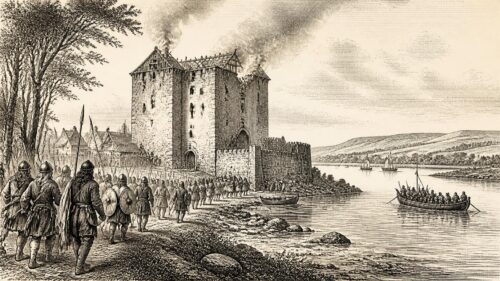
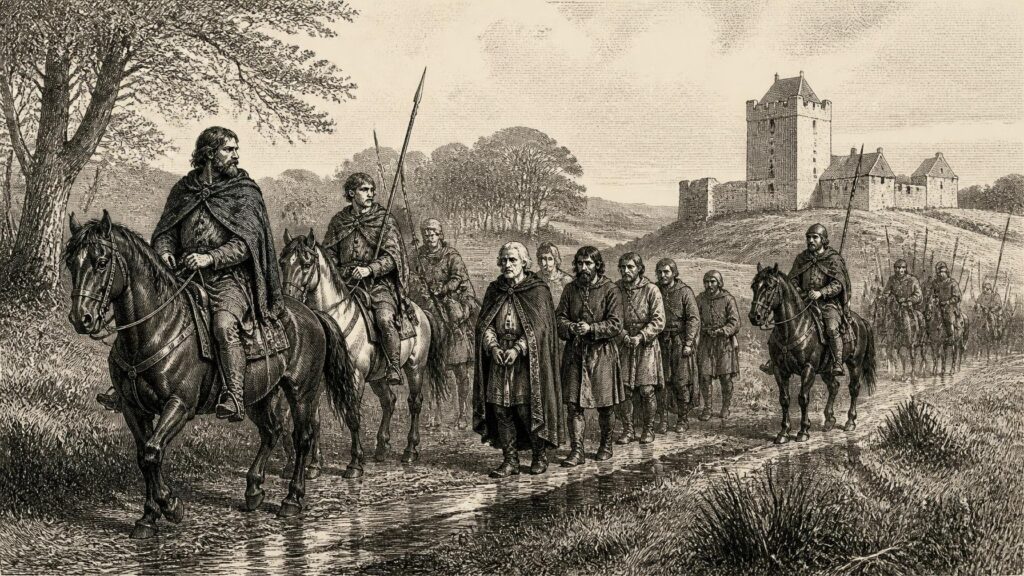
The identity of the captive earl is made explicit by the Connacht annalist: he was Desmond. Tadhg Ó Conchobhair, described as Desmond’s brother-in-law, escorted him and other prisoners to Carbury Castle. Among those captured were Christopher Plunket, William Nugent the younger, a Barnewall, and the prior of St Mary’s, Trim. The presence of a senior religious house’s prior among the prisoners is a reminder that monasteries and priories were entangled in the landed and political society of the lordship, not insulated from its dangers.
Captivity did not settle the matter. Men of Dublin came to the prisoners’ aid and removed them from Carbury despite Ó Conchobhair’s forces. No exact date, battlefield or sequence of negotiations survives in the annals, and it would be wrong to manufacture one. What is clear is that the Dublin community could still organise an armed response beyond its walls, while Conn Ó Conchobhair’s success exposed how vulnerable the lordship’s military power was at its western edge.
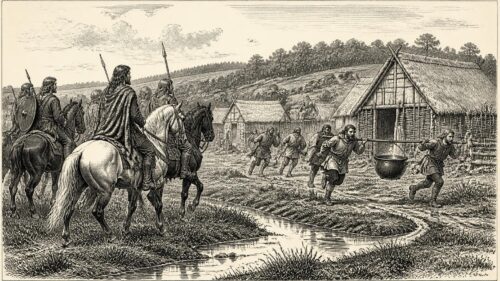
The immediate aftermath was harsh for neighbouring districts. The Annals of Connacht say that raiding parties from Uí Fhailí ranged north to Tara and south to Naas, while men of Bréifne and Oriel burned and plundered in Meath for a time without pursuit. Such notices do not provide a complete map of devastation, but they do reveal the practical meaning of a military defeat: unprotected countryside could be raided, livestock driven away, crops and settlements endangered, and the prestige of local rulers diminished.
Tadhg Ó Briain’s Summer Advance
Desmond’s reverse formed the background to the year’s other great assertion of power. During the summer, Tadhg an Chomhaid Ó Briain, king of Thomond, led an army across the Shannon. The Connacht annalist used deliberately exceptional language, claiming that no comparable muster of his dynasty had been heard of since Brian Boru. That comparison is rhetorical rather than a reliable count of troops, but it conveys the scale and ambition attributed to Tadhg’s expedition.
The annals say that he secured the adherence of Gaelic groups in Munster and Leinster and that some were summoning him towards Tara. This should not be treated as evidence that Tadhg was about to become high king of Ireland. Tara retained powerful symbolic force, and chroniclers could use it to magnify a successful ruler. Yet the report does show that the collapse of Desmond’s expedition gave Tadhg leverage well beyond Thomond.
The concrete gains attributed to him were substantial. Clanwilliam and County Limerick were said to have been surrendered by the earl of Desmond as a price of peace, while the people of Limerick town were to pay sixty marks yearly. Sixty marks equalled £40, a significant annual black rent. The annals present the grant as perpetual, but they do not demonstrate how regularly it was paid thereafter. It is safer to understand it as a recorded political settlement and a public acknowledgement of Tadhg’s temporary superiority, rather than proof of a permanent transfer of government.
Tadhg returned home and died later in 1466 after an illness. One annal preserves the contemporary-sounding claim that he was thought to have suffered from the evil eye; this is evidence for explanation and belief, not a diagnosis. Conchobhar, son of Toirdhealbhach Ó Briain, succeeded him. The sudden death of a ruler at the height of expansion prevented the year’s altered balance in Munster from developing in a straightforward way.
Border Wars and Connacht Feuds
Conflict was not confined to Uí Fhailí and Thomond. Áed, son of Eoghan Ó Néill, inflicted what the Annals of Ulster call a great defeat on the English of the Plain of Oriel. The annal gives neither a precise location nor numbers, but its inclusion alongside the Offaly victory underlines pressure on the lordship’s northern and western approaches. At the same time, the English of Meath defeated the Mac Mahons, taking Áed Óg Mac Mathghamhna and Mac Donnchaidh Domhnaill of Clann Cheallaigh prisoner. Feidhlimidh Mac Mathghamhna, king of Oriel, also died in 1466. The sources do not permit these events to be compressed into one campaign, but together they suggest a region of competing raids, captures and shifting leadership.
Connacht’s politics were equally unsettled. A major coalition in Machaire Connacht rose against Feidhlimidh Finn Ó Conchobhair, forcing him to seek support from Mac Diarmata in the Curlew Mountains and to leave his cattle under that lord’s protection. Cattle were not merely food or movable wealth: they financed households, fed military followers and represented a ruler’s capacity to reward allies. An ensuing hosting by MacWilliam Burke and Feidhlimidh Finn burned Ballintober, while other entries report killings, counter-raids and disputes among branches of the Ó Conchobhair, Mac Diarmata and Ó Dubhda kindreds.
These conflicts should not be mistaken for disorder without rules. Hostages, fosterage, marriage ties, cattle protection and negotiated submissions were the working instruments of power. The alliance between a Connacht lord and a major Burke leader, as well as Tadhg Ó Conchobhair’s relationship to Desmond, demonstrates that kinship and diplomacy crossed the convenient modern categories of ‘Gaelic’ and ‘English’ Ireland.
Plague, Fire and Religious Communities
The Annals of Connacht report ‘a great plague in Dublin, in Meath and in Leinster’. This is firmly placed in the annal for 1466, but the evidence does not identify the disease, give mortality figures or establish how long the outbreak lasted. It should therefore not automatically be labelled bubonic plague. Its geographical spread nevertheless mattered: Dublin, Meath and Leinster included the core districts through which the lordship’s administration, markets and military mobilisation operated. Disease struck in a year already marked by raiding and insecurity.
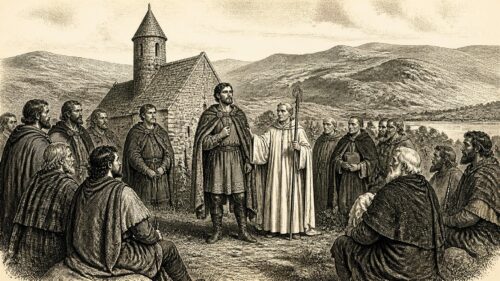
Religious institutions also experienced loss. Brian Maguire, abbot of Lisgool, died on 11 January according to the Annals of Ulster; Domnall Ó Leannáin, a canon of the same community, died on 7 May. Their deaths provide unusually precise dates amid the year’s broader notices. Áine, daughter of Mac Eochagáin and wife of Thomas Maguire junior, died as well, recording the importance of elite marriage in linking lordly families and ecclesiastical landscapes around Fermanagh.
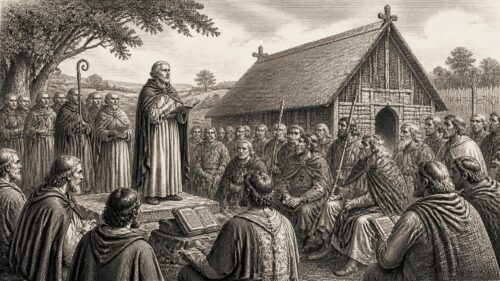
At Holy Trinity Abbey on Trinity Island in Lough Key, the monastery and its image of the Trinity were burned when a lit candle carried by a canon’s wife caused a fire. The annalist’s detail is striking, but it tells us neither the extent of the physical damage nor whether anyone died. Holy Trinity was a Premonstratensian foundation with connections to the literary culture around Lough Key. The loss was therefore more than an architectural mishap: a fire at such a house threatened worship, accommodation, stored goods and, potentially, books and records.
The annals also mark the deaths of figures from learned families, including Fergal Ó Duibhgeannáin of Kilronan, the canon Muirgius Ó Mael Chonaire, and Donnchadh Ó Dálaigh. Their notices are brief, yet they belong to a society in which hereditary learned lineages sustained legal, historical, poetic and ecclesiastical knowledge. Another lord, Tadhg Mac Néill, was remembered for his guest-house. Hospitality was a political duty as well as a social virtue: a ruler’s household had to feed clients, travellers, poets and fighting men.
A Year of Exposed Power
1466 did not produce a single new order. Desmond’s rescue did not erase the shock of his capture; Tadhg Ó Briain’s gains did not survive unchanged after his death; and warfare continued in Oriel and Connacht. But the year demonstrated that power in late medieval Ireland was intensely local, mobile and negotiable. Castles such as Carbury could hold prestigious captives, Dublin could mount a rescue, cattle could secure an alliance, and a town could be compelled to promise annual tribute. Alongside these contests, plague and accidental fire exposed the fragility of ordinary institutional life. The annals leave many silences, but they preserve enough to show 1466 as a year when even the greatest men could be taken, ransomed, outmanoeuvred or suddenly gone.
Source References
Hover over a number to see the source. Select it to open the source.

- [1] Annála Connacht: Annal 1466
- [2] The Annals of Ulster: Year U1466
- [3] CELT Project: Annals of the Four Masters
- [4] O'Brien (Ó Briain), Tadhg an Chomhaid
- [5] FitzGerald, Thomas fitz James
- [6] O'Connor Faly (Ó Conchobhair Failghe), Conn
- [7] O'Connor Faly (Ó Conchobhair Failghe), An Calbach
- [8] FitzGerald, Thomas ‘fitz Maurice’
- [9] The Earldom of Desmond, 1463–1583
- [10] The English Lordship of Ireland and the Irish Sea World: Re-assessing the Origins of the Kildare Ascendancy, c.1390–c.1513
- [11] The Horizons of English Rule: Retreat and Recovery
- [12] Climate, Disease and Society in Late-Medieval Ireland
- [13] Trinity Abbey
- [14] Medieval Lough Cé: History, Archeology and Landscape
- [15] 1991:112 - Holy Trinity Abbey, Trinity Island, Roscommon
- [16] The Medieval Irish Plea Rolls – An Introduction
- [17] A Tract on the Plague
- [18] CELT Project: The Annals of Ulster
- [19] Exploring the Irish Annals
- [20] Ireland
- [21] The Earldom of Desmond, 1463–1583: The Decline and Crisis of a Feudal Lordship
Primary Sources
- Annála Connacht: Annal 1466
- The Annals of Ulster: Year U1466
- CELT Project: Annals of the Four Masters
- O'Brien (Ó Briain), Tadhg an Chomhaid
- FitzGerald, Thomas fitz James
- O'Connor Faly (Ó Conchobhair Failghe), Conn
- O'Connor Faly (Ó Conchobhair Failghe), An Calbach
- FitzGerald, Thomas ‘fitz Maurice’
- The Earldom of Desmond, 1463–1583
- The English Lordship of Ireland and the Irish Sea World: Re-assessing the Origins of the Kildare Ascendancy, c.1390–c.1513
- The Horizons of English Rule: Retreat and Recovery
- Climate, Disease and Society in Late-Medieval Ireland
- Trinity Abbey
- Medieval Lough Cé: History, Archeology and Landscape
- 1991:112 – Holy Trinity Abbey, Trinity Island, Roscommon
- The Medieval Irish Plea Rolls – An Introduction
- A Tract on the Plague
- CELT Project: The Annals of Ulster
- Exploring the Irish Annals
- Ireland
- The Earldom of Desmond, 1463–1583: The Decline and Crisis of a Feudal Lordship