Cúil Mic an Treoin1456 CE
In 1456 Enrí Ó Néill consolidated power in northern Ireland after the death of his father, Eóghan, whom he had displaced as ruler of Tír Eóghain in 1455. Allied with Tomás Óg Mag Uidhir, he invaded Inis Eógain, where Domhnall Ó Domhnaill of Tír Conaill was killed on 28 May and opponents captured. Ó Néill installed Toirdelbach Cairbreach Ó Domhnaill, securing acknowledged superiority rather than annexation. Obituaries from Connacht recorded the deaths of Moylurg’s tanist Fergal Mac Diarmata, his daughter Lasarfina, and John Burke. At Lisgabhail, deaths among teachers and fosterage networks reveal ecclesiastical communities, learning, kinship and women’s roles.
Dateline
The surviving Irish record for 1456 is brief, but it preserves a year of exceptional consequence in the north. At its centre stood Enrí Ó Néill, recently installed as head of the Uí Néill of Tír Eóghain, and his campaign into Inis Eógain against Domhnall Ó Domhnaill, king of Tír Conaill. The campaign ended with the killing of Domhnall, the capture of leading opponents, and the imposition of an Ó Néill-approved ruler in Tír Conaill. The Annals of Ulster, unusually precise on this point, place the decisive encounter on 28 May.
Elsewhere the annals chiefly record deaths: an aged former ruler in Tír Eóghain, a tanist and his married daughter in Moylurg, a Burke gentleman in Connacht, and people associated with the religious community at Lisgabhail, or Lisgoole, beside Lough Erne. Such notices are not incidental. They reveal a political world held together by family, fosterage, marriage, lordship and ecclesiastical institutions, even in a year whose best-recorded development was war.
A Father’s Death and a Son’s Rule
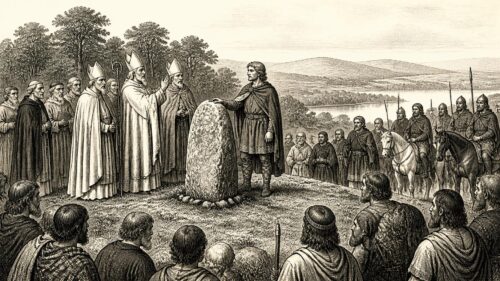
The year opened under the shadow of Eóghan Ó Néill’s death. The annalist called it “a great tale in Ireland”, an indication of his standing. Eóghan was the son of Niall Óg and had been king of Tír Eóghain through a long and contested career. Yet he was no longer the effective head of his dynasty when he died. In July 1455 his eldest son, Enrí, had been inaugurated as king of Tír Eóghain after displacing his aged father. Archbishop John Mey of Armagh confirmed that settlement soon afterwards.
That sequence matters in reading 1456. The death was not the sudden removal of a reigning commander in the middle of the campaign; Enrí already exercised power. But it removed an alternative focus of authority within a great northern kindred. Enrí could now act without the ambiguity created by his father’s surviving prestige, while presenting himself as the defender and enlarger of the inheritance of Niall Óg and Niall Mór.
Enrí’s authority was neither a modern monarchy nor a simple hereditary succession. The title Ó Néill was held within a ruling lineage, and political capacity, armed following, alliances and acceptance by leading churchmen all mattered. His 1455 settlement with Mey had recognised realities on the ground: the archbishop required protection and room to exercise ecclesiastical rights, while Ó Néill gained a useful acknowledgement of his standing. In 1456, the alliance with Tomás Óg Mag Uidhir of Fir Manach showed that Enrí’s rule also depended on relationships beyond Tír Eóghain.
The Inis Eógain Campaign
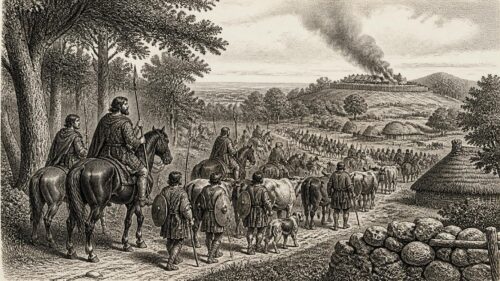
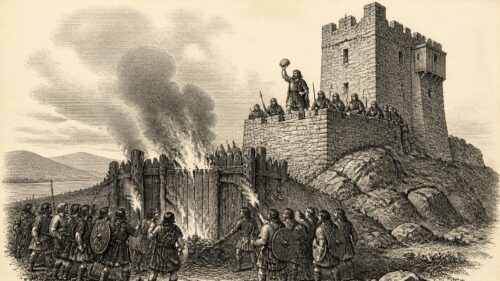
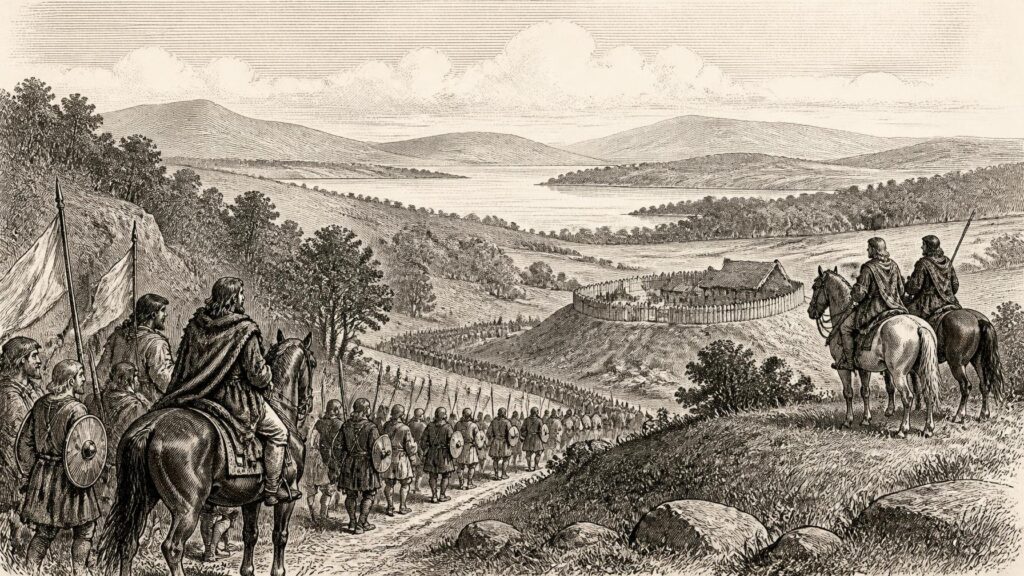
The principal firmly dated event of the year was the northern expedition. The Annals of Ulster state that “great war” arose between Ó Néill and Domhnall, son of Niall Ó Domhnaill, king of Tír Conaill. Enrí and Mag Uidhir entered Inis Eógain with what the annalist describes as a large host. They took a fortified position close to Cúil Mic an Treoin. The source does not give numbers, nor does it allow a modern reconstruction of every stage of the operation; it does, however, make clear that this was a deliberate incursion into a strategically sensitive borderland, not a chance skirmish.
Domhnall Ó Domhnaill, his brother Aodh Ruadh and Mac Suibhne of Fanad then rode out from their own army with only three horses, seeking intelligence on Ó Néill’s movements. Two of Enrí’s sons, Toirdelbach Ruadh and Ruaidhrí, were near the castle and saw them. They pursued. Domhnall was killed; Aodh Ruadh and Mac Suibhne were captured. The annal dates what followed to Cell Baithín on 28 May. It is prudent not to turn this compressed account into a fully described battlefield scene. Nonetheless, its essentials are unmistakable: reconnaissance exposed senior commanders; a small mounted encounter had major political consequences; and the king of Tír Conaill died in the operation.
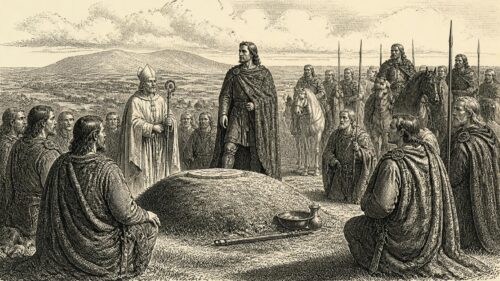
The immediate settlement was as important as the killing. Toirdelbach Cairbreach, son of Neachtan Ó Domhnaill, came to Ó Néill, who made him king over Tír Conaill. The new ruler gave substantial gifts to Ó Néill, his royal sons, subordinate kings and favourites, and the annalist says that lordship was humbly granted to Ó Néill thereafter. This language should not be mistaken for evidence that Tír Conaill had become an annexed province. It records a relationship of superiority secured by force, installation and gift-giving. Such arrangements could be powerful, but they were personal and conditional, dependent upon the continued ability of the victor to command allies and enforce his claims.
For Enrí, the result was a remarkable assertion of authority. The Ó Domhnaills had long been formidable rivals for influence across Ulster and north-west Connacht. By defeating one king, approving another and taking captives from the opposing party, Ó Néill converted a campaign into a public demonstration of provincial dominance. Mag Uidhir’s participation was equally significant. Fir Manach, with its lakeways, islands and routes between Ulster, Bréifne and Connacht, was not a peripheral ally. Its ruler brought men, resources and local strategic weight to the expedition.
War, Diplomacy and the Limits of Rule
The 1456 campaign shows how war and diplomacy overlapped. A fortified place was seized; scouts were sent out; a rival king was killed; prisoners were taken; then a replacement ruler offered gifts and accepted a superior’s lordship. Violence did not stand apart from government. It was one means by which lordship was negotiated and displayed.
It also shows why political geography cannot be reduced to a boundary between a supposedly English east and a Gaelic west or north. Enrí’s Tír Eóghain, Mag Uidhir’s Fir Manach and Ó Domhnaill’s Tír Conaill were powerful lordships with their own institutions, churches, client networks and military obligations. Meanwhile, the English lordship continued around Dublin and the eastern towns. Richard, duke of York, remained the king’s lieutenant in Ireland, while Thomas FitzGerald, seventh earl of Kildare, served as his deputy lieutenant at least into late 1456. This is necessary background to the year, but there is no evidence that the Dublin administration directed or settled the Inis Eógain conflict.
Rather, the northern war demonstrates the practical limits of distant government. The leading political actors in the episode were local and regional rulers, their kin, their retainers and an allied lord of Fir Manach. Their decisions were made through a mixture of armed action, familial eligibility and negotiated submission. The English crown’s nominal claim to Ireland did not erase those political realities.
Connacht’s Recorded Losses
In Connacht, Annála Connacht records no comparable campaign for 1456, but its obituaries illuminate another layer of political life. Fergal son of Conchobar Mac Diarmata, tanist of Moylurg, died, as did his daughter Lasarfina, wife of Cairpre Ó Conchobair. A tanist was an acknowledged successor or heir within a ruling kin-group, not merely a private relation. Fergal’s death therefore mattered to the Mac Diarmata lordship centred on Moylurg in what is now north Roscommon and adjoining country.
Lasarfina’s notice is equally revealing. The annalist identifies her first through her father and then through her marriage to Cairpre Ó Conchobair. Her position connected two important Connacht dynasties. The record does not tell us whether her death altered a particular alliance, and it would be wrong to invent such an outcome. But the form of the obituary itself shows that marriage was political as well as familial: a woman’s relationships could locate her within the public map of lordship.
The same annal records the death of John, son of Thomas Burke. Nothing more is safely supplied for him in the entry. This restraint is instructive. Connacht’s Burkes were spread across competing branches and lordships, and a bare obituary cannot responsibly be attached to a later-famous line or event without further proof. In a thinly documented year, silence is part of the evidence.
Lisgabhail’s School and Household
The Annals of Ulster preserve a different kind of history at Lisgabhail, generally identified with Lisgoole on Upper Lough Erne. Donnchadh son of Gilla-na-naem Mag Sgoloigi, described specifically as a schoolmaster there, “rested” in 1456. The conventional phrase means that he died, but the description of his work is unusually valuable. It confirms that a religious house could sustain teaching as well as worship, hospitality and landholding. Learning was embedded in lordly and ecclesiastical society, not confined to the urban institutions of the English lordship.
Two further notices make the community more visible. Nicholas Mag Arachain died, though the annal gives no office. Gráinne, daughter of Aodh son of Ardghal, also died; she had been foster-nurse to the young abbot, Brian son of Gilla-Padraig. This is a small but vivid glimpse of care and kinship around an ecclesiastical office. Fosterage created enduring social obligations, and an abbot’s household involved more than ordained clerics. The annalist thought Gráinne’s relationship to the young abbot worth preserving, a reminder that women’s labour and ties of nurture underpinned institutions whose formal records often foreground men.
Thus 1456 was not simply a year of conquest. It was a year in which succession was managed in several settings: the former king of Tír Eóghain died after his son’s elevation; a new king of Tír Conaill was made under pressure from Ó Néill; Moylurg lost its tanist; and Lisgabhail marked the deaths of people who taught, fostered and served a religious community. The campaign around Cúil Mic an Treoin gave the year its sharpest drama. The quieter obituaries give it its human texture.
Primary Sources
- The Annals of Ulster, Year U1456
- Annals of Ulster Otherwise Annala Senait, Year U1456 (Irish Text)
- The Annals of Ulster: CELT Project Edition and Bibliography
- Annála Connacht, Annal 1456
- Annála Connacht: CELT Project Edition and Bibliography
- Annals of the Four Masters: CELT Project Edition
- Annals of the Kingdom of Ireland, Volume IV
- O'Neill (Ó Néill), Eóghan
- O'Neill (Ó Néill), Enrí
- Maguire (Mág Uidhir), Tomás Óg
- FitzGerald, Thomas ‘fitz Maurice’
- Mey, John
- O'Neill (Ó Néill), Niall Mór
- O'Neill (Ó Néill), Niall Óg
- O'Donnell (Ó Domhnaill), Niall Garbh
- O'Donnell (Ó Domhnaill), Toirdhealbhach
- O'Neill (Ó Néill), Domhnall Bog
- O'Neill (Ó Néill), Aodh Buidhe
- Maguire (Mág Uidhir), Pilib (Philip)
- Butler, James
- Burke (de Burgh), Thomas
- The Chronicle of Ireland: Then and Now
- The English Lordship of Ireland and the Irish Sea World: Re-assessing
- Cultural Landscapes of Late Medieval Gaelic Ulster, Volume I