Muirchertach Baccach’s Last Hosting1403 CE
In 1403, Irish annals record shifting alliances, warfare and successions across Connacht, Breifne, Ulster and Munster. Muirchertach Baccach Ó Conchobair of Sligo joined Ó Conchobair Donn in a hosting through central Connacht, subduing Uí Maine and aiding Ulick de Burgh in Clanricarde, before dying that autumn. Uí Maine saw aristocratic deaths alongside killings. Breifne conflict brought deaths, captures and a Ó Raigillig ruler. Northern dynasties changed: Niall Ó Néill and his son died, while Oirgialla and Tyrone gained successors. Disputed annal dates complicate Ulster and Munster events. Records emphasise lordship, patronage, hospitality and religious prestige, while preserving fragmentary, partisan perspectives.
Dateline
The most clearly documented Irish events of 1403 cluster in Connacht, Breifne and Ulster. They show a country of overlapping lordships rather than a single political arena: Gaelic dynasties, Hiberno-English magnates and local kindreds made alliances, pursued captives, replaced rulers and sought religious prestige. The year’s best-attested campaign was led by Muirchertach Baccach Ó Conchobair, lord of Sligo, whose successful hosting into central Connacht was followed, remarkably soon, by his death in the autumn.
Such a sequence is important precisely because it should not be turned into a story of inevitable conquest. Medieval Irish annals record selected actions, deaths and successions, not continuous narrative. They preserve the viewpoint of politically connected and literate communities. Their praise for courage, generosity, hospitality and penitence tells us much about the standards expected of rulers, but does not offer a neutral tally of power or popular feeling.
Connacht’s Moving Alliances
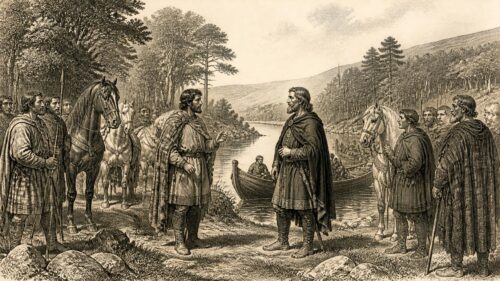
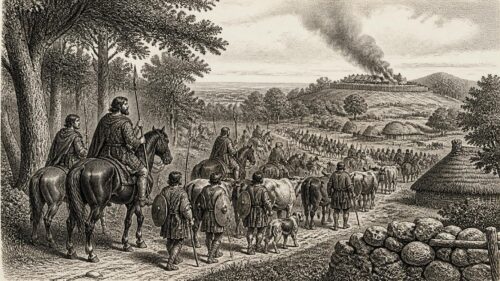
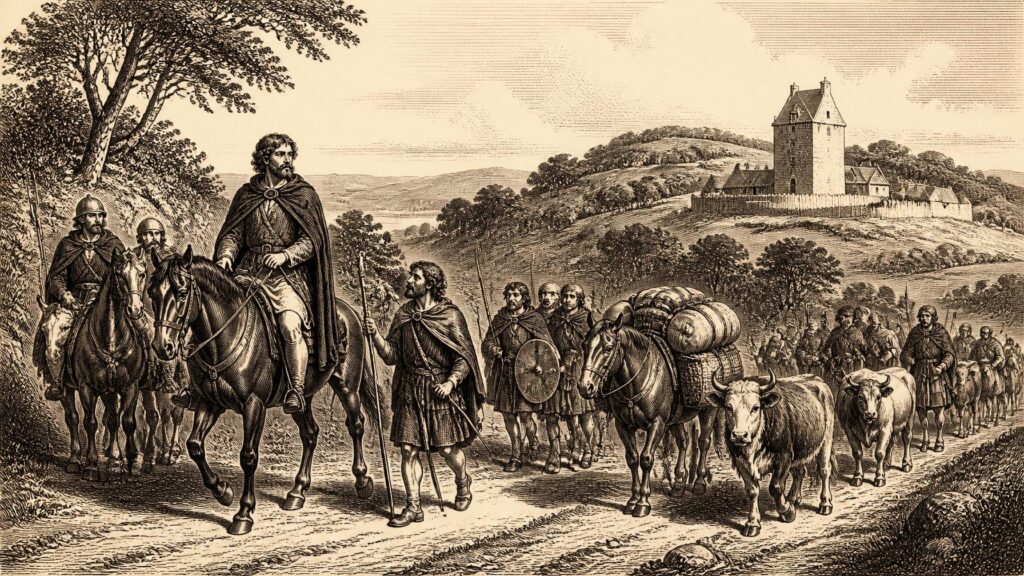
According to Annála Connacht and the Annals of Loch Cé, Muirchertach Baccach joined Ó Conchobair Donn in an immense hosting during 1403. The accounts differ slightly in their geographical wording, calling the destination South or Upper Connacht, but agree on its principal results. The force took the lordship of Eóghan Ó Madadháin, son of Murchad, and then entered Clanricarde to aid Ulick, son of Richard de Burgh, against Uí Maine. The expedition subdued Uí Maine and returned home without recorded loss or mishap.
This was not a simple encounter between an ‘Irish’ side and an ‘English’ side. Muirchertach and Ó Conchobair Donn belonged to leading Gaelic Connacht lineages; Ulick de Burgh was of the powerful Hiberno-English Burke kindred; and Uí Maine was itself a major Gaelic lordship, spanning much of the country around the Shannon and Suck. The campaign demonstrates how military coalitions followed immediate rivalries and opportunities. Kinship, local claims and mutual advantage mattered at least as much as ancestry.
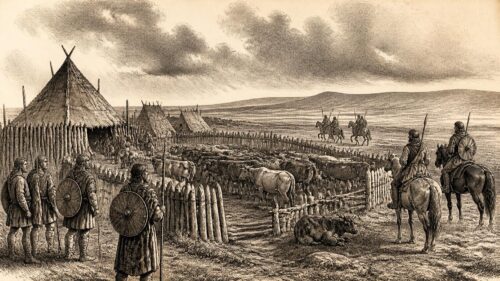
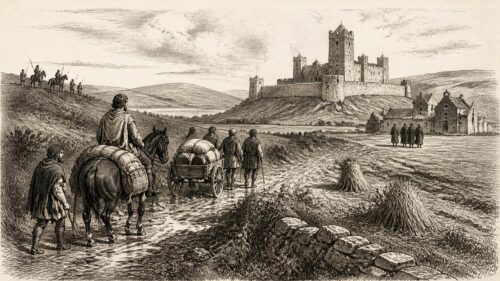
A hosting was more than a battle, and the annals do not claim that a single pitched battle decided the issue. It involved assembling armed followers, moving through rival territories, acquiring submission or control, and maintaining sufficient food, animals and discipline to get home. That the chronicler stresses an untroubled return is therefore meaningful. It signals an expedition judged successful by contemporaries, not merely a raid that happened to take place.
Muirchertach’s death followed on the Friday after Michaelmas, in the autumn. The Annals of Connacht call him lord of North Connacht, while other annalistic wording associates him with Lower Connacht and Sligo; these labels reflect the fluid regional language of the sources rather than a modern county map. The obituary says he had overcome enemies in every part of Ireland, conventional but emphatic praise for a man whose influence had evidently reached beyond his own lordship. His death so soon after the hosting underlines a central feature of lordship: a coalition could be impressive in one season yet become precarious when one of its principal organisers disappeared.
Deaths and Pressure in Uí Maine
The year was especially unsettled for Uí Maine. Conchobar Anabaid Ó Cellaig, its king, died after receiving unction and penance and was buried at the monastery of St John the Baptist in Tír Maine. The annalist’s language is striking: he is styled a destructive and swift ‘serpent’ among the Gaels. That is not a detached character assessment, but it suggests a reputation built upon aggressive raiding and rapid mobilisation. His burial in a monastery to which he had been generous joins political memory, family standing and religious patronage.
Findguala, daughter of Toirdelbach Ó Conchobair and wife of Máel Sechlainn Ó Cellaig, also died in 1403. The annals praise her fame and reputation throughout Ireland. The notice is necessarily brief, yet it is a reminder that elite women appear in the record not only as relatives named to establish male descent, but as people whose marriages linked ruling houses and whose deaths were considered worthy of commemoration.
Violence continued around the lordship. Muirchertach Garb Ó Sechnusaig, an eligible prince of Uí Fhiachrach Aidhne, was killed by Uí Maine. Seán Buíde Burke was slain by descendants of Eóghan Ó Cellaig together with the sons of Hubert Dalton. Three members of the Ó Díomasaigh family were killed by Gallaibh, ‘foreigners’ in the annal’s terminology, although the entry does not identify the particular force. These notices should not be inflated into a complete regional war, but alongside the Connacht hosting they reveal a landscape in which political transitions and local feuds had immediate lethal consequences.
Breifne and Cavan
Further north-east, a great war arose between the men of Breifne and Clann Donnchaid. Tomaltach Óg Mac Dorchaid, described as the last chief of Cenél Luachain, was killed, as was Muirchertach Óg Ó hÉilide, whom the annalist calls a wealthy and prosperous brughaidh. This term indicates a substantial layman associated with hospitality and provisioning. Its appearance matters: the year’s conflicts did not affect only kings and heirs. Men whose standing rested on wealth, household resources and public generosity could be drawn into, or destroyed by, war.
Máelmórda, son of Cú Chonnacht and descendant of Gilla Ísu Ruad Ó Raigillig, assumed the kingship of Muintir Máelmórda, a ruling branch in eastern Breifne. The succession was quickly followed by captures and wounds. Eóghan, son of Seán Ó Ruairc, was taken by Máelmórda Ó Raigillig; another Ó Ruairc, Seán son of Tadc, was seized and wounded by Muintir Máelmórda. The annals say that war between Muintir Raigillig and Muintir Ruairc followed. They also refer to an attack on Cavan ‘according to another book’, an unusually candid signal that annalists worked from differing reports and records. It is safer to say that an attack was remembered in this context than to reconstruct its scale or outcome.
Ulster’s Uncertain Chronology
Ulster provides a lesson in the care required with medieval dates. The Annals of Ulster place the death of Niall Ó Néill the younger in 1403, in the harvest season, and record the death of his son Brian in the same year. Other annalistic compilations place closely related notices under 1402. Rather than forcing a false certainty, the events should be treated as belonging to the transition between those annal years, with the Annals of Ulster specifically assigning them to 1403.
Its obituary for Niall is revealing. He is called arch-king of Ulster, courageous and powerful; learned companies and pilgrims were said to believe that his lineage, martial prowess and hospitality might bring him the kingship of Ireland. This was an aspiration, not evidence that he ruled the island. The entry instead captures the prestige of the senior Uí Néill tradition and the importance of learned and religious travellers as audiences for political reputation. The same chronicle notes that Philip Mag Mathgamna, ruler of Oirgialla, died and was succeeded by Ardghal Mag Mathgamna. In the Annals of the Four Masters, Domnall, son of Henry Ó Néill, is placed in possession of the lordship of Tyrone in 1403. Taken together, the notices point to rapid reorganisation among northern dynasties, but not to a settled province.
Munster and the Limits of the Record
The Annals of Ulster date a great war between the earls of Ormond and Desmond to 1403 and state that the two Mac William de Burghs brought their musters to help Ormond. Yet the Annals of Loch Cé and the Annals of the Four Masters place the same conflict under 1402. It is therefore firmly connected with this immediate period, but its precise annal year is disputed. What can responsibly be said is that the rivalries of Munster’s greatest magnate houses drew Connacht lords into wider military alignments. Ireland’s regions were not isolated political compartments.
There is no securely dated annalistic report for 1403 of famine, plague, exceptional weather, new trade regulations or major urban construction. Everyday life nonetheless appears in fragments: the household in which a claimant could be killed, the monastery that received a ruler’s body, the seasonal language of summer and harvest, and the resources required for hospitality and campaigning. Silence is not proof of calm or prosperity. It is simply a limit of the surviving record.
For culture and learning, the year’s notices are unusually expressive. Poets are invoked to praise Cathal Ó Díomasaigh’s generosity and valour; learned companies and pilgrims are made witnesses to Niall Ó Néill’s standing; ecclesiastical burial and penitence frame several deaths. In 1403, authority in Ireland was exercised through force, followers and territorial claims, but it was also measured by the reputation a lord could sustain among poets, churchmen, guests and travellers. Muirchertach Baccach’s last hosting, followed by his autumn death, brings those realities into unusually sharp focus.
Primary Sources
- Annála Connacht: Annal 1403
- Annála Connacht: Irish Text and Editorial Information
- The Annals of Loch Cé: Annal LC1403
- Annals of Loch Cé A.D. 1014–1590: Irish Text and Editorial Information
- The Annals of Ulster: Year U1403
- Annals of Ulster Otherwise Annala Senait, Annals of Senat: Irish Text and Editorial Information
- Annals of the Four Masters: Annal M1403
- Annals of the Four Masters, Volume 4: Irish Text and Editorial Information
- The Annals of Ulster: Background Details and Bibliographic Information
- Annála Connacht: Background Details and Bibliographic Information
- Annals of the Four Masters: Background Details and Bibliographic Information
- The Annals of Loch Cé: A Chronicle of Irish Affairs from A.D. 1014 to A.D. 1590
- Factions, Feuds and Noble Power in the Lordship of Ireland, c.1356–1496
- The ‘Calculus of Faction’ and Richard II's Duchy of Ireland, c.1382–9
- Richard II and the Wider Gaelic World: A Reassessment
- English Lordship of Ireland and the Irish Sea World: Re-assessing the Origins of the Kildare Ascendancy, c.1390–c.1513
- The Annals of Loch Cé: National Library of Ireland Catalogue Record
- Exploring the Irish Annals
- List of Published Texts at CELT
- Glossary of Common Words in Irish Placenames: Machaire