Carbury Capture1368 CE
In 1368, Irish authority remained fragmented and precarious. Aed Ó Conchobair, king of Connacht, died at Roscommon and Ruaidri Ó Conchobair succeeded amid partition, contested claims, disease and the killing of Tadc Ó Conchobair, which deepened dynastic hostility. In Oriel, Niall Ó Néill accepted Brian Mac Mathghamhna’s submission, but unauthorised allies attacked and were defeated with heavy losses. In Kildare, Berminghams captured royal chancellor Thomas de Burley and other officials, securing his exchange for an imprisoned kinsman and ransoms. On 17 October, fire destroyed St Mary’s monastic church at Trim. Together, these events show institutions dependent on unstable personal alliances.
Dateline
In 1368, Ireland’s political map was not neatly divided between an English lordship and a Gaelic outside. Authority overlapped, was bargained for and could fail abruptly. A royal chancellor was seized after a meeting at Carbury in Kildare; the king of Connacht died at Roscommon and was succeeded by a rival kinsman; an Ulster army accepted terms in Oriel only for fighting to resume without its commander’s consent. In Trim, a major church burned. These firmly dated reports make 1368 unusually vivid: a year in which institutions, hostages, fortifications, kinship and armed followings all mattered, but none guaranteed security.
Roscommon and the Connacht Succession
The most consequential Gaelic political event recorded for the year was the death of Aed (Hugh) son of Feidlim Ó Conchobair, king of Connacht. Annála Connacht places his death at Roscommon after twelve years as provincial king, describing him in the elevated language customary for a successful ruler: a leader of valour who had resisted both Galls—foreigners, normally Anglo-Irish interests in this context—and Gaelic opponents. Its accompanying verse insists that, despite having been wounded many times in war, he died in his bed after religious repentance. That combination of martial praise and a penitent death was an ideal aristocratic ending, rather than evidence that the succession itself was peaceful.
Ruaidri son of Toirdelbach Ó Conchobair assumed the kingship of Connacht in the same annal-year. This was not a modern hereditary accession in which the eldest son automatically inherited a fixed throne. Provincial kingship depended on ancestry, armed support, alliances and the consent—or acquiescence—of powerful neighbouring dynasties. Aed’s death therefore opened a contest within the broad Ó Conchobair kindred and among the lords whose support made a Connacht king effective. Roscommon, the place of his death, was consequently more than a burial setting: it lay within the core territory from which the leading Connacht dynasty projected authority.
Two related developments reveal how quickly the political landscape could be rearranged. Carbury, an Ó Conchobair lordship in north Connacht, was divided between the two sons of Magnus Ó Conchobair and Domnall son of Muirchertach Ó Conchobair. This was a Connacht Carbury, quite distinct from the Kildare Carbury of the year’s Anglo-Irish crisis. Division could settle a claim temporarily, but it also created smaller and potentially competing power bases. Meanwhile Fergal Mac Diarmata, ruler of Moylurg around Lough Cé, died, as did his son and designated successor Tomaltach Óg. Aed son of Conchobor Mac Diarmata then took the lordship. The deaths of both lord and tanist in one year made the transition especially exposed.
Disease contributed to that vulnerability. The annal expressly says that Tomaltach Óg died of smallpox, as did William ‘the Englishman’, son of Sir Raymond Burke and heir of the MacWilliam line, on Inishcoe off the Mayo coast. Medieval diagnostic labels should not be treated as laboratory certainty, but the entries show that contemporaries recognised a named, serious illness and that it struck men whose positions carried political consequence. These notices do not demonstrate a nationwide epidemic in 1368; they do demonstrate that sickness could remove prospective leaders as decisively as battle or assassination.
The most ominous Connacht episode was the seizure of Tadc, son of Magnus Ó Conchobair, by Ruaidri in Tadc’s own stronghold at Ardakillin. The annalist presents the capture as an exceptional breach of trust. Tadc was later handed to Domnall son of Muirchertach and killed in Sligo castle. No exact day is supplied, and the text’s statement that the act became ‘the seed of great war’ should not be inflated into a claim that every later conflict began immediately in 1368. Yet it is clear that the killing embedded bitterness among the Ó Conchobair branches and their allies, including MacWilliam and Mac Diarmata. The year’s succession was therefore secured through an act that made further disorder more likely.
Oriel: Agreement, Then Battle
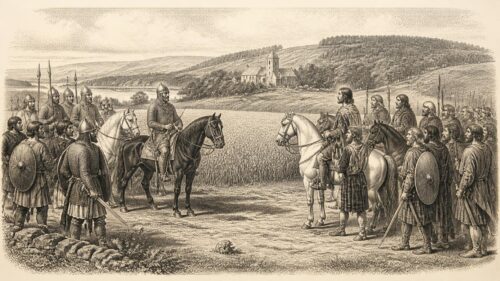
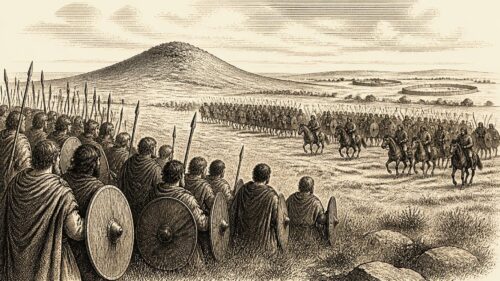
In Oriel, roughly centred on modern County Monaghan and adjoining districts, Niall Ó Néill, king of Ulster, led what Annála Connacht calls a huge army against Brian Mac Mathghamhna. The force encamped in the middle of Brian’s country. Such a hosting was not simply an exercise in destruction: it was a demand for submission, compensation and a revised political order. Brian offered major concessions—half Oriel for Niall’s predecessor, also named Niall, as well as substantial payments in recompense for the death of a Mac Domnaill. Niall Ó Néill accepted.
The settlement did not hold because not all participants accepted their leader’s decision. Niall, son of Murchad Mac Mathghamhna, and Alaxandar Óg Mac Domnaill, commander of the gallowglasses, attacked Brian’s camp with three large battalions without Ó Néill’s sanction. Brian met them with the followers immediately available and routed them. The attackers included heirs as well as professional military leadership: Murchad’s son, described as heir to Oriel; Alaxandar Óg, heir to Clann Domnaill; and Eogan, another prominent member of that wider kindred, were killed alongside many others.
This sequence is a valuable corrective to simple ethnic labels. Gaelic rulers and gallowglass captains operated within networks of tribute, marriage, compensation, overlordship and private vengeance. A negotiated settlement might be undone by ambitious subordinates, rival heirs or men who judged the price of peace unacceptable. The annal’s phrase ‘gentle and simple’ also indicates that the losses were not confined to named elites. For households attached to the defeated force, the consequences included bereavement, disrupted service and the loss of animals, equipment and protection.
The Chancellor Taken at Carbury
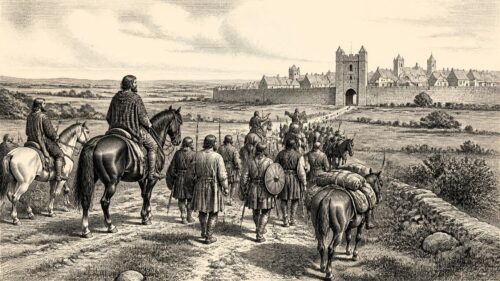
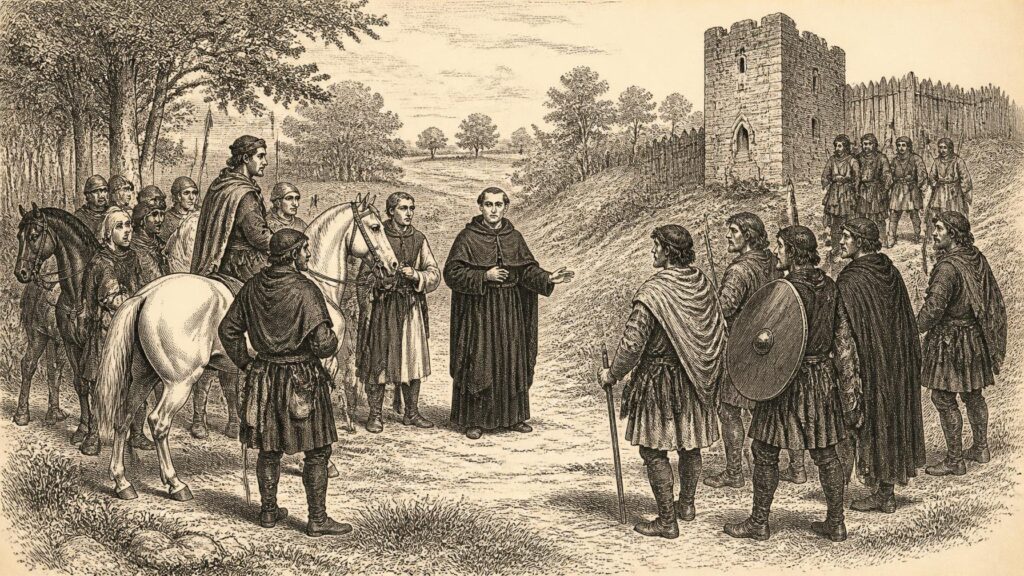
At Carbury in County Kildare, the vulnerability of the English crown’s administration was displayed even more starkly. The Latin annals associated with John Pembridge record that, after a parliament or formal meeting involving Irish and English interests had ended, the Berminghams and others of Carbury captured Thomas de Burley, prior of Kilmainham and the king’s chancellor in Ireland. They also seized John FitzRichard, sheriff of Meath, Robert Tyrrel, baron of Castleknock, and many companions.
The episode belongs to a local conflict that was already under way. In 1367 the same annals report serious thefts and warfare between the Berminghams of Carbury and the people of Meath; Robert de Preston had placed a substantial guard in Carbury castle. Recent scholarship characterises the Berminghams from this period as ‘English rebels’: a landed lineage of colonial origin whose alliances and raids did not conform reliably to the interests of Dublin government. The label mattered because it exposed the limits of the supposed divide between ‘English’ and ‘Irish’. The crown’s problem was not only resistance from Gaelic lordships but also autonomous violence by families formally within its political world.
The captives were released on unequal terms. James de Bermingham, then held in Trim Castle in iron manacles and fetters as a traitor, was exchanged for Burley; the other prisoners made ransoms. Hostage-taking, imprisonment and ransom were not marginal practices. They were instruments through which armed communities converted military leverage into political concessions and cash. That the king’s chancellor could be captured after a meeting intended to manage conflict shows why statutes and official titles alone could not make royal authority effective in the lordship’s western borderlands.
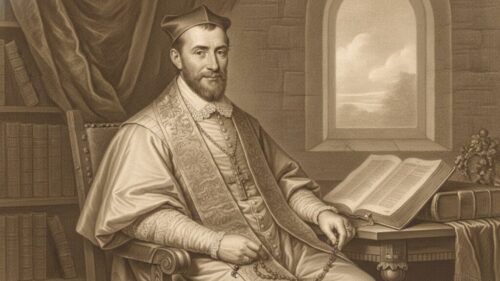
Gerald fitz Maurice FitzGerald, earl of Desmond, was justiciar of Ireland throughout 1368, serving from April 1367 until June 1369. His office represented the king’s government, but he governed through magnates, sheriffs, religious houses and negotiated local power. The Statutes of Kilkenny, enacted only two years earlier, had sought to reinforce the lordship’s legal and cultural boundaries. Carbury demonstrated a more immediate reality: officials could be overpowered by an armed regional family, and a royal prisoner might be recovered only by releasing another prisoner and accepting ransoms.
Fire at Trim
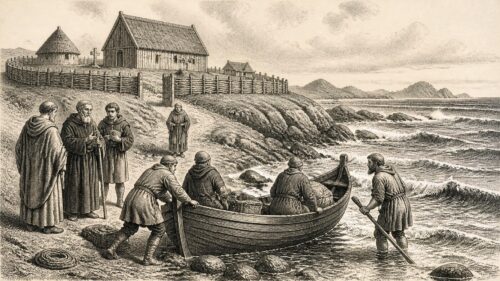
One event has an unusually precise date. On the vigil of St Luke—that is, 17 October 1368—the church of St Mary’s monastery at Trim was destroyed by fire. The source does not identify a cause, name casualties or describe the scale of damage, so none should be invented. Later historical work generally connects the notice with the Augustinian priory of St Mary, an important religious house beside the Boyne. Its church, community, books, vestments and stores would all have been vulnerable in a serious blaze, but the surviving record permits certainty only about the fire itself.
The destruction nevertheless belongs beside the year’s political events. Trim was a crucial Meath strongpoint, home to a royal castle and close to the imprisonment of James de Bermingham. A monastic church was a place of worship, local memory, estate management and hospitality as well as a building. Its burning was thus a material loss within a landscape already strained by conflict. The later prominence of St Mary’s as a pilgrimage destination makes the 1368 fire a reminder that medieval religious institutions could suffer severe interruption and still recover.
A Year of Fragile Authority
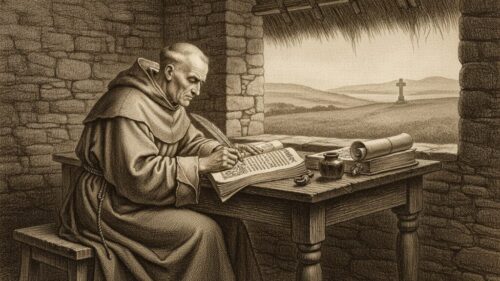
The evidence for 1368 is uneven and must be read carefully. The Connacht annals preserve Gaelic perspectives and give the year an exact calendrical heading; the Pembridge annals are especially valuable for affairs of Leinster and the English administration. Later compilations corroborate some developments but need cautious handling, while the Annals of Ulster employ a chronological system whose entries around this point are offset from the modern calendar. For that reason, events placed by that annal under its heading ‘1368’ but corresponding to 1372 are not treated here as events of this calendar year.
What can responsibly be said is substantial. In 1368, succession in Connacht was accompanied by partition, captivity and the loss of heirs to disease; a negotiated settlement in Oriel collapsed into a deadly unauthorised attack; the crown’s chancellor was seized in Kildare; and a major Trim church burned on 17 October. Ireland was not one political arena but many connected arenas. Kings, lords, churchmen, sheriffs, gallowglasses and local communities all navigated a world in which authority rested less on permanent institutions than on relationships that could be revised—or violently broken—within a single year.
Source References
Hover over a number to see the source. Select it to open the source.

- [1] Annála Connacht: Annal 1368
- [2] Annála Connacht
- [3] Annales Hibernie ab anno Christi 1162 usque ad annum 1370
- [4] TEI Header for Annales Hibernie ab anno Christi 1162 usque ad annum 1370
- [5] Annales Hiberniae
- [6] Annals of the Four Masters, Part 20
- [7] Annals of the Four Masters
- [8] The Annals of Ulster: Year U1368
- [9] The Annals of Ulster
- [10] Annals of Loch Cé
- [11] FitzGerald, Gerald fitz Maurice (‘Gearóid Iarla’)
- [12] MacMahon (Mac Mathghamhna), Brian Mór
- [13] Pembridge, John
- [14] History of the Law in Ireland
- [15] Extending the English Pale: Berminghams’ Country, and the Rise of Sir William Bermingham, Baron of Carbury (c.1485–1548)
- [16] The Archaeology and History of Medieval Trim, County Meath
- [17] County Meath Urban Archaeology Survey
- [18] Trim, Irish Historic Towns Atlas
- [19] The Medieval Irish Plea Rolls – An Introduction
- [20] History of Parliament in Ireland
Primary Sources
- Annála Connacht: Annal 1368
- Annála Connacht
- Annales Hibernie ab anno Christi 1162 usque ad annum 1370
- TEI Header for Annales Hibernie ab anno Christi 1162 usque ad annum 1370
- Annales Hiberniae
- Annals of the Four Masters, Part 20
- Annals of the Four Masters
- The Annals of Ulster: Year U1368
- The Annals of Ulster
- Annals of Loch Cé
- FitzGerald, Gerald fitz Maurice (‘Gearóid Iarla’)
- MacMahon (Mac Mathghamhna), Brian Mór
- Pembridge, John
- History of the Law in Ireland
- Extending the English Pale: Berminghams’ Country, and the Rise of Sir William Bermingham, Baron of Carbury (c.1485–1548)
- The Archaeology and History of Medieval Trim, County Meath
- County Meath Urban Archaeology Survey
- Trim, Irish Historic Towns Atlas
- The Medieval Irish Plea Rolls – An Introduction
- History of Parliament in Ireland