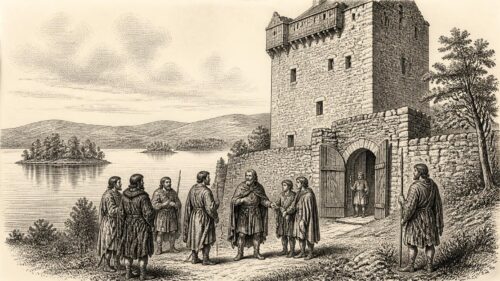
Desmond’s Dublin Castle1355 CE
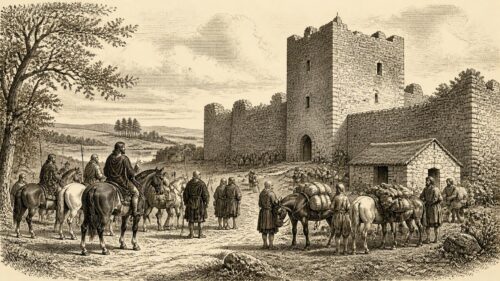
In 1355 Edward III appointed Maurice fitz Thomas FitzGerald, first earl of Desmond, justiciar of Ireland, and he began serving in August. His restoration after earlier conflict with the crown demonstrated royal dependence on powerful Anglo-Irish magnates. Dublin’s institutions could not control a politically fragmented island, where Gaelic and Anglo-Irish lordships exercised overlapping authority. Plague’s recent effects worsened economic and military pressures. Annal-dated reports describe killings, successions and retaliatory warfare in Bréifne, Annaly, Muintir Eolais and Connacht, alongside ecclesiastical and legal continuity. Desmond’s appointment was firmly dated, but annal chronology requires caution. Governance relied on negotiated regional, often violent power.
Dateline
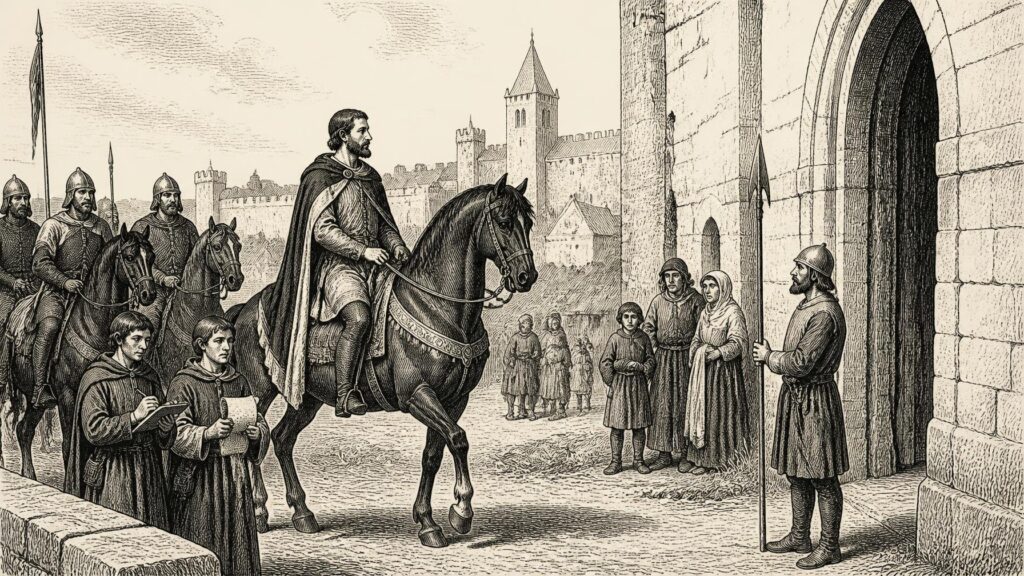
In 1355 the most securely dated Irish development was a change at the summit of the English lordship’s administration. On 8 July Edward III appointed Maurice fitz Thomas FitzGerald, first earl of Desmond, as justiciar of Ireland. He was acting from 8 August. The office made him the king’s chief governor in Ireland: responsible, in theory, for royal justice, defence, finance and the conduct of government from Dublin Castle. In practice, his appointment acknowledged a basic reality of fourteenth-century Ireland. Royal authority depended heavily on powerful local lords, among whom Desmond himself was pre-eminent.
A Magnate Becomes Justiciar
Maurice’s elevation was striking because his relationship with the crown had long been troubled. He had been an ambitious lord in Munster, entangled in disputes over land, castles and influence, and had fallen badly out with the Dublin administration in the 1340s. His lands had been seized and he had spent time in English custody. Yet he had subsequently been pardoned and restored to favour. In 1355 the men who had stood surety for him during his earlier disgrace also received royal pardons. The appointment therefore marked not merely a new administration but the culmination of a political rehabilitation.
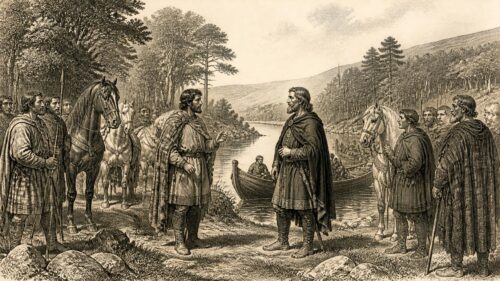
Desmond was no outsider dispatched from England to impose an unfamiliar programme. He was an Anglo-Irish earl whose power rested in Desmond, Kerry, Decies and connected lordships, whose family networks crossed the Irish Sea, and whose career had included alliances and negotiations with Gaelic rulers. His appointment illustrates the extent to which the crown needed such men. Dublin possessed chancery, exchequer, courts, a castle and a civic community, but it could not govern the island by paperwork or garrisons alone. A governor required affinities, military followers, credit, local intelligence and the capacity to bargain.
Maurice fitz Thomas’s tenure was brief, but that belongs to the following calendar year: he died in Dublin Castle on 25 January 1356. It is important not to import that death into 1355 merely because the Annals of Loch Cé places it under its heading for 1355. The royal appointment and the beginning of his service in August 1355 are the firm dates that define this year.
Rule from Dublin, Power Beyond It
The justiciar governed the lordship of Ireland, not a politically uniform country. English royal institutions were strongest in and around Dublin and in the towns, shires, liberties and landed estates tied to the crown. Elsewhere, Gaelic lordships and autonomous Anglo-Irish powers exercised authority through kinship, clientship, tribute, hospitality, ecclesiastical patronage and armed followings. The boundaries between these worlds were neither fixed nor simply ethnic. Men described in annals as “Foreigners” might be long-established families of English origin; their rivals could include other Anglo-Irish families as well as Gaelic dynasties.
The appointment of Desmond should consequently not be read as a moment when Dublin recovered command over all Ireland. It was instead an attempt to make royal government workable through a magnate whose regional influence was already considerable. Maurice FitzGerald, fourth earl of Kildare, another leading Anglo-Irish lord, also served in a deputy capacity during August 1355. Government was collaborative, improvised and dependent on men whose private lordships could be as consequential as their public offices.
The wider condition of the country also mattered. Ireland was still living with the consequences of the great plague outbreak that had reached the island in 1348 and remained active into 1350. This is context for 1355, not evidence for a fresh nationwide epidemic in that year. Surviving estate evidence and later analysis point to tenant shortages, vacant holdings and declining rents in parts of the English lordship, while the effect was uneven across regions and social settings. In a society already affected by warfare and insecure travel, demographic loss could weaken cultivation, reduce seigneurial income and make military service and local defence harder to sustain. The new justiciar inherited these pressures; no surviving evidence permits a precise national reckoning for 1355.
Violence in the Annals
Irish annals assign a dense group of deaths and killings to 1355, especially in Bréifne, Annaly, Muintir Eolais and Connacht. These records are indispensable but require care. The Annals of the Four Masters and the Annals of Loch Cé, compiled later from earlier material, agree in placing several events under 1355. Their year headings, however, do not always correspond exactly to modern calendar dating. The Loch Cé entry for “1355” includes Maurice Desmond’s demonstrably 1356 death and an account of the battle of Poitiers, fought in September 1356. Such material must therefore be described as annal-dated rather than treated as firmly dated calendar-year events.
Within that limitation, the entries give an unusually close view of the hazards of local lordship. Domhnall, son of John Ó Fearghail, chief of Annaly, died and was buried at Lethráth. Diarmaid Ó Maelmiadhaigh, chief of Muintir Cerbhalláin, was killed by Muintir Birn, together with many men of Muintir Eolais. Cormac Mac Raghnaill, chief of Muintir Eolais, was then killed by the sons of Ímar Mac Raghnaill. These were not abstract disturbances at the edge of government. The deaths of chiefs could alter control of land, cattle, dependants, routes and tribute, while also opening succession disputes within kindreds.
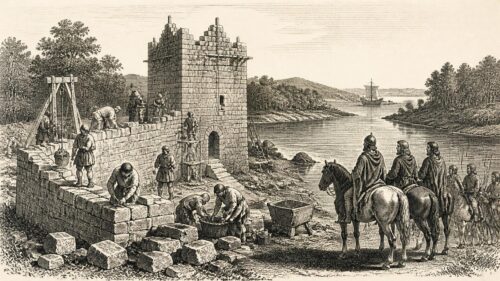
One entry is especially revealing of the intersection between household politics and violence. Donnchadh Ó Domhnaill was killed while forcibly carrying off Gormlaith, daughter of Aodh Ruadh Mag Uidhir, at Maguire’s fortress; the Four Masters names Donn Mac Murchadha as her defender. The annal’s wording must be taken seriously: it presents the taking as coercive, not as an agreed marriage. At the same time, the episode shows why elite women could become central to conflict. Marriage, fosterage and kinship were instruments of alliance, but a contested woman’s movement between lordly households could also provoke immediate armed retaliation.
Connacht’s Competing Houses
The annals also place fighting in Connacht under 1355. They report that the “English of West Connacht” defeated Mac William Burke and killed many of his people. This was not a straightforward clash between an English colony and a Gaelic population. The Burkes were themselves an immensely important Hiberno-Norman family whose branches had become deeply embedded in Connacht politics. The language of the annals instead captures competing regional coalitions, each capable of drawing on people of differing ancestry and political allegiance.
Further annal-dated entries describe Edmond Burke being killed by Síl Anmchadha, followed by a counterstroke from Richard Óg Burke against Edmond’s household and Síl Anmchadha. Stephen Mac Jordan, Henry Mac Philbin and sixteen leaders of Síl Anmchadha were said to have died in that defeat. Exact chronology should not be pressed beyond the sources, but the sequence conveys the scale of lordly warfare: a killing could trigger rapid retaliation, while the loss of named captains and chiefs damaged the political as well as the military strength of a coalition. It also shows why a justiciar in Dublin could not assume that royal appointment translated into control in the west.
Church, Learning and Continuity
The notices for 1355 are not confined to warfare. The Four Masters records the death of Conchobhar Mac Consnamha, bishop of Bréifne, whose diocese stretched from Drumcliff to Kells, along with Mac Gallgael, prior of Holy Trinity, and Mac Cathail, abbot of Sruthair. These deaths remind us that bishops, priors and abbots were important figures in local society: they supervised religious life, held lands, maintained communities and participated in the web of patronage that joined churches to ruling families.
The death of Tadhg Mac Aodhagáin, described as learned in fenechas, or traditional Irish law, is equally significant. Legal learning remained a specialised and valued discipline, preserved by hereditary learned families and applied within Gaelic lordships. Its presence in the year’s obituary material offers a corrective to any picture of Ireland as simply disordered. Conflict existed alongside durable institutions of law, religion, education and record-keeping. The annalists themselves, by naming bishops, abbots, jurists and local rulers, show what their society considered worth remembering.
A Year of Limited Reach
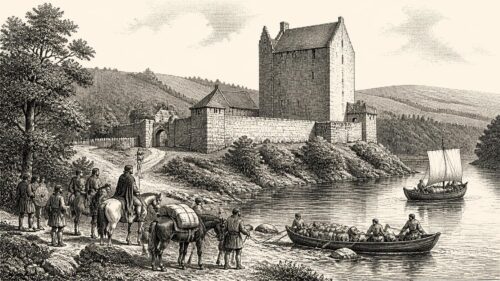
Thus 1355 is best understood through contrast. At Dublin Castle, the crown entrusted its government to a restored earl whose authority rested as much on lordly power as on royal commission. Across the island, annal-dated reports record fragile successions, killings, retaliation and regional contests in which Gaelic and Anglo-Irish actors were often interwoven. The legacy of recent plague compounded the difficulty of rule, even though it cannot be reduced to a single national statistic. Desmond’s arrival as justiciar was real and firmly dated; the wider annalistic picture is vivid but chronologically less secure. Together they reveal an Ireland governed not from one centre, but through overlapping, negotiated and frequently violent systems of power.
Primary Sources
- Annals of the Four Masters, Part 19
- Annals of Loch Cé, Part 1
- The Annals of Ulster, Part 158
- Annals of the Four Masters: Irish-language edition, Part 19
- Annals of Loch Cé: Irish-language edition
- CELT: A Chronology of Ireland
- FitzGerald, Maurice fitz Thomas, Dictionary of Irish Biography
- FitzGerald, Maurice fitz Thomas, fourth earl of Kildare, Dictionary of Irish Biography
- CIRCLE – A Calendar of Chancery Letters, Trinity Centre for Digital Humanities
- CIRCLE: A Calendar of Irish Chancery Letters, c.1244–1509, University of East Anglia Research Portal
- Factions, feuds and noble power in the lordship of Ireland, c. 1356–1496
- The Identification of Some Pestilences Recorded in the Irish Annals
- Ireland, chapter in The Complete History of the Black Death
- ‘Unheard-of Mortality’… The Black Death in Ireland
- Two Nations, One Order: The Franciscans in Medieval Ireland
- Maurice Fitz Thomas, first earl of Desmond: a study of his career, 1293–1356
- The Siege of Castleisland
- Annals of Loch Cé, Vol. II
- Exploring the Irish Annals
- Richard II and the Wider Gaelic World: A Reassessment
- Colonisation and Conquest in Medieval Ireland
- Galway City
- Saintonge Green Glazed Wine Jug
- Calendar of the Patent Rolls Preserved in the Public Record Office: Edward III, 1327–1377