Athleague’s Rival Stronghold1337 CE
In 1337, Ireland remained politically fragmented, with Anglo-Irish, Gaelic and royal authorities pursuing alliances, rents and warfare. William, son of the Earl of Ulster, reached a rent-based settlement with Brian Bán Ó Briain, while Aodh Reamhar Ó Néill made northern peace. In Connacht, Toirdelbach Ó Conchobair established a military position at Athleague against Edmund Burke, but Clann Cheallaig defeated and captured him. Feuds in Dartry and Breifne brought killings, raids, captivity and succession. Domnall Ruadh Ó Máille and his son were murdered. Dublin received royal governors, while bishops, scholars and poets died, illustrating the interdependence of power, church and learning.
Dateline
In 1337, Ireland’s political map was not governed by a single rhythm. The English crown maintained a formal lordship centred on Dublin, while powerful Anglo-Irish lordships, Gaelic kingships and regional kindreds negotiated, fought and made peace on their own terms. The year’s surviving records are especially rich for Connacht and its neighbouring regions. They show a country in which a settlement over rents, a defensive position at a river crossing, a hostage-taking and the deaths of learned churchmen all belonged to the same political world: authority depended on land, armed followings, kinship and reputation.
A Peace Measured in Rent
The Annála Connacht places one important agreement at the head of its entries for the year. William, described as the son of the Earl of Ulster, made peace with Brian Bán Ó Briain. Brian retained every territory that he had previously abandoned to William, but was to pay the rent due from each. The formula matters. This was not a simple surrender by one side or an unconditional restoration by the other. Control of land could be conceded while a continuing financial obligation recognised the claimant’s superior interest.
The annal does not date the agreement more closely, identify every territory involved, or explain how long it endured. Yet it offers an unusually clear glimpse of political bargaining. In a society where lordship rested partly on the ability to reward retainers, collect renders and protect dependants, the value of a peace lay in making possession predictable. The settlement also cautions against treating Gaelic and Anglo-Irish politics as separate spheres. A member of the Ó Briain dynasty and the heir-designated as the earl’s son could bargain in terms intelligible to both: land held, rent paid and conflict suspended.
Another peace was recorded in the north. Aodh Reamhar Ó Néill made peace with the Airgíalla of Oriel and with the Fir Manach of Fermanagh. Again, no date or terms survive. Still, the notice is significant because it records active diplomacy across territories rather than a royal command imposed from Dublin. Peace-making was an achievement worth entering in an annal precisely because it could interrupt the routine of raids, counter-raids and disputed succession.
Connacht at Athleague
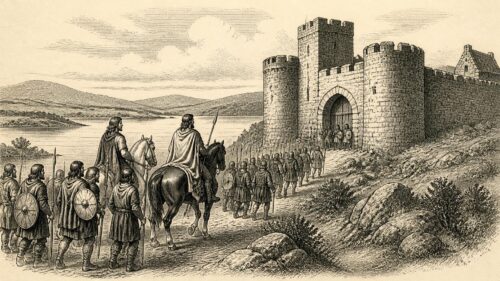
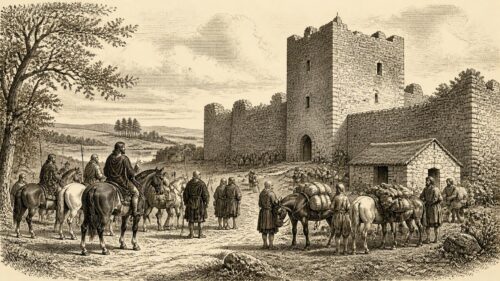
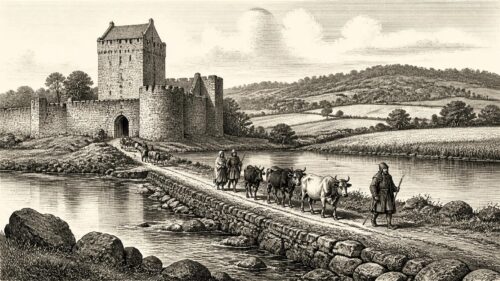
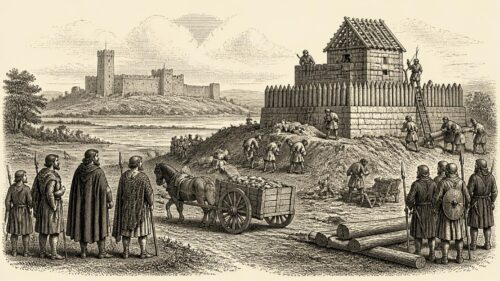
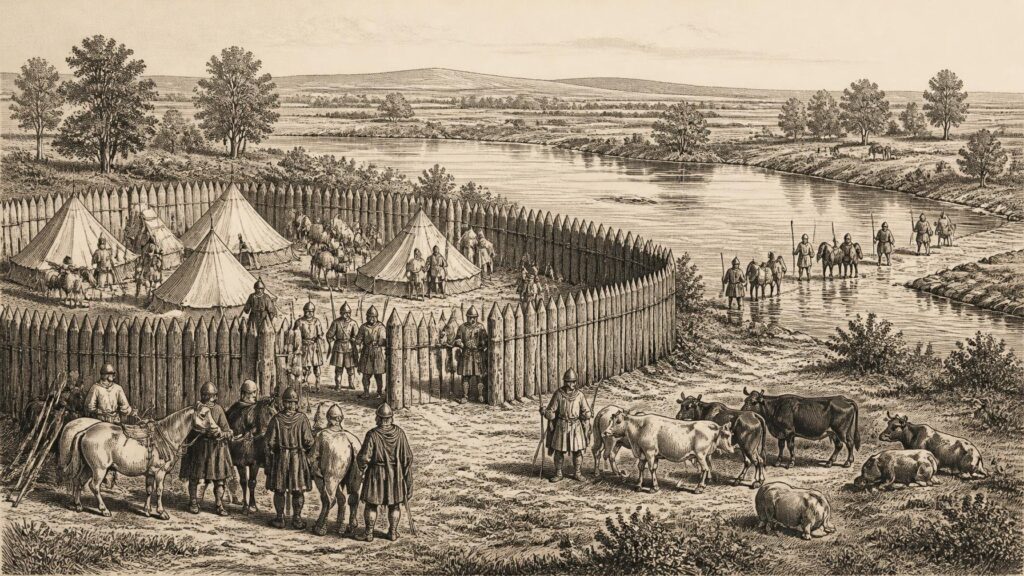
The year’s central Connacht episode concerned Toirdelbach Ó Conchobair, king of Connacht, and Edmund Burke. Annála Connacht says that Toirdelbach made a stronghold at Áth Liag, Athleague, against Edmund. The later Annals of the Four Masters instead calls it a camp pitched at Athleague. The difference should not be concealed: neither text supplies a plan or a duration, and it is safest to understand the entry as evidence for a substantial military position rather than to claim a permanently built castle.
Athleague, at a Shannon crossing, was an apt place from which to watch movement between territories and to gather a following. The entry demonstrates how strategic geography shaped politics. Rivers were not simply boundaries. A ford or crossing could connect cattle routes, travelling armies, lordly residences and places of exchange; controlling it could help determine who possessed practical influence in a contested region.
Toirdelbach’s measures did not secure an untroubled year. The same annal reports that the Clann Cheallaig heavily defeated him. He was wounded and captured; horses and armour were lost, and many of his men were killed. The bare notice preserves no battlefield location, date or explanation of Clann Cheallaig’s aims. It does, however, show the limits of the title “king of Connacht”. Kingship was a claim requiring continual defence, and a defeat could expose a ruler’s person, equipment and followers to the victors.
These events belonged to an already unsettled Connacht. The killing of William de Burgh, earl of Ulster, in 1333 had unsettled the de Burgh inheritance and weakened established arrangements in the west. That was background rather than an event of 1337, but it helps explain why the annals of this particular year give such prominence to agreements, defensive preparations and rival armed interests. What can responsibly be said is that 1337 found Toirdelbach and Burke in open opposition; the dramatic further collapse of de Burgh power belongs to later years and should not be brought forward into this one.
Dartry, Breifne and the Cost of Feud
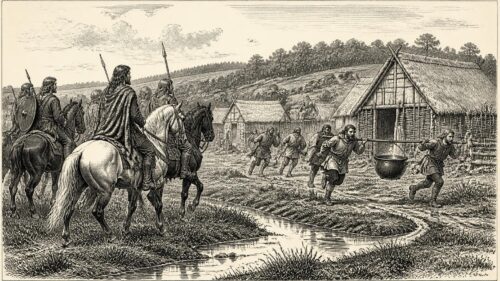
Far from Athleague, the annals trace smaller-scale but no less consequential struggles. Tadhg Mac Flannchaidh, chief of Dartry, was killed with many others by Cormac, son of Ruaidhrí, son of Domnall Ó Conchobair, in vengeance for Seoan, son of Domnall. Great raids then fell on Dartry, and the son of Muiris Mac Flannchaidh died while pursuing the raiders. The sequence is explicit about revenge, but not about the original offence. It should therefore be read as a record of escalation, not as proof that either party possessed a just cause.
For ordinary households, such a raid was more than a brief military incident. It threatened cattle, horses, stores and the labour needed to maintain a farmstead. The annal’s attention to pursuit indicates that a prey of livestock and movable goods was at stake, even though it does not offer numbers. Warfare in this landscape was often mobile and seasonal in its possibilities, but its effects could reach well beyond those killed in combat.
A second struggle within the Mac Raghnaill kindred reveals how succession could be decided through force. Cathal Mac Raghnaill captured Tadhg and Maelsechlainn, sons of Imar Mac Raghnaill. Their kinsmen assembled a force, joined by Uilliam son of Mathgamain and local young men, pursued Cathal and killed him. Magnus son of Fergal also died that day, after which Tadhg Mac Raghnaill took the chieftainship. The annal’s compact wording joins captivity, rescue, killing and accession. Chieftainship was hereditary in a broad dynastic sense, but it was not an automatic inheritance: backing from relatives and followers was decisive.
Other notices extend the pattern across the island. Donnchadh, lord of Cenél Fiachach, was killed by the Uí Fhailge. Seoan Ó Fallamain, chief of Clann Uatach, died. Donnchadh Mór Ó Dubhda, tanist of Uí Fhiachrach, also died. A tanist was an acknowledged heir or successor within a ruling kin-group, so his death mattered politically even where the annal does not narrate a succession dispute. These entries should not be inflated into a general national crisis. They do show, nonetheless, that local lordship was vulnerable to sudden loss and that every death of a ruler, heir or leading warrior could rearrange regional alliances.
A Disputed Winter Killing
The killing of Domnall Ruadh Ó Máille and his son Cormac supplies a useful warning about medieval evidence. Annála Connacht says that they were killed by Clann Mebricc and other Galla on the night of St Stephen’s feast. The Annals of the Four Masters, compiled much later from earlier material, gives St Martin’s night and describes the accompanying men as English. Since the sources disagree over the feast-day, the exact date cannot safely be repeated as fact. What remains firm is that father and son were killed in 1337 by Clann Mebricc with outside allies identified in one tradition as Galla, a word often used for foreigners or English-speaking settlers.
The episode points to the mixed political world of the western seaboard. Maritime families such as the Ó Máilles operated within networks that crossed coasts and islands, while local conflicts could draw in men whom annalists marked as outsiders. The record is too terse to reconstruct a naval campaign, a trading quarrel or a raid. Its value lies in showing that coastal politics, like those of Connacht’s interior, were shaped by shifting partnerships rather than neat ethnic blocs.
Dublin’s New Governors
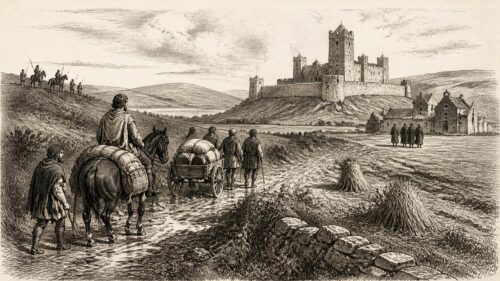
While these conflicts unfolded, royal administration changed hands. Sir John Darcy’s tenure as justiciar ended on 28 July 1337. John de Charleton, lord of Powys, was appointed in his place, and his brother Thomas Charleton, bishop of Hereford, became chancellor of Ireland on the same date. John received instructions from the king’s council in late June; ships were ordered in July; he and his entourage landed in Ireland on 14 October. Thomas arrived the following day.
The new regime came with conspicuous resources: 1,000 marks for expenses and a force including 200 Welsh archers. Such provision acknowledged the strain on the English lordship, especially in Leinster, but it did not mean that Dublin governed the whole island in practice. Roger Outlawe, prior of Kilmainham, served as deputy justiciar until 15 October, overlapping with the transition. A surviving mandate of 18 June, issued through Outlawe, granted the vicarage of St Patrick’s, Kellistown in County Carlow to the prior of Kells in Ossory. It is a small document, but it shows government operating through church patronage and written authority even as wider security remained uncertain.
The Charletons’ arrival belongs firmly to 1337; their later campaigns and disputes do not. In this year, their landing represented preparation and a change of personnel rather than a demonstrated transformation of Irish politics.
Bishops, Masters and Poets
Two episcopal deaths gave 1337 a marked ecclesiastical character. Lugaid Ó Dálaigh, bishop of Clonmacnoise, died, as did Tomás, son of Cormac Ó Domhnaill, bishop of Tír Conaill, or Raphoe. The Connacht annalist praises Tomás as wise, pious, charitable and kindly; the Four Masters similarly commends him for wisdom and piety. Such praise is conventional, but it also indicates the qualities expected from a bishop: learning, religious standing, generosity and public usefulness.
The deaths of the Master Ó Rothláin and of Matha Ó hUicinn, remembered for poetry and humanity, bring the world of learning into view. Their exact careers are not supplied, and it would be unsafe to assign either to a particular school or patron. Yet the annals’ decision to preserve their deaths confirms the social importance of professional scholarship and poetry. Learned men did not stand outside politics: they depended on hospitality and patronage, carried legal, genealogical and literary knowledge, and helped establish the reputations of the families among whom they worked.
Thus 1337 was not merely a catalogue of violence. It was a year in which people sought peace through rent, strengthened a river crossing against a rival, fought over captives and chieftainship, replaced royal officers, and commemorated bishops and scholars. Its records do not support a claim of island-wide change. They do reveal a deeply connected Ireland in which political power, material resources, religious institutions and learned culture continually met.
Primary Sources
- Annála Connacht: Annal 1337
- Annála Connacht: Irish text, Annal 1337
- Annála Connacht
- Annals of the Four Masters, Part 17
- Annals of the Four Masters
- Annals of Ulster
- Annala Uladh: Annals of Ulster otherwise Annala Senait, Annals of Senat
- Annales Hiberniae
- Annales Breves Hiberniae
- Annalium Hiberniae Chronicon ad annum MCCCXLIX
- John Clyn
- The Annals of Ireland by Friar John Clyn: Edited and translated with an Introduction by Bernadette Williams
- Darcy, Sir John
- Charlton, John
- Charlton (de Charleton, de Cherleton), Thomas
- Outlaw (Outlagh, Outlawe, Utlagh, Utlawe), Roger
- Bermingham, Walter
- O'Brien (Ó Briain), Muirchertach
- Mandate from Edward III, delivered by Roger Outlawe, Prior of the Hospital of St John of Jerusalem in Ireland, deputy for John Darcy, justiciar, granting the vicariate of St Patrick, Kellistown
- Fine Rolls, Edward III (1331 to 1347), page 189
- Calendar of the Close Rolls Preserved in the Public Record Office: Edward III, 1337–1339
- Irish Parliaments in the Reign of Edward II
- Irish Script on Screen: TCD MS 1337/1-4
- Annals of the Kingdom of Ireland: National Library of Ireland catalogue record